
Spiral bevel gears are critical components in heavy-duty mechanical systems, yet their complex tooth geometry and dynamic meshing behavior pose challenges in achieving stable transmission. This study investigates the effects of damping and drive acceleration time on the dynamic characteristics of spiral bevel gears through parametric modeling and finite element analysis.
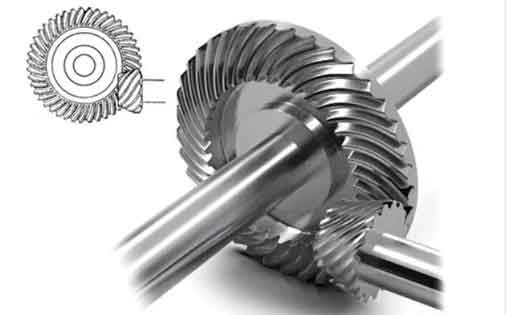
1. Parametric Modeling and Meshing
The geometric parameters of the analyzed spiral bevel gear pair are summarized in Table 1. A MATLAB-generated discrete point cloud was imported into SolidWorks to construct high-precision tooth profiles, ensuring minimal machining errors.
| Parameter | Pinion | Gear |
|---|---|---|
| Number of Teeth | 11 | 43 |
| Pressure Angle (°) | 20 | |
| Module (mm) | 6 | |
| Spiral Angle (°) | 35 | |
| Shaft Angle (°) | 90 | |
The dynamic equation governing spiral bevel gear meshing can be expressed as:
$$ I\ddot{\theta} + C\dot{\theta} + K\theta = T $$
where \( I \) represents moment of inertia, \( C \) damping coefficient, \( K \) stiffness, and \( T \) torque.
2. Dynamic Contact Analysis
Hypermesh-generated hexahedral meshes (Fig. 1) were analyzed in ABAQUS with explicit dynamics. Key boundary conditions included:
- Pinion angular velocity: 80 rad/s
- Gear resistance torque: 500 Nm
- Damping coefficient range: 300–700
The transient contact force during meshing follows:
$$ F_c(t) = \sqrt{F_x^2 + F_y^2 + F_z^2} $$
where \( F_x, F_y, F_z \) represent contact force components in orthogonal directions.
3. Influence of Damping Characteristics
| Damping Coefficient | Stabilization Time (s) | Max Contact Force (kN) | Steady-state Force (kN) |
|---|---|---|---|
| 300 | 0.0100 | 95.94 | 6.21 |
| 500 | 0.0072 | 78.27 | 6.37 |
| 700 | 0.0074 | 65.35 | 6.30 |
Increased damping reduces oscillation amplitude and stabilization time, though excessive damping slightly decreases steady-state contact force due to energy dissipation.
4. Acceleration Time Effects
The pinion acceleration profile follows:
$$ \omega(t) = \begin{cases}
\frac{80}{t_a}t & 0 \leq t < t_a \\
80 & t \geq t_a
\end{cases} $$
where \( t_a \) represents acceleration duration.
| Acceleration Time (s) | Peak Contact Force (kN) | Stabilization Time (s) |
|---|---|---|
| 0.001 | 78.26 | 0.0072 |
| 0.003 | 20.82 | 0.0050 |
| 0.007 | 12.61 | 0.0080 |
Longer acceleration durations significantly reduce initial impact forces but may prolong system stabilization. A 0.003s acceleration time demonstrates optimal balance between impact reduction and stabilization efficiency.
5. Conclusion
This analysis reveals critical relationships between spiral bevel gear dynamics and system parameters:
- Damping coefficients between 500–700 provide optimal vibration suppression
- Acceleration times of 0.003–0.005s minimize initial impact while maintaining rapid stabilization
- Parametric modeling ensures <3% deviation in contact force predictions
The methodology enables accurate prediction of spiral bevel gear performance under various operating conditions, supporting enhanced design of heavy-duty transmission systems.