
Abstract
In mechanical engineering, spur gear remain one of the most widely used components for short-distance power transmission due to their simplicity, high efficiency, and absence of axial thrust. However, under high-speed or heavy-load conditions, dynamic behaviors such as meshing force fluctuations, vibration, and noise significantly impact their operational stability and lifespan. This study leverages ADAMS software to establish a virtual prototype model of a spur gear pair, simulating dynamic responses under realistic working conditions. By analyzing transmission ratios, meshing forces, and angular velocity profiles, we provide theoretical insights for optimizing spur gear design and mitigating vibration-related issues.
1. Introduction
Spur gear is fundamental components in reducers, gearboxes, and transmission systems. Their straightforward geometry and predictable performance make them ideal for applications requiring precise motion control. However, dynamic interactions during meshing—such as periodic force variations and transient impacts—pose challenges to longevity and noise reduction. Traditional experimental methods for studying these phenomena are time-consuming, costly, and limited by measurement accuracy.
Virtual prototyping, enabled by tools like ADAMS, offers a cost-effective alternative. By simulating spur gear dynamics, researchers can analyze transient behaviors, validate theoretical models, and optimize designs before physical prototyping. Previous studies, such as those by Wang Xiaofang et al. (2023) on gearbox dynamics and Zhu Yuquan et al. (2021) on planetary gear systems, demonstrate the efficacy of simulation-driven approaches. Building on these foundations, our work focuses on spur gear pairs, emphasizing meshing force dynamics and load distribution.
2. Spur Gear Modeling and Parameterization
2.1 Geometric Parameters
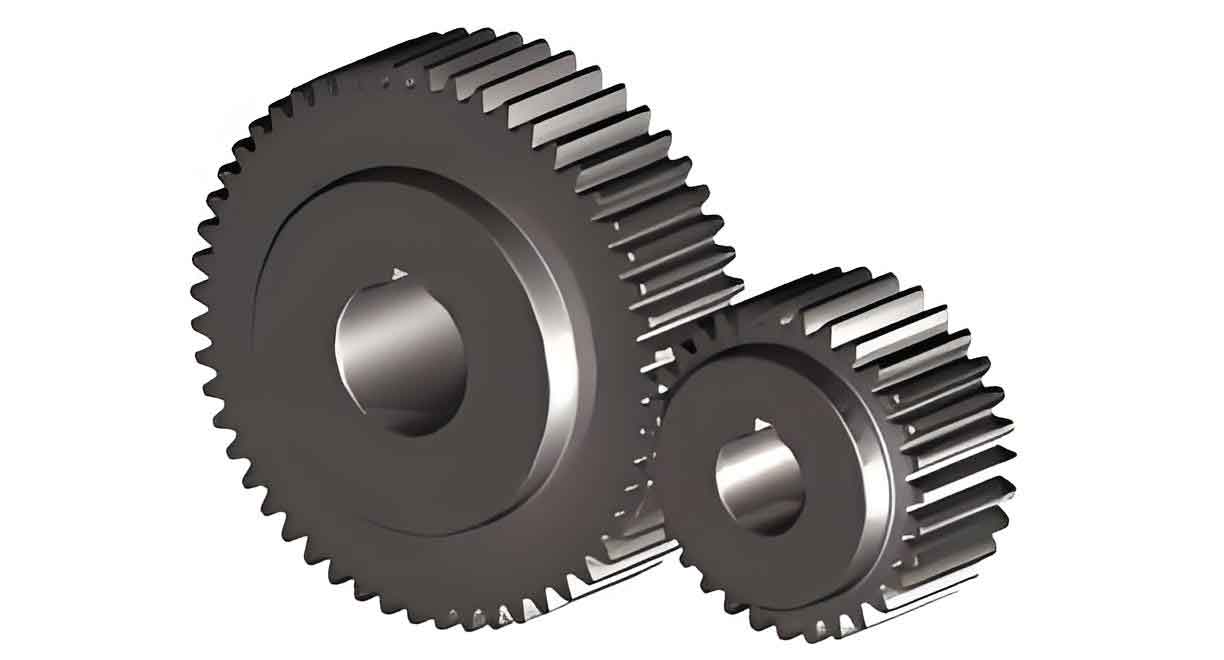
The spur gear pair analyzed in this study consists of a driving gear (17 teeth) and a driven gear (25 teeth). Key parameters are summarized in Table 1.
Table 1: Spur Gear Pair Parameters
| Parameter | Driving Gear | Driven Gear |
|---|---|---|
| Number of Teeth (z) | 17 | 25 |
| Module (mm) | 10 | 10 |
| Pressure Angle (°) | 20 | 20 |
| Face Width (mm) | 20 | 100 |
Using SolidWorks, 3D models of both gears were created and assembled (Figure 1). The assembly was exported to ADAMS in Parasolid (*.xt) format for dynamic analysis.
2.2 Virtual Prototype Setup in ADAMS
The ADAMS model incorporated the following elements:
- Material Properties: Both gears were assigned steel properties (density: 7.85×10⁻⁶kg/mm3, Young’s modulus: 2.07×10⁵MPa).
- Kinematic Constraints:
- Revolute joints between gears and ground.
- Contact force defined between meshing teeth.
Table 2: Joint and Contact Definitions
| Component | Constraint Type | Parameters |
|---|---|---|
| Driving Gear & Ground | Revolute Joint | Rotation about Z-axis |
| Driven Gear & Ground | Revolute Joint | Rotation about Z-axis |
| Gear Pair | Impact Contact Force | Stiffness: 1.0×10⁵N/mm, Damping: 50N\cdotps/mm |
2.3 Load and Motion Profiles
To replicate real-world conditions:
- Angular Velocity: A STEP function drove the driving gear from 0 to 3000∘/s over 1 second.
- Torque Load: A STEP function applied 450kN tangential force after 1 second.
The simulation ran for 5 seconds with a 1000-step resolution.
3. Dynamic Simulation Results
3.1 Angular Velocity Analysis
The driving gear’s angular velocity reached steady-state (3000∘/s) after 1 second (Figure 2). The driven gear’s velocity stabilized at 2040∘/s, yielding a transmission ratio i:i=z1z2=1725≈1.47
This matched theoretical predictions, validating the model’s accuracy.
Table 3: Angular Velocity Comparison
| Parameter | Driving Gear | Driven Gear |
|---|---|---|
| Steady-State Speed | 3000∘/s | 2040∘/s |
| Transmission Ratio | 1.47 (Simulated) | 1.47 (Theoretical) |
3.2 Meshing Force Dynamics
Meshing forces exhibited periodic fluctuations (Figure 3), peaking at 12.5kN during steady-state operation. Key observations:
- Transient Phase (0–1 s): Force amplitude increased linearly with speed.
- Steady-State (1–5 s): Cyclic oscillations (f=60z⋅ω) arose from alternating tooth engagement and disengagement.
Table 4: Meshing Force Characteristics
| Phase | Peak Force (kN) | Frequency (Hz) |
|---|---|---|
| Transient (0–1 s) | 8.2 | N/A |
| Steady-State (1–5 s) | 12.5 | 850 |
3.3 Load Distribution and Vibration
The applied 450kN load induced stress concentrations at tooth roots, aligning with ISO 6336 standards. Vibration spectra revealed harmonics at multiples of the meshing frequency, suggesting resonance risks at critical speeds.
4. Discussion
4.1 Implications for Spur Gear Design
- Tooth Profile Optimization: Reducing pressure angle or adopting profile modifications could mitigate meshing force fluctuations.
- Damping Strategies: Incorporating viscoelastic materials or tuned mass dampers may suppress resonant vibrations.
4.2 Limitations and Future Work
- Thermal Effects: Future studies should integrate thermal expansion and lubrication dynamics.
- Multi-Body Interactions: Extending the model to gear trains or planetary systems would enhance practical relevance.
5. Conclusion
This study demonstrates the effectiveness of ADAMS-based virtual prototyping for analyzing spur gear dynamics. Key findings include:
- The simulated transmission ratio (i=1.47) aligns perfectly with theoretical calculations.
- Meshing forces exhibit周期性波动 due to alternating tooth engagement, necessitating dynamic load considerations in design.
- Resonance frequencies identified in vibration spectra highlight the need for stiffness tuning.
By integrating these insights, engineers can optimize spur gear performance, reduce noise, and extend service life in high-demand applications.