
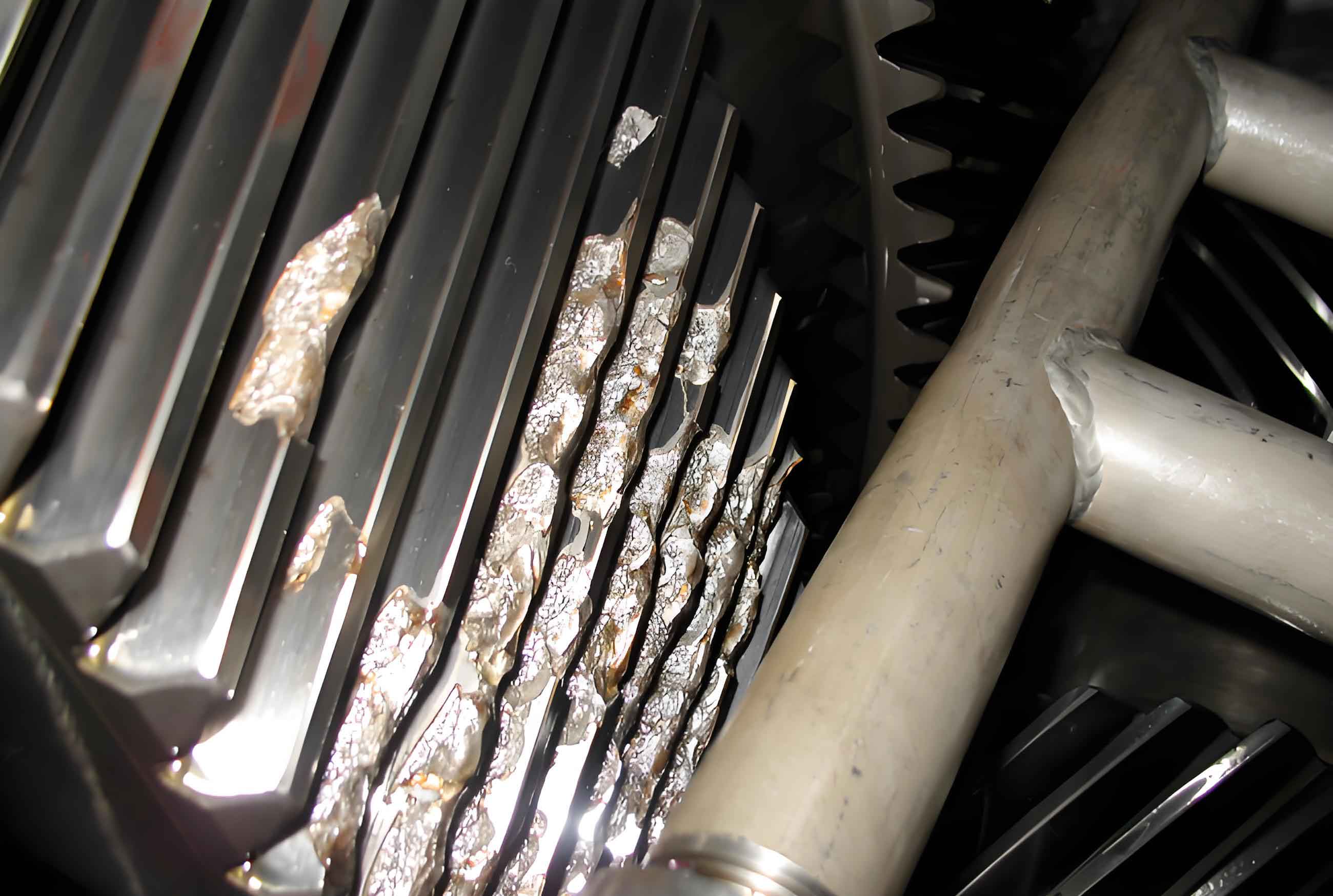
This research addresses wind turbine gearbox reliability by developing a comprehensive dynamic model integrated with stochastic wind loading, nonlinear strength degradation, and correlated failure mechanisms. We establish a gear-shaft-bearing dynamics model for a 2 MW system, incorporating time-varying mesh stiffness and transmission errors to compute dynamic meshing forces under constant loads. A Weibull-distributed stochastic wind speed model generates external excitations, enabling stress-time history derivation for all gear pairs under variable loading. Gamma processes simulate material strength degradation based on P-S-N curves, while hybrid Copula functions quantify failure dependencies across component and system levels. Our nested reliability model reveals that gear contact fatigue dominates early service stages, while bending fatigue governs later phases, with correlated failure analysis yielding more realistic reliability predictions than independence assumptions.
Dynamic Model of Transmission System
We model the drivetrain as an NGW planetary stage coupled with two parallel-axis stages. Using lumped-parameter theory for the planetary stage and finite element methods for parallel axes, displacements are defined as:
$$ \mathbf{q} = \{ \underbrace{x_c, y_c, u_c}_{\text{Carrier}}, \underbrace{x_r, y_r, u_r}_{\text{Ring Gear}}, \underbrace{x_s, y_s, u_s}_{\text{Sun Gear}}, \underbrace{\eta_i, \xi_i, u_i}_{\text{Planets } i=1-3}, \underbrace{x_n, y_n, z_n, \theta_n}_{\text{Parallel Stage } n=1-32} \} $$
The equation of motion is expressed as:
$$ \mathbf{M}\ddot{\mathbf{q}} + \left[ \mathbf{K}_b(t) + \mathbf{K}_m(t) + \mathbf{K}_u(t) \right] \mathbf{q} = \mathbf{T}(t) $$
where \(\mathbf{M}\) is the mass matrix, \(\mathbf{K}_b\) the bearing stiffness matrix, \(\mathbf{K}_m\) the time-varying mesh stiffness matrix, and \(\mathbf{K}_u\) the torsional stiffness matrix. Dynamic meshing forces (Figure 1) exhibit periodic fluctuations under constant torque:
| Gear Pair | Amplitude Range (kN) | Periodicity |
|---|---|---|
| Sun-Planet | 410-500 | Strong |
| Planet-Ring | 380-500 | Strong |
| Intermediate Stage | 150-325 | Moderate |
| High-Speed Stage | 50-150 | Moderate |
Stress History Under Stochastic Wind Loading
Wind speed \(v\) follows a Weibull distribution:
$$ f_w(v) = 1 – \exp\left[ -\left( \frac{v}{c} \right)^k \right], \quad p(v) = \frac{k}{c} \left( \frac{v}{c} \right)^{k-1} \exp\left[ -\left( \frac{v}{c} \right)^k \right] $$
with shape parameter \(k = 4.9\) and scale parameter \(c = 8.7 \text{ m/s}\) for Xinjiang’s wind profile. Input torque correlates with wind speed as:
$$ T = \begin{cases}
0 & v < 3.5 \text{ m/s} \\
T_{\text{rate}} \frac{v^2}{v_{\text{rate}}^2} & 3.5 \leq v < 11.5 \text{ m/s} \\
T_{\text{rate}} & 11.5 \leq v < 25 \text{ m/s} \\
0 & v \geq 25 \text{ m/s}
\end{cases} $$
Gear stresses are derived via quasi-static scaling:
$$ \sigma(t) = \frac{P(t)}{P} \sigma_{\text{static}} $$
Contact stress \(\sigma_H\) and bending stress \(\sigma_F\) are calculated as:
$$ \sigma_H = Z_E Z_H Z_\beta Z_\epsilon \sqrt{\frac{K_A K_V K_{H\beta} K_{H\alpha} F_t}{b d} \cdot \frac{u+1}{u}} $$
$$ \sigma_F = \frac{K_A K_V K_{F\beta} K_{F\alpha} F_t}{b m} Y_{F\alpha} Y_{S\alpha} Y_\epsilon Y_\beta $$
Stochastic loading disrupts periodicity and increases stress variability (K-S tests confirm normal/lognormal distributions):
| Gear | Contact Stress (MPa) | Bending Stress (MPa) |
|---|---|---|
| Sun | 931 ± 62 (Normal) | 290 ± 40 (Lognormal) |
| Helical G1 | 850 ± 225 (Lognormal) | 275 ± 85 (Normal) |
Dynamic Reliability Modeling with Correlated Failures
Initial strengths for contact (\(\sigma_{H0}\)) and bending (\(\sigma_{F0}\)) fatigue are:
$$ \sigma_{H0} = \sigma_{H\text{Lim}} Z_N Z_V Z_L Z_R Z_W Z_X $$
$$ \sigma_{F0} = \sigma_{F\text{Lim}} Y_{ST} Y_{NT} Y_{\delta T} Y_{RT} Y_X $$
Parameters follow normal distributions (Monte Carlo simulated). Strength degradation is modeled via Gamma process with probability density:
$$ G(d|v(t), \mu) = \frac{\mu^{v(t)}}{\Gamma(v(t))} d^{v(t)-1} e^{-\mu d} I_{(0,\infty)}(d) $$
Shape parameters \(v(t)\) and scale parameters \(\mu\) for 20CrMnTi steel (carburized) are derived from P-S-N curves:
| Survival Rate | \(m_c\) | \(C\) |
|---|---|---|
| 0.99 | 28.5714 | 1.08×10102 |
| 0.95 | 21.8866 | 7.10×1079 |
| 0.50 | 14.0449 | 1.16×1054 |
| Component | \(v_H(t)\) | \(\mu_H\) | \(v_F(t)\) | \(\mu_F\) |
|---|---|---|---|---|
| Sun Gear | 0.0015 | 1.0312 | 0.0015 | 0.5663 |
| Helical G4 | 0.0019 | 1.4230 | 0.0019 | 0.7954 |
Limit state functions for contact (\(g_1\)) and bending (\(g_2\)) failure modes are:
$$ g_1 = \sigma_{H0} – D_H – \sigma_H, \quad g_2 = \sigma_{F0} – D_F – \sigma_F $$
where \(D_H\) and \(D_F\) are Gamma-distributed degradation increments. Hybrid Copula models capture failure dependencies:
$$ C_n(\cdot) = \varepsilon_G C_G(F_{i1}, F_{i2}, \theta) + \varepsilon_C C_C(F_{i1}, F_{i2}, \alpha) + \varepsilon_F C_F(F_{i1}, F_{i2}, \gamma) $$
with weights \(\varepsilon_G + \varepsilon_C + \varepsilon_F = 1\). Gumbel, Clayton, and Frank Copulas are defined as:
$$ C_G = \exp\left\{ -\left[ (-\ln u)^\theta + (-\ln v)^\theta \right]^{1/\theta} \right\} $$
$$ C_C = \left( u^{-\alpha} + v^{-\alpha} – 1 \right)^{-1/\alpha} $$
$$ C_F = -\frac{1}{\gamma} \ln \left[ 1 + \frac{(e^{-\gamma u} – 1)(e^{-\gamma v} – 1)}{e^{-\gamma} – 1} \right] $$
Optimal parameters minimize residual sum of squares (RSS):
$$ \text{RSS} = \frac{1}{n} \sum_{i=1}^{n} \left( F_{1,2}[F_{i1}, F_{i2}] – C_n(F_{i1}, F_{i2}) \right)^2 $$
A multi-level nesting structure quantifies system reliability considering component and subsystem interdependencies.
Case Study: Reliability Assessment
For a 2 MW turbine (17 rpm rated speed), component reliability curves reveal distinct failure characteristics:
| Component | Contact Fatigue R=0.98 (Years) | Bending Fatigue R=0.98 (Years) |
|---|---|---|
| Sun Gear | 1.5 | >20 |
| Planet Gear | 5.0 | 15.2 |
| Helical G4 | 6.0 | 8.5 |
Critical observations include:
- Contact fatigue governs early-stage gear failure (years 1-6)
- Bending fatigue dominates late-stage gear failure (years 8-20)
- Helical G4 exhibits the highest gear failure risk due to elevated speeds
Nested Copula parameters for planetary stage:
| Copula | \(\varepsilon_G\) | \(\varepsilon_C\) | \(\varepsilon_F\) | \(\theta\) | \(\alpha\) | \(\gamma\) |
|---|---|---|---|---|---|---|
| C₁(·) | 0.000 | 0.048 | 0.952 | 931.29 | 1.505 | 0.837 |
| C₆(·) | 0.989 | 0.000 | 0.011 | 217.50 | 191.0 | 20.76 |
System reliability comparison (20-year operation):
$$ R_{\text{independent}} = 0.1396, \quad R_{\text{correlated}} = 0.2975 $$
Independence assumptions underestimate reliability by 53.1% at year 20, demonstrating that correlated failure analysis is essential for accurate gear failure prediction.
Conclusion
Our integrated methodology demonstrates that wind turbine gearbox reliability is significantly influenced by the synergy between stochastic wind loads, nonlinear strength degradation, and failure dependencies. Key findings include:
- Early-stage maintenance should prioritize contact fatigue prevention to mitigate gear failure.
- Late-stage interventions require combined contact/bending fatigue management for critical components like high-speed helical gears.
- Hybrid Copula nesting effectively quantifies multi-level failure dependencies, with Frank Copulas dominating component-level interactions (\(\varepsilon_F > 0.95\)).
- Neglecting failure correlation yields overly conservative reliability estimates (46.8% error at 15 years).
This framework provides a foundation for predictive maintenance scheduling and robust gearbox design optimization. Future work will incorporate lubrication effects and surface wear models to enhance gear failure prognostics.