
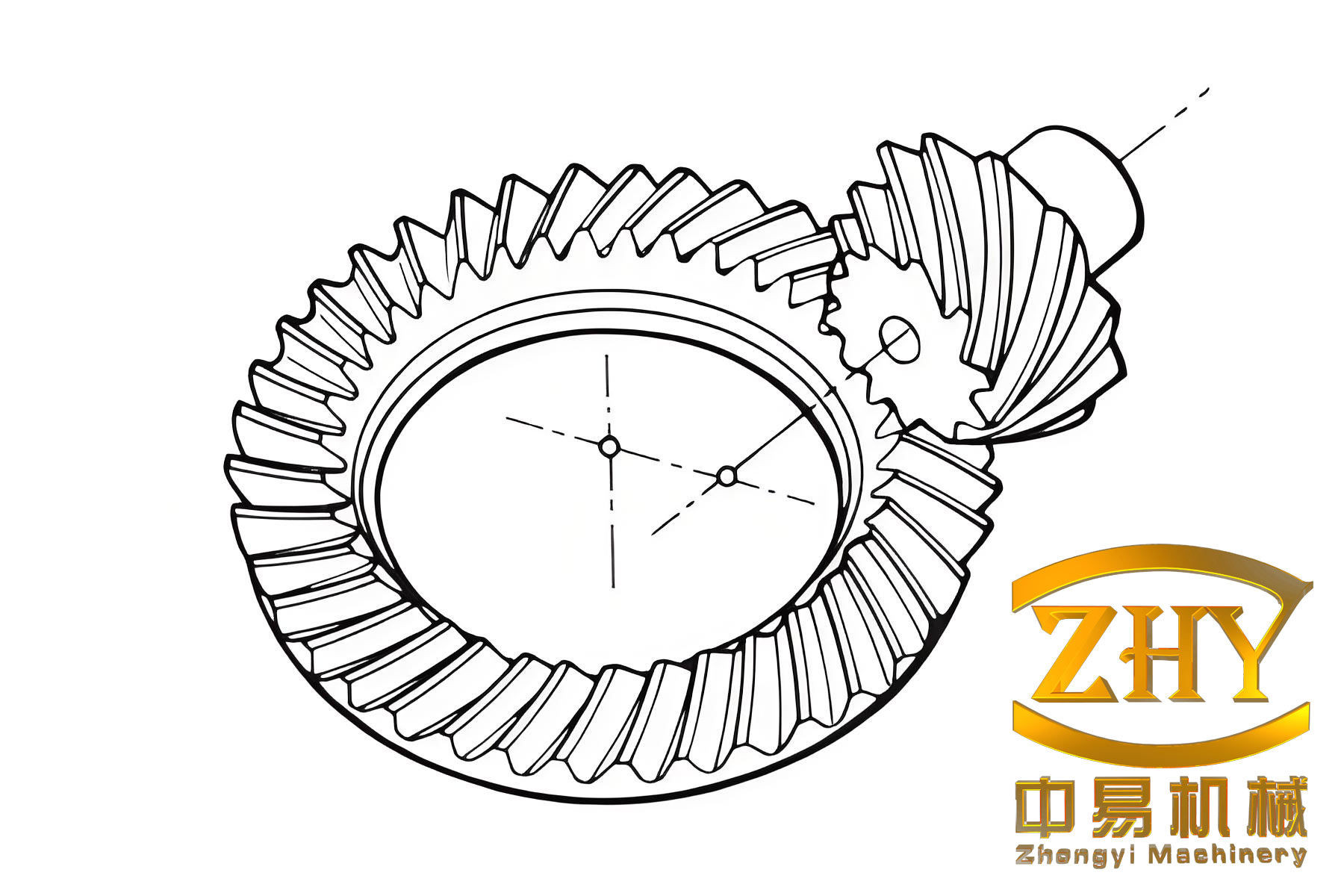
In modern mechanical engineering, the demand for high-performance transmission systems has led to the widespread adoption of hypoid bevel gears in applications such as aerospace, automotive, and heavy machinery. These gears offer advantages like high load capacity, large transmission ratios, and smooth operation, but they also introduce challenges related to vibration, noise, and dynamic loads under high-speed and heavy-duty conditions. As a result, dynamic response analysis and optimization have become critical for improving reliability and performance. In this study, I focus on the dynamic behavior of a hypoid bevel gearbox, employing finite element methods to simulate excitation forces and optimize the housing structure for reduced vibration. The goal is to minimize acceleration responses while meeting static constraints, leveraging advanced computational tools like ANSYS and LS-DYNA. Throughout this work, the term “hypoid bevel gear” is emphasized to highlight its centrality in transmission systems, and I aim to provide a comprehensive framework that integrates simulation, testing, and optimization.
The dynamic performance of a hypoid bevel gearbox is influenced by multiple factors, including gear mesh stiffness, shaft deformations, and bearing supports. To accurately capture these effects, I developed a nonlinear dynamic contact finite element model of the hypoid bevel gear transmission system. This model incorporates gear teeth meshing deformations, bending of shafts, and bearing stiffness, enabling a realistic simulation of operational conditions. The explicit dynamics solver LS-DYNA was used to solve the transient contact problem, as it efficiently handles large deformations and complex interactions. The governing equations are derived from the principle of minimum potential energy, leading to the weak form of the motion equation:
$$ \int_V (\rho \ddot{u}_i – f_i) \delta u_i dV + \int_V \sigma_{ij} \delta \varepsilon_{ij} dV – \int_{S_\sigma} T_i \delta u_i dS = 0 $$
where \( \rho \) is the mass density, \( u_i \) is the displacement tensor, \( f_i \) is the body force tensor, \( \delta u_i \) is the virtual displacement tensor, \( \sigma_{ij} \) is the stress tensor, \( \delta \varepsilon_{ij} \) is the virtual strain tensor, \( S_\sigma \) is the boundary with applied tractions, and \( T_i \) is the surface force tensor. Discretizing the structure into finite elements yields the matrix form of the equation:
$$ \mathbf{M} \ddot{\mathbf{u}} = \mathbf{P} – \mathbf{F} + \mathbf{R} + \mathbf{H} – \mathbf{C} \dot{\mathbf{u}} $$
Here, \( \mathbf{M} \) is the global mass matrix, \( \mathbf{P} \) is the external load vector, \( \mathbf{F} \) is the stress divergence vector, \( \mathbf{R} \) is the contact force vector, \( \mathbf{H} \) is the hourglass damping force vector, and \( \mathbf{C} \) is the damping matrix. LS-DYNA employs an explicit central difference method to solve this equation iteratively over time steps:
$$ \ddot{\mathbf{u}}^n_t = \mathbf{M}^{-1} [\mathbf{P}^n_t – \mathbf{F}^n_t + \mathbf{R}^n_t + \mathbf{H}^n_t – \mathbf{C} \dot{\mathbf{u}}^{n-1/2}_t] $$
$$ \dot{\mathbf{u}}^{n+1/2}_t = \dot{\mathbf{u}}^{n-1/2}_t + \ddot{\mathbf{u}}^n_t \Delta t^n $$
$$ \mathbf{u}^{n+1}_t = \mathbf{u}^n_t + \dot{\mathbf{u}}^{n+1/2}_t \Delta t^{n+1/2} $$
For the hypoid bevel gear transmission, I created a detailed 3D model using SOLID164 elements for gears, shafts, and bearings, with SHELL163 elements for rigid connections at input and output flanges. The mesh consisted of 114,424 nodes and 74,205 elements, as shown in the finite element representation. Contact pairs were defined between gears and between shafts and bearings to simulate dynamic interactions. The material properties were set to steel with elastic modulus \( E = 2.06 \times 10^{11} \, \text{N/m}^2 \), Poisson’s ratio \( \nu = 0.3 \), and density \( \rho = 7.8 \times 10^3 \, \text{kg/m}^3 \). The geometric parameters of the hypoid bevel gear pair are summarized in Table 1, which illustrates the key dimensions essential for modeling.
| Parameter | Value |
|---|---|
| Number of teeth (pinion/gear) | 7 / 39 |
| Module at large end | 4.254 mm |
| Shaft angle | 90° |
| Mean pressure angle | 21.25° |
| Offset distance | 23 mm |
| Spiral angle at reference point | 35° |
The simulation applied a rotational speed of 3,000 rpm at the input shaft and a torque of 1,114 N·m at the output shaft, representing typical operational conditions. From this dynamic analysis, I extracted the time-varying support reactions at the bearings, which serve as excitation forces for the gearbox housing. The bearing reactions exhibited periodic behavior, with dominant frequencies corresponding to the shaft rotational frequency (50 Hz) and gear mesh frequency (350 Hz). For instance, the dynamic reaction at the bearing near the input pinion is plotted over time, showing fluctuations due to gear meshing and shaft dynamics. These forces are critical inputs for subsequent vibration analysis of the hypoid bevel gearbox housing.
With the dynamic bearing forces obtained, I proceeded to analyze the transient response of the hypoid bevel gearbox housing. A parametric finite element model of the housing was developed in ANSYS using APDL scripting, meshed with tetrahedral elements totaling 21,629 nodes and 91,300 elements. The bearing reactions were applied as time-dependent loads at the housing bore locations, and a full transient dynamic analysis was conducted with a time step of 0.2 ms over 100 ms. The acceleration responses at key points on the housing surface were computed, and the root-mean-square (RMS) values were derived to quantify vibration levels. Table 2 lists the RMS accelerations for selected nodes, indicating significant vibrational energy that necessitates optimization.
| Node | \( a_X \) (m/s²) | \( a_Y \) (m/s²) | \( a_Z \) (m/s²) | \( a_{\text{sum}} \) (m/s²) |
|---|---|---|---|---|
| 10,053 | 2.1289 | 0.6234 | 1.0429 | 2.4512 |
| 2,535 | 1.7564 | 0.5566 | 1.020 | 2.1060 |
| 6,721 | 1.1386 | 1.4213 | 0.9377 | 2.0484 |
| 4,676 | 2.0491 | 0.7780 | 1.0016 | 2.4098 |
| 3,004 | 1.2091 | 1.2120 | 0.9233 | 1.9451 |
To validate the simulation results, I conducted experimental tests on a hypoid bevel gearbox dynamic performance test rig. The setup included a DC motor, the gearbox under study, torque-speed sensors, and a magnetic powder brake. Accelerometers were mounted at locations corresponding to the finite element nodes, and vibration data were collected under the same operational conditions. The measured acceleration responses showed good agreement with the simulated values in terms of amplitude and trend, confirming the accuracy of the dynamic model. For example, the acceleration curves at a bearing housing point demonstrated similar periodic characteristics, with peaks aligning to the gear mesh frequency. This correlation between simulation and experiment underscores the reliability of using finite element analysis for hypoid bevel gearbox dynamics.
Building on the dynamic response analysis, I formulated an optimization problem to minimize vibration while adhering to static constraints. The objective was to reduce the RMS acceleration of the housing, which correlates with noise and dynamic loads in hypoid bevel gear systems. The optimization was performed using ANSYS’s zero-order method, which approximates objective and constraint functions with response surfaces. The general optimization problem is mathematically expressed as:
$$ \min f(\mathbf{x}) $$
$$ \text{subject to: } g_i(\mathbf{x}) \leq g^U_i \quad (i=1,2,\ldots,m_1) $$
$$ h^L_i \leq h_i(\mathbf{x}) \quad (i=1,2,\ldots,m_2) $$
$$ w^L_i \leq w_i(\mathbf{x}) \leq w^U_i \quad (i=1,2,\ldots,m_3) $$
$$ x^L_i \leq x_i \leq x^U_i \quad (i=1,2,\ldots,n) $$
Here, \( f(\mathbf{x}) \) is the objective function, \( \mathbf{x} = (x_1, x_2, \ldots, x_n)^T \) are the design variables, and \( g_i, h_i, w_i \) are state variables with upper and lower bounds. For the hypoid bevel gearbox housing, I selected 15 structural parameters as design variables, representing wall thicknesses and geometric features. These variables are listed in Table 3 along with their initial values. The choice of variables was based on sensitivity to dynamic response, ensuring that optimization focuses on critical areas of the housing.
| Variable | Description | Initial Value (mm) |
|---|---|---|
| \( x_f \) | Front wall thickness | 11.5 |
| \( x_b \) | Back wall thickness | 26.5 |
| \( x_r \) | Right wall thickness | 12.0 |
| \( x_l \) | Left wall thickness | 12.0 |
| \( x_{f1} \) | Front bearing seat thickness | 62.5 |
| \( x_{f2} \) | Front outer step height | 8.5 |
| \( x_{b1} \) | Back bearing seat height | 29.0 |
| \( x_{b2} \) | Back seat groove width | 26.0 |
| \( x_{b3} \) | Back seat groove depth | 23.0 |
| \( x_{r1} \) | Right inner seat thickness | 16.0 |
| \( x_{r2} \) | Right groove radius between seats | 34.5 |
| \( x_{r3} \) | Right outer step height | 23.0 |
| \( x_{r4} \) | Right inner step height | 20.0 |
| \( x_{r5} \) | Right inner seat step height | 23.0 |
| \( x_{r6} \) | Right outer seat thickness | 45.0 |
The objective function was defined as the average RMS acceleration across five key nodes on the housing surface, which effectively represents the overall vibration level of the hypoid bevel gearbox:
$$ \psi(\mathbf{x}) = \frac{1}{n} \sum_{i=1}^n \sqrt{a_{mi}^2} $$
where \( a_{mi} \) is the RMS acceleration at node \( i \), and \( n = 5 \). This formulation aims to minimize dynamic responses while considering multiple points to avoid local optima. The constraints included static stress, displacement, and volume limits to ensure structural integrity and practicality:
$$ \sigma_{\text{max}} \leq \sigma_s $$
$$ u_{\text{max}} \leq u_0 $$
$$ V_{\text{sum}} \leq V_0 $$
Here, \( \sigma_{\text{max}} \) is the maximum equivalent stress, \( \sigma_s = 250 \, \text{MPa} \) is the material yield strength (for cast iron), \( u_{\text{max}} \) is the maximum static displacement, \( u_0 = 0.01 \, \text{mm} \) is the allowable displacement, \( V_{\text{sum}} \) is the housing volume, and \( V_0 = 0.011 \, \text{m}^3 \) is the initial volume. These constraints prevent over-design and maintain functionality under static loads.
The zero-order method in ANSYS approximates the functions using a quadratic polynomial with cross-terms:
$$ \hat{f}(\mathbf{x}) = a_0 + \sum_{i} a_i x_i + \sum_{i} \sum_{j} b_{ij} x_i x_j $$
where coefficients \( a_i \) and \( b_{ij} \) are determined by weighted least squares. The constrained problem is transformed into an unconstrained one via a penalty function:
$$ \min F(\mathbf{x}, p_k) = \hat{f} + f_0 p_k \left[ \sum_{i=1}^n X(x_i) + \sum_{i=1}^{m_1} G(\hat{g}_i) + \sum_{i=1}^{m_2} H(\hat{h}_i) + \sum_{i=1}^{m_3} W(\hat{w}_i) \right] $$
where \( X, G, H, W \) are penalty functions for design and state variable constraints, \( p_k \) is a response surface parameter, and \( f_0 \) is a reference value. The sequential unconstrained minimization technique (SUMT) iteratively solves this, increasing \( p_k \) for convergence.
After 24 iterations, the optimization converged to an optimal set of design variables, as shown in Table 4. The changes in wall thicknesses and geometric features reflect a balanced design that reduces vibration without compromising strength. For instance, the front wall thickness decreased from 11.5 mm to 8.58 mm, while the back bearing seat height reduced from 29.0 mm to 15.94 mm, indicating material redistribution for better dynamic performance.
| Variable | Optimal Value (mm) |
|---|---|
| \( x_f \) | 8.58 |
| \( x_b \) | 23.20 |
| \( x_r \) | 12.13 |
| \( x_l \) | 10.85 |
| \( x_{f1} \) | 76.68 |
| \( x_{f2} \) | 3.25 |
| \( x_{b1} \) | 15.94 |
| \( x_{b2} \) | 15.50 |
| \( x_{b3} \) | 25.12 |
| \( x_{r1} \) | 14.45 |
| \( x_{r2} \) | 52.65 |
| \( x_{r3} \) | 13.31 |
| \( x_{r4} \) | 16.98 |
| \( x_{r5} \) | 19.13 |
| \( x_{r6} \) | 27.26 |
The optimized housing was reanalyzed for dynamic response, resulting in significantly reduced acceleration levels. Table 5 compares the RMS accelerations before and after optimization, showing a decrease from an average of 2.21 m/s² to 1.56 m/s², a reduction of 29.4%. This improvement demonstrates the effectiveness of the optimization approach for hypoid bevel gearbox applications. Additionally, the housing volume slightly decreased to 0.0099 m³, while static stress and displacement remained within limits, confirming that the design is both lightweight and robust.
| Performance Metric | Before Optimization | After Optimization |
|---|---|---|
| Average RMS acceleration (m/s²) | 2.21 | 1.56 |
| Housing volume (m³) | 0.0110 | 0.0099 |
| Maximum equivalent stress (MPa) | 16.30 | 16.42 |
| Maximum static displacement (mm) | 0.0087 | 0.0092 |
The dynamic response curves for key nodes also showed attenuated vibrations post-optimization. For example, the acceleration time history at node 10,053 exhibited lower peak amplitudes and smoother oscillations, indicating enhanced stability for the hypoid bevel gear transmission system. These results highlight the importance of integrating dynamic simulations with optimization techniques to achieve superior performance in mechanical designs.
In conclusion, this study presents a comprehensive methodology for analyzing and optimizing the dynamic response of a hypoid bevel gearbox. By developing a detailed finite element model that accounts for gear mesh, shaft bending, and bearing stiffness, I accurately simulated bearing reaction forces using LS-DYNA. These forces were then applied to the housing model in ANSYS for transient dynamic analysis, with results validated through experimental tests. The optimization phase employed a zero-order method to minimize vibration acceleration, with design variables targeting housing geometry. The optimal design achieved a 29.4% reduction in RMS acceleration while meeting static constraints, demonstrating the potential for improved reliability and noise reduction in hypoid bevel gear systems. Future work could explore multi-objective optimization considering thermal effects or wear, further advancing the performance of hypoid bevel gearboxes in high-demand applications.
The hypoid bevel gear, with its unique geometry and load-bearing capabilities, remains a critical component in modern transmissions. Through this research, I have shown that dynamic response optimization can significantly enhance its operational characteristics, contributing to quieter and more efficient machinery. The integration of simulation, testing, and optimization serves as a robust framework for addressing complex engineering challenges, paving the way for innovations in gear design and manufacturing.