
This study addresses the vibration suppression challenges in thin-walled spoke plates of aeronautical spiral bevel gears by proposing optimized damping hole configurations. A dynamic response analysis framework is established through modal superposition theory and orthogonal experimental design, validated using finite element simulations.
1. Theoretical Basis for Dynamic Analysis
The dynamic behavior of spiral bevel gears is governed by the forced vibration equation:
$$ M \ddot{u} + C \dot{u} + K u = F $$
where \( M \), \( C \), and \( K \) represent mass, damping, and stiffness matrices, respectively. Modal superposition method decomposes the system response into orthogonal modal components:
$$ u = \sum_{i=1}^n \Phi_i y_i $$
The critical frequency margin between natural frequencies (\( f_N \)) and meshing excitation frequency (\( f \)) is calculated as:
$$ M = \frac{|f_N – f|}{f} \times 100\% $$
2. Case Study: Spiral Bevel Gear System
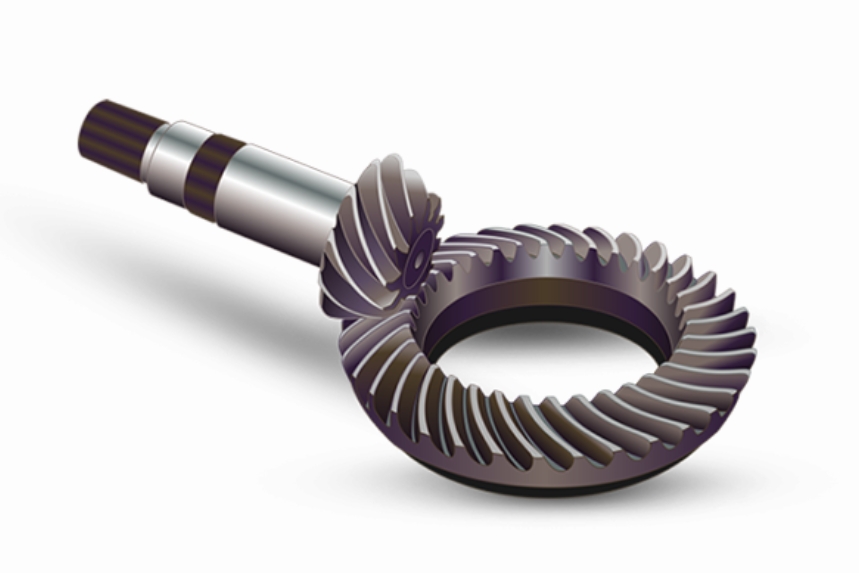
Gear parameters:
| Parameter | Value |
|---|---|
| Power | 1,900 kW |
| Speed | 20,900 rpm |
| Module | 3.85 mm |
| Teeth ratio | 27:74 |
3. Modal Characteristics Analysis
Natural frequencies and corresponding frequency margins:
| Mode | Frequency (Hz) | Margin (%) |
|---|---|---|
| 1 | 291.2 | 96.90 |
| 2 | 1,056.6 | 88.77 |
| 3 | 1,137.8 | 87.90 |
| 4 | 1,426.0 | 84.84 |
| 5 | 1,426.0 | 84.84 |
| 6 | 1,708.5 | 81.83 |
4. Dynamic Response Comparison
Vibration acceleration RMS values for different hole configurations:
| Hole Type | RMS1 (mm/s²) | RMS2 (mm/s²) |
|---|---|---|
| Circular | 1.736×10⁶ | 1.715×10⁶ |
| Waist | 1.541×10⁶ | 1.511×10⁶ |
| Pillow | 1.558×10⁶ | 1.513×10⁶ |
| Triangular | 1.770×10⁶ | 1.746×10⁶ |
5. Orthogonal Optimization of Waist-Shaped Holes
Experimental factors and levels for spoke plate optimization:
| Factor | Level 1 | Level 2 | Level 3 | Level 4 |
|---|---|---|---|---|
| Hole count (n) | 5 | 6 | 7 | 8 |
| Angle θ₁ (°) | 5 | 6 | 7 | 8 |
| Radius r (mm) | 5 | 6 | 7 | 8 |
Optimal parameters determined through signal-to-noise ratio analysis:
$$ \eta = -10 \lg \left( \frac{1}{n} \sum_{i=1}^n y_i^2 \right) $$
| Factor | Optimal Level |
|---|---|
| Hole count | 5 |
| Angle θ₁ | 5° |
| Radius r | 5 mm |
6. Validation of Optimized Design
The optimized waist-shaped hole configuration demonstrates superior vibration suppression:
| Configuration | RMS Reduction |
|---|---|
| Original circular | Baseline |
| Optimized waist | 33.09% (Point 1) 37.62% (Point 2) |
7. Conclusion
This investigation establishes an effective methodology for enhancing spiral bevel gear dynamic performance through spoke plate optimization. The waist-shaped hole configuration with parameters \( n=5 \), \( θ₁=5° \), and \( r=5 \) mm achieves significant vibration reduction while maintaining structural integrity. The proposed approach provides valuable insights for high-performance spiral bevel gear design in aerospace applications.