
In mechanical transmission systems, spur gears play a fundamental role in transmitting power and motion. Their operational health is critical, as failures like cracks, spalls, or tooth breakage under harsh cyclic loading can lead to catastrophic system breakdowns. Therefore, investigating the dynamic response characteristics of spur gear systems provides an essential theoretical foundation for condition monitoring and fault diagnosis. The time-varying mesh stiffness (TVMS) is universally recognized as the most significant internal excitation source within a gear transmission system. The acceleration response features it induces serve as vital indicators for monitoring gear health. Traditional lumped parameter models often simplify the system excessively, potentially overlooking the dynamic coupling effects of shafts and bearings. This work addresses these limitations by establishing a comprehensive finite element (FE) model for a two-stage gear transmission system. Furthermore, it develops a precise analytical model for calculating TVMS under various fault conditions, integrating this into the dynamic model to simulate and analyze response characteristics, which are then validated against experimental data.
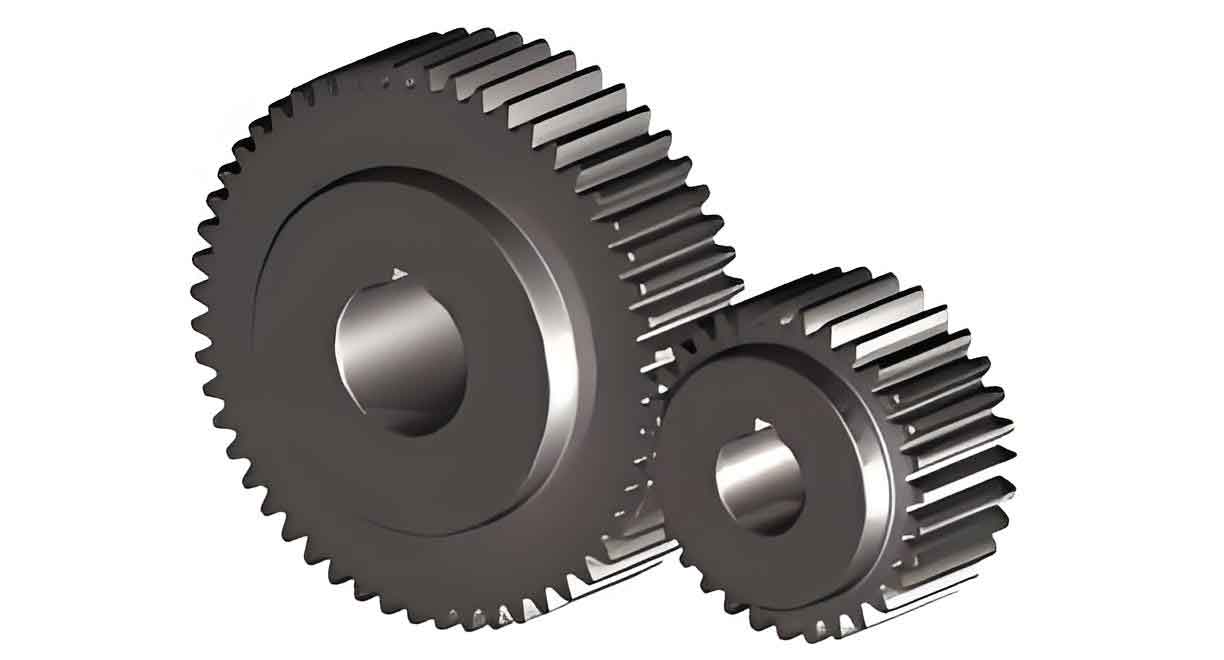
The dynamic behavior of a gearbox is influenced not only by the gears themselves but also by the supporting structure. To fully account for the effects of shafts and bearings on the gear mesh force, a full finite element modeling approach is adopted. The rotor system is discretized using two-node Timoshenko beam elements. Each node possesses three degrees of freedom (DOFs): translational displacements in the x and y directions and a rotational displacement about the z-axis. The element displacement vector, mass matrix, and stiffness matrix for a beam element of length $$l$$, elastic modulus $$E$$, density $$\rho$$, cross-sectional area $$A$$, and area moment of inertia $$J$$ are given below.
The elemental displacement vector is:
$$ \mathbf{q}^e = \{ x_i, y_i, \omega_i, x_{i+1}, y_{i+1}, \omega_{i+1} \}^T $$
The consistent mass matrix $$\mathbf{M}^e$$ is:
$$ \mathbf{M}^e = \frac{\rho A l}{6} \begin{bmatrix}
2 & 0 & 0 & 1 & 0 & 0 \\
0 & 2 & 0 & 0 & 1 & 0 \\
0 & 0 & 2J/A & 0 & 0 & -J/A \\
1 & 0 & 0 & 2 & 0 & 0 \\
0 & 1 & 0 & 0 & 2 & 0 \\
0 & 0 & -J/A & 0 & 0 & 2J/A
\end{bmatrix} $$
The stiffness matrix $$\mathbf{K}^e$$ is:
$$ \mathbf{K}^e = \frac{E}{l} \begin{bmatrix}
A & 0 & 0 & -A & 0 & 0 \\
0 & 12J/l^2 & 6J/l & 0 & -12J/l^2 & 6J/l \\
0 & 6J/l & 4J & 0 & -6J/l & 2J \\
-A & 0 & 0 & A & 0 & 0 \\
0 & -12J/l^2 & -6J/l & 0 & 12J/l^2 & -6J/l \\
0 & 6J/l & 2J & 0 & -6J/l & 4J
\end{bmatrix} $$
For a two-stage parallel-axis gearbox, two gear mesh interfaces exist. Each mesh is modeled as a spring-damper element acting along the line of action. The mesh stiffness matrix couples the DOFs of the connected pinion and gear nodes. For a pinion (p) and gear (g) with base radii $$r_p$$ and $$r_g$$, pressure angle $$\alpha$$, and mesh stiffness $$k_m(t)$$, the elemental mesh stiffness matrix $$\mathbf{K}_m^e$$ is derived from the geometry of the line of action.
The bearing supports are modeled as linear springs in the x and y directions at the corresponding nodes, with their stiffness values incorporated into the global stiffness matrix.
After assembling all beam, mesh, and bearing elements by coupling nodes, the global finite element model for the entire two-stage spur gear transmission system is obtained. The system equation of motion is:
$$ \mathbf{M}\ddot{\mathbf{x}} + \mathbf{C}\dot{\mathbf{x}} + \mathbf{K}(t)\mathbf{x} = \mathbf{F}_L $$
where $$\mathbf{M}$$, $$\mathbf{C}$$, and $$\mathbf{K}(t)$$ are the global mass, damping, and time-varying stiffness matrices, respectively; $$\mathbf{x}$$ is the displacement vector; and $$\mathbf{F}_L$$ is the load vector. Damping is modeled using Rayleigh damping: $$\mathbf{C} = \alpha \mathbf{M} + \beta \mathbf{K}$$.
The accuracy of the dynamic model heavily depends on the precise calculation of the TVMS of the spur gears. The potential energy method, incorporating bending, shear, axial compressive, and Hertzian contact energies, is widely used. However, its accuracy relies on a correct description of the tooth profile, especially the fillet curve. A universal tooth profile equation derived from the gear generation process with a rack cutter is employed to obtain exact coordinates for both the involute and fillet regions.
The coordinate transformation from the cutter coordinate system $$(X_1, O_1, Y_1)$$ to the gear blank coordinate system $$(x, O, y)$$ yields the following equations.
Involute Segment:
$$
\begin{cases}
x = \left[ r_d – \frac{1}{2}(r_d \phi_1 – y_0) \sin(2\alpha_0) \right] \cos \phi_1 + (r_d \phi_1 – y_0 \cos^2\alpha_0) \sin \phi_1 \\
y = \left[ r_d – \frac{1}{2}(r_d \phi_1 – y_0) \sin(2\alpha_0) \right] \sin \phi_1 – (r_d \phi_1 – y_0 \cos^2\alpha_0) \cos \phi_1
\end{cases}
$$
for $$ \phi_1 \in \left[ \frac{1}{r_d}\left(y_0 – \frac{2h_a}{\sin(2\alpha_0)}\right), \quad \frac{1}{r_d}\left(y_c + x_c \tan(\frac{\pi}{2} – \alpha_0)\right) \right] $$.
Fillet Segment:
$$
\begin{cases}
x = \left[ r_d – x_c – r_p \cos \gamma \right] \cos \phi_2 + (r_d \phi_2 – y_c + r_p \sin \gamma) \sin \phi_2 \\
y = \left[ r_d – x_c – r_p \cos \gamma \right] \sin \phi_2 – (r_d \phi_2 – y_c + r_p \sin \gamma) \cos \phi_2
\end{cases}
$$
for $$ \phi_2 \in \left[ \frac{1}{r_d} y_c, \quad \frac{1}{r_d}\left(y_c + x_c \tan(\frac{\pi}{2} – \alpha_0)\right) \right] $$.
Here, $$r_d$$ is the pitch radius, $$\alpha_0$$ is the pressure angle, $$r_p$$ is the cutter tip radius, and $$(x_c, y_c)$$ are the coordinates of the fillet arc center. The parameters $$y_0$$, $$\gamma$$ are determined by the tool geometry (module $$m$$, addendum coefficient $$h_a^*$$, clearance coefficient $$c^*$$, tool pressure angle $$\alpha_0$$).
Using these equations, the tooth profile is accurately defined. The total mesh stiffness for a single tooth pair is then the series combination of individual tooth stiffnesses, each calculated by summing the compliances from different energy components:
$$ \frac{1}{k_{total}} = \frac{1}{k_{h}} + \frac{1}{k_{b1} + k_{s1} + k_{a1}} + \frac{1}{k_{b2} + k_{s2} + k_{a2}} + \frac{1}{k_{f1}} + \frac{1}{k_{f2}} $$
where subscripts $$b$$, $$s$$, $$a$$, $$h$$, and $$f$$ denote bending, shear, axial, Hertzian contact, and fillet foundation stiffness, respectively. The formulas for these components are integrated along the path of contact using the geometric relationships derived from the profile equations.
For a spur gear with a root crack, the crack is modeled as a parabolic curve emanating from the fillet. This modifies the area $$A_x$$ and area moment of inertia $$I_x$$ of the cracked cross-section along the tooth height, which are then used in the bending and shear stiffness integrals within the cracked zone.
For a tooth with a spall (surface pitting), the spall is modeled as an elliptical cavity on the tooth flank. This causes a localized reduction in the effective tooth thickness, thereby reducing the cross-sectional area $$\Delta A_x$$ and moment of inertia $$\Delta I_x$$ within the spalled region. The stiffness contributions are calculated by subtracting the compliance of the “missing” material in the spall zone.
The parameters for the first-stage spur gear pair used in the analysis are summarized in the table below.
| Parameter | Pinion | Gear |
|---|---|---|
| Number of Teeth | 36 | 90 |
| Module (mm) | 1.5 | |
| Face Width (mm) | 15 | |
| Pressure Angle (°) | 20 | |
| Young’s Modulus (GPa) | 206 | |
| Poisson’s Ratio | 0.3 | |
| Crack Dimensions (mm) | Parabola through points B, C, D | N/A |
| Spall Dimensions (mm) | Ellipse: Length=2, Depth=1 | N/A |
The calculated TVMS over one mesh cycle for the healthy and faulty spur gears shows distinct characteristics. For healthy spur gears, the stiffness varies smoothly between single and double tooth contact zones. A root crack in the spur gear reduces the stiffness throughout the entire contact path. A spall on the spur gear tooth flank causes a sharp, localized drop in stiffness when contact occurs over the spalled area. A broken tooth on the spur gear results in a complete loss of stiffness contribution from that tooth during its mesh period, causing a deep, abrupt reduction in the total mesh stiffness.
The TVMS functions for the various spur gear conditions are incorporated into the global time-varying stiffness matrix $$\mathbf{K}(t)$$ of the full FE model. The dynamic response is solved numerically using the Newmark-$$\beta$$ integration method. The simulation parameters are as follows:
| Parameter | Value |
|---|---|
| Input Shaft Speed | 1000 rpm (16.67 Hz) |
| 1st Stage Mesh Frequency | 600 Hz |
| Load Torque | 30 N·m |
| Simulation Time | 5 s |
The acceleration response at the bearing housing near the first-stage pinion is extracted for analysis. To validate the model, experimental data was acquired from a gearbox test rig operating under similar conditions (input speed: 1000 rpm, load: 30 N·m). Acceleration signals were measured for healthy, cracked, spalled, and broken spur gear teeth.
Spur Gear with Root Crack: The simulated response for the cracked spur gear shows periodic impacts in the time domain, spaced at the pinion rotation period $$T_i = 0.06$$ s. The frequency spectrum reveals sidebands around the mesh frequency (600 Hz) and its harmonics, spaced at the pinion rotational frequency (16.67 Hz). The experimental order spectrum (angular domain) confirms this, showing elevated sidebands at ±1 order (corresponding to the input shaft) around the 36th order (mesh order).
Spur Gear with Surface Spall: The dynamic response for the spalled spur gear exhibits similar temporal and spectral features to the cracked case, as both are localized faults. However, the impact magnitude in the time domain and the amplitude of the sidebands in the frequency domain are noticeably lower than for the crack, reflecting the less severe structural damage caused by a spall. This trend is also observed in the experimental order spectrum.
Spur Gear with Broken Tooth: The broken tooth fault generates the most severe response. The time-domain signal shows large-amplitude, sharp impacts corresponding to the missing tooth’s engagement. The frequency spectrum is dominated by high-amplitude sideband families around the mesh frequency. The experimental data strongly correlates with this simulation, showing dramatically higher energy at the characteristic sidebands compared to the crack or spall faults.
The following table summarizes the key dynamic response features for faulty spur gears, comparing simulation and experimental observations.
| Fault Type | Simulation: Time Domain | Simulation: Frequency Domain | Experimental Correlation |
|---|---|---|---|
| Root Crack | Clear impacts at shaft period | Sidebands at $$f_{mesh} \pm n \cdot f_{shaft}$$ | Strong sidebands at mesh order ± n*1 order |
| Surface Spall | Moderate impacts at shaft period | Sidebands present, lower amplitude | Discernible sidebands, lower amplitude |
| Broken Tooth | Severe, large-amplitude impacts | Very high-amplitude sidebands | Very high energy at characteristic sidebands |
In this study, a comprehensive methodology for analyzing the dynamic response of spur gear transmission systems has been presented. The core contribution is the development of a full finite element dynamic model that incorporates the effects of shafts and bearings, moving beyond simplified lumped parameter models. This model is driven by a high-fidelity time-varying mesh stiffness calculation derived from a universal tooth profile equation, which accurately accounts for the geometry of healthy, cracked, spalled, and broken spur gears.
The simulation results demonstrate that localized faults in spur gears, such as cracks, spalls, and breakage, produce characteristic dynamic signatures. In the time domain, periodic impacts occur at the faulted gear’s rotational period. In the frequency/order domain, these manifest as sidebands around the gear mesh frequency and its harmonics, spaced at the rotational frequency of the faulty spur gear. Crucially, the intensity of these impacts and sidebands is positively correlated with the severity of the fault, providing a potential metric for fault quantification.
The strong agreement between the simulated response of the spur gear system and the experimental measurements validates the correctness and effectiveness of the proposed modeling approach. The integrated model, combining a full FE system representation with precise TVMS calculation, serves as a powerful theoretical tool for understanding the vibration generation mechanism in spur gearboxes and forms a solid foundation for developing advanced condition monitoring and diagnostic algorithms for spur gear transmissions.