
In the study of gear lapping processes for spiral bevel gears, understanding the dynamic behavior is crucial for optimizing performance and minimizing undesirable effects such as impact and vibration. Spiral bevel gears are widely used in various mechanical transmissions due to their high load capacity and smooth operation, but during lapping, dynamic responses can lead to issues like tooth separation and collisions. In this article, I explore the dynamic response of a spiral bevel gear lapping system by establishing a vibration model that accounts for backlash and transmission errors. Through numerical analysis, I investigate how different braking torques influence the system’s behavior, aiming to identify conditions that ensure continuous tooth contact and reduce拍击 phenomena. The focus is on spiral bevel gears, as their unique geometry and meshing characteristics pose specific challenges in lapping applications. By delving into the mathematical modeling and computational results, I provide insights that can aid in improving lapping processes for spiral bevel gears, ultimately enhancing gear quality and longevity.
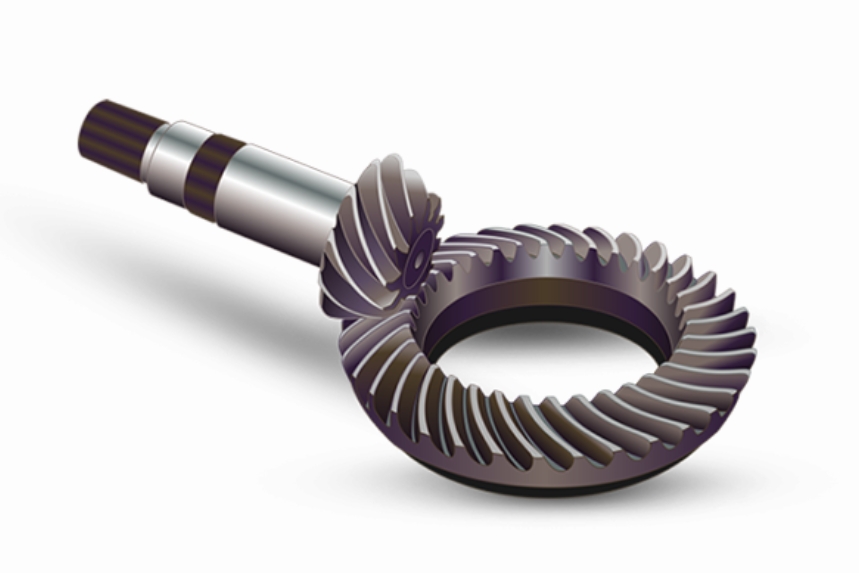
The lapping of spiral bevel gears involves applying a braking torque to the driven gear to maintain a static pressure during the process, ensuring that tooth surfaces remain in contact without separation or collision. However, due to the presence of transmission errors and backlash, the meshing state can vary, leading to mixed conditions of engagement, separation, and impact. This dynamic interaction can cause拍击, which is detrimental to the lapping system. In this context, I develop a two-degree-of-freedom torsional vibration model for spiral bevel gear lapping systems, incorporating nonlinearities from backlash and time-varying transmission errors. While the meshing stiffness of spiral bevel gears is time-varying, its effect is less pronounced compared to spur gears, allowing for simplification using average stiffness in the model. This approach helps in analyzing the dynamic response under different braking torques, with the goal of determining the minimum torque required for complete tooth surface engagement. Spiral bevel gears are central to this analysis, as their design parameters significantly influence the system’s dynamics.
To begin, I establish the vibration model for the spiral bevel gear lapping system. The system is simplified by assuming rigid connections between the gears and their shafts, incorporating the rotational inertias into the gear inertias. The model considers two degrees of freedom in the circumferential direction, focusing on torsional vibrations. The key factors included are backlash between the gear pair and the transmission error, which represents deviations from ideal meshing due to manufacturing inaccuracies. The vibration equations are derived based on Newton’s second law for rotational systems. Let \( J_1 \) and \( J_2 \) be the polar moments of inertia for the pinion and gear, respectively, \( \theta_1 \) and \( \theta_2 \) their angular displacements, \( \dot{\theta}_1 \) and \( \dot{\theta}_2 \) the angular velocities, and \( \ddot{\theta}_1 \) and \( \ddot{\theta}_2 \) the angular accelerations. The meshing force in the normal direction is modeled with a linear spring and damper, where \( k’ \) is the normal meshing stiffness, \( c’ \) is the normal meshing damping, and \( f \) is a nonlinear function accounting for backlash. The average driving torque is \( T_m \), and the average braking torque is \( T_l \). The radii \( r_{m1} \) and \( r_{m2} \) represent distances from the axis to the midpoint of the tooth surface, while \( r_1 \) and \( r_2 \) are distances to the meshing point; \( n_t \) is the projection of the normal vector at the meshing point in the circumferential direction. The transmission error in the normal direction is denoted by \( e \).
The vibration equations can be written as:
$$ J_1 \ddot{\theta}_1 + r_1 n_t W = T_m $$
$$ J_2 \ddot{\theta}_2 – r_2 n_t W = -T_l $$
where \( W = c’ \cdot (r_{m1} \dot{\theta}_1 n_t – r_{m2} \dot{\theta}_2 n_t – \dot{e}) + k’ \cdot f(r_{m1} \theta_1 n_t – r_{m2} \theta_2 n_t – e) \). This formulation captures the dynamic interactions in spiral bevel gears during lapping. The nonlinear function \( f \) defines the backlash effect, and it is given by:
$$ f(x) =
\begin{cases}
x – \theta_0 & \text{if } x > \theta_0 \\
0 & \text{if } -\theta_0 \leq x \leq \theta_0 \\
x + \theta_0 & \text{if } x < -\theta_0
\end{cases} $$
Here, \( \theta_0 \) is the angular backlash converted from the normal clearance. The variable \( x \) represents the relative angular displacement considering transmission error. Based on tooth contact analysis (TCA) for spiral bevel gears, the geometric transmission error \( \Delta \phi \) can be expressed as:
$$ \Delta \phi = (\phi_2 – \phi_2^*) – \frac{Z_1}{Z_2} (\phi_1 – \phi_1^*) $$
where \( Z_1 \) and \( Z_2 \) are the numbers of teeth, \( \phi_1 \) and \( \phi_2 \) are the meshing angles, and \( \phi_1^* \) and \( \phi_2^* \) are the meshing angles at the midpoint of the tooth surface. Converting this to the normal direction, the transmission error \( e = \Delta \phi \cdot r_2 n_t \). Since \( r_1 n_t \) and \( r_2 n_t \) vary minimally along the contact path, they can be approximated by their values at the midpoint, denoted as \( n_{mt} \). Thus, the vibration equations simplify to:
$$ J_1 \ddot{\theta}_1 + r_{m1} n_{mt}^2 [c’ \cdot (r_{m1} \dot{\theta}_1 – r_{m2} \dot{\theta}_2 – r_{m2} \dot{\Delta \phi}) + k’ \cdot f(r_{m1} \theta_1 – r_{m2} \theta_2 – r_{m2} \Delta \phi)] = T_m $$
$$ J_2 \ddot{\theta}_2 – r_{m2} n_{mt}^2 [c’ \cdot (r_{m1} \dot{\theta}_1 – r_{m2} \dot{\theta}_2 – r_{m2} \dot{\Delta \phi}) + k’ \cdot f(r_{m1} \theta_1 – r_{m2} \theta_2 – r_{m2} \Delta \phi)] = -T_l $$
To further reduce the system, I define the gear ratio \( i_{12} = r_{m2} / r_{m1} \), the relative angular displacement \( \theta = \theta_1 – i_{12} \theta_2 \), and the equivalent inertia \( J = \frac{J_1 J_2}{i_{12}^2 J_1 + J_2} \). Also, let \( c = c’ r_{m1} n_{mt}^2 \) and \( k = k’ r_{m1}^2 n_{mt}^2 \). The vibration equation then becomes:
$$ \ddot{\theta} + \frac{c}{J} (\dot{\theta} – i_{12} \dot{\Delta \phi}) + \frac{k}{J} f(\theta – i_{12} \Delta \phi) = \frac{T_m}{J_1} + \frac{i_{12} T_l}{J_2} $$
This equation describes the dynamic response of the spiral bevel gear lapping system, with the nonlinear function \( f \) accounting for backlash. The system can exhibit five motion states depending on the relationship between \( \theta \) and \( i_{12} \Delta \phi \): tooth surface engagement when \( \theta > i_{12} \Delta \phi \), tooth separation when \( -\theta_0 < \theta < i_{12} \Delta \phi \), tooth back engagement when \( \theta < -\theta_0 \), tooth surface impact when \( \theta = i_{12} \Delta \phi \), and tooth back impact when \( \theta = -\theta_0 \). These states are critical for understanding the lapping dynamics of spiral bevel gears.
Next, I perform a dimensionless normalization of the equation to simplify analysis. Define the natural frequency \( \omega’ = \sqrt{k/J} \), damping ratio \( \xi = c/(2\sqrt{Jk}) \), dimensionless time \( \tau = \omega’ t \), dimensionless angular displacement \( \bar{\theta} = \theta \), dimensionless velocity \( \dot{\bar{\theta}} = \dot{\theta}/\omega’ \), dimensionless acceleration \( \ddot{\bar{\theta}} = \ddot{\theta}/\omega’^2 \), dimensionless transmission error \( \bar{\Delta \phi} = \Delta \phi \), and dimensionless torques \( \bar{T}_l = T_l/(J_2 \omega’^2) \) and \( \bar{T}_m = T_m/(J_1 \omega’^2) \). The equation transforms to:
$$ \ddot{\bar{\theta}} + 2\xi (\dot{\bar{\theta}} – i_{12} \dot{\bar{\Delta \phi}}) + f(\bar{\theta} – i_{12} \bar{\Delta \phi}) = i_{12} \bar{T}_l + \bar{T}_m \quad \text{(engagement)} $$
$$ \ddot{\bar{\theta}} = i_{12} \bar{T}_l + \bar{T}_m \quad \text{(separation)} $$
$$ \dot{\bar{\theta}}^+ = -\epsilon \dot{\bar{\theta}}^- \quad \text{(impact)} $$
where \( \dot{\bar{\theta}}^+ \) and \( \dot{\bar{\theta}}^- \) are the post- and pre-impact dimensionless velocities, and \( \epsilon \) is the coefficient of restitution. This dimensionless formulation facilitates numerical computation and parametric studies for spiral bevel gear lapping systems.
For numerical analysis, I consider a spiral bevel gear pair with 25 and 32 teeth, typical in industrial applications. The parameters used in the calculation are summarized in the table below, which highlights key values for the spiral bevel gears system.
| Parameter | Value |
|---|---|
| \( J_1 \) (kg·m²) | 0.0078 |
| \( J_2 \) (kg·m²) | 0.026 |
| \( \xi \) | 0.1 |
| \( k’ \) (N·m/rad) | 3.12 × 10⁸ |
| \( r_{m1} n_{mt} \) (m) | 0.034 |
| \( \theta_0 \) (rad) | 0.002 |
| \( \epsilon \) | 0.8 |
The transmission error curve for the convex side of the large gear, obtained from TCA, is used as an input. It exhibits periodic variations that influence the dynamic response. Using the fourth-order Runge-Kutta method, I compute the dynamic response under different braking torques. The results reveal distinct behaviors based on the torque magnitude. For lower braking torques, the system experiences a mixed state of engagement, impact, and separation. For instance, at a braking torque of 0.8 N·m, the dimensionless angular displacement time history shows alternating phases above and below thresholds corresponding to engagement and separation. This torque represents a critical value for tooth back impact; above it, tooth back impact disappears, and the system transitions to a state of tooth surface engagement, impact, and separation only.
To elaborate, I analyze specific cases with braking torques of 1.8 N·m, 3.3 N·m, and 5.5 N·m. The phase plots and time-displacement histories are computed, focusing on the relative angular displacement \( \phi = \bar{\theta} – i_{12} \bar{\Delta \phi} \). The following table summarizes the observations for these cases, emphasizing the behavior of spiral bevel gears under varying conditions.
| Braking Torque (N·m) | Number of Tooth Surface Impacts per Cycle | Dimensionless Relative Angular Displacement during Separation | Motion State |
|---|---|---|---|
| 1.8 | 3 | 0.00063 | Single-period with engagement and separation |
| 3.3 | 5 | 0.00032 | Single-period with increased impacts |
| 5.5 | 7 | 0.00017 | Single-period with further reduced separation |
As the braking torque increases, the system remains in single-period motion, but the number of tooth surface impacts per cycle rises, while the dimensionless relative angular displacement during separation decreases. This indicates a trend toward more continuous engagement. At a braking torque of 12 N·m, separation vanishes entirely, and the system enters a state of complete tooth surface engagement. This is the minimum braking torque required to prevent拍击 in the spiral bevel gear lapping system, ensuring smooth operation without collisions or separations. The phase plot at this torque shows chaotic-like behavior but with all points above the zero line, confirming full engagement.
The dynamic response of spiral bevel gear lapping systems is highly sensitive to braking torque due to nonlinearities from backlash and transmission errors. At lower torques, the interplay of engagement, impact, and separation can lead to拍击, which is undesirable for lapping quality. As torque increases, tooth back impact is eliminated, and the system progressively moves toward complete tooth surface engagement. The numerical results demonstrate that for the given spiral bevel gears parameters, a braking torque of 12 N·m ensures no separation or impact, providing an optimal condition for lapping. This insight is valuable for designing lapping processes for spiral bevel gears, as it helps in selecting appropriate torques to minimize vibrations and improve gear surface finish.
In conclusion, the two-degree-of-freedom vibration model effectively captures the dynamic behavior of spiral bevel gear lapping systems. By incorporating backlash and transmission errors, I have shown how different braking torques influence the meshing state. The analysis highlights the importance of achieving complete tooth surface engagement to avoid拍击, with a specific minimum torque identified for the example gear pair. Future work could explore more complex models, such as those with time-varying stiffness or multi-body dynamics, to further refine the understanding of spiral bevel gears in lapping applications. Overall, this study contributes to the optimization of lapping processes for spiral bevel gears, enhancing their performance and reliability in mechanical transmissions.
The role of spiral bevel gears in modern machinery cannot be overstated, and their lapping process is critical for achieving high precision. The dynamic response analysis presented here underscores the need for careful control of braking torque to maintain continuous engagement. By leveraging numerical methods and nonlinear dynamics, I have provided a framework for evaluating spiral bevel gear lapping systems under various operating conditions. This approach can be extended to other gear types or lapping techniques, but the focus remains on spiral bevel gears due to their unique challenges and widespread use. As technology advances, further research into the dynamic response of spiral bevel gears will continue to drive improvements in gear manufacturing and application.