
Our research focuses on the dynamic wear evolution and performance degradation of helical gears in the axle‑suspended gearbox of high‑speed trains. We combined the multibody dynamics software SIMPACK with the Archard wear theory to develop a comprehensive dynamic wear model for helical gears. This model incorporates realistic features such as gearbox bearings, elastic suspension of the housing, wheel‑rail adhesion loads, and train vibration excitations, achieving a two‑way coupling between internal/external excitations and gear wear. Through detailed simulations over a full maintenance cycle, we analyzed how operating parameters and gearbox excitations influence wear and performance deterioration. The following sections present our methodology, validation results, and parametric studies.
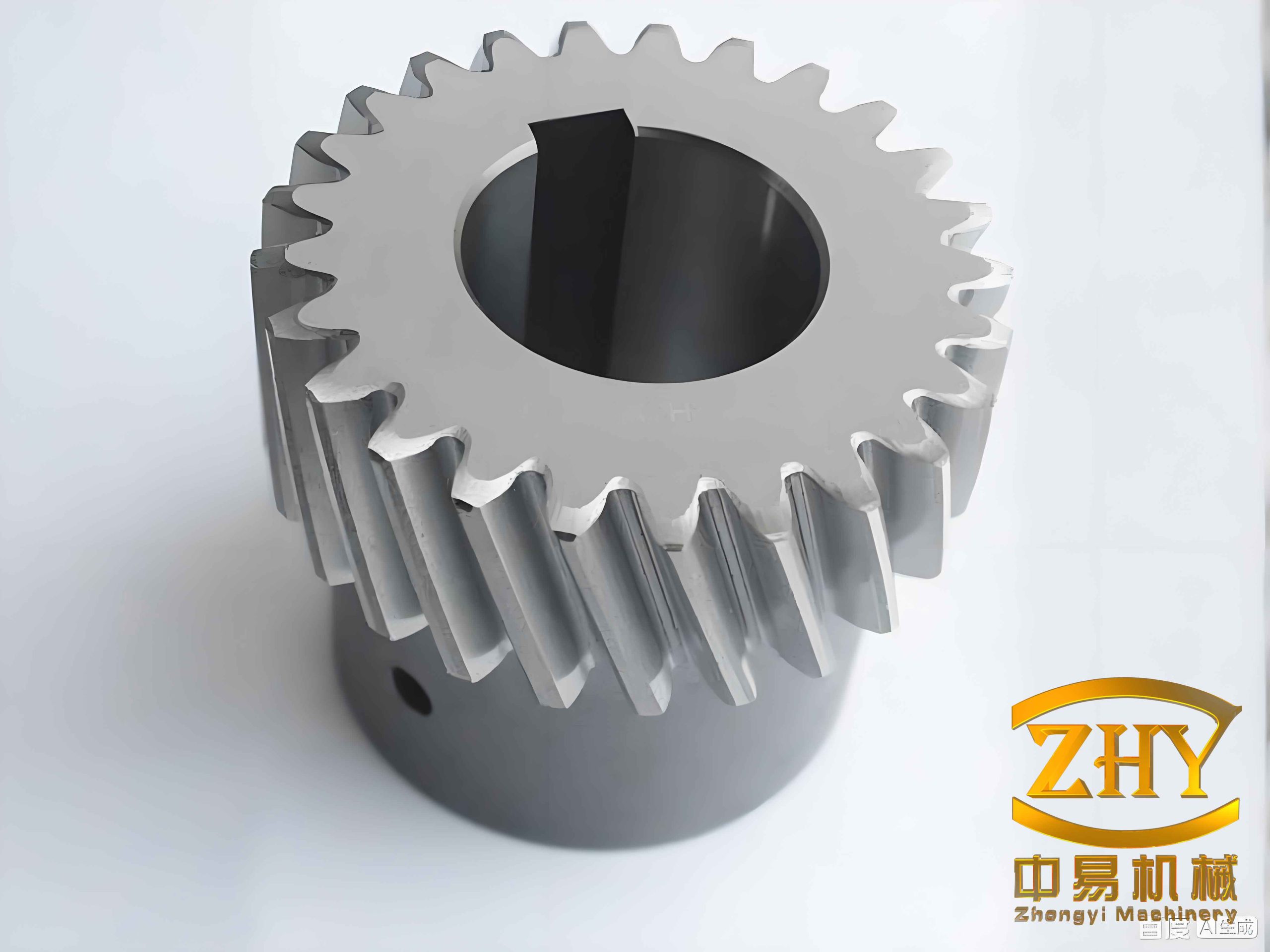
We built a high‑fidelity multibody model of the high‑speed train gearbox inside SIMPACK. The model includes:
- A gear pair force element (225: gear pair) to simulate the meshing of helical gears, with time‑varying mesh stiffness computed via the slice method and energy method according to DIN 3990‑1:1987 (Method B).
- Rolling bearing force elements (88: Rolling Bearing) for the pinion bearings (NU215, QJ214) and gear bearings (EC32944), with nonlinear stiffness and damping calculated per ISO 16281.
- Bushing force elements (43: Bushing cmp) for the elastic suspension (C‑bracket) connecting the gearbox housing to the bogie frame, representing rubber element nonlinearities.
- Wheel‑rail adhesion loads and track irregularities (Chinese high‑speed railway spectrum) to generate realistic external excitations.
The total meshing force Fn(t) is distributed among the simultaneously engaged tooth pairs using the time‑varying contact‑line‑length percentage method:
$$ L(t) = \sum_{k=1}^{\lceil \gamma_\varepsilon \rceil} l_k(t), \quad l_k(t) = l_1\!\left(t – (k-1)T_m\right) $$
$$ F_k(t) = F_n(t) \cdot \frac{l_k(t)}{L(t)} $$
where γε = 2.648 is the total contact ratio, Tm the mesh period, and l1(t) is obtained from helical gear geometry. The contact surface is discretised into an I × J grid. For each point M(i,j) on the tooth flank, the wear depth per mesh cycle is given by the Archard model:
$$ \Delta h_{n,ij} = k_{ij} \cdot p_{ij} \cdot s_{ij}, \quad n=1,2 $$
with pij the mean Hertz contact pressure and sij the sliding distance. The wear coefficient kij is based on the mixed‑EHL regression formula of Janakiraman:
$$ k_{ij} = 3.981 \times 10^{-29} \, (L)^{1.219} (G)^{7.377} (S)^{1.589} E_{\text{eq}} $$
where L is the dimensionless load, G the dimensionless pressure‑viscosity coefficient, and S the dimensionless composite surface roughness. Table 1 summarises the gear parameters used in our study.
| Parameter | Pinion (active) | Gear (driven) |
|---|---|---|
| Normal module mn (mm) | 6 | |
| Pressure angle αn (°) | 20 | |
| Helix angle β (°) | 18 | |
| Addendum coefficient han* | 1 | |
| Clearance coefficient cn* | 0.35 | |
| Number of teeth | 35 | 85 |
| Addendum modification coefficient x | 0.225 | 0.024 |
| Tooth width B (mm) | 66 | 65 |
| Material | 18CrNiMo7-6 | |
| Elastic modulus E (Pa) | 2.1×10¹¹ | |
| Poisson’s ratio λ | 0.3 | |
| Surface roughness RMS Rq (μm) | 0.44 | |
| Pressure‑viscosity coefficient α (m²/N) | 2.3683×10⁻⁸ | |
To update the tooth geometry, we divide the maintenance mileage (1.2×10⁶ km) into stages of 5×10⁴ km. After each stage, the accumulated wear is applied as a modification to the tooth profile, and the dynamic model is re‑evaluated. The number of load cycles for each tooth in a stage is
$$ \zeta = \frac{x_w \cdot i_g}{\pi d_w} \quad (\text{pinion}), \qquad \zeta = \frac{x_w}{\pi d_w} \quad (\text{gear}) $$
where xw is the stage mileage, ig the gear ratio, and dw the wheel diameter.
We first validated our approach by comparing with published results for a helical gear wear test. The wear profiles from our model matched those of Zhou et al. (2018) closely, confirming the correctness of the load‑sharing method. We then compared five models of increasing fidelity:
- Model 1: pure torsional gear pair.
- Model 2: bending‑torsional gear pair with bearings.
- Model 3: axle‑suspended gearbox (proposed baseline).
- Model 4: Model 3 with externally imposed track irregularities.
- Model 5: Model 3 integrated into a full vehicle dynamics model (true coupling).
The single‑mesh maximum wear increased by 7.9% from Model 1 to Model 3, showing that bearing elasticity and housing suspension significantly raise meshing impact. In the full‑vehicle model (Model 5), wear accelerated further due to coupled train vibrations. Table 2 summarises the wear comparison at the end of the maintenance cycle.
| Model | Single‑mesh max wear (×10⁻⁶ μm) | Cumulative max wear (μm) |
|---|---|---|
| Model 1 (torsional) | 1.52 | 0.108 |
| Model 2 (with bearings) | 1.61 | 0.115 |
| Model 3 (axle‑suspended) | 1.64 | 0.117 |
| Model 4 (external track irregularity) | 1.72 | 0.125 |
| Model 5 (full vehicle) | 1.83 | 0.131 |
Furthermore, we replaced the constant load with an adhesion‑fluctuating load and observed a 15% increase in wear by the end of the cycle, confirming the importance of realistic wheel‑rail adhesion.
We then conducted a parametric study using Model 5 (full vehicle + track irregularities) to explore the effects of operating parameters and internal/external excitations on the helical gear wear and performance degradation.
Effect of Operating Parameters
We varied the train running speed, motor input torque, and axle load while keeping other conditions constant. The maximum wear was always located at the root of the rear‑end face of the pinion, because the sliding distance and contact pressure are highest there. Table 3 lists the relative increase in cumulative wear at the pinion’s root when each parameter was increased by a typical margin.
| Parameter | Baseline | Increased value | Wear increase (%) |
|---|---|---|---|
| Running speed (km/h) | 250 | 350 | 22.4 |
| Motor torque (N·m) | 500 | 1000 | 35.1 |
| Axle load (t) | 14 | 18 | 28.7 |
Torque and axle load both increase the tooth force directly, leading to a larger wear coefficient k and deeper wear scars. The speed mostly affects the dynamic load fluctuation and sliding velocity.
Effect of Internal Excitations: Transmission Error
We introduced a sinusoidal transmission error with amplitude e (0, 10, 20, 30 μm) to simulate manufacturing inaccuracies. Figure 14 in the original paper (not reproduced here) shows the single‑mesh maximum wear over mileage. We observed that for small errors (e = 10–20 μm), the initial wear acts as a favourable profile modification, temporarily reducing wear. For larger errors (30 μm), the wear rate increases monotonically after the early stage. At the end of the maintenance cycle, the average mesh stiffness dropped by 10.8% compared to the perfect condition, and the RMS of the vertical acceleration at the bearing housing increased by 43.2%. Table 4 summarises key indicators.
| Error amplitude e (μm) | Single‑mesh max wear (relative to e=0) | Average mesh stiffness (N/m ×10⁸) | Housing vertical acceleration RMS (m/s²) |
|---|---|---|---|
| 0 | 1.00 | 1.75 | 8.5 |
| 10 | 1.12 | 1.70 | 10.4 |
| 20 | 1.28 | 1.63 | 12.1 |
| 30 | 1.52 | 1.56 | 14.6 |
We also detected instantaneous double‑side contact events (contact ratio deviating from its normal range) when error was present, which increased the mesh stiffness at those instants but also caused higher impact loads.
Effect of Backlash
Backlash b was varied from 0.1 to 0.4 mm. Its influence on wear was less pronounced than transmission error. Interestingly, the optimal backlash that minimised the single‑mesh wear at the beginning of the cycle was 0.3 mm, while at the end it shifted to 0.2 mm (due to the added wear of about 0.1 mm). This suggests that a middle value of 0.25 mm would yield the lowest overall wear throughout the maintenance cycle. Larger backlash always increased the housing vibration RMS. Table 5 lists the wear and stiffness values for different backlashes.
| Backlash b (mm) | Single‑mesh max wear (×10⁻⁶ μm) | Average mesh stiffness (×10⁸ N/m) | Housing acceleration RMS (m/s²) |
|---|---|---|---|
| 0.1 | 1.72 | 1.80 | 9.2 |
| 0.2 | 1.65 | 1.77 | 10.5 |
| 0.3 | 1.68 | 1.73 | 12.8 |
| 0.4 | 1.75 | 1.68 | 15.3 |
Our recommended backlash design is 0.25 mm, which agrees with the GB/Z 18620‑2008 recommended minimum of 0.286 mm.
Effect of Train Vibration Excitation
We compared three scenarios: (i) ideal (no train vibration), (ii) without track irregularities (only carbody vibrations), (iii) with track irregularities (full excitation). The results clearly show that train vibration greatly accelerates wear. At the end of the cycle, the single‑mesh maximum wear with track irregularities was 13% higher than the ideal case, and the housing vertical acceleration RMS increased by 58.8%. The average mesh stiffness dropped 5.3% more than the ideal case. Moreover, the centre‑distance deviation increased significantly due to wear, causing low‑frequency fluctuations in the mesh stiffness. Table 6 gathers the comparative data.
| Scenario | Single‑mesh max wear (×10⁻⁶ μm) | Average mesh stiffness (×10⁸ N/m) | Housing acceleration RMS (m/s²) |
|---|---|---|---|
| Ideal (no vibration) | 1.64 | 1.75 | 8.5 |
| Without track irregularity | 1.75 | 1.70 | 11.2 |
| With track irregularity | 1.86 | 1.66 | 13.5 |
The coupling effect is evident: as wear increases, the gear meshing becomes more irregular, which in turn amplifies the dynamic response of the gearbox, creating a vicious cycle.
Conclusions
In this work, we developed a dynamic wear model for helical gears in a high‑speed train axle‑suspended gearbox. The model integrates realistic bearing, suspension, adhesion load, and vehicle‑track excitation, enabling coupled wear‑dynamics analysis. Our key findings are:
- Wear is highest at the tooth root near the pinion’s rear end due to the combination of high sliding and high contact pressure. The pinion wears more than the gear.
- Increasing speed, torque, or axle load exacerbates wear, with torque having the strongest effect (35% increase per 100% torque rise).
- Transmission error significantly worsens wear and vibration; an error amplitude of 30 μm raises single‑mesh wear by 52.4% and housing acceleration by 43.2% over the maintenance cycle.
- Backlash has a minor but non‑negligible effect; there exists an optimal backlash (≈0.25 mm) that minimises the average wear over the cycle.
- Train vibration (especially from track irregularities) accelerates wear and accelerates performance degradation, reducing mesh stiffness and increasing housing vibration substantially.
- The single‑mesh wear often first decreases (due to beneficial profile modification) and then increases. The cumulative wear is almost linear, but the wear rate (slope) increases when errors or vibrations are present.
Our results provide valuable guidelines for gear design, maintenance planning, and condition monitoring of high‑speed train helical gear transmissions. Future work will include experimental validation and the extension to fatigue‑wear coupling.