
In mechanical transmission systems, the cylindrical gear is a fundamental component widely used in various industries such as aerospace, automotive, and manufacturing. The performance and reliability of these systems heavily depend on the dynamic characteristics of the cylindrical gear pairs. Among common faults, tooth pitting is a prevalent issue that significantly affects the time-varying mesh stiffness, leading to altered vibration responses and potential system failures. In this article, I will explore the impact of tooth pitting on the dynamics of cylindrical gear pairs, focusing on analytical modeling, numerical simulations, and experimental validations. The goal is to provide insights into fault detection and diagnosis, enhancing the design and maintenance of cylindrical gear systems.
The cylindrical gear operates through tooth engagement, where the mesh stiffness varies periodically due to changing contact conditions. When pitting occurs on tooth surfaces, it introduces discontinuities that alter the contact geometry, thereby modifying the stiffness and damping properties. This, in turn, influences the dynamic behavior, including natural frequencies and resonance amplitudes. Understanding these effects is crucial for predictive maintenance and optimization of cylindrical gear transmissions.
To model tooth pitting, I approximate each pit as a part of an elliptical cylinder, based on its shape and distribution. This approach allows for a realistic representation of pitting morphology. Depending on the location and quantity of pits, I define three damage levels: mild pitting, moderate pitting, and severe pitting. These levels help quantify the extent of damage and its impact on system dynamics. The table below summarizes the characteristics of each pitting level.
| Pitting Level | Number of Pits | Typical Location | Effect on Stiffness |
|---|---|---|---|
| Mild | 1-3 | Near base circle | Minor reduction |
| Moderate | 4-6 | Mid-tooth region | Significant reduction |
| Severe | 7+ | Towards tip circle | Major reduction |
The time-varying mesh stiffness of a cylindrical gear pair is a key parameter in dynamic analysis. I calculate it using the potential energy method, which considers bending, shear, and axial compressive energies. For a healthy cylindrical gear, the mesh stiffness \( k_m(t) \) can be expressed as:
$$ k_m(t) = \frac{1}{\frac{1}{k_b} + \frac{1}{k_s} + \frac{1}{k_a}} $$
where \( k_b \), \( k_s \), and \( k_a \) are the bending, shear, and axial stiffness components, respectively. These components vary with the gear rotation angle \( \theta \), leading to periodic stiffness. When pitting is present, the effective contact area decreases, reducing the stiffness. I model this reduction by introducing a damage factor \( \delta \) that depends on pit dimensions and location. For a pit with semi-major axis \( a \) and semi-minor axis \( b \), the stiffness reduction \( \Delta k \) can be approximated as:
$$ \Delta k = \gamma \cdot \frac{\pi a b}{A_c} $$
where \( \gamma \) is a material constant, and \( A_c \) is the nominal contact area. The time-varying mesh stiffness for a pitted cylindrical gear then becomes:
$$ k_m'(t) = k_m(t) – \sum_{i=1}^{N} \Delta k_i $$
with \( N \) being the number of pits. This formulation allows for comparing stiffness across different pitting levels.
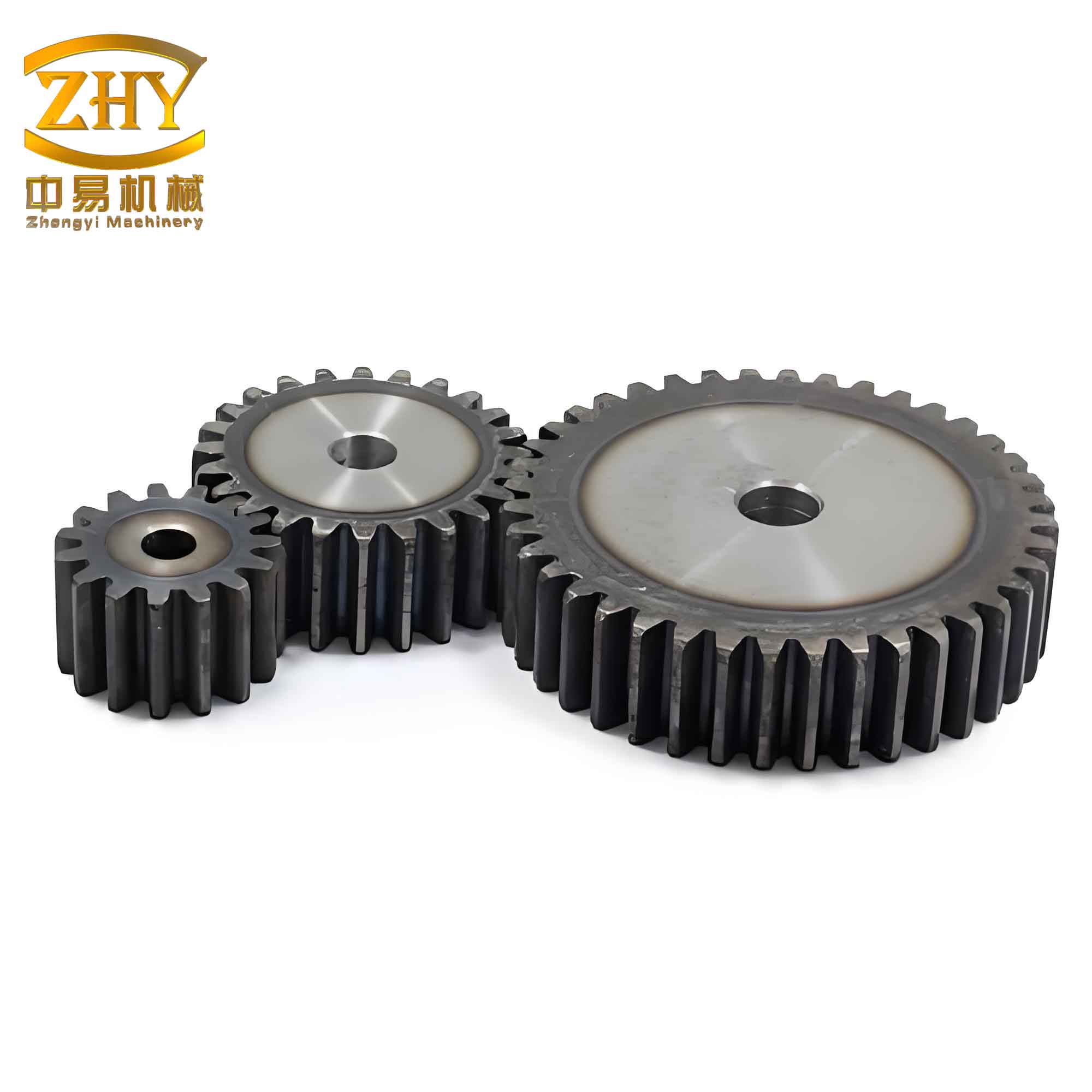
The vibration response of a cylindrical gear pair is governed by equations of motion that incorporate time-varying mesh stiffness and damping. I consider a single-stage spur gear system, modeled as a two-degree-of-freedom system with masses \( m_1 \) and \( m_2 \), representing the driving and driven gears. The equations are:
$$ m_1 \ddot{x}_1 + c(\dot{x}_1 – \dot{x}_2) + k_m'(t)(x_1 – x_2) = T_1 $$
$$ m_2 \ddot{x}_2 + c(\dot{x}_2 – \dot{x}_1) + k_m'(t)(x_2 – x_1) = -T_2 $$
where \( x_1 \) and \( x_2 \) are displacements, \( c \) is damping coefficient, and \( T_1 \), \( T_2 \) are input and output torques. For a cylindrical gear, the mesh frequency \( f_m \) is given by \( f_m = N \cdot f_r \), with \( N \) as tooth number and \( f_r \) as rotational frequency. The natural frequencies of the system can be affected by pitting, as stiffness reduction lowers resonant frequencies.
To analyze the effects, I perform numerical simulations using finite element methods. The cylindrical gear geometry is discretized, and pitting is introduced as localized material removal. The contact analysis yields stiffness values, which are then used in dynamic simulations. The results show that as pitting severity increases, the mesh stiffness decreases nonlinearly, leading to higher vibration amplitudes at resonant frequencies. The table below illustrates the percentage reduction in average mesh stiffness for different pitting levels in a cylindrical gear pair.
| Pitting Level | Average Stiffness Reduction (%) | Resonance Amplitude Increase (%) |
|---|---|---|
| Mild | 5-10 | 10-20 |
| Moderate | 15-25 | 30-50 |
| Severe | 30-40 | 60-80 |
The location of pitting on the cylindrical gear tooth also plays a critical role. When pits are near the base circle, the stiffness reduction is minimal due to lower contact stress. As pits move towards the tip circle (increasing location parameter \( \lambda \)), the reduction becomes more pronounced. This can be quantified by a position factor \( \eta(\lambda) \), modifying the stiffness reduction as:
$$ \Delta k = \eta(\lambda) \cdot \gamma \cdot \frac{\pi a b}{A_c} $$
where \( \eta(\lambda) \) increases with \( \lambda \). For a cylindrical gear, typical values range from 0.8 at the base to 1.2 at the tip. Additionally, pit dimensions influence stiffness: longer semi-major axis \( a \) leads to greater reduction, while changes in semi-minor axis \( b \) have a uniform effect across damage levels within the same angular displacement range.
Experimental validation is conducted using a power transmission fault diagnosis test rig. The setup includes a cylindrical gear pair with artificially induced pitting, accelerometers to measure vibration, and load cells to apply torque. The results align with theoretical predictions, showing increased vibration spectra at mesh harmonics for pitted gears. The frequency response functions (FRFs) demonstrate shifts in resonant peaks, confirming stiffness reduction. The experimental data for a cylindrical gear with moderate pitting is summarized below.
| Frequency Band (Hz) | Healthy Gear Amplitude (m/s²) | Pitted Gear Amplitude (m/s²) | Increase (%) |
|---|---|---|---|
| 100-500 | 0.05 | 0.08 | 60 |
| 500-1000 | 0.10 | 0.15 | 50 |
| 1000-1500 | 0.20 | 0.35 | 75 |
For deeper analysis, I consider fractional-order dynamics to model viscoelastic behavior in cylindrical gear materials. The fractional-order derivative introduces memory effects, enhancing the accuracy of vibration predictions. The modified equation for a cylindrical gear pair is:
$$ m \ddot{x} + c D^\alpha x + k_m'(t) x = F(t) $$
where \( D^\alpha \) is the fractional derivative of order \( \alpha \), and \( F(t) \) is excitation force. This approach captures nonlinear damping phenomena common in pitted cylindrical gears.
In terms of design implications, the identified stiffness and damping models can be integrated into finite element software for predictive simulations. For cylindrical gear systems, this allows optimizing tooth profiles and material selection to mitigate pitting effects. The contact stiffness \( K_c \) and damping \( C_c \) for a cylindrical gear interface can be derived from experimental-numerical hybrid methods, minimizing error functions like:
$$ E(K_c, C_c) = \sum_{i=1}^{M} (f_{i,exp} – f_{i,sim})^2 + (A_{i,exp} – A_{i,sim})^2 $$
where \( f_i \) are natural frequencies and \( A_i \) are resonance amplitudes from experiments and simulations. Optimization yields \( K_c \) and \( C_c \), crucial for dynamic analysis.
Furthermore, I explore the impact of misalignment between base circle and root circle on mesh stiffness in cylindrical gears. Misalignment adds complexity, reducing effective contact and exacerbating pitting effects. The combined stiffness \( k_{total} \) can be expressed as:
$$ k_{total} = \left( \frac{1}{k_m’} + \frac{1}{k_{mis}} \right)^{-1} $$
with \( k_{mis} \) as stiffness loss due to misalignment. This is vital for high-precision cylindrical gear applications.
To summarize, the dynamics of cylindrical gear pairs are highly sensitive to tooth pitting. Through analytical models, numerical simulations, and experiments, I demonstrate how pitting reduces time-varying mesh stiffness and amplifies vibrations. The cylindrical gear’s performance degrades with increasing pitting severity, location towards the tip, and larger pit sizes. The proposed methods enable accurate stiffness identification and vibration prediction, supporting fault diagnosis in cylindrical gear transmissions.
For future work, extending this analysis to helical cylindrical gears or planetary gear sets could provide broader insights. Additionally, real-time monitoring techniques using vibration data from cylindrical gear systems can be developed for industrial applications. The resilience of cylindrical gear designs against pitting can be enhanced through advanced materials and surface treatments, ensuring longer service life and reliability.
In conclusion, this comprehensive study on cylindrical gear dynamics with tooth pitting offers a foundation for improving mechanical transmission systems. By integrating theoretical, numerical, and experimental approaches, I contribute to the advancement of cylindrical gear technology, fostering innovation in various engineering fields.