
Spiral bevel gear milling machines frequently experience chatter during machining processes, compromising workpiece quality. This issue stems from dynamic instabilities in the tool spindle system. To address this, we establish an equivalent dynamics model using the lumped mass method, derive spindle rotor stiffness matrices via Timoshenko beam theory, and develop computational formulas for axial/radial stiffness of tapered roller bearings under preload. Experimental validation confirms the model’s accuracy in capturing critical dynamic behaviors of gear milling systems.
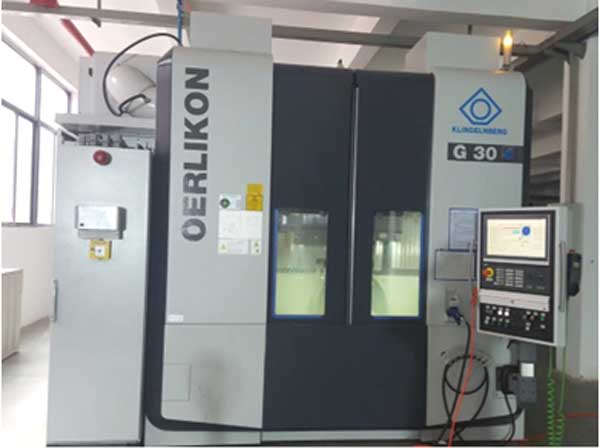
The tool spindle system comprises the spindle, tapered roller bearings, torque motor, cutter head assembly (including milling cutter and flange), and coupling sleeve. Discretization using lumped mass principles converts continuous mass distributions into concentrated masses at bearing locations:
$$m_j^L = \frac{1}{l} \sum_{k=1}^{n} \mu_k l_k (l – a_k)$$
$$m_j^R = \frac{1}{l} \sum_{k=1}^{n} \mu_k l_k a_k$$
where \( \mu_k \) and \( l_k \) denote segment mass/length, \( a_k \) is centroid distance, \( l \) is total length, and \( m_j \) represents the lumped mass at bearing \( j \).
| Component | Equivalent Mass Position | Mass Contribution |
|---|---|---|
| Cutter Head | Front Bearing | $$m_{b1}$$ |
| Torque Motor | Rear Bearing | $$m_{b2}$$ |
| Spindle Shaft | Both Bearings | Distributed via Eq. (1) |
The undamped dynamics equation governs the gear milling spindle system:
$$M \ddot{X} + KX = F(t)$$
with displacement vector \( X = [x_{b1}, y_{b1}, x_{b2}, y_{b2}, z]^T \), mass matrix \( M = \text{diag}(m_{b1}, m_{b1}, m_{b2}, m_{b2}, m_{b1} + m_{b2}) \), and stiffness matrix \( K = \text{diag}(k_{b1}, k_{b1}, k_{b2}, k_{b2}, k_z) \). Natural frequencies satisfy:
$$|K – \omega_n^2 M| = 0$$
Spindle rotor stiffness uses Timoshenko beam theory accounting for shear deformation and rotary inertia. The state matrix formulation relates displacements \( d = [y_b, \theta]^T \) and forces \( F = [Q, M]^T \) at shaft ends:
$$\begin{bmatrix} d_L \\ F_L \end{bmatrix} = K_s \begin{bmatrix} d_R \\ F_R \end{bmatrix}$$
where \( K_s \) contains stiffness coefficients derived from beam parameters:
$$K_s = \begin{bmatrix}
D_0 – \sigma D_2 & lD_4 & \cdots \\
\frac{l^2[(\beta^4 + \sigma^2)D_3 – \sigma D_1]}{\beta^4 EI} & -\frac{l^2 D_2}{EI} & \cdots \\
\vdots & \vdots & \ddots
\end{bmatrix}$$
with \( \sigma = \frac{\mu \omega^2 l^2}{GAk} \), \( \beta^4 = \frac{\mu \omega^2 l^4}{EI} \), and \( D_i \) as transcendental functions of eigenvalues \( \lambda_1, \lambda_2 \).
| Stiffness Type | Equation | Variables |
|---|---|---|
| Axial | $$k_a = \frac{F_a}{\delta_a}, \delta_a = \frac{6 \times 10^{-4}}{\sin \alpha} Q^{0.9} l_a^{0.8}$$ | \( F_a \): Preload, \( \alpha \): Contact angle \( Q \): Roller load, \( l_a \): Effective length |
| Radial | $$k_r = \frac{1}{m \ln F_r + m + n}, F_r = F_{a0} \sin \alpha + F_{or}$$ | \( m, n \): Geometry coefficients \( F_{or} \): External radial load |
Model validation used impact hammer testing (700–1000N force) with piezoelectric accelerometers. Frequency spectra comparisons show high correlation between numerical predictions and experimental measurements for gear milling dynamics:
| Mode | Experimental (Hz) | Numerical (Hz) | Error (%) | Stiffened System (Hz) |
|---|---|---|---|---|
| 1 | 880.43 | 1002.53 | 13.87 | 1305.80 |
| 2 | 1805.59 | 1985.16 | 9.95 | 2013.19 |
| 3 | 2568.09 | 2769.39 | 7.84 | 2700.12 |
| 4 | 2801.92 | 2980.51 | 6.37 | 2986.57 |
| 5 | 2883.25 | 3009.12 | 4.37 | 3001.36 |
Higher preload (6500N) increased natural frequencies by 10–15%, enhancing stability in gear milling operations. The dynamics model effectively guides spindle-bearing optimization for chatter suppression in spiral bevel gear milling applications.