
In the field of industrial robotics, precision and reliability are paramount, and the rotary vector reducer plays a critical role in ensuring these qualities. As a key component in robotic joints, the rotary vector reducer offers high reduction ratios, compact design, and excellent torsional stiffness. Over the years, extensive research has been conducted to understand and optimize the dynamic behavior of rotary vector reducers, focusing on aspects such as transmission accuracy and performance under operational conditions. This article delves into the dynamics characteristic analysis of a rotary vector reducer transmission system, employing a comprehensive approach that incorporates time-varying meshing stiffness, damping effects, and transmission errors. Through this investigation, I aim to provide insights that can enhance the design and fault diagnosis of rotary vector reducers, ultimately contributing to advancements in robotic systems.
The rotary vector reducer, often abbreviated as RV reducer, is a complex mechanical system that combines planetary gear trains with cycloidal drives to achieve high torque and precision. Its operation involves multiple stages of motion transmission, leading to intricate dynamic interactions. Early studies on rotary vector reducers primarily addressed static performance, but recent advancements have shifted toward dynamic analysis, considering factors like variable stiffness and damping. However, many existing models overlook the time-dependent nature of meshing stiffness and the influence of composite transmission errors, which can significantly impact vibration and noise levels. In this work, I develop a coupled torsional dynamics model for a three-crank-shaft rotary vector reducer, integrating support stiffness, meshing damping, time-varying meshing stiffness, and comprehensive meshing errors. By solving the dynamics equations numerically and validating results through simulation, I explore the system’s vibrational response and dynamic meshing forces, offering a foundation for optimizing rotary vector reducer designs.
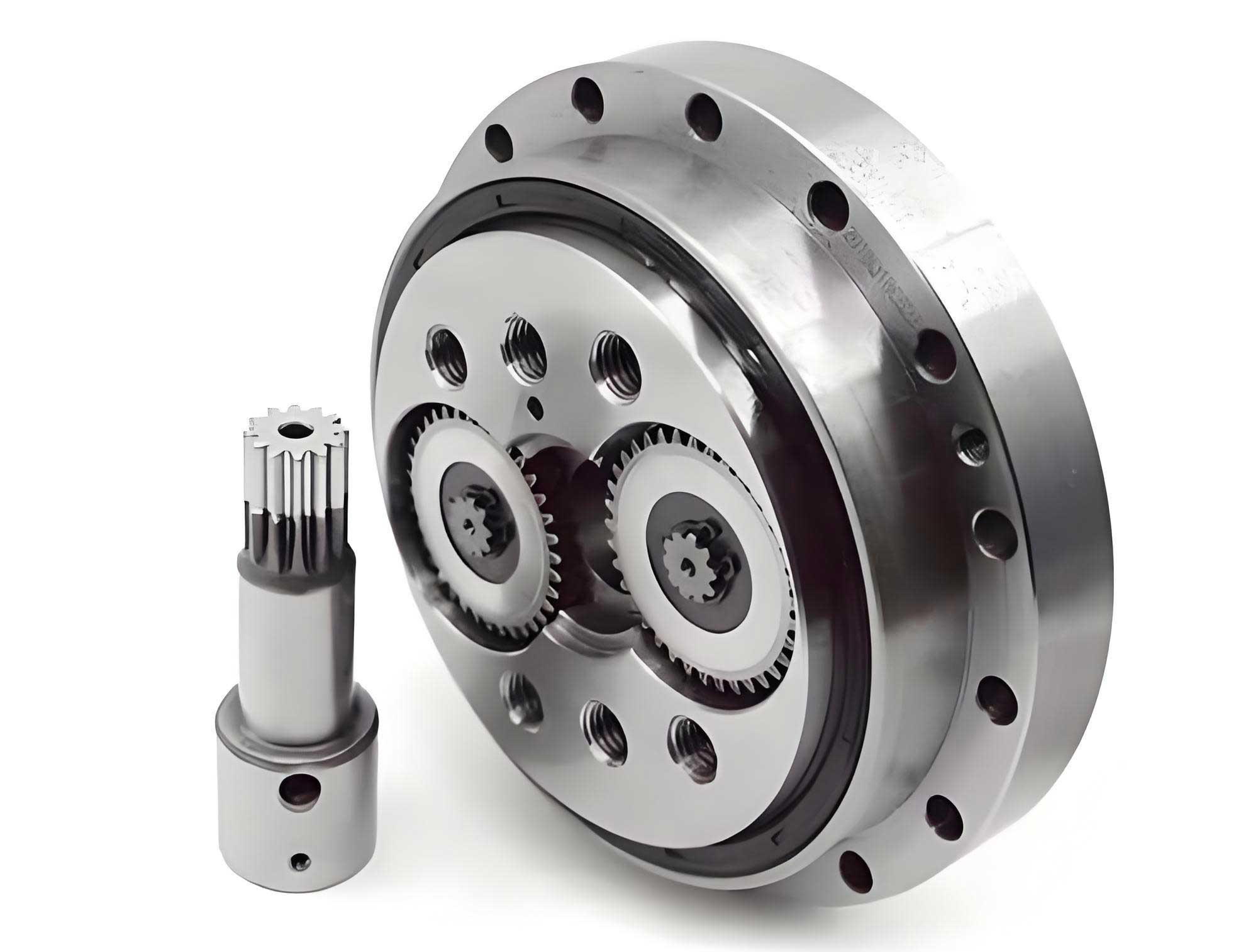
The transmission principle of a rotary vector reducer is fundamental to understanding its dynamics. As illustrated in the figure above, the system consists of an input shaft connected to a motor, which drives a sun gear in a planetary gear set. This engagement results in the first stage of speed reduction. The planetary gears are fixed to crank shafts, which serve as inputs for the cycloidal drive stage. Each crank shaft, through eccentric motions, drives cycloid gears that mesh with a fixed pin gear. The cycloid gears undergo both revolution and rotation, with the rotational motion transmitted to the output via a planet carrier. This two-stage process—planetary gear reduction followed by cycloidal reduction—enables the rotary vector reducer to achieve high reduction ratios, typically ranging from 30:1 to over 100:1, while maintaining compactness and high load capacity. The interplay between these components introduces dynamic challenges, such as varying meshing conditions and error propagation, which necessitate detailed analysis for optimal performance.
To analyze the dynamics of a rotary vector reducer, I employ a lumped-parameter approach, which simplifies the system into discrete masses and stiffness elements. This method is effective for capturing essential dynamic behaviors without excessive computational complexity. The model assumptions include: treating support bearings as linear springs; considering the masses and moments of inertia of gears as concentrated parameters; assuming constant support stiffness for bearings; neglecting frictional effects at gear meshes; and simplifying the crank shafts into three lumped masses per shaft. These simplifications allow for the development of a torsional dynamics model that focuses on key vibrational modes. The dynamics model of the rotary vector reducer can be represented by a set of differential equations derived from Newton’s second law. For instance, the equation for the sun gear’s angular displacement $\theta_s$ is given by:
$$ J_s \ddot{\theta}_s + c_{sp} (\dot{\theta}_s r_s – \dot{\theta}_{pi} r_p) + k_{sp}(t) (\theta_s r_s – \theta_{pi} r_p) = T_{in} $$
where $J_s$ is the moment of inertia of the sun gear, $c_{sp}$ is the meshing damping, $k_{sp}(t)$ is the time-varying meshing stiffness, $r_s$ and $r_p$ are the base circle radii of the sun and planetary gears, $\theta_{pi}$ is the angular displacement of the i-th planetary gear, and $T_{in}$ is the input torque. Similar equations are formulated for other components, including planetary gears, crank shafts, cycloid gears, and the planet carrier. The overall system dynamics can be expressed in matrix form as:
$$ \mathbf{J} \ddot{\boldsymbol{\theta}} + \mathbf{C} \dot{\boldsymbol{\theta}} + \mathbf{K}(t) \boldsymbol{\theta} = \mathbf{F}(t) $$
where $\mathbf{J}$ is the inertia matrix, $\mathbf{C}$ is the damping matrix, $\mathbf{K}(t)$ is the time-varying stiffness matrix, $\boldsymbol{\theta}$ is the vector of angular displacements, and $\mathbf{F}(t)$ is the force vector including external torques and error excitations. This formulation captures the coupled torsional vibrations inherent in rotary vector reducers, enabling analysis of natural frequencies and dynamic responses.
The time-varying meshing stiffness is a critical factor in the dynamics of a rotary vector reducer, as it directly influences vibration and noise generation. For the involute gear pair in the planetary stage, the meshing stiffness varies periodically with gear rotation due to changes in the number of contacting teeth. Based on the Ishikawa formula, the single-tooth and double-tooth meshing stiffness values are calculated, and the average meshing stiffness is derived. The time-varying meshing stiffness $k_{sp}(t)$ for the involute gears can be expressed as a Fourier series:
$$ k_{sp}(t) = k_m + k_1 \cos(\omega_{sp} t + \phi) $$
where $k_m$ is the average meshing stiffness, $k_1$ is the stiffness amplitude, $\omega_{sp}$ is the meshing angular frequency, and $\phi$ is the phase angle. For the cycloidal drive in the rotary vector reducer, the meshing stiffness is more complex due to multiple simultaneous tooth contacts. Instead of summing individual tooth stiffness directly, it is transformed into an equivalent torsional stiffness model. The torsional contact stiffness $k_{cp}$ for the cycloid-pin pair is given by:
$$ k_{cp} = \sum_{i=1}^{n} k_{ni} \cdot l_i^2 $$
where $k_{ni}$ is the single-tooth meshing stiffness for the i-th contact pair, $l_i$ is the force arm from the contact point to the rotation center, and $n$ is the number of contacting tooth pairs. This approach accounts for the distributed nature of loads in cycloidal drives, which is essential for accurate dynamic modeling of rotary vector reducers.
Meshing damping in a rotary vector reducer dissipates energy and mitigates vibrations, contributing to system stability. For the involute gear pair, the meshing damping $c_{sp}$ is calculated using the formula:
$$ c_{sp} = 2\xi \sqrt{k_{sp} \left( \frac{r_s^2}{J_s} + \frac{r_p^2}{J_p} \right)} $$
where $\xi$ is the damping ratio, typically ranging from 0.03 to 0.17, $k_{sp}$ is the average meshing stiffness, and $J_s$ and $J_p$ are the moments of inertia of the sun and planetary gears. For the cycloidal drive, the torsional damping $c_{cp}$ is expressed as:
$$ c_{cp} = 2\xi \sqrt{k_{cp} \left( \frac{1}{J_c} + \frac{1}{J_z} \right)} $$
where $k_{cp}$ is the equivalent torsional stiffness, $J_c$ is the moment of inertia of the cycloid gear, and $J_z$ is the moment of inertia of the pin gear. These damping terms are incorporated into the dynamics model to simulate realistic energy dissipation in rotary vector reducers.
Transmission errors in a rotary vector reducer arise from manufacturing inaccuracies and assembly tolerances, leading to deviations from ideal motion transmission. While involute gear errors are relatively small, cycloidal drive errors dominate the overall error in rotary vector reducers. These errors include small-period errors (over one crank shaft revolution) and large-period errors (over one output revolution). They are modeled as sinusoidal functions to represent periodic disturbances. The composite transmission error $e(t)$ for the cycloidal drive is given by:
$$ e(t) = E \cdot \sin(\omega t + \varphi) $$
where $E$ is the error amplitude, $\omega$ is the meshing angular frequency, and $\varphi$ is the phase angle. The error amplitudes are derived from factors such as pin hole position errors, cycloid tooth pitch errors, and bearing runouts. Tables summarizing these errors are provided below to illustrate their magnitudes and effects on rotary vector reducer performance.
| Error Source | Small-Period Error (rad) | Typical Value (mm) |
|---|---|---|
| Pin hole circumferential error | $\Delta \phi_{s1} = \frac{K_1 \delta_{t1}}{e z_g}$ | 0.026 |
| Pin hole radial error | $\Delta \phi_{s2} = \frac{\delta_{t2}}{2 e z_g}$ | 0.020 |
| Cycloid tooth pitch error | $\Delta \phi_{sA} = \frac{K_1 \delta_{fpt}}{e z_g}$ | 0.075 |
In this table, $K_1$ is the shortening coefficient, $e$ is the eccentricity, $z_g$ is the number of cycloid teeth, and $\delta$ terms represent specific error values. For large-period errors, additional factors like cumulative pitch errors and bearing runouts are considered, as shown in the next table.
| Error Source | Large-Period Error (rad) | Typical Value (mm) |
|---|---|---|
| Pin hole cumulative error | $\Delta \phi_{B1} = \frac{K_1 \delta_{Fp1}}{e z_g}$ | 0.115 |
| Cycloid tooth cumulative error | $\Delta \phi_{B2} = \frac{K_1 \delta_{Fp}}{e z_g}$ | 0.100 |
| Cycloid gear runout error | $\Delta \phi_{B3} = \frac{\delta_{Ft1}}{2 e z_g}$ | 0.038 |
| Planet carrier hole position error | $\Delta \phi_{B4} = \frac{\Delta_1}{2 e z_g}$ | 0.020 |
| Bearing runout error | $\Delta \phi_{B5} = \frac{\Delta_2}{2 e z_g}$ | 0.030 |
These errors are integrated into the dynamics model as excitation terms, allowing for analysis of their impact on vibration and dynamic meshing forces in rotary vector reducers.
To solve the dynamics equations for the rotary vector reducer, I use a numerical integration method, specifically the 4th–5th order variable-step Runge-Kutta algorithm. This approach is suitable for handling the nonlinearities and time-varying parameters in the system. The input conditions are set based on typical operational parameters for a rotary vector reducer: rated power of 1.64 kW, input speed of 1515 rpm, and standard load conditions. The parameters for components, such as moments of inertia and stiffness values, are derived from geometric and material properties. Key parameters are summarized in the following tables to provide a clear overview of the rotary vector reducer model.
| Component | Moment of Inertia (kg·mm²) |
|---|---|
| Input Shaft | 81.6309 |
| Sun Gear | 6.3462 |
| Planetary Gear | 69.3480 |
| Crank Shaft Second Mass | 3.9230 |
| Crank Shaft Third Mass | 6.7796 |
| Cycloid Gear (Rotation) | 2548.1443 |
| Cycloid Gear (Revolution) | 2549.8650 |
| Planet Carrier | 14920.6917 |
Stiffness parameters for the rotary vector reducer are equally important, as they define the system’s elastic behavior. The values used in the simulation are listed below.
| Stiffness Type | Value (N·mm/rad or N/mm) |
|---|---|
| Input Shaft Torsional Stiffness | $7.66 \times 10^7$ |
| Involute Gear Meshing Stiffness | $1.46 \times 10^5$ |
| Crank Shaft First to Second Torsional Stiffness | $3.2 \times 10^7$ |
| Crank Shaft Second to Third Torsional Stiffness | $2.95 \times 10^8$ |
| Arm Bearing Support Stiffness | $5.73 \times 10^5$ |
| Planet Carrier Bearing Support Stiffness | $4.97 \times 10^5$ |
| Cycloidal Drive Equivalent Torsional Stiffness | $2.8268 \times 10^5$ |
With these parameters, the dynamics equations are solved to obtain vibrational responses. The angular displacement responses for key components, such as the sun gear, planetary gears, and planet carrier, are analyzed. For instance, the sun gear exhibits an angular displacement amplitude of approximately 0.1094°, with an average value of 0.0256°. The planetary gears show similar amplitudes, around 0.1097°, but with slightly higher averages due to their dynamic interactions. In contrast, the planet carrier, which outputs the motion in the rotary vector reducer, has a lower amplitude of 0.1092° and an average of 0.0240°. These results indicate that high-speed components, like planetary gears, experience more significant vibrations, while low-speed outputs are relatively smoother, highlighting the vibration-damping effect of the cycloidal stage in rotary vector reducers.
Angular velocity responses further elucidate the dynamic behavior of the rotary vector reducer. The sun gear’s angular velocity oscillates with an amplitude of about 5.3825°/s, centered around zero. Planetary gears show higher amplitudes, up to 6.2832°/s, reflecting their role in transmitting motion under varying meshing conditions. The planet carrier’s angular velocity amplitude is 5.9364°/s, indicating that output fluctuations are moderated but still present due to error excitations. These vibrational characteristics are crucial for assessing the performance and reliability of rotary vector reducers in applications requiring precision, such as robotic arms.
To validate the dynamics model of the rotary vector reducer, I conduct simulation experiments using ADAMS software, a multi-body dynamics simulation tool. A 3D model of the rotary vector reducer is created in UG and imported into ADAMS for dynamic analysis. The simulation conditions mirror those used in the numerical solution, with the same input speed and load. The output angular velocity of the planet carrier from ADAMS is compared with the numerical results. As shown in the comparison, the numerical simulation yields an average angular velocity of 0.014°/s, while ADAMS gives 0.012°/s. Given that the permissible output error for rotary vector reducers is typically less than 1 arcmin/s (approximately 0.017°/s), this discrepancy is within acceptable limits, confirming the accuracy of the dynamics model. Such validation is essential for ensuring that the model can reliably predict the behavior of rotary vector reducers under various operating conditions.
Dynamic meshing forces are another critical aspect of rotary vector reducer analysis, as they directly affect gear life and noise. Based on the dynamics model, the meshing force for the involute gear pair is calculated from the linear displacement along the line of action:
$$ \delta_{pi} = \theta_{pi} r_p – \theta_s r_s $$
where $\delta_{pi}$ is the displacement for the i-th planetary gear. The meshing force $F_{pi}$ is then:
$$ F_{pi} = k_{sp}(t) (\theta_{pi} r_p – \theta_s r_s) + c_{sp} (\dot{\theta}_{pi} r_p – \dot{\theta}_s r_s) $$
For the cycloidal drive, the torsional displacement is defined as:
$$ \delta_{cj} = \theta_{cj2} – \theta_{cj1} – e(t) $$
where $\theta_{cj1}$ and $\theta_{cj2}$ are the angular displacements for cycloid gear rotation and revolution, respectively. The equivalent torsional moment $M_{pj}$ is:
$$ M_{pj} = k_{cp} (\theta_{cj2} – \theta_{cj1} – e(t)) + c_{cp} (\dot{\theta}_{cj2} – \dot{\theta}_{cj1} – \dot{e}(t)) $$
Comparative analysis between numerical simulations and ADAMS results shows good agreement. For the involute gear pair, the numerical meshing force averages 233.5 N, while ADAMS gives 242.49 N, an error of less than 6%. For the cycloidal drive, the numerical torsional moment averages 640,053 N·mm, and ADAMS yields 597,791.2 N·mm, an error under 7%. These small differences can be attributed to simplifications in stiffness and damping models, but overall, the consistency validates the dynamics approach for rotary vector reducers.
The influence of meshing stiffness on dynamic meshing forces in a rotary vector reducer is significant, as stiffness variations directly alter internal excitations. To investigate this, I vary the involute gear meshing stiffness $k_{sp}$ and observe changes in meshing forces. As stiffness increases from $1.46 \times 10^3$ N/mm to $1.46 \times 10^5$ N/mm, the meshing force amplitude rises, but the average value decreases slightly. For example, at $k_{sp} = 1.46 \times 10^3$ N/mm, the force amplitude is 385.7 N with an average of 247.1 N; at $k_{sp} = 1.46 \times 10^5$ N/mm, the amplitude increases to 794.9 N, while the average drops to 233.5 N. This trend indicates that higher stiffness reduces deformation, bringing the gear mesh closer to ideal conditions, but also amplifies force fluctuations due to increased internal激励. When stiffness exceeds a threshold, such as $1.46 \times 10^6$ N/mm, the meshing forces become unstable and diverge, highlighting the need for optimal stiffness selection in rotary vector reducer design to balance stability and performance.
In summary, this analysis of rotary vector reducer dynamics provides valuable insights into vibrational behavior and force transmission. The coupled torsional model, incorporating time-varying stiffness, damping, and errors, effectively captures the complex interactions within rotary vector reducers. Numerical solutions reveal that high-speed stages exhibit more pronounced vibrations, while low-speed outputs are relatively stable, underscoring the damping role of cycloidal drives. Validation through ADAMS simulations confirms model accuracy, with errors within acceptable ranges for practical applications. Furthermore, parameter studies on meshing stiffness demonstrate that optimal values can enhance stability in rotary vector reducers, but excessive stiffness may lead to force divergence. These findings contribute to the optimization of rotary vector reducers for industrial robotics, enabling improved fault diagnosis and design refinements. Future work could explore nonlinear effects or thermal influences to further advance the understanding of rotary vector reducer dynamics.