
In this study, I investigate the intricate interaction between the dynamic characteristics of gear shafts and the elastic deformation of the housing in a vehicle transmission system. The coupling effects are critical for understanding vibration, noise, and durability in automotive powertrains. By integrating finite element analysis, multibody dynamics, and experimental validation, I develop a comprehensive model to quantify these interactions. The focus is on a multi-speed transmission for tracked vehicles, where gear shafts are subjected to multi-source excitations from engine torque fluctuations, road loads, and gear meshing forces. The housing, as a flexible structure, responds dynamically, influencing the gear shaft behavior through bearing supports. This research aims to bridge gaps in prior studies by establishing a fully coupled dynamics model and providing insights for optimization in transmission design.
The transmission system comprises several gear shafts arranged in a complex layout to enable multiple gear ratios. For this analysis, I consider a steady-state operation in the sixth gear, where power flows through specific gear pairs. The gear shafts are supported by rolling element bearings housed within an aluminum alloy casting. The elastic nature of the housing cannot be ignored, as it modifies the boundary conditions for the gear shafts. Below, I summarize the geometric parameters of the engaged gear pairs in this configuration.
| Parameter | Pinion (Z26) | Gear (Z33) | Pinion (Z21) | Gear (Z37) |
|---|---|---|---|---|
| Number of Teeth | 26 | 33 | 21 | 37 |
| Module (mm) | 9 | 9 | ||
| Pressure Angle (°) | 20 | 20 | ||
| Face Width (mm) | 35 | 35 | ||
| Profile Shift Coefficient | 0.3 | -0.3 | 0.3 | -0.3 |
| Accuracy Grade | 7GJ | 7GJ | ||
The housing is a thin-walled structure with intricate ribbing and bearing seats. To characterize its elasticity, I perform a finite element analysis using tetrahedral solid elements, resulting in a model with over 440,000 elements. The material properties are set for cast aluminum alloy ZL101A. Free modal analysis reveals natural frequencies and mode shapes, highlighting regions prone to deformation, such as around bearing seats and central ribs. For validation, experimental modal testing is conducted using impact hammer techniques and accelerometers. The comparison shows errors within 6%, confirming the model’s accuracy. The first twenty natural frequencies are listed below.
| Mode Number | Experimental Frequency (Hz) | Simulated Frequency (Hz) | Error (%) |
|---|---|---|---|
| 1 | 367.2 | 376.8 | 2.55 |
| 2 | 391.4 | 385.1 | 1.60 |
| 3 | 419.1 | 424.0 | 1.17 |
| 4 | 434.5 | 452.1 | 4.10 |
| 5 | 458.6 | 474.2 | 3.40 |
| 6 | 498.9 | 487.8 | 2.22 |
| 7 | 531.1 | 548.9 | 3.35 |
| 8 | 563.3 | 564.7 | 0.25 |
| 9 | 578.6 | 569.5 | 1.57 |
| 10 | 609.6 | 576.6 | 5.41 |
| 11 | 619.7 | 615.2 | 0.73 |
| 12 | 659.3 | 668.7 | 1.43 |
| 13 | 693.3 | 700.1 | 0.98 |
| 14 | 711.9 | 728.8 | 2.37 |
| 15 | 739.1 | 748.7 | 1.30 |
| 16 | 755.0 | 761.6 | 0.87 |
| 17 | 782.9 | 791.5 | 1.10 |
| 18 | 793.3 | 817.5 | 3.05 |
| 19 | 829.2 | 848.2 | 2.29 |
| 20 | 848.9 | 858.7 | 1.15 |
To model the dynamics coupling, I propose a simplified representation of the housing-bearing-gear shaft system. The housing and gear shafts are discretized into mass units connected via spring-damper elements that represent bearing stiffness and damping. The mathematical formulation for a single direction (e.g., y-axis) is given by:
$$ m_{x1} \ddot{x}_{x1} = (k_{x1} + k_{x2}) x_{x1} – k_{x2} x_{x2} + (c_{x1} + c_{x2}) \dot{x}_{x1} – c_{x2} \dot{x}_{x2} $$
$$ \vdots $$
$$ m_{xn} \ddot{x}_{xn} = (k_{xn} + k_{bi}) x_{xn} – k_{xn} x_{xn-1} – k_{bi} x_{zn} + (c_{xn} + c_{bi}) \dot{x}_{xn} – c_{xn} \dot{x}_{xn-1} – c_{bi} \dot{x}_{zn} $$
$$ m_{zm} \ddot{x}_{zm} = (k_{zm} + k_{bi}) x_{zm} – k_{bi} x_{xn} – k_{zm} x_{zm-1} + (c_{zm} + c_{bi}) \dot{x}_{zm} – c_{bi} \dot{x}_{xn} – c_{zm} \dot{x}_{zm-1} $$
$$ \vdots $$
$$ m_{z1} \ddot{x}_{z1} = (k_{z1} + k_{z2}) x_{z1} – k_{z2} x_{z2} + (c_{z1} + c_{z2}) \dot{x}_{z1} – c_{z2} \dot{x}_{z2} $$
Here, subscripts \(x\) and \(z\) denote housing and gear shaft discrete units, respectively, while \(b\) refers to bearing properties. This set of equations captures the displacement coupling at bearing interfaces, enabling force transmission and mutual influence between gear shaft vibrations and housing deformations.
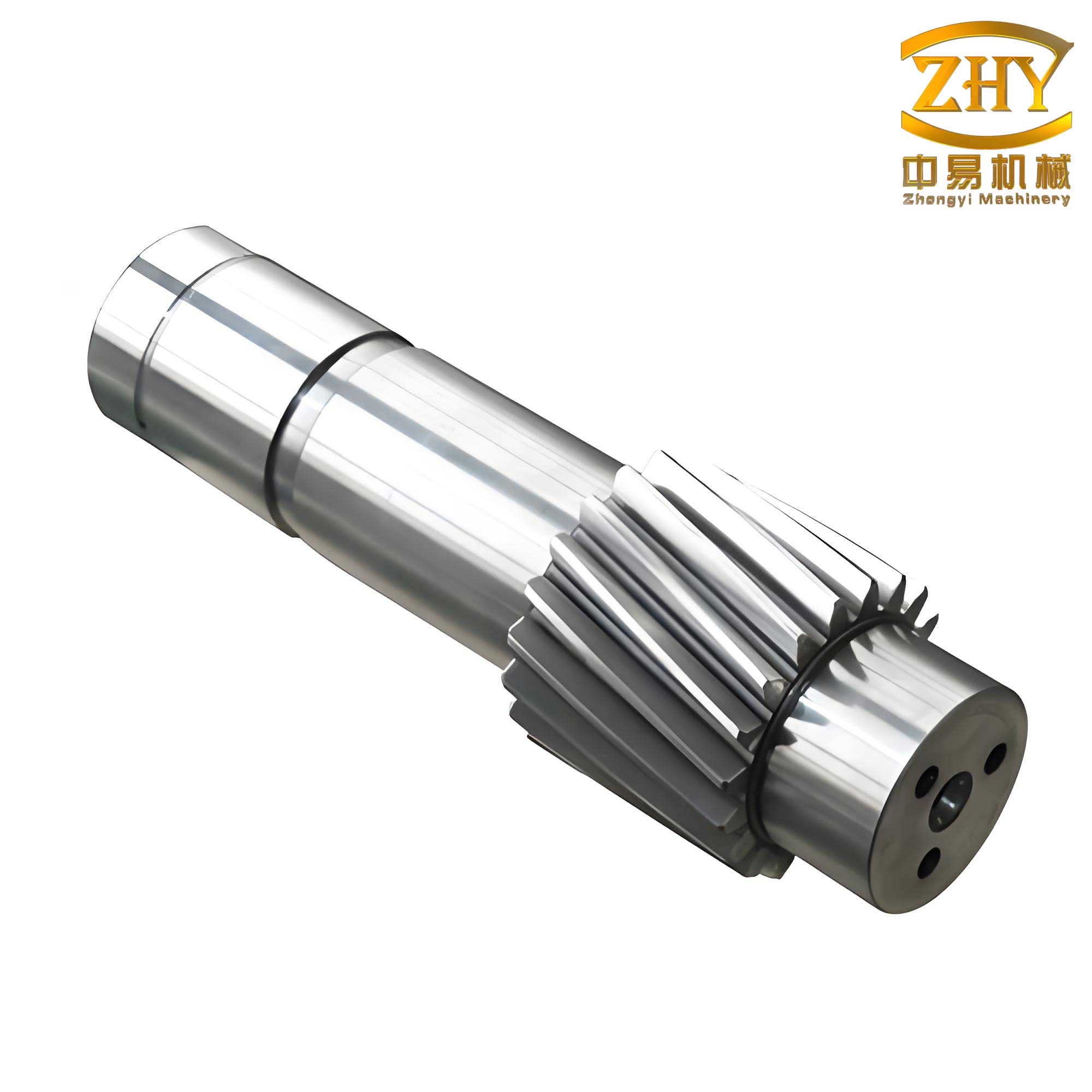
The gear shaft assembly includes helical gear pairs, rolling bearings, wet clutches, and shafts. For the sixth gear, the engaged pairs are modeled dynamically using a lumped-parameter approach with an intermediate massless gear to simulate mesh stiffness and error excitations. The gear mesh force is expressed as:
$$ T_1 – \frac{[k’_g e'(t) + k’_g (\theta_c – \theta_2) + c’_g (\dot{\theta}_c – \dot{\theta}_2)]}{i} = J_{g1} \ddot{\theta}_1 $$
$$ [k’_g e'(t) + k’_g (\theta_2 – \theta_c) + c’_g (\dot{\theta}_2 – \dot{\theta}_c)] – T_2 = J_{g2} \ddot{\theta}_2 $$
where \(T_1\) and \(T_2\) are input and output torques, \(\theta\) terms are angular displacements, \(k’_g\) and \(c’_g\) are equivalent torsional stiffness and damping, \(e'(t)\) is transmission error, and \(i\) is gear ratio. Bearings are characterized by time-varying stiffness and damping matrices derived from Hertzian contact theory. Key parameters for the bearings supporting the gear shafts are summarized below.
| Bearing ID | Pitch Diameter (mm) | Ball Diameter (mm) | Contact Angle (°) | Radial Stiffness (N/mm) | Damping (N·s/m) |
|---|---|---|---|---|---|
| 1, 3, 6 | 110 | 20 | 35 | ~1.2e6 | ~5e3 |
| 2 | 125 | 22.5 | 35 | ~1.4e6 | ~6e3 |
| 5, 8 | 140 | 25 | 35 | ~1.6e6 | ~7e3 |
| 4 | 117.5 | 21.25 | 35 | ~1.3e6 | ~5.5e3 |
| 7, 9 | 147.5 | 26.25 | 35 | ~1.8e6 | ~8e3 |
Wet clutches in engaged state transmit torque via frictional forces, modeled as \(M_{CC} = \mu_d R_{eq} z F_{non}\), where \(\mu_d\) is dynamic friction coefficient, \(R_{eq}\) effective radius, \(z\) number of friction plates, and \(F_{non}\) normal force. The gear shafts are further elasticized using modal reduction techniques, resulting in modal neutral files imported into multibody dynamics software. The complete coupled model incorporates housing flexibility, gear mesh dynamics, bearing nonlinearities, and shaft elasticity. Simulations are run under steady-state conditions at engine rated speed of 2000 rpm, corresponding to vehicle speed of 70 km/h in sixth gear.
Analysis of kinematic parameters shows that output speed of the gear shaft is unaffected by housing elasticity, as it depends solely on input conditions and gear ratios. The speed fluctuates around 4850 rpm due to torque variations. However, load characteristics reveal significant coupling effects. Gear mesh forces on the primary gear shaft exhibit minimal change, with errors below 3% in peak values. In contrast, bearing reaction forces are highly sensitive; for instance, the y-direction force on bearing 6 increases by over 40% when housing flexibility is considered. This is attributed to additional deformations at bearing housings altering the effective compliance. Dynamic responses of the gear shaft, such as displacement and acceleration at nodes near gear contacts, show amplified oscillations under coupled conditions, indicating strong interaction.
To validate the model, I conduct real vehicle road tests on cement pavement. Accelerometers are mounted at critical locations on the housing surface, including bearing seats and rib areas. Data acquisition systems record vibration signals, which are filtered to remove noise and irrelevant frequencies. Comparisons between simulated and experimental acceleration responses in time and frequency domains demonstrate good agreement. The root mean square (RMS) values for normal accelerations at selected points are compared below.
| Measurement Point | Simulated RMS (m/s²) | Experimental RMS (m/s²) | Error (%) |
|---|---|---|---|
| Point 2 | 29.1 | 35.3 | 17.6 |
| Point 3 | 39.3 | 51.5 | 23.7 |
| Point 4 | 39.9 | 51.1 | 21.9 |
| Point 5 | 124.3 | 83.8 | 32.6 |
| Point 6 | 34.6 | 48.3 | 28.4 |
| Point 7 | 95.1 | 132.2 | 28.1 |
| Point 8 | 64.7 | 90.5 | 28.5 |
Discrepancies arise from unmodeled factors like road vertical excitations, friction losses, and measurement noise. Nonetheless, the trends and dominant frequencies align, supporting the model’s credibility. The gear shaft dynamics are evidently coupled with housing vibrations, emphasizing the need for integrated analysis in transmission design.
In conclusion, this study successfully establishes a dynamics coupling model for vehicle transmission systems, highlighting the mutual influence between gear shafts and housing. The gear shaft behavior, particularly in terms of bearing forces and vibrational responses, is markedly affected by housing elasticity, whereas kinematic outputs and gear mesh forces remain relatively invariant. The proposed modeling methodology, combining finite element analysis, multibody dynamics, and experimental testing, offers a robust framework for predicting coupled performance. Future work could extend to transient conditions, such as gear shifts, and incorporate thermal effects for more comprehensive insights. This research underscores the importance of considering gear shaft-housing interactions in optimizing transmission durability and noise-vibration-harshness (NVH) characteristics.