
The pursuit of reliable and efficient power transmission in mechanical systems places significant demands on the health and integrity of their core components. Among these, helical gears are ubiquitous due to their superior characteristics, such as higher load capacity, smoother operation, and reduced noise compared to their spur gear counterparts. This smoothness stems from their gradual engagement process, where the contact between mating teeth initiates at one end of the tooth and progresses diagonally across the face width. This fundamental characteristic, while advantageous for performance, introduces considerable complexity when analyzing and diagnosing faults.
A critical and prevalent failure mode in gear systems is tooth surface spalling. This defect manifests as the flaking or pitting away of material from the tooth surface, typically initiated by subsurface fatigue cracks under cyclic contact stresses. The presence of a spall disrupts the normal contact pattern, acting as a source of internal excitation that generates unique dynamic responses within the gearbox. For spur gears, the analysis is relatively more straightforward as the contact occurs simultaneously across the entire face width. However, for helical gears, the moving contact line and the complex three-dimensional geometry of a spall defect make the extraction and interpretation of vibration signatures profoundly challenging. The fault-induced vibrations are modulated by the time-varying contact conditions as the spall moves through the mesh zone. Therefore, a deep understanding of the failure mechanism—rooted in accurately modeling the altered gear mesh stiffness and the subsequent dynamic response—is paramount for developing effective condition monitoring and diagnostic strategies for systems employing helical gears.
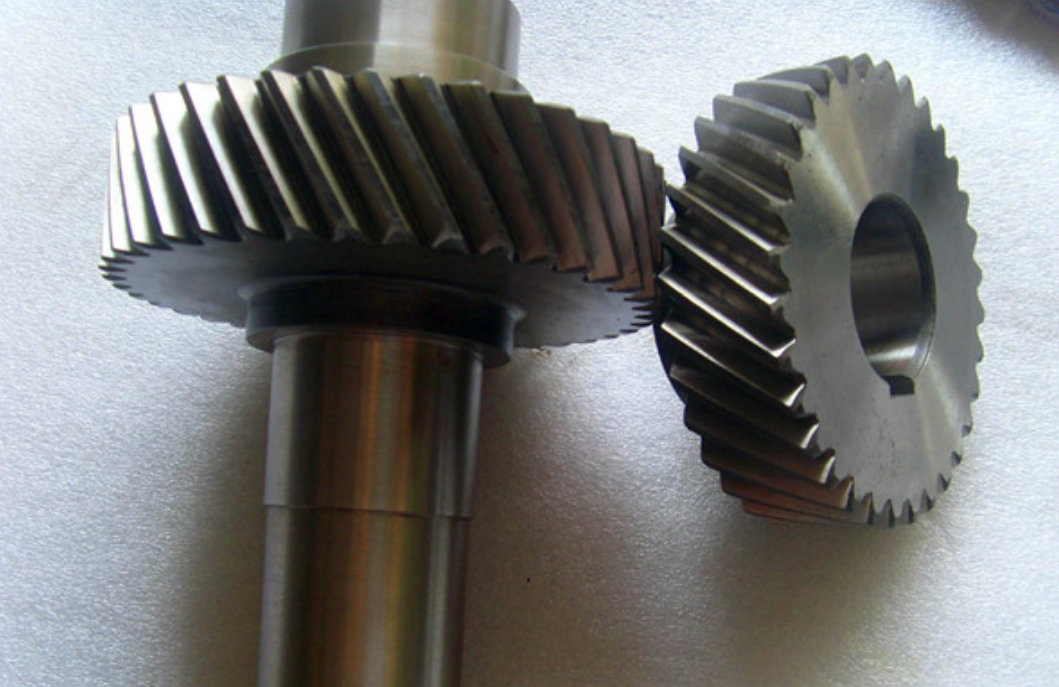
This article presents a comprehensive analytical framework for studying the dynamics of helical gears with spalling defects. The core of the methodology is a novel analytical model for calculating the time-varying mesh stiffness of a faulty helical gear pair. This model integrates the potential energy method with a slicing technique to account for the unique geometry and fault conditions. Furthermore, a six-degree-of-freedom (6-DOF) lumped-parameter dynamic model is developed to simulate the vibration response. The influence of key fault parameters, such as spall length and width, as well as operational conditions like rotational speed and load torque, on the system’s dynamic characteristics is investigated in detail.
Analytical Modeling of Mesh Stiffness for Faulty Helical Gears
The time-varying mesh stiffness is the primary internal excitation source in geared systems. For a healthy gear pair, it fluctuates periodically due to the changing number of teeth in contact and the variation in the contact position along the tooth profile. A spall defect introduces a localized loss of contact, effectively reducing the instantaneous contact length and thus the local Hertzian contact stiffness. Accurately capturing this effect is the first step in fault dynamics modeling.
Theoretical Foundation: Potential Energy Method for a Spur Gear Slice
The modeling approach for helical gears builds upon the well-established potential energy method for spur gears. A single spur gear tooth can be modeled as a non-uniform cantilever beam. The total elastic energy stored in the mating teeth during engagement comprises several components: Hertzian contact energy, bending energy, shear energy, axial compressive energy, and the energy from fillet foundation deflection. The corresponding stiffness components are derived from these energy terms.
For a single tooth pair of a spur gear, the mesh stiffness $K_{spur}(\tau)$ at a roll angle $\tau$ can be synthesized from these individual stiffness components:
$$
K_{spur}(\tau) = \frac{1}{\frac{1}{K_h} + \frac{1}{K_{b1}} + \frac{1}{K_{s1}} + \frac{1}{K_{a1}} + \frac{1}{K_{f1}} + \frac{1}{K_{b2}} + \frac{1}{K_{s2}} + \frac{1}{K_{a2}} + \frac{1}{K_{f2}}}
$$
Where the subscripts 1 and 2 denote the driving and driven gear, respectively. The symbols represent:
- $K_h$: Hertzian contact stiffness
- $K_b$: Bending stiffness
- $K_s$: Shear stiffness
- $K_a$: Axial compressive stiffness
- $K_f$: Fillet foundation stiffness
The detailed formulas for calculating each of these stiffness components based on gear geometry and material properties are available in the literature. The variable $\tau$ parameterizes the position of the contact point along the path of action.
Slicing Technique for Helical Gears
A helical gear can be conceptually discretized into a series of infinitesimally thin spur gear slices, each with a slight angular offset from its neighbor. This is the foundational idea of the slicing method. The total mesh stiffness of the helical gear pair at any instant is the sum of the stiffness contributions from all slices that are in contact. If we divide the face width into $n$ slices, the mesh stiffness for one pair of teeth is:
$$
K_t = \sum_{i=1}^{n} K_i
$$
where $K_i$ is the mesh stiffness of the $i$-th spur gear slice, calculated using the potential energy method. For a healthy helical gear, the total length of the contact lines on the plane of action, $l_0(\tau)$, varies with time. It can be described piecewise based on the gear’s transverse contact ratio $\varepsilon_{\alpha}$ and axial contact ratio $\varepsilon_{\beta}$:
$$
l_0(\tau) = \begin{cases}
l_{max} \cdot \tau / \varepsilon_{\beta} & \tau \le \varepsilon_{\beta} \\
l_{max} & \varepsilon_{\beta} \le \tau \le \varepsilon_{\alpha} \\
-l_{max} \cdot (\tau – \varepsilon) / \varepsilon_{\beta} & \varepsilon_{\alpha} \le \tau \le \varepsilon
\end{cases}
$$
Here, $\varepsilon = \varepsilon_{\alpha} + \varepsilon_{\beta}$ is the total contact ratio, $l_{max}$ is the maximum possible contact line length, and $\tau$ is a dimensionless parameter related to the pinion’s rotational angle.
Incorporating the Spalling Defect
The introduction of a spall defect on the tooth surface of a helical gear locally removes material, creating a cavity. As the gear rotates and the spall enters the mesh zone, it interrupts the contact lines. The primary mechanical effect is the reduction of the effective contact length available for load sharing.
Let $l_b(\tau)$ represent the instantaneous length of the spall cavity projected onto the plane of action, i.e., the portion of the contact line that is lost due to the defect. Therefore, the effective contact line length for a gear pair with a spall, $l_{gb}(\tau)$, becomes:
$$
l_{gb}(\tau) = l_0(\tau) – l_b(\tau)
$$
The Hertzian contact stiffness is directly proportional to this contact length. For a healthy slice, it is given by:
$$
K_h(\tau) = \frac{\pi E l_0(\tau)}{4(1-\nu^2)}
$$
For a slice intersecting the spall defect, the contact stiffness is reduced to:
$$
K_{hb}(\tau) = \frac{\pi E l_{gb}(\tau)}{4(1-\nu^2)}
$$
where $E$ is the Young’s modulus and $\nu$ is the Poisson’s ratio of the gear material.
A key simplifying assumption in this model is that the spall depth is relatively small compared to the tooth thickness. This allows us to neglect the defect’s influence on the stiffness components related to the tooth’s structural deformation (bending, shear, axial compression, and foundation deflection). These components are collectively represented by $K_b(\tau)$, which can be derived from the healthy gear’s total stiffness and its Hertzian component:
$$
K_b(\tau) = \frac{1}{\frac{1}{K_t(\tau)} – \frac{1}{K_h(\tau)}}
$$
Consequently, the mesh stiffness for a single tooth pair of a helical gear with a spalling defect, considering only the slices affected by the fault, is calculated as:
$$
K_s(\tau) = \frac{1}{\frac{1}{K_b(\tau)} + \frac{1}{K_{hb}(\tau)}}
$$
For slices not affected by the spall, the healthy stiffness $K_t(\tau)$ is used. The total mesh stiffness $K_m(t)$ for the entire gear pair is then obtained by summing the contributions from all simultaneously engaged tooth pairs, each calculated using the above principles, and is a periodic function of time.
Model Validation and Stiffness Analysis
To validate the proposed analytical model, its results were compared against those obtained from a detailed nonlinear finite element analysis (FEA). The geometric and material parameters of the helical gear pair used for validation are summarized in Table 1.
| Parameter | Pinion | Gear |
|---|---|---|
| Number of Teeth | 25 | 31 |
| Normal Module (mm) | 3 | |
| Transverse Pressure Angle (°) | 20 | |
| Helix Angle at Pitch Circle (°) | 22.5 | |
| Mass (kg) | 0.9 | 1.45 |
| Moment of Inertia (kg·m²) | $5.8 \times 10^{-4}$ | $1.4 \times 10^{-3}$ |
| Young’s Modulus (GPa) | 210 | |
| Poisson’s Ratio | 0.3 | |
The comparison between the mesh stiffness calculated by the analytical model and the FEA for a gear with a specified spall showed excellent agreement in both trend and magnitude, with minimal error. This confirms the accuracy and effectiveness of the proposed analytical method for efficiently computing the time-varying mesh stiffness of faulty helical gears.
Subsequent analysis using this model reveals the impact of spall geometry. As the spall length (dimension along the tooth profile) or width (dimension across the face width) increases, the periodic drop in the mesh stiffness curve becomes more pronounced and wider. The stiffness reduction is directly correlated to the amount of contact line length lost ($l_b(\tau)$) during the meshing cycle. A summary of the influence of spall dimensions on key stiffness metrics is presented in Table 2.
| Spall Dimension Increased | Effect on Single-Tooth-Pair Stiffness | Effect on Total Mesh Stiffness | Underlying Mechanism |
|---|---|---|---|
| Length (A) | Deeper and wider periodic drop near the pitch line. | Increased depth of periodic modulation; average stiffness decreases. | Longer spall causes loss of contact over a greater portion of the path of action. |
| Width (B) | Deeper periodic drop; drop duration may increase. | Deeper modulation; more significant reduction in minimum stiffness value. | Wider spall affects more slices simultaneously, reducing effective contact length more severely at a given $\tau$. |
Dynamic Modeling of the Helical Gear System
To investigate the vibration response induced by the time-varying mesh stiffness of a faulty helical gear, a lumped-parameter dynamic model is established. The model considers six degrees of freedom: the rotational and two translational motions (in the plane of action and perpendicular to it) for both the pinion and the gear. The system includes mass, damping, and stiffness elements representing the gears and their supporting bearings.
The equations of motion for the 6-DOF model are derived from Newton’s second law:
$$
\begin{aligned}
J_p \ddot{\theta}_p &= T_p – N R_{bp} \\
J_g \ddot{\theta}_g &= -T_g + N R_{bg} \\
m_p \ddot{x}_p &= N \tan(\beta_b) – k_{px} x_p – c_{px} \dot{x}_p \\
m_g \ddot{x}_g &= -N \tan(\beta_b) – k_{gx} x_g – c_{gx} \dot{x}_g \\
m_p \ddot{y}_p &= -N – k_{py} y_p – c_{py} \dot{y}_p \\
m_g \ddot{y}_g &= N – k_{gy} y_g – c_{gy} \dot{y}_g
\end{aligned}
$$
Where:
- $J_p, J_g$: Mass moments of inertia of pinion and gear.
- $m_p, m_g$: Masses of pinion and gear.
- $\theta_p, \theta_g$: Rotational displacements.
- $x_p, x_g, y_p, y_g$: Translational displacements ($x$ is axial direction component in the plane of action, $y$ is the direction normal to the plane of action, i.e., the line of action direction).
- $T_p, T_g$: Input and output torques.
- $R_{bp}, R_{bg}$: Base circle radii.
- $\beta_b$: Base circle helix angle.
- $k_{px}, k_{py}, k_{gx}, k_{gy}$: Bearing support stiffnesses in $x$ and $y$ directions.
- $c_{px}, c_{py}, c_{gx}, c_{gy}$: Bearing support damping coefficients in $x$ and $y$ directions.
The dynamic meshing force $N$ is the key coupling element and is expressed as:
$$
N = K_m(t) \cdot \delta + C_m \cdot \dot{\delta}
$$
Here, $K_m(t)$ is the time-varying mesh stiffness calculated in the previous section, $C_m$ is the mesh damping (often considered constant or proportional to $K_m$), and $\delta$ is the Dynamic Transmission Error (DTE). The DTE is a crucial parameter in gear dynamics, defined as the relative displacement of the mating teeth along the line of action, accounting for both torsional and translational motions:
$$
\delta = y_p – y_g + R_{bp} \theta_p + R_{bg} \theta_g
$$
The excitation from the spall defect enters the system through the periodic reduction in $K_m(t)$. Solving this set of differential equations (e.g., using numerical integration methods like the Runge-Kutta method) yields the time-domain response of the DTE and other state variables, which can be analyzed to extract fault features.
Dynamic Response Characteristics and Parametric Study
Using the parameters from Table 1 and the developed models, the dynamic response of the helical gear system under various spall conditions and operating parameters is simulated. The primary diagnostic signal analyzed is the Dynamic Transmission Error (DTE).
Effect of Spall Size
Simulations were conducted with a constant pinion speed of 200 RPM and a load torque of 50 N·m, while varying the spall length (A). The results clearly demonstrate the fault signature.
- Time-Domain Response: The DTE signal for a healthy gear shows primarily periodic content at the mesh frequency. With a spall defect, distinct impulse-like impacts appear in the time-domain waveform. The time interval between these consecutive impulses is exactly equal to the rotational period of the pinion (0.3 seconds in this case), confirming that the impact is generated once per revolution when the faulty tooth enters the mesh. As the spall length increases, the amplitude of these impulsive features grows significantly.
- Frequency-Domain Response: The Fast Fourier Transform (FFT) of the DTE provides further insight. The healthy gear spectrum is dominated by the mesh frequency ($f_m$ = 83.33 Hz) and its harmonics. For the faulty gear, sidebands appear around the mesh frequency and its harmonics. These sidebands are spaced at the pinion’s rotational frequency ($f_r$ = 3.33 Hz). More notably, the amplitude of the rotational frequency component $f_r$ and its lower-order harmonics (e.g., $2f_r$, $3f_r$) in the low-frequency range becomes distinctly visible and increases with the spall size. This is a classic signature of a localized fault.
| Spall Condition | Time-Domain Feature | Frequency-Domain Feature |
|---|---|---|
| Healthy (A=0 mm) | Smooth, periodic waveform at mesh frequency. | Strong peaks at $f_m$, $2f_m$, $3f_m$; negligible low-frequency content. |
| Small Spall (A=6 mm) | Small, periodic impulses at shaft rate. | Emergence of $f_r$ and sidebands $\pm f_r$ around $f_m$; low-level harmonics of $f_r$. |
| Large Spall (A=22 mm) | Large-amplitude, periodic impulses at shaft rate. | Significant increase in amplitude of $f_r$, $2f_r$, $3f_r$; prominent sidebands around mesh harmonics. |
Effect of Rotational Speed
Investigating the effect of speed with a fixed spall size (6mm x 2mm) reveals an interesting characteristic. As the pinion speed is increased from 200 RPM to 1500 RPM, the overall amplitude level of the DTE response does not show a consistent, dramatic shift. However, the character of the response changes. At higher speeds, dynamic effects become more pronounced, potentially exciting system resonances and altering the shape of the impulses. The fundamental diagnostic markers—the periodic impulses at the rotational period in the time domain and the rotational frequency components in the spectrum—remain, but their manifestation can be modulated by the system’s changing dynamic behavior across different speed ranges.
Effect of Load Torque
The load torque has a more direct and pronounced effect on the fault response than speed. Simulations with torque varying from 25 N·m to 100 N·m show a strong correlation. As the load increases:
- The mean level of the DTE signal increases linearly, reflecting the larger static deflection.
- The amplitude of the vibration oscillations around the mean, particularly the fault-induced impulses, increases significantly. The higher load forces the mating teeth to deflect more to “drop into” the spall cavity and then snap back, creating a stronger impact.
- In the frequency domain, the amplitudes of both the mesh frequency components and the fault-related rotational frequency components grow with increasing torque. This makes fault detection potentially easier under higher loads, provided the signal-to-noise ratio is favorable.
The relationship can be summarized by the following simplified expression for impulse amplitude $A_{imp}$:
$$
A_{imp} \propto \Delta K \cdot T
$$
where $\Delta K$ represents the stiffness loss due to the spall and $T$ is the load torque. This underscores the importance of considering operational load conditions when setting alarm thresholds in condition monitoring systems for helical gears.
| Operational Parameter | Effect on DTE Mean Level | Effect on Fault Impulse Amplitude | Effect on Frequency Spectrum |
|---|---|---|---|
| Increased Rotational Speed | Negligible change | Minor change; impulse shape/ duration may be affected by dynamics. | Frequency components shift; amplitudes may change non-monotonically due to resonances. |
| Increased Load Torque | Linear increase | Significant, near-linear increase. | Amplitudes of $f_m$, $f_r$, and associated sidebands increase proportionally. |
Conclusion
This article has presented an integrated analytical-computational framework for modeling and analyzing the dynamics of helical gears with tooth surface spalling defects. The core contributions are the development of an efficient analytical model for calculating the time-varying mesh stiffness of faulty helical gears and a corresponding 6-DOF dynamic model to simulate the vibration response.
The mesh stiffness model, combining the potential energy method and the slicing technique, successfully captures the essential effect of a spall: the time-varying loss of contact line length. It provides a fast and accurate alternative to computationally expensive FEA for parametric studies. The dynamic model effectively translates this stiffness excitation into observable vibration signatures, primarily analyzed through the Dynamic Transmission Error.
The simulation results lead to several critical conclusions for the condition monitoring of helical gears:
- Fault Signature: A spall defect generates periodic impulsive events in the time-domain DTE signal, synchronized with the rotational frequency of the faulty gear. In the frequency domain, it elevates the amplitude of the rotational frequency component and its harmonics, and creates sidebands around the mesh frequency and its harmonics.
- Fault Severity: The amplitude of these fault-related features (both time-domain impulses and frequency-domain components) increases monotonically with the size (length and width) of the spall defect. This relationship provides a potential pathway for quantifying fault progression.
- Operational Dependence: The system’s response is highly sensitive to load torque. Higher loads amplify the fault signatures, making them more detectable, but also increase the overall vibration level. Rotational speed has a more complex, non-monotonic influence due to dynamic effects, but the fundamental fault periodicity remains tied to the shaft speed.
The methodologies and findings presented here form a solid theoretical foundation for understanding the failure mechanism of spalling in helical gears. This knowledge is directly applicable to improving diagnostic algorithms, such as those based on spectral kurtosis, envelope analysis, or synchronous averaging, by informing analysts about what features to look for and how they are influenced by fault and operational parameters. Ultimately, this work aids in the development of more reliable and proactive condition-based maintenance strategies for critical machinery utilizing helical gear transmissions.