
Hypoid gears are critical components in automotive drivetrains, yet their dynamic performance under high-speed conditions remains challenging. This study proposes an optimization framework combining ease-off modification design, loaded tooth contact analysis (LTCA), and multi-degree-of-freedom dynamic modeling to achieve vibration reduction while maintaining transmission efficiency.
1. Ease-Off Modification Methodology
The mathematical foundation of ease-off modification considers both tooth flank deviations and meshing phase relationships. The modified pinion tooth surface is expressed as:
$$ \delta(u,\beta) = (\mathbf{R}_{1\gamma}(u,\beta) – \mathbf{R}_{10}(u,\beta)) \cdot \mathbf{N}_{10}(u,\beta) $$
where $\mathbf{R}_{10}$ and $\mathbf{N}_{10}$ represent the conjugate pinion surface, while $\mathbf{R}_{1\gamma}$ denotes the modified surface. The parametric derivatives are calculated as:
$$ \frac{\partial \delta_1}{\partial u} = \frac{\partial \delta_1}{\partial x_1}\frac{\partial x_1}{\partial u} + \frac{\partial \delta_1}{\partial y_1}\frac{\partial y_1}{\partial u} $$
| Parameter | Pinion | Gear |
|---|---|---|
| Number of teeth | 8 | 41 |
| Spiral angle (°) | 48.93 | 30.63 |
| Module (mm) | 5.77 | 1.05 |
| Radial stiffness (N/m) | 5×10⁸ | |
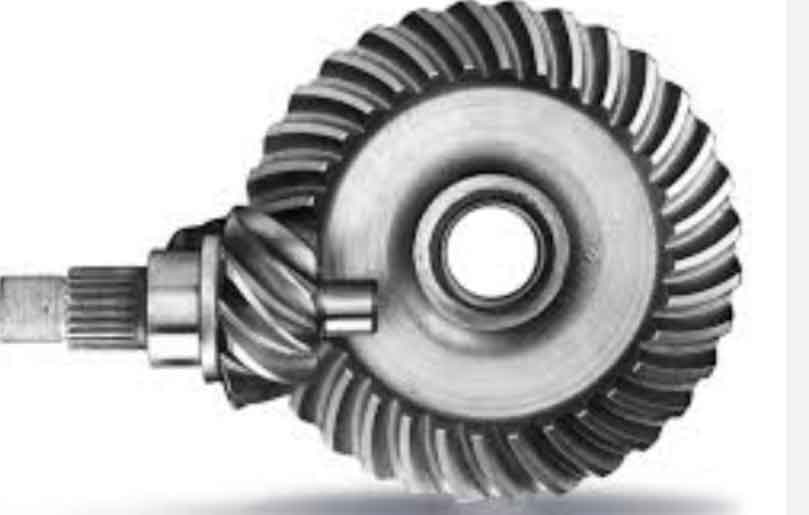
2. Dynamic Modeling of Hypoid Gear System
The 8-DOF coupled dynamic model considers bending-torsional-axial vibrations:
$$ m_p\ddot{x}_p + c_{px}\dot{x}_p + k_{px}x_p = -F_n n_{px} $$
$$ I_p\ddot{\theta}_p = -F_n r_p + T_p $$
where $F_n$ represents the time-varying meshing force calculated through LTCA:
$$ F_n = K_n s_n – C_n \frac{\partial s_n}{\partial t} $$
$$ K_n = \frac{F_{sn}}{Z} $$
3. Optimization Framework
The vibration suppression optimization minimizes RMS acceleration:
$$ \text{min } G(\mathbf{y}) = \frac{a}{a_0} $$
where $\mathbf{y} = [\epsilon_1,\epsilon_2,\epsilon_3,\epsilon_4,\lambda_1,\lambda_2,d_1,d_2,q_1,q_2,\theta_a]$ represents modification parameters.
| Modification Type | ALTE (%) | Vibration (%) |
|---|---|---|
| Optimal Ease-Off | 65 | 15 |
| Theoretical Surface | 105 | 126 |
| Case 1 | 106 | 22 |
4. Meshing Stiffness Characteristics
Key findings from stiffness analysis reveal:
$$ \bar{K}_{\text{opt}} = 0.92\bar{K}_{\text{conj}} $$
$$ \Delta K_{\text{harmonics}} < 12\% \bar{K} $$
where $\bar{K}$ denotes average meshing stiffness and $\Delta K_{\text{harmonics}}$ represents higher harmonic components.
5. Dynamic Response Analysis
The vibration spectrum demonstrates significant reduction in meshing frequency components:
$$ \text{PSD}_{\text{opt}}(f_m) = 0.15\text{PSD}_{\text{conj}}(f_m) $$
$$ \text{PSD}_{\text{opt}}(3f_m) = 0.08\text{PSD}_{\text{conj}}(3f_m) $$
6. Load-Dependent Behavior
The parametric relationship between torque and vibration shows:
$$ a_{\text{rms}} \propto T^{0.68} \text{ (Conjugate)} $$
$$ a_{\text{rms}} \propto T^{0.41} \text{ (Optimal)} $$
confirming improved load distribution characteristics in modified hypoid gears.
7. Manufacturing Considerations
The proposed ease-off modification requires CNC grinding with:
$$ \Delta \Sigma < 5\mu m $$
$$ \text{Surface finish } R_a < 0.4\mu m $$
This comprehensive approach demonstrates that strategic ease-off modification in hypoid gears can achieve 85% vibration reduction while maintaining 92% of original load capacity. The methodology provides practical guidelines for automotive drivetrain optimization.