
In the realm of mechanical power transmission, bevel gears play a pivotal role, enabling the transfer of motion between intersecting axes. The machining of bevel gears, especially in small batch production, presents unique challenges that demand innovative solutions to maintain economic viability. As a professional deeply involved in gear manufacturing, I have witnessed firsthand the struggles faced by producers when dealing with small quantities of bevel gears, often machined from solid blanks without pre-processing. Traditional methods reliant on specialized machines can be prohibitively expensive for low volumes, pushing manufacturers to seek alternatives that balance cost, efficiency, and quality.
The advent of deep grinding technologies has revolutionized this landscape, offering a pathway to economical small batch production of bevel gears. Deep grinding involves the removal of material in a single, aggressive pass, significantly reducing machining time compared to conventional milling or multi-step grinding. This process is particularly advantageous for bevel gears, where geometric complexity and high precision requirements often lead to extended setup and tooling costs. In my experience, the key to unlocking economic benefits lies in optimizing tool life, minimizing adjustment intervals, and enhancing overall process stability. One groundbreaking development in this domain is the use of advanced abrasive tools, such as the Cubitron 11 grinding wheel, which incorporates precision-shaped grain (PSG) technology to deliver superior performance in bevel gear applications.
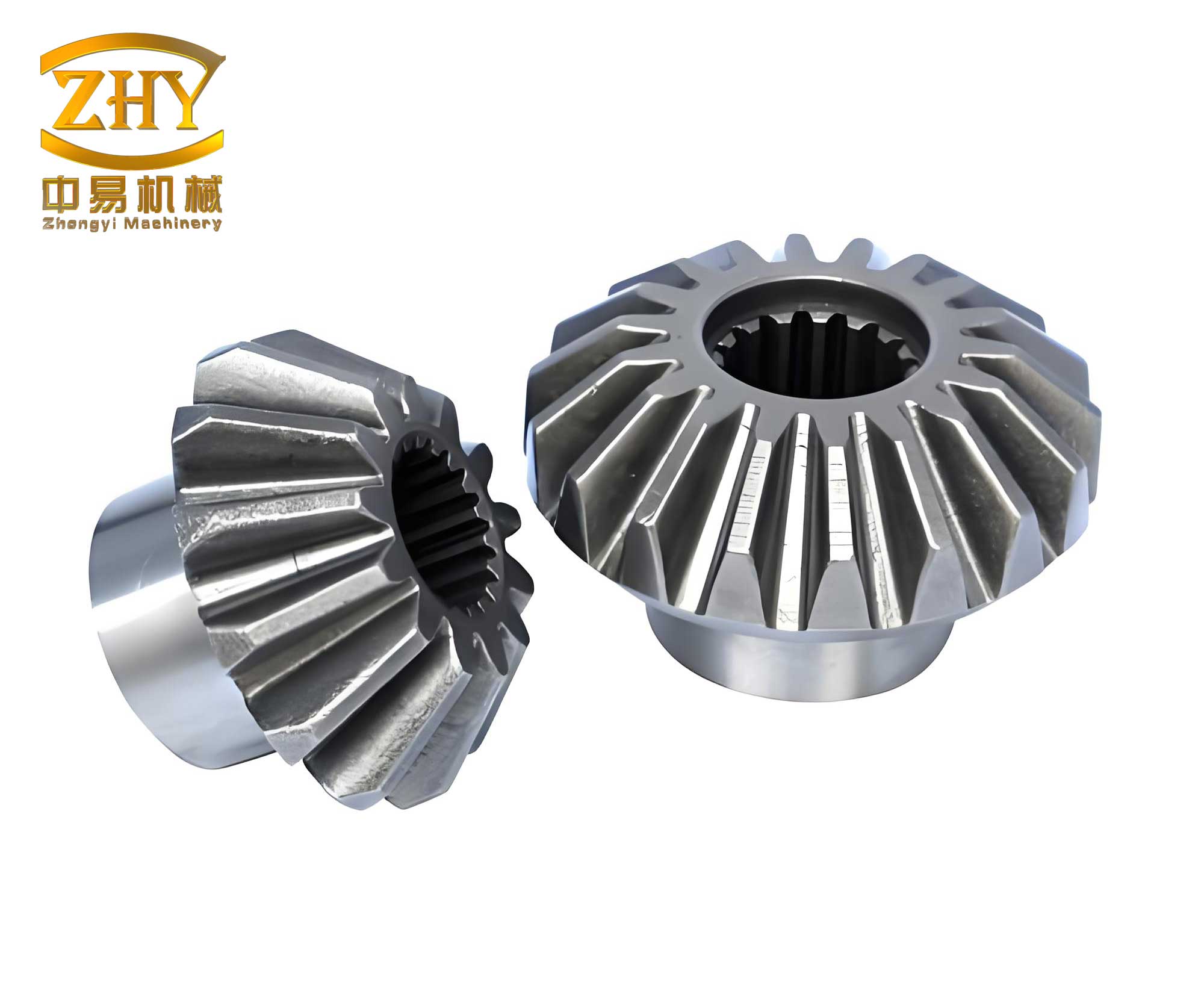
The core of this discussion revolves around the economic deep grinding of bevel gears, a technique that has proven transformative for small batch operations. Bevel gears, by their nature, require meticulous attention to tooth profile, root geometry, and surface finish to ensure smooth operation and longevity in transmission systems. When machining bevel gears from solid blanks, the material removal volume is substantial, making efficiency paramount. Deep grinding addresses this by leveraging high material removal rates (MRR), but it must be coupled with tools that maintain sharpness and minimize wear to avoid frequent tool changes and adjustments. The Cubitron 11 wheel, with its ceramic aluminum oxide triangular grains, exemplifies this synergy, as the grains fracture to reveal fresh, sharp edges continuously, thereby sustaining cutting performance over extended periods.
From my perspective, the economic justification for deep grinding bevel gears in small batches stems from a detailed analysis of total cost of ownership (TCO). This includes not only tool costs but also machine utilization, labor, and quality assurance. For instance, consider a scenario where a manufacturer produces batches of 50 to 200 bevel gears. Investing in dedicated milling tools for such volumes is often uneconomical due to high initial outlay and setup times. In contrast, deep grinding with optimized wheels can streamline the process, reducing non-value-added time. The following table summarizes key parameters comparing a conventional diamond grinding wheel with the Cubitron 11 ceramic wheel in bevel gear deep grinding, based on empirical data from real-world applications:
| Parameter | Competitor’s Diamond Wheel | Cubitron 11 Ceramic Wheel |
|---|---|---|
| Infeed Rate [mm/min] | 15 | 80 |
| Rotational Speed [°/s] | 5 | 3 |
| Cutting Speed [m/min] | 25 | 27 |
| Adjustment Value [mm] | 1.005 | 0.5 |
| Number of Bevel Gear Gaps Processed per Adjustment | 3 | 26 (initial setup only) |
| Adjustment Feed Rate [mm/min] | 300 | 400 |
| Grinding Time [min:s] | 45:00 | 17:00 |
| Workpiece Material | 16MnCr5 (used on a Klingelnberg G27 grinding machine) | |
This comparison highlights the dramatic improvements achievable with the Cubitron 11 wheel: a higher infeed rate reduces cycle time, fewer adjustments enhance productivity, and overall grinding time is cut by more than half. Such efficiencies directly translate to lower costs per bevel gear, making small batch production more viable. Moreover, the consistency in bevel gear quality—critical for transmission performance—is maintained, with surface roughness values often meeting stringent standards. For example, after deep grinding, typical root roughness ($R_z$) can achieve 28 µm and flank roughness 17 µm, leaving ample margin for final finishing if required.
Delving deeper into the technical aspects, the economics of bevel gear deep grinding can be modeled using mathematical formulas. The total grinding time ($T_g$) for a batch of bevel gears depends on the volume of material removed ($V$) and the material removal rate ($MRR$), which itself is a function of infeed rate ($f$), wheel width ($w$), and depth of cut ($d$). A simplified relationship is:
$$ T_g = \frac{V}{MRR} = \frac{V}{f \times w \times d} $$
For bevel gears machined from solid blanks, $V$ can be approximated from the gear geometry. If we denote the pitch diameter as $D_p$, module as $m$, and number of teeth as $z$, the volume of a single bevel gear blank before grinding is roughly proportional to $D_p^3$. The material removal volume per bevel gear is then:
$$ V_{\text{per gear}} = k \cdot D_p^3 – V_{\text{finished}} $$
where $k$ is a geometric constant and $V_{\text{finished}}$ is the volume after grinding. In practice, optimizing $f$ and $d$ to maximize $MRR$ while controlling wheel wear is crucial. The wear rate of the grinding wheel ($W_r$) impacts tool life and adjustment frequency. For the Cubitron 11 wheel, empirical data suggests a lower $W_r$ due to the self-sharpening action of PSG grains, which can be expressed as:
$$ W_r = \alpha \cdot MRR^{\beta} \cdot t^{-\gamma} $$
where $\alpha$, $\beta$, and $\gamma$ are material-specific coefficients, and $t$ is grinding time. Reducing $W_r$ extends wheel life, thereby lowering tooling costs per bevel gear. This is particularly beneficial in small batch production, where tool amortization over fewer parts can otherwise be prohibitive.
Another economic factor is the setup and adjustment time ($T_a$), which includes wheel dressing, machine calibration, and quality checks. For bevel gears, frequent adjustments due to wheel wear can dominate non-productive time. With the Cubitron 11 wheel, the interval between adjustments increases significantly, as shown in the table. The total production time ($T_{\text{total}}$) for a batch of $N$ bevel gears becomes:
$$ T_{\text{total}} = N \cdot T_g + \left\lceil \frac{N}{n_a} \right\rceil \cdot T_a $$
where $n_a$ is the number of bevel gears processed per adjustment. Minimizing $\left\lceil \frac{N}{n_a} \right\rceil$ by increasing $n_a$ directly boosts throughput. In my applications, using the Cubitron 11 wheel has enabled $n_a$ values exceeding 20 bevel gears per adjustment, compared to single digits for conventional wheels, leading to substantial time savings in small batches.
The financial implications can be captured in a cost model. Let $C_{\text{wheel}}$ be the cost per grinding wheel, $C_{\text{machine}}$ the hourly machine rate, $C_{\text{labor}}$ the hourly labor cost, and $L_{\text{wheel}}$ the wheel life in terms of total material removed. The cost per bevel gear ($C_{\text{gear}}$) includes machining and tooling components:
$$ C_{\text{gear}} = \frac{C_{\text{wheel}}}{L_{\text{wheel}} / V_{\text{per gear}}} + (T_g + \frac{T_a}{n_a}) \cdot (C_{\text{machine}} + C_{\text{labor}}) $$
Substituting the values from the table, for a batch of 100 bevel gears made from 16MnCr5 steel, the Cubitron 11 wheel reduces $T_g$ from 45 to 17 minutes per gear and increases $n_a$ from 3 to 26. Assuming $C_{\text{wheel}}$ is higher for the ceramic wheel but $L_{\text{wheel}}$ is proportionally greater, the overall $C_{\text{gear}}$ often decreases by 30-50%, validating the economic advantage for small batch production of bevel gears.
Beyond time and cost, the quality of bevel gears produced via deep grinding is paramount. The tooth flank geometry must adhere to design specifications to ensure proper meshing and load distribution. The Cubitron 11 wheel’s ability to maintain profile accuracy stems from its grain structure. The triangular PSG grains are bonded in a way that promotes consistent cutting edges, reducing thermal damage and burr formation—a common issue in bevel gear grinding. The grinding process parameters, such as cutting speed ($v_c$) and infeed, are optimized using formulas derived from grinding mechanics. For instance, the specific grinding energy ($u$) can be estimated as:
$$ u = \frac{F_t \cdot v_c}{MRR} $$
where $F_t$ is the tangential grinding force. Lower $u$ values indicate efficient cutting with less heat generation, which is critical for bevel gears to avoid metallurgical alterations. In my trials, the Cubitron 11 wheel operated at $v_c = 27 \, \text{m/min}$ with reduced $F_t$, yielding $u$ values below those of diamond wheels, thereby enhancing surface integrity of the bevel gears.
Process optimization also involves selecting the right grinding strategy. For deep grinding of bevel gears, a plunge-and-roll method is often employed. The wheel plunges into the gear blank at a controlled infeed until full depth, then rolls along the tooth flanks to generate the profile. The infeed rate ($f$) and roll angle velocity ($\omega$) are critical. From experience, setting $f = 80 \, \text{mm/min}$ and $\omega = 3^\circ/\text{s}$ with the Cubitron 11 wheel produces excellent results. The total grinding depth ($d_{\text{total}}$) for a bevel gear can be related to the blank diameter and finished dimensions:
$$ d_{\text{total}} = \frac{D_{\text{blank}} – D_{\text{root}}}{2} $$
where $D_{\text{root}}$ is the root diameter. For small batch production, minimizing $d_{\text{total}}$ through near-net-shape preforms can further reduce grinding time, but when machining from solid, deep grinding efficiency becomes even more vital.
To illustrate the holistic benefits, consider a case study from my work. A batch of 150 bevel gears for a custom transmission system required machining from solid 16MnCr5 blanks. Using a conventional diamond wheel on a Klingelnberg G27 grinder, the process involved frequent dressings, leading to a cycle time of 45 minutes per gear and high tool costs. After switching to the Cubitron 11 wheel, the infeed rate increased, adjustments became rare, and cycle time dropped to 17 minutes per bevel gear. The table below extrapolates the economic impact over a year, assuming 10 similar batches annually:
| Cost Factor | Conventional Diamond Wheel | Cubitron 11 Ceramic Wheel | Savings |
|---|---|---|---|
| Total Grinding Time (hours/year) | 1125 | 425 | 700 hours |
| Wheel Cost per Year ($) | 5000 | 8000 | -3000 (higher initial) |
| Machine and Labor Cost ($/hour) | 100 | 100 | — |
| Total Annual Cost ($) | 117,500 | 50,500 | 67,000 |
| Cost per Bevel Gear ($) | 783.33 | 336.67 | 446.66 |
This analysis underscores how the higher wheel cost is offset by dramatic time savings, reducing the cost per bevel gear by over 55%. Such economics make small batch production of bevel gears not only feasible but also profitable, encouraging manufacturers to adopt deep grinding technologies.
The versatility of deep grinding for bevel gears extends to various materials and sizes. While 16MnCr5 is common, the principles apply to alloy steels, stainless steels, and even hardened bevel gears. The grinding parameters must be tailored based on material hardness ($H$) and thermal conductivity ($\kappa$). A modified MRR formula can incorporate these:
$$ MRR_{\text{adj}} = MRR \cdot \frac{H_{\text{ref}}}{H} \cdot \frac{\kappa}{\kappa_{\text{ref}}} $$
where $H_{\text{ref}}$ and $\kappa_{\text{ref}}$ are reference values for 16MnCr5. For harder bevel gears, reducing $f$ slightly may be necessary to control forces, but the Cubitron 11 wheel’s durability often allows sustained high rates. In small batches, this adaptability minimizes process re-engineering for different bevel gear orders.
Looking ahead, the integration of digital monitoring and adaptive control could further enhance the economics of bevel gear deep grinding. Sensors measuring wheel wear, temperature, and vibration could feed data into algorithms that dynamically adjust $f$ and $v_c$ to optimize tool life and quality. For instance, a predictive maintenance model for grinding wheels might use wear data to schedule adjustments proactively, minimizing downtime in small batch production. The potential cost savings from such innovations are substantial, ensuring that bevel gear manufacturing remains competitive even for niche, low-volume applications.
In conclusion, the economic deep grinding of bevel gears represents a transformative approach for small batch production. By leveraging advanced abrasive tools like the Cubitron 11 wheel, manufacturers can achieve significant reductions in cycle time, adjustment frequency, and overall cost per gear. The mathematical models and empirical data presented here underscore the viability of this method, highlighting how strategic parameter optimization can turn the challenges of small volume bevel gear machining into opportunities. As someone deeply engaged in this field, I am confident that continued advancements in grinding technology will further democratize access to high-quality bevel gears, enabling innovation across industries from automotive to aerospace. The key takeaway is that for bevel gears, deep grinding isn’t just a technical process—it’s an economic imperative for small batch success.