
The pursuit of quieter and more reliable power transmission systems is a perpetual endeavor in mechanical engineering. Among the various noise and vibration sources in gearboxes, the inherent excitations arising from the meshing process of helical gear pairs are paramount. Manufacturing errors, assembly misalignments, and load-induced deflections disrupt the ideal conjugate motion, leading to parametric excitations and impacts that propagate through shafts and bearings, ultimately radiating as objectionable noise. To mitigate these dynamic issues, intentional tooth surface modifications, or gear profiling, have become an indispensable design and manufacturing technique. This article delves into the specific influence of a particular modification strategy—diagonal modification—on both the quasi-static load distribution and the dynamic response of helical gear systems. I will present a comprehensive analysis, from the fundamental geometric definition to the resulting system-level vibrations, employing detailed mathematical models and computational analyses.
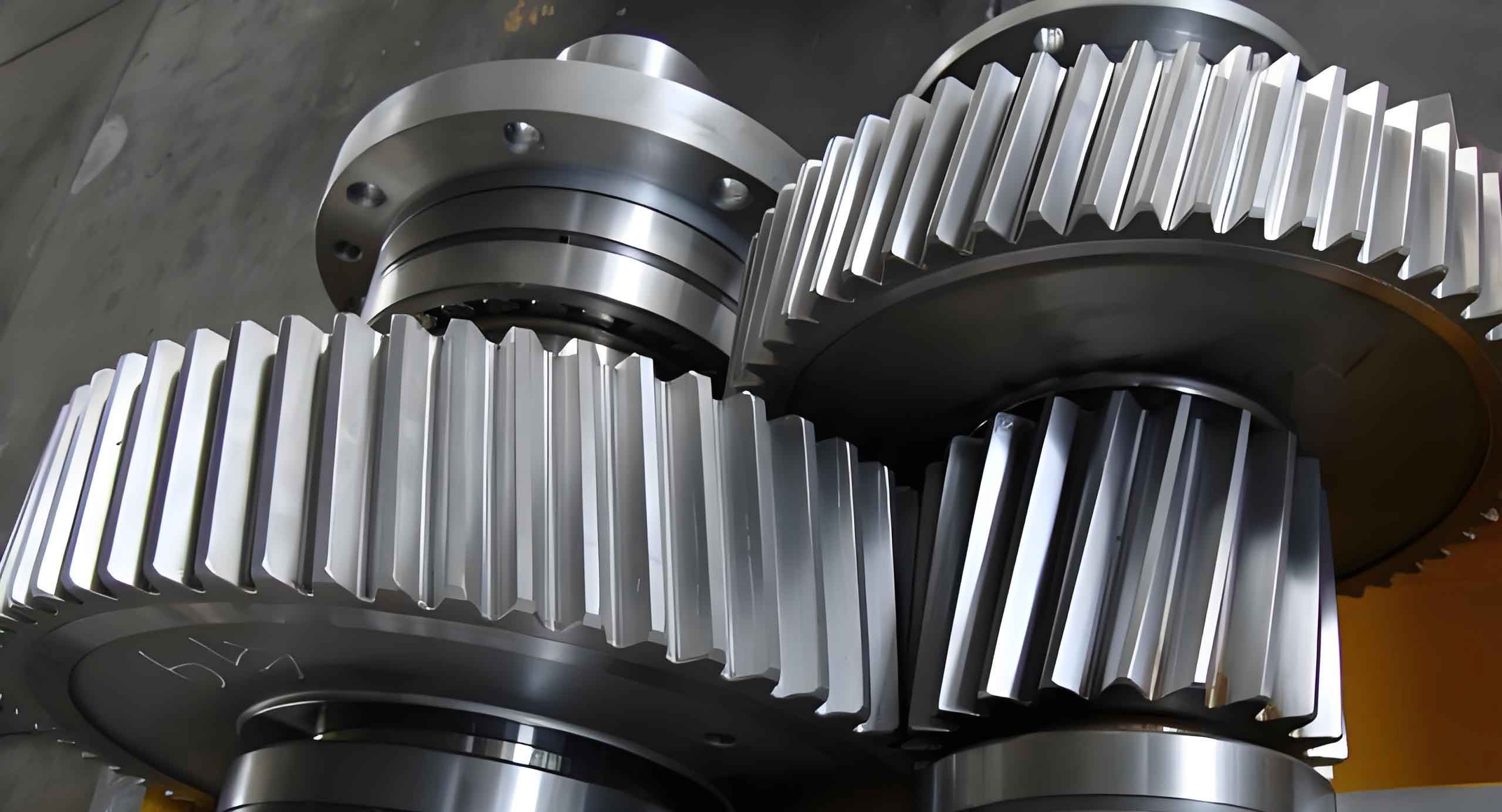
The unique characteristic of a helical gear lies in its angled teeth, which provides smoother engagement and higher load capacity compared to spur gears. However, this also means the line of contact is not parallel to the gear axis. Traditional profile (lead) modifications, effective for spur gears, can significantly reduce the total length of contact lines in a helical gear pair, thereby lowering the contact ratio and potentially weakening tooth strength. Diagonal modification offers an alternative by selectively removing material only from the entry and exit regions of the tooth flank, specifically along the direction of the contact line. This targeted approach aims to compensate for mesh deflections at the points most susceptible to edge contact and impact, while largely preserving the central, well-aligned contact region and thus maintaining a high effective contact ratio. The core objective is to design a modification that minimizes dynamic excitation without substantially compromising the static load-carrying capacity of the helical gear.
The geometry of diagonal modification for a helical gear pair can be effectively described within the plane of action. The modification is typically applied to the tip of the driving gear (mesh exit region) and the tip of the driven gear (mesh entry region). The modified zones appear as triangular regions on the plane of action. It is convenient to define these zones using a rotated coordinate system \( (x_2, y_2) \) aligned with the contact lines. The diagonal modification surface, representing the amount of material removed, is commonly defined by a parabolic function to ensure a smooth transition. For a point \( P \) with coordinate \( x_P \) in this rotated system, the modification amount \( E(x, y) \) is given by:
$$
E(x, y) = \begin{cases}
E_1 \left( \frac{x_P + L_{OM}}{L_{AM}} \right)^2, & x_P < -L_{OM} \\[6pt]
0, & -L_{OM} \leq x_P \leq L_{ON} \\[6pt]
E_2 \left( \frac{x_P – L_{ON}}{L_{DN}} \right)^2, & x_P > L_{ON}
\end{cases}
$$
Here, \( E_1 \) and \( E_2 \) are the modification depths at the entry and exit regions, respectively. \( L_{AM} \) and \( L_{DN} \) are the lengths of the modification zones measured perpendicular to the contact line direction (i.e., along the path of contact). \( L_{OM} \) and \( L_{ON} \) define the start points of the modification zones. The three fundamental parameters governing the diagonal modification are thus the modification curve (parabola), the modification depth \( E \), and the modification length \( L \).
To accurately predict the behavior of a diagonally modified helical gear pair under load, a quasi-static loaded tooth contact analysis (LTCA) model is essential. This model treats the meshing process as the contact of two elastic bodies. The continuous contact lines are discretized into a series of potential contact points. The total compliance at each point is considered as the sum of the global structural bending/shear deflection and the local Hertzian contact deformation. The intentional modification is treated as an initial separation or gap between the tooth surfaces at these discrete points. The system of equations governing the contact can be expressed in matrix form as:
$$
\begin{aligned}
-[\lambda]_{\text{Global}} \{F\} – \{u\}_{\text{Local}} + x_s + \{d\} &= \{\varepsilon\} \\
\sum_{i=1}^{n} F_i = \{I\}^T\{F\} &= P \\
\text{If } F_i > 0 & \text{ then } d_i = 0 \\
\text{If } F_i = 0 & \text{ then } d_i \geq 0
\end{aligned}
$$
where \( [\lambda]_{\text{Global}} \) is the global structural flexibility matrix, \( \{F\} \) is the vector of contact loads, \( \{u\}_{\text{Local}} \) is the vector of local contact deformations, \( \{d\} \) is the vector of remaining separations, \( \{\varepsilon\} \) is the vector of initial separations (modification), \( x_s \) is the static transmission error (STE), and \( P \) is the total transmitted load. Solving this nonlinear system yields the detailed load distribution \( F_i \) across the tooth face and the corresponding static transmission error \( x_s \) for one mesh cycle. From these results, the key quasi-static excitation parameters for the helical gear pair are derived. The mesh stiffness \( k_m \) is calculated as the ratio of total load to the net deflection at each angular position:
$$
k_m = \sum_{i=1}^{n} \frac{F_i}{x_s – \varepsilon_i}
$$
Furthermore, the composite mesh error \( e_m \), which combines the effect of the modification geometry under load, is obtained as a weighted average:
$$
e_m = \frac{\sum_{i=1}^{n} k_i \varepsilon_i}{k_m}, \quad \text{where } k_i = \frac{F_i}{x_s – \varepsilon_i}
$$
This composite error \( e_m \) is a critical input for subsequent dynamic analysis. The influence of diagonal modification parameters \( E \) and \( L \) on these quasi-static properties is profound and nonlinear. A parametric study reveals distinct trends. For a helical gear pair with a total contact ratio of 2.83, operating under a nominal load, the following observations are made regarding the quasi-static behavior:
| Modification Parameter | Effect on Load Distribution | Effect on Mesh Stiffness \(k_m\) | Effect on STE Fluctuation \(\Delta x_s\) |
|---|---|---|---|
| Small \(E\) / Optimal \(L\) | Reduced load at entry/exit; uniform central load. | Minimal change; mean stiffness preserved. | Significant reduction (up to 80%). |
| Large \(E\) / Excessive \(L\) | Loss of contact at entry/exit; shortened contact lines. | Mean stiffness decreases; fluctuation increases. | Increases dramatically; may exceed unmodified case. |
The table summarizes that an optimal combination of depth and length exists which dramatically reduces the fluctuation of the static transmission error—the primary source of kinematic excitation—with only a minimal reduction in the mean mesh stiffness. This is a key advantage of diagonal modification for helical gears: it effectively manages excitation without severely compromising tooth strength. Excessive modification, however, truncates the contact lines too aggressively, destabilizing the load sharing between tooth pairs and degrading performance.
To evaluate the dynamic consequences, a system-level model is necessary. A generalized finite element model of the helical gear-rotor-bearing system is developed. Shaft segments are modeled using Timoshenko beam elements to account for bending, shear, axial, and torsional deformations. The helical gear pair is modeled as a mesh element connecting two nodes on the driving and driven shafts, incorporating the time-varying mesh stiffness \( k_m(t) \) and composite error \( e_m(t) \). The bearings are represented as linear spring-damper elements connecting the shaft nodes to ground. Assembling these elements yields the system equations of motion:
$$
\mathbf{M} \ddot{\mathbf{x}}(t) + \mathbf{C} [\dot{\mathbf{x}}(t) – \dot{\mathbf{e}}(t)] + \mathbf{K}(t) [\mathbf{x}(t) – \mathbf{e}(t)] = \mathbf{P}_0
$$
Here, \( \mathbf{M} \), \( \mathbf{C} \), and \( \mathbf{K}(t) \) are the global mass, damping, and stiffness matrices, respectively. \( \mathbf{x}(t) \) is the vector of generalized coordinates, \( \mathbf{e}(t) \) is the vector of excitation errors (largely \( e_m(t) \) at the mesh node), and \( \mathbf{P}_0 \) is the static load vector. The time-varying nature of \( \mathbf{K}(t) \), due to \( k_m(t) \), makes this a parametrically excited system. Direct numerical integration is computationally expensive for large models. A highly effective simplification is achieved by separating the dynamic excitation force. The static equilibrium equation is \( \mathbf{K}(t)[\mathbf{x}_s(t) – \mathbf{e}(t)] = \mathbf{P}_0 \). Decomposing the stiffness matrix into a constant mean part \( \mathbf{K}_0 \) and a fluctuating part \( \Delta \mathbf{K}(t) \), and the static displacement into a mean \( \mathbf{x}_{s0} \) and fluctuation \( \Delta \mathbf{x}_s(t) \), the dynamic equation can be reformulated. After algebraic manipulation and neglecting damping terms in the excitation for simplicity in non-resonant regions, we obtain:
$$
\mathbf{M} \ddot{\mathbf{x}}(t) + \mathbf{C} \dot{\mathbf{x}}(t) + \mathbf{K}_0 \mathbf{x}(t) = \mathbf{K}_0 \mathbf{x}_{s0} + \mathbf{K}_0 \Delta \mathbf{x}_s(t)
$$
The term \( \mathbf{K}_0 \Delta \mathbf{x}_s(t) \) on the right-hand side is crucial. It represents the transmission error excitation force fluctuation. This reformulation transforms the original system with parametric excitation (time-varying coefficients on the left) into a system with constant coefficients subjected to an external forcing function on the right. This forcing function is the product of the mean system stiffness and the fluctuation of the static transmission error. This reveals a fundamental insight: for a modified helical gear pair, the primary driver of vibration is not necessarily the fluctuation of the mesh stiffness itself, but rather the fluctuation of the loaded transmission error. The equation can now be solved efficiently in the frequency domain using methods like the Fourier series expansion.
Key dynamic response metrics include the Dynamic Transmission Error (DTE), which is the relative displacement between the gears along the line of action, and the dynamic bearing forces. For a bearing with stiffness coefficients \( k_{xx}, k_{yy}, k_{zz} \) and damping \( c_{xx}, c_{yy}, c_{zz} \), the dynamic force components are:
$$
\begin{aligned}
F_{bx} &= k_{xx} x_b + c_{xx} \dot{x}_b \\
F_{by} &= k_{yy} y_b + c_{yy} \dot{y}_b \\
F_{bz} &= k_{zz} z_b + c_{zz} \dot{z}_b
\end{aligned}
$$
where \( x_b, y_b, z_b \) are the dynamic displacements of the shaft node at the bearing. The minimization of DTE and bearing force fluctuations is the goal of modification.
Given the insight from the transformed dynamic equation, the optimal diagonal modification parameters are those that minimize the fluctuation \( \Delta \mathbf{x}_s(t) \) of the static transmission error. Since \( \mathbf{K}_0 \) is nearly constant for a given helical gear system, minimizing the STE fluctuation directly minimizes the dominant excitation force \( \mathbf{K}_0 \Delta \mathbf{x}_s(t) \). Therefore, a graphical optimization can be performed using the results from the LTCA model. By plotting the magnitude of STE fluctuation (or its RMS value over a mesh cycle) as a function of modification depth \( E \) and length \( L \), a clear “valley” or region of minimal excitation is identified. For the example helical gear system studied, this graphical method pinpointed an optimal zone corresponding to a modification depth of approximately 11 μm and a modification length of 10.5 mm.
| Performance Metric | Unmodified Helical Gear | Optimally Diagonally Modified Helical Gear | Improvement |
|---|---|---|---|
| STE Fluctuation Amplitude | High | Very Low | >80% Reduction |
| Mesh Stiffness Mean Value | \(k_{m0}\) | \(\approx 0.96 \cdot k_{m0}\) | <4% Reduction |
| Dynamic TE (RMS, 1500 RPM) | Baseline | Significantly Lower | Major Reduction at 1x & 2x Mesh Freq. |
| Bearing Force Fluctuation | Baseline | Significantly Lower | Major Reduction at 1x & 2x Mesh Freq. |
The dynamic results confirm the theory. Under an operating condition of 1500 RPM input speed and a substantial load, the helical gear system with optimal diagonal modification shows a dramatically reduced dynamic transmission error. The time-domain waveform is much smoother, and its frequency spectrum shows severe attenuation at the fundamental mesh frequency and its second harmonic. Consequently, the fluctuating component of the bearing forces is also significantly reduced across a wide speed range. While resonance peaks still occur when the mesh frequency coincides with system natural frequencies, the overall vibration levels are substantially lower for the modified helical gear system compared to the unmodified one at all operating speeds. Importantly, because the diagonal modification causes only a slight reduction in mean mesh stiffness, it does not induce a significant shift in system resonance frequencies, unlike some extensive lead modifications which can soften the gear mesh excessively.
In conclusion, the analysis of diagonal modification on helical gear systems reveals a highly effective strategy for vibration control. The quasi-static loaded tooth contact analysis demonstrates that a carefully chosen combination of modification depth and length can drastically reduce the fluctuation of the static transmission error—the key kinematic excitation—while causing only a minimal reduction in the mean mesh stiffness and thus the load capacity of the helical gear. The system dynamic analysis, facilitated by a reformulated equation of motion, confirms that the minimized transmission error fluctuation translates directly into lower dynamic transmission error and lower bearing dynamic loads. The primary mechanism is the mitigation of the transmission error excitation force, rather than an attempt to smooth the mesh stiffness curve itself. For helical gear designers, diagonal modification presents a compelling option, offering significant acoustic and dynamic benefits without the pronounced loss of contact ratio associated with other modification types, making it a superior choice for high-performance, low-noise helical gear applications.