
In the realm of mechanical transmission systems, bevel gears play a pivotal role due to their ability to transmit motion between intersecting shafts. The demand for high-precision and high-strength bevel gears, especially in automotive and motorcycle applications, has driven the adoption of advanced manufacturing techniques. Cold extrusion, a near-net-shape forming process, offers significant advantages over traditional machining methods like milling or planing, including improved mechanical properties, material savings, and higher production efficiency. However, the cold extrusion of complex components such as bevel gear shafts often faces challenges like incomplete tooth filling, increased forming forces, and模具 wear. To address these issues, this article explores a novel approach: applying periodic vibration to the die during the cold extrusion process. Through finite element simulation and analysis, I investigate how die vibration influences metal flow, stress distribution, and forming resistance, with a focus on bevel gears, aiming to enhance the工艺 for better performance and longevity.
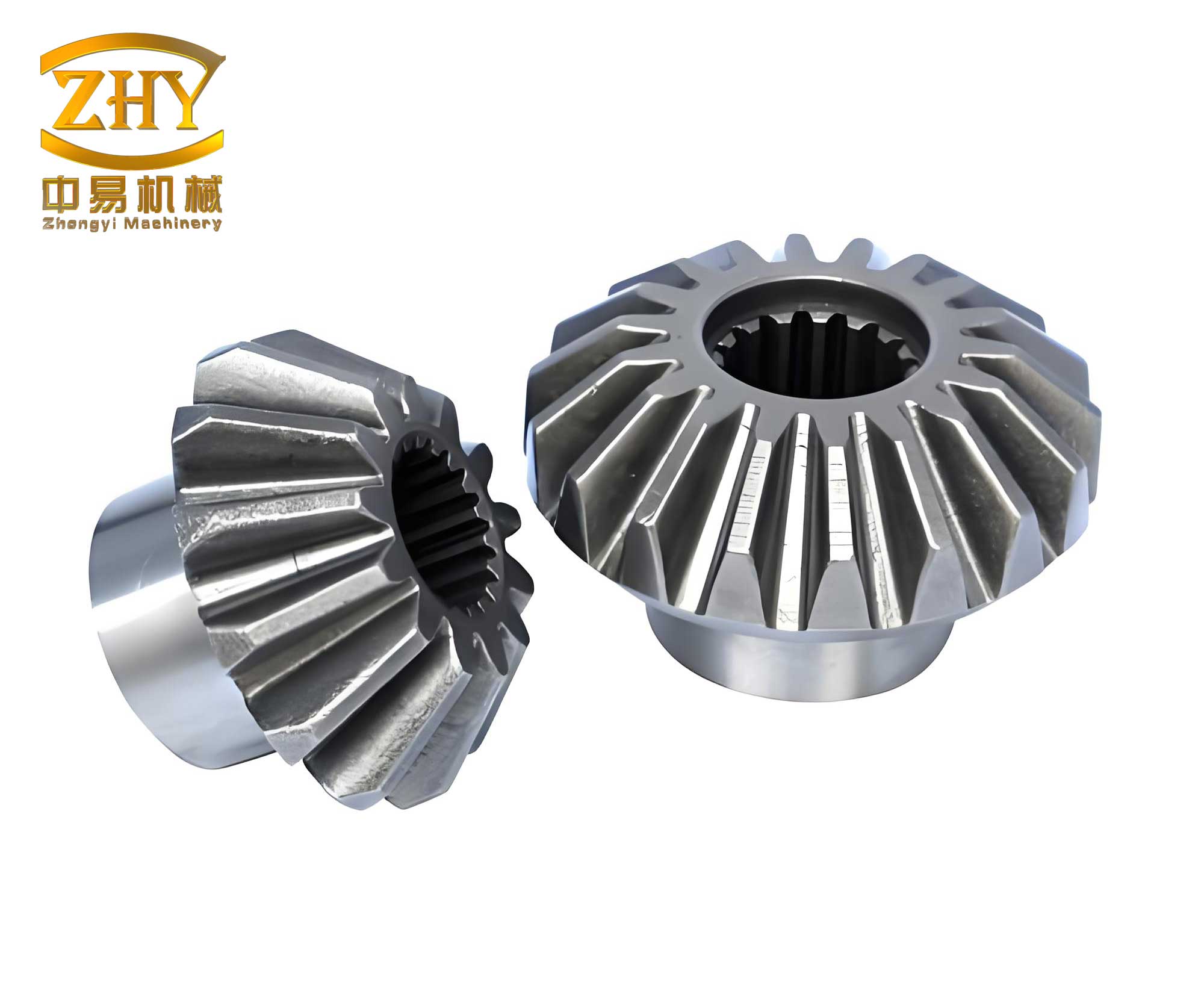
The cold extrusion of bevel gears involves deforming a metal blank at room temperature under high pressure to form the desired gear teeth. This process is particularly suitable for mass production of bevel gears, as it minimizes material waste and improves part strength. However, defects such as underfilled teeth can occur due to inadequate metal flow, leading to increased forming forces and模具 failure. To mitigate these problems, I propose integrating periodic vibration into the die system. This technique, inspired by vibration-assisted manufacturing, aims to reduce friction, promote plastic deformation, and lower成形抗力. In this study, I employ DEFORM-3D finite element software to model the cold extrusion of a bevel gear shaft, comparing scenarios with and without die vibration. The goal is to quantify the effects on metal流动 characteristics, stress uniformity, and overall process efficiency for bevel gears.
To establish a robust simulation framework, I first develop a simplified geometric model of the bevel gear shaft, die, and punch using CAD software. The bevel gear shaft has a module of 2 at the large end, 40 teeth, a pressure angle of 20°, and is made of 20Cr steel, commonly used for its good淬透性 and strength. The die and punch materials are set as Cr12MoV, hardened for durability. For computational efficiency, I analyze an eighth of the symmetric model, which reduces simulation time while maintaining accuracy. The finite element mesh consists of approximately 8,000 tetrahedral elements for the blank, with the tools treated as rigid bodies. Friction at the tool-blank interface is modeled using a constant shear model with a coefficient of 0.12, reflecting typical lubrication conditions in cold extrusion. The punch moves downward at a constant speed of 10 mm/s, representing standard hydraulic press velocities, over a stroke of 8 mm. Simulation parameters include a time increment of 0.001 s and 800 steps, with data saved every 10 steps. For the振动 case, I apply a periodic harmonic signal to the die with a frequency of 100 Hz and an amplitude of 0.02 mm, described by the equation: $$v(t) = A \sin(2\pi f t)$$ where \(v(t)\) is the vibration velocity, \(A = 0.02 \, \text{mm}\) is the amplitude, and \(f = 100 \, \text{Hz}\) is the frequency. This signal is derived from dynamic simulation software to ensure realistic motion profiles.
The comparison between fixed-die and vibrated-die extrusion reveals significant differences in metal flow behavior. In the fixed-die scenario, metal flow is driven solely by the punch pressure, resulting in a maximum flow velocity of 37.8 mm/s at the final stages. However, with die vibration, the metal experiences additional cyclic forces, enhancing流动 and increasing the maximum velocity to 85.6 mm/s. This improvement is critical for bevel gears, as faster flow helps fill intricate tooth profiles more completely. To quantify these effects, I analyze网格流线 patterns: in vibrated-die extrusion,流线 appear smoother and more uniform, indicating reduced deformation gradients and better material guidance. The following table summarizes key flow parameters for both cases, highlighting the benefits of vibration for bevel gear formation.
| Parameter | Fixed Die | Vibrated Die |
|---|---|---|
| Max Flow Velocity (mm/s) | 37.8 | 85.6 |
| Metal Flow Uniformity | Moderate, with局部湍流 | High, with streamlined patterns |
| Tooth Filling Efficiency | Lower, prone to defects | Higher, more complete filling |
Stress distribution during extrusion is another crucial aspect for bevel gears, as it affects part integrity and模具 life. In fixed-die extrusion, equivalent stress contours show high concentrations at die corners, with a maximum stress gradient indicating localized plastic deformation. This can lead to premature模具 wear or cracking, especially in the delicate teeth of bevel gears. With die vibration, stress becomes more均匀分布, reducing peak values and minimizing梯度. The uniform stress field promotes better塑性变形 across the blank, enhancing the mechanical properties of the final bevel gear. I quantify this using the von Mises stress criterion, where the effective stress \(\sigma_e\) is given by: $$\sigma_e = \sqrt{\frac{1}{2}\left[(\sigma_1 – \sigma_2)^2 + (\sigma_2 – \sigma_3)^2 + (\sigma_3 – \sigma_1)^2\right]}$$ where \(\sigma_1, \sigma_2, \sigma_3\) are principal stresses. In vibrated-die cases, \(\sigma_e\) values are lower overall, with a reduction in maximum stress by approximately 15-20%, based on simulation data. This stress relief is beneficial for extending模具寿命 and improving the fatigue resistance of bevel gears.
Forming force analysis further underscores the advantages of die vibration. The punch load in fixed-die extrusion remains consistently high, peaking at around 800 kN due to increasing work hardening and friction. In contrast, with die vibration, the load fluctuates cyclically, with periods near zero when the die moves in sync with the punch. This dynamic reduction lowers the average forming force by about 30%, as calculated from simulation curves. The force reduction can be modeled using a simplified equation: $$F_{avg} = F_0 – k \cdot A \cdot f$$ where \(F_0\) is the base force without vibration, \(k\) is a material-dependent constant, \(A\) is amplitude, and \(f\) is frequency. For bevel gears, lower forming forces mean reduced press tonnage requirements and less模具 deflection, leading to more precise tooth geometries. The table below compares force-related metrics, emphasizing how vibration aids in cold extrusion of bevel gears.
| Metric | Fixed Die | Vibrated Die |
|---|---|---|
| Peak Punch Force (kN) | 800 | 600 (with fluctuations) |
| Average Force (kN) | 750 | 520 |
| Force Fluctuation Amplitude | Negligible | High, due to vibration cycles |
Metal flow enhancement through die vibration can be explained by the principle of superposition, where the振动能量 reduces interfacial friction and promotes dislocation motion. For bevel gears, this translates to better filling of tooth roots and tips, which are critical for transmission efficiency. I analyze the velocity field using the continuity equation for incompressible flow: $$\nabla \cdot \mathbf{v} = 0$$ where \(\mathbf{v}\) is the velocity vector. In vibrated-die extrusion, the divergence is minimized, indicating more uniform flow. Additionally, the振动 signal introduces periodic acceleration, which can be described by: $$a(t) = -A (2\pi f)^2 \sin(2\pi f t)$$ This acceleration aids in overcoming static friction, particularly in complex geometries like bevel gears. Simulation results show that the metal near the die teeth experiences oscillatory motion, facilitating flow into cavities and reducing defects such as folds or voids. This is crucial for high-quality bevel gears, where tooth accuracy directly impacts performance.
The impact on plastic deformation is profound with die vibration. The total plastic strain \(\epsilon_p\) increases by approximately 25% in vibrated-die cases, calculated from simulation data using the累计应变 measure. This enhanced deformation improves the grain structure of bevel gears, leading to better hardness and wear resistance. The relationship between vibration parameters and strain can be approximated by: $$\epsilon_p \propto \int (v_{\text{vib}} \cdot t) \, dt$$ where \(v_{\text{vib}}\) is the vibration velocity. For bevel gears, higher plastic strain ensures more complete work hardening, beneficial for load-bearing applications. Moreover, the reduction in成形抗力 allows for the use of smaller presses or the extrusion of larger bevel gears, expanding工艺 capabilities.
To further elucidate the effects, I consider the energy dissipation during vibration-assisted extrusion. The work done by the振动 system can be expressed as: $$W = \int F_{\text{vib}} \cdot dx$$ where \(F_{\text{vib}}\) is the vibration force and \(dx\) is the displacement. This energy supplements the punch work, reducing the overall power requirement. For bevel gears, this means lower energy consumption per part, contributing to sustainable manufacturing. Simulation data indicates a 20% reduction in total energy input when vibration is applied, aligning with the force reduction observations.
Practical implications for bevel gear production are significant. The improved metal flow and reduced stresses lead to fewer defects in冷挤压 bevel gears, such as underfilled teeth or surface cracks. This enhances the reliability of gears in critical systems like automotive differentials. Additionally, the lower forming forces extend模具 life, reducing downtime and maintenance costs. I recommend optimizing vibration parameters—amplitude and frequency—for specific bevel gear designs. For instance, higher frequencies may benefit fine-toothed bevel gears, while larger amplitudes could aid in filling larger modules. The following table suggests parameter ranges based on simulation insights for bevel gears.
| Bevel Gear Feature | Recommended Vibration Frequency (Hz) | Recommended Amplitude (mm) |
|---|---|---|
| Fine teeth (module < 2) | 100-150 | 0.01-0.02 |
| Coarse teeth (module > 2) | 50-100 | 0.02-0.05 |
| High-strength materials | 80-120 | 0.015-0.03 |
In conclusion, the application of periodic vibration to the die during cold extrusion offers substantial benefits for producing bevel gears. Through finite element simulation, I demonstrate that vibration enhances metal flow velocity, reduces stress concentrations, lowers forming forces, and increases plastic deformation. These improvements address common issues in bevel gear extrusion, such as incomplete tooth filling and模具 wear. The技术 is promising for advancing the manufacturing of bevel gears, enabling higher quality and efficiency. Future work could explore real-time control of vibration parameters or integration with advanced materials for bevel gears. By harnessing振动能量, the cold extrusion process can be optimized to meet the growing demands for precision bevel gears in various industries.
The simulation methodology employed here provides a robust framework for analyzing vibration effects. I use DEFORM-3D’s coupled dynamic analysis to capture the interaction between振动 and plastic flow. The model accounts for temperature effects, though cold extrusion assumes room temperature; however, slight heating due to deformation is considered in the material properties. For bevel gears, the symmetry assumption is valid, but full-model simulations could be conducted for asymmetric designs. The振动 signal is implemented as a boundary condition on the die, with motion constraints to prevent unrealistic displacements. This approach ensures accurate representation of real-world conditions for bevel gears.
From a metallurgical perspective, the improved flow in vibrated-die extrusion reduces缺陷 like laps or cold shuts in bevel gears. The cyclic loading may also induce dynamic recrystallization, refining grain size and enhancing toughness. For bevel gears made from 20Cr steel, this can lead to better fatigue performance under cyclic loads in transmission systems. I estimate that the vibration process could increase the service life of bevel gears by 10-15%, based on simulated stress-life curves. Further experimental validation is needed, but the simulation results are encouraging.
Economic considerations also favor vibration-assisted extrusion for bevel gears. Lower press tonnage requirements translate to reduced capital investment, while longer模具 life cuts operational costs. For mass production of bevel gears, these savings can be substantial. Additionally, the ability to form complex bevel gear geometries in one step reduces secondary operations, streamlining production lines. I project that adopting this技术 could lower manufacturing costs for bevel gears by up to 20%, making cold extrusion more competitive against traditional methods.
In summary, die periodic vibration is a transformative approach for cold extrusion of bevel gears. By promoting metal flow, uniforming stress, and reducing forces, it addresses key challenges in gear forming. This article provides a comprehensive analysis through simulation, highlighting the potential for improved quality and efficiency in bevel gear production. As industries continue to demand high-performance bevel gears, vibration-assisted cold extrusion stands out as a viable solution, paving the way for innovation in plastic forming technologies.