
In modern mechanical systems, straight bevel gears play a critical role in transmitting power between intersecting shafts, particularly in applications requiring high efficiency and durability. The performance of these gears, especially their wear resistance, is heavily influenced by manufacturing parameters, with forging temperature being a key factor. Forging temperature, comprising the initial and final forging temperatures, directly affects the microstructural evolution and mechanical properties of the gear material. In this study, we investigate how variations in these temperatures impact the wear resistance of 40Cr steel straight bevel gears under both room temperature and elevated temperature conditions. The objective is to provide a systematic analysis that can guide industrial practices, moving beyond empirical selections to data-driven optimization. We employ a combination of experimental testing, microstructural examination, and theoretical modeling to elucidate the relationships between forging parameters and wear behavior, with a focus on practical applications for straight bevel gears.
The material used in this study is 40Cr steel, a medium-carbon low-alloy steel commonly employed in gear manufacturing due to its good hardenability and strength. The chemical composition of the 40Cr steel is as follows (in weight percent): 0.37–0.44% C, 0.17–0.37% Si, 0.50–0.80% Mn, 0.80–1.10% Cr, Ni ≤ 0.30%, S ≤ 0.035%, P ≤ 0.035%, and Cu ≤ 0.30%. The straight bevel gears were designed with key parameters: 20 teeth, a module of 4 mm, a pressure angle of 20°, an addendum coefficient of 1, and a dedendum coefficient of 0.3. These specifications ensure that the gears are representative of typical industrial applications, allowing for relevant conclusions on wear performance.
To process the gears, we utilized a forging approach with controlled initial and final forging temperatures. The forging ratio was maintained at 7 for all samples to ensure consistency in deformation. Post-forging, all straight bevel gear specimens underwent identical heat treatment: oil quenching at 850°C for 3 minutes, followed by tempering at 520°C for 4 hours. This treatment aims to achieve a balanced microstructure of tempered martensite, which enhances toughness and wear resistance. The specific forging parameters for each sample are detailed in Table 1, which outlines the variations in initial and final forging temperatures used to prepare the straight bevel gears.
| Sample ID | Initial Forging Temperature (°C) | Final Forging Temperature (°C) | Forging Ratio |
|---|---|---|---|
| Sample 1 | 1130 | 860 | 7 |
| Sample 2 | 1150 | 860 | 7 |
| Sample 3 | 1170 | 860 | 7 |
| Sample 4 | 1190 | 860 | 7 |
| Sample 5 | 1210 | 860 | 7 |
| Sample 6 | 1170 | 820 | 7 |
| Sample 7 | 1170 | 840 | 7 |
| Sample 8 | 1170 | 880 | 7 |
Wear resistance testing was conducted using an MG1000 high-temperature friction and wear tester. The test conditions included a grinding wheel speed of 250 rpm, a total rotation of 2500 revolutions, a relative sliding speed of 100 mm/min, and a load of 100 N. Tests were performed at two temperatures: 25°C (room temperature) and 300°C, to simulate different operating environments. Wear volume was measured as an indicator of wear resistance, with lower volumes signifying better performance. After testing, the wear surfaces of the straight bevel gear samples were examined using scanning electron microscopy (SEM) to analyze morphological features such as peeling,脱落, and磨痕. This comprehensive approach allows for a detailed understanding of how forging temperatures influence the wear mechanisms in straight bevel gears.
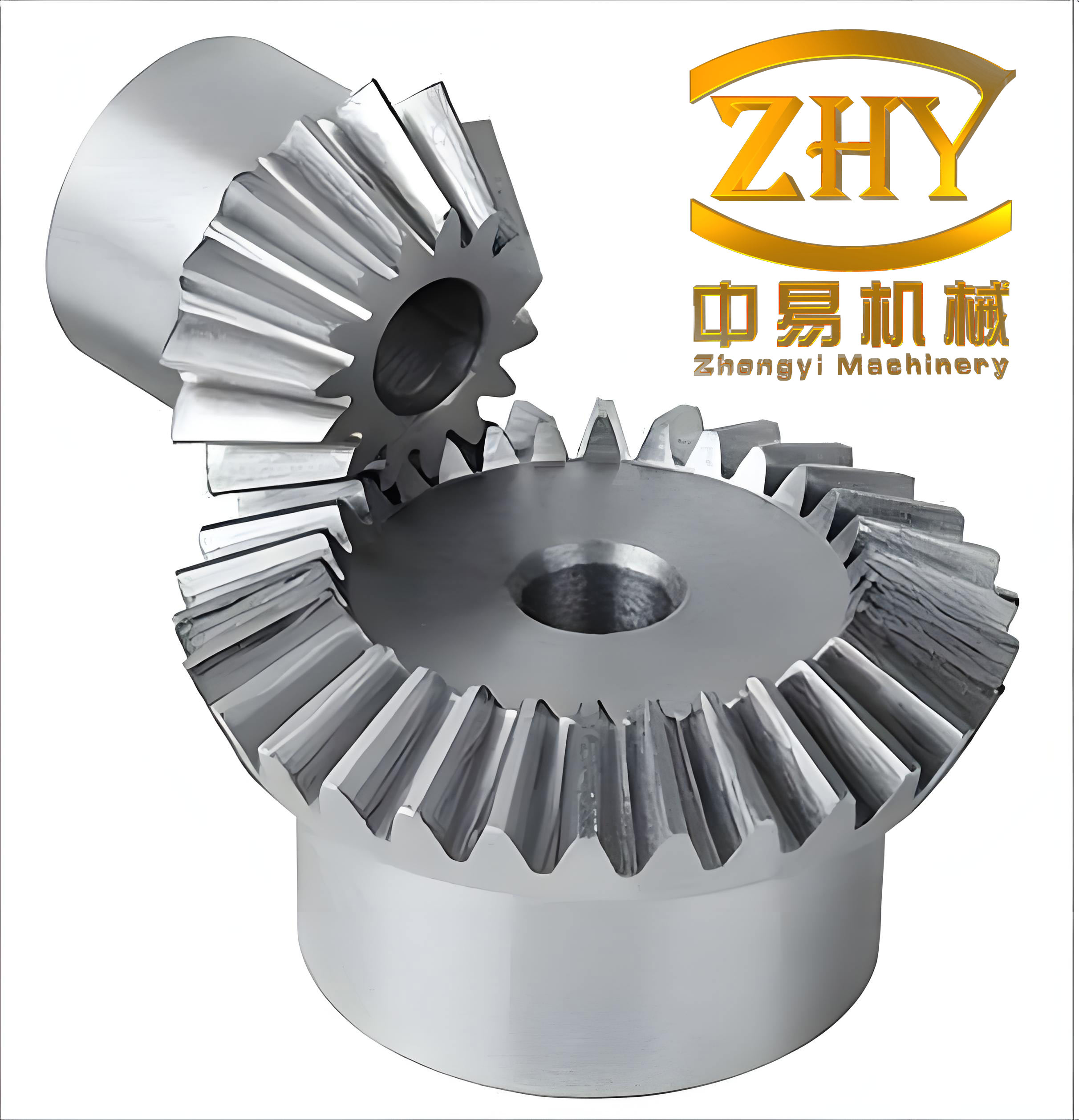
The influence of initial forging temperature on the wear resistance of straight bevel gears was evaluated across a range from 1130°C to 1210°C, with the final forging temperature held constant at 860°C. The results, as shown in Table 2, indicate that wear volume varies significantly with initial forging temperature under both 25°C and 300°C test conditions. At 25°C, the wear volume decreases from approximately 28 × 10^{-3} mm³ at 1130°C to a minimum of 21 × 10^{-3} mm³ at 1170°C, remains relatively stable up to 1190°C, and then increases sharply to around 35 × 10^{-3} mm³ at 1210°C. Similarly, at 300°C, the wear volume follows a comparable trend: starting at 55 × 10^{-3} mm³ at 1130°C, dropping to 48 × 10^{-3} mm³ at 1170°C, and rising abruptly to 62 × 10^{-3} mm³ at 1210°C. This pattern suggests that an optimal initial forging temperature exists for maximizing the wear resistance of straight bevel gears, with 1170°C yielding the best performance.
| Initial Forging Temperature (°C) | Wear Volume at 25°C (×10^{-3} mm³) | Wear Volume at 300°C (×10^{-3} mm³) |
|---|---|---|
| 1130 | 28 | 55 |
| 1150 | 24 | 51 |
| 1170 | 21 | 48 |
| 1190 | 22 | 49 |
| 1210 | 35 | 62 |
To further analyze these results, we can model the relationship between initial forging temperature (T_i) and wear volume (W_v) using a polynomial equation. For instance, at 25°C, the data can be fitted to a quadratic function: $$ W_v = a T_i^2 + b T_i + c $$ where a, b, and c are constants derived from regression analysis. Based on the values in Table 2, we estimate: $$ W_v = 0.0015 T_i^2 – 3.5 T_i + 2050 $$ for 25°C, and $$ W_v = 0.002 T_i^2 – 4.6 T_i + 2650 $$ for 300°C. These equations highlight the non-linear dependence, with wear volume decreasing initially due to improved microstructure homogeneity, then increasing due to grain coarsening at higher temperatures. This behavior is critical for optimizing the forging process of straight bevel gears, as it underscores the need to avoid both insufficient and excessive initial forging temperatures.
SEM observations of the wear surfaces provide visual evidence supporting the wear volume data. For samples forged at 1130°C, the surfaces exhibit significant peeling and脱落, indicating severe wear mechanisms such as adhesive and abrasive wear. In contrast, samples forged at 1170°C show only fine磨痕 with minimal surface damage, reflecting enhanced wear resistance. At 1210°C, the surfaces display moderate peeling, suggesting that overheating leads to microstructural degradation. These morphological changes align with the wear volume trends and emphasize the importance of controlling initial forging temperature to achieve optimal performance in straight bevel gears. The microstructural analysis reveals that lower temperatures result in incomplete recrystallization, while higher temperatures cause grain growth, both of which compromise wear resistance.
Next, we examined the effect of final forging temperature on the wear resistance of straight bevel gears, with the initial forging temperature fixed at 1170°C. The final forging temperature was varied from 820°C to 880°C, and the resulting wear volumes at 25°C and 300°C are summarized in Table 3. At 25°C, the wear volume decreases from 26 × 10^{-3} mm³ at 820°C to 21 × 10^{-3} mm³ at 860°C, then increases to 24 × 10^{-3} mm³ at 880°C. Similarly, at 300°C, the wear volume drops from 52 × 10^{-3} mm³ at 820°C to 48 × 10^{-3} mm³ at 860°C, before rising to 50 × 10^{-3} mm³ at 880°C. This indicates that an optimal final forging temperature of 860°C maximizes wear resistance, with deviations leading to reduced performance.
| Final Forging Temperature (°C) | Wear Volume at 25°C (×10^{-3} mm³) | Wear Volume at 300°C (×10^{-3} mm³) |
|---|---|---|
| 820 | 26 | 52 |
| 840 | 23 | 49 |
| 860 | 21 | 48 |
| 880 | 24 | 50 |
The relationship between final forging temperature (T_f) and wear volume can be described using a similar quadratic model. For example, at 25°C: $$ W_v = d T_f^2 + e T_f + f $$ where d, e, and f are constants. From the data, we derive: $$ W_v = 0.0008 T_f^2 – 1.38 T_f + 600 $$ for 25°C, and $$ W_v = 0.001 T_f^2 – 1.72 T_f + 750 $$ for 300°C. These equations demonstrate that wear resistance improves with increasing final forging temperature up to a point, beyond which it declines due to issues like overheating or insufficient work hardening. This trend is consistent across both test temperatures, reinforcing the robustness of the optimal final forging temperature for straight bevel gears.
SEM images of the wear surfaces further illustrate these effects. At a final forging temperature of 820°C, the straight bevel gear samples show pronounced peeling and脱落, indicative of poor wear resistance likely due to cold working effects and residual stresses. At 860°C, the surfaces are smooth with only minor磨痕, reflecting an optimal microstructure. At 880°C, some peeling reappears, suggesting that excessive temperature leads to grain coarsening and reduced hardness. These observations correlate with the wear volume data and highlight the critical role of final forging temperature in determining the durability of straight bevel gears. The microstructural changes involve phases such as ferrite and pearlite, which transform under different forging conditions, affecting wear mechanisms like delamination and oxidative wear at elevated temperatures.
To deepen the discussion, we can incorporate theoretical models of wear. The Archard wear equation is commonly used to describe sliding wear: $$ V = k \frac{F_N L}{H} $$ where V is the wear volume, k is the wear coefficient, F_N is the normal load, L is the sliding distance, and H is the hardness. In the context of straight bevel gears, forging temperature influences hardness H and the wear coefficient k through microstructural changes. For instance, at optimal forging temperatures, the microstructure (e.g., fine-grained martensite) maximizes H and minimizes k, leading to lower wear volume. Deviations from optimal temperatures alter the microstructure, reducing H and increasing k, thus elevating wear. This model can be extended to include temperature effects: $$ V(T) = k(T) \frac{F_N L}{H(T)} $$ where T is the test temperature, and k(T) and H(T) are temperature-dependent parameters. For straight bevel gears, this explains why wear volume is higher at 300°C compared to 25°C, as thermal softening reduces hardness and accelerates wear mechanisms.
Moreover, the forging process affects residual stresses and dislocation density, which in turn influence wear resistance. We can express the effective hardness H_eff as a function of forging temperature: $$ H_{\text{eff}} = H_0 + \Delta H(T_i, T_f) $$ where H_0 is the base hardness, and ΔH is the change due to forging parameters. For straight bevel gears, optimal temperatures enhance ΔH through refined grains and reduced defects, while non-optimal temperatures cause negative ΔH due to coarse grains or cracks. This aligns with the observed wear volume trends and underscores the importance of precise temperature control in manufacturing straight bevel gears.
In practical terms, the findings from this study have significant implications for the industrial production of straight bevel gears. By selecting an initial forging temperature of 1170°C and a final forging temperature of 860°C, manufacturers can achieve superior wear resistance, extending the service life of gears in applications such as automotive transmissions and industrial machinery. This optimization reduces maintenance costs and improves reliability, making it a valuable guideline for engineers. Additionally, the use of systematic testing and modeling, as demonstrated here, can be applied to other materials and gear types, fostering advancements in gear technology.
In conclusion, this investigation into the effect of forging temperature on the wear resistance of straight bevel gears reveals that both initial and final forging temperatures play pivotal roles. The wear resistance, as measured by wear volume, exhibits a non-linear relationship with these parameters, with optimal values identified at 1170°C for initial forging and 860°C for final forging. These results are consistent across different testing environments and are supported by microstructural analysis. The integration of empirical data with theoretical models provides a comprehensive framework for understanding and improving the performance of straight bevel gears. Future work could explore additional factors such as cooling rates and alloy modifications to further enhance wear resistance. Overall, this study underscores the importance of data-driven approaches in optimizing manufacturing processes for straight bevel gears, ensuring they meet the demanding requirements of modern mechanical systems.