
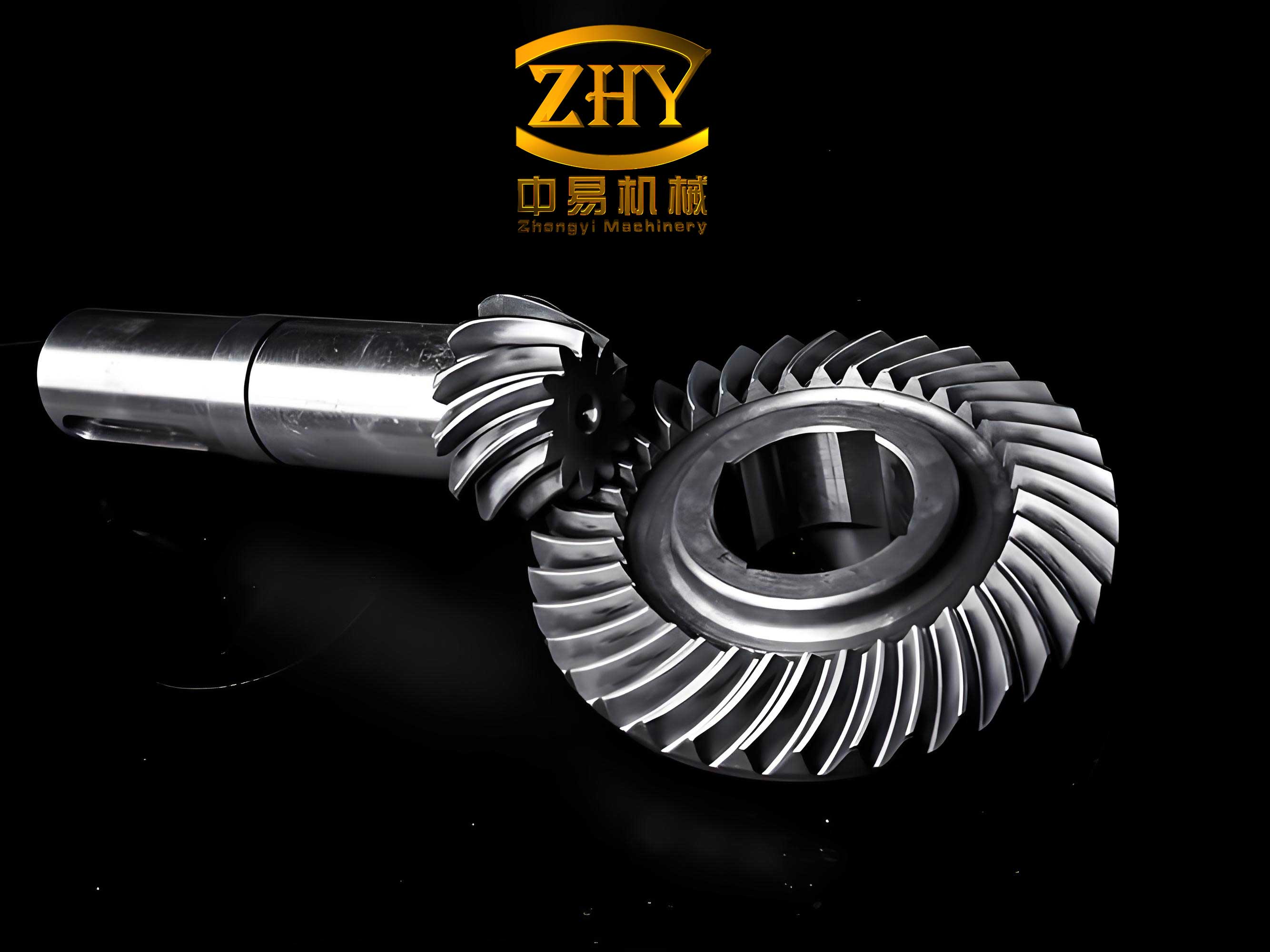
Spiral bevel gears are critical components in power transmission systems where non-parallel, intersecting shafts are required. Their capacity for high load transmission, smooth operation, and compact design makes them indispensable in demanding applications such as aerospace, automotive differentials, and heavy machinery. The performance and longevity of these spiral bevel gear sets are predominantly governed by the quality of tooth contact under operational conditions. Achieving an optimal contact pattern—centered on the tooth flank with adequate size and shape—is a primary goal in the design and manufacturing of spiral bevel gears. This desired contact pattern ensures even load distribution, minimizes stress concentrations, reduces noise and vibration, and enhances the overall efficiency of the gear transmission system.
However, the theoretical perfect contact condition derived from ideal geometry and alignment is often compromised in real-world assemblies. Installation errors are inevitable due to tolerances in manufacturing, assembly processes, and deformations under load. For spiral bevel gears, which have complex curved tooth surfaces, the contact characteristics are exceptionally sensitive to misalignments. Even minute deviations from the ideal assembly position can lead to significant shifts in the contact path, the formation of edge contacts, increased transmission error (a key source of vibration and noise), and ultimately, premature failure due to pitting, scuffing, or tooth breakage. Therefore, a profound understanding of how specific installation errors influence the meshing behavior is paramount for robust design, precise manufacturing, and reliable assembly of spiral bevel gear systems.
This article delves into the mathematical modeling and systematic analysis of tooth contact in spiral bevel gears subjected to installation errors. We establish a comprehensive theoretical framework, starting from the fundamental geometry of the gear tooth surfaces. We then incorporate common installation errors into the meshing model to perform a detailed Tooth Contact Analysis (TCA). Through numerical case studies, we will quantify and visualize the impact of these errors on the contact path and transmission error, providing critical insights for engineers working with spiral bevel gear applications.
Theoretical Modeling of Spiral Bevel Gear Tooth Surfaces
The foundation of any contact analysis lies in an accurate mathematical description of the contacting surfaces. For a spiral bevel gear pair, we consider the generation of tooth surfaces based on a imaginary generating gear, often referred to as a crown gear or generating gear. The tooth profile of this generator is defined, and the spiral bevel gear tooth surface is generated as the envelope of the generator’s family of surfaces through the relative cutting or grinding motion. We focus here on a formulation suitable for generic spiral bevel gear geometry, applicable to both hypoid and bevel types with localized modifications.
Let us define a coordinate system fixed to the generating gear, \( S_g(X_g, Y_g, Z_g) \). The surface of the generating gear tooth, \( \mathbf{r}_g(u_g, \theta_g) \), can be described by two independent parameters: a profile parameter \( u_g \) and a length-of-line parameter \( \theta_g \) related to the spiral motion.
$$ \mathbf{r}_g(u_g, \theta_g) = \begin{bmatrix} x_g(u_g, \theta_g) \\ y_g(u_g, \theta_g) \\ z_g(u_g, \theta_g) \end{bmatrix} $$
The unit normal vector to this surface, \( \mathbf{n}_g(u_g, \theta_g) \), is essential for meshing conditions and is given by:
$$ \mathbf{n}_g(u_g, \theta_g) = \frac{\frac{\partial \mathbf{r}_g}{\partial u_g} \times \frac{\partial \mathbf{r}_g}{\partial \theta_g}}{\left\| \frac{\partial \mathbf{r}_g}{\partial u_g} \times \frac{\partial \mathbf{r}_g}{\partial \theta_g} \right\|} $$
To obtain the tooth surface of the actual spiral bevel gear (say, the pinion), we consider the coordinate transformation from the generating gear system \( S_g \) to the pinion coordinate system \( S_1(X_1, Y_1, Z_1) \). This transformation, \( M_{1g}(\phi_g) \), encapsulates the relative rolling motion between the generator and the pinion blank during the virtual cutting process, where \( \phi_g \) is the rotation angle of the generator.
$$ \mathbf{r}_1(u_g, \theta_g, \phi_g) = M_{1g}(\phi_g) \cdot \mathbf{r}_g(u_g, \theta_g) $$
$$ \mathbf{n}_1(u_g, \theta_g, \phi_g) = L_{1g}(\phi_g) \cdot \mathbf{n}_g(u_g, \theta_g) $$
Here, \( L_{1g} \) is the 3×3 rotational sub-matrix of \( M_{1g} \). The generated pinion tooth surface is the envelope of the family of surfaces \( \mathbf{r}_1(u_g, \theta_g, \phi_g) \), satisfying the equation of meshing:
$$ f_1(u_g, \theta_g, \phi_g) = \mathbf{n}_g \cdot \mathbf{v}_g^{(1g)} = 0 $$
where \( \mathbf{v}_g^{(1g)} \) is the relative velocity between the generator and the pinion in the generator coordinate system. Solving this equation allows us to express one parameter in terms of the others, typically yielding the pinion surface as \( \mathbf{R}_1(u_1, \theta_1) \). A similar procedure is followed to generate the gear tooth surface \( \mathbf{R}_2(u_2, \theta_2) \) in its coordinate system \( S_2 \). The fundamental geometry of these spiral bevel gear surfaces determines their inherent kinematic and contact properties.
Tooth Contact Analysis (TCA) Framework with Installation Errors
Tooth Contact Analysis (TCA) is a computational technique used to simulate the meshing of two gear tooth surfaces under loaded or unloaded conditions. For unloaded geometric TCA, the goal is to find a series of contact points and calculate the kinematic transmission error by solving the conditions for continuous tangency between the two surfaces as they rotate. We now extend this framework to include installation errors.
In an ideal assembly, the pinion and gear axes intersect at a designated angle (typically 90° for bevel gears) and their apexes (cone points) coincide at the intersection point. In reality, errors disrupt this ideal configuration. The three primary linear installation errors for a spiral bevel gear pair are:
1. Pinion Axis Offset (\( \Delta E \)): Displacement of the pinion axis parallel to the gear axis.
2. Pinion Apex Error (\( \Delta P \)): Displacement of the pinion along its own axis, moving its apex towards or away from the theoretical intersection point.
3. Gear Apex Error (\( \Delta G \)): Displacement of the gear along its own axis.
Additionally, an Axis Angle Error (\( \Delta \Sigma \)) represents a deviation from the theoretical shaft angle.
We introduce a fixed global coordinate system \( S_f \). The pinion and gear surfaces, along with their normals, are transformed into this common system considering their respective rotation angles \( \phi_1 \) and \( \phi_2 \), and the installation error parameters. The transformation for the pinion includes its rotation and the error displacements/rotations, and similarly for the gear.
$$ \mathbf{r}_f^{(1)}(u_1, \theta_1, \phi_1, \Delta P, \Delta E, \Delta \Sigma) = M_{f1}(\phi_1, \Delta P, \Delta E, \Delta \Sigma) \cdot \mathbf{R}_1(u_1, \theta_1) $$
$$ \mathbf{n}_f^{(1)}(u_1, \theta_1, \phi_1, \Delta P, \Delta E, \Delta \Sigma) = L_{f1}(\phi_1, \Delta P, \Delta E, \Delta \Sigma) \cdot \mathbf{N}_1(u_1, \theta_1) $$
$$ \mathbf{r}_f^{(2)}(u_2, \theta_2, \phi_2, \Delta G) = M_{f2}(\phi_2, \Delta G) \cdot \mathbf{R}_2(u_2, \theta_2) $$
$$ \mathbf{n}_f^{(2)}(u_2, \theta_2, \phi_2, \Delta G) = L_{f2}(\phi_2, \Delta G) \cdot \mathbf{N}_2(u_2, \theta_2) $$
The conditions for contact at any instant are that a point on the pinion surface coincides with a point on the gear surface, and their unit normals are collinear (opposite in direction for driving and driven sides). This gives us a system of six scalar equations (three from position vector equality, two from independent components of the unit normal vector equality since \( \|\mathbf{n}\|=1 \), and one from the equation of meshing which is implicitly satisfied if both surfaces are conjugate or can be used as an extra condition for ease of solution).
$$ \mathbf{r}_f^{(1)}(u_1, \theta_1, \phi_1, \Delta P, \Delta E, \Delta \Sigma) = \mathbf{r}_f^{(2)}(u_2, \theta_2, \phi_2, \Delta G) $$
$$ \mathbf{n}_f^{(1)}(u_1, \theta_1, \phi_1, \Delta P, \Delta E, \Delta \Sigma) = -\mathbf{n}_f^{(2)}(u_2, \theta_2, \phi_2, \Delta G) $$
For a given input pinion rotation angle \( \phi_1 \), this system can be solved numerically (e.g., using Newton-Raphson method) for the five unknowns: \( u_1, \theta_1, u_2, \theta_2, \phi_2 \). The solution provides the coordinates of the instantaneous contact point on both tooth surfaces and the corresponding gear rotation angle \( \phi_2 \). By incrementing \( \phi_1 \) through a mesh cycle, we obtain the path of contact across the tooth flank.
The Transmission Error (TE) is computed as the deviation of the actual gear position from its theoretical position based on the gear ratio \( N_{1}/N_{2} \), where \( N \) denotes the number of teeth.
$$ TE(\phi_1) = \phi_2(\phi_1) – \phi_{2,ideal}(\phi_1) = \phi_2(\phi_1) – \left( -\frac{N_1}{N_2} \phi_1 \right) $$
This transmission error curve is a critical indicator of mesh quality and excitation for noise and vibration in spiral bevel gear systems.
Numerical Case Study and Analysis of Error Effects
To concretely demonstrate the influence of installation errors, we perform TCA on a sample spiral bevel gear pair. The basic design parameters of this spiral bevel gear set are summarized in the table below.
| Parameter | Pinion | Gear |
|---|---|---|
| Number of Teeth (N) | 15 | 43 |
| Module (mm) | 4.5 | |
| Shaft Angle (deg) | 90.0 | |
| Face Width (mm) | 38.0 | |
| Spiral Angle at Mid-point (deg) | 35.0 | |
| Hand of Spiral | Left | Right |
First, we establish the baseline by performing TCA under ideal assembly conditions (\( \Delta P = \Delta E = \Delta G = \Delta \Sigma = 0 \)). The resulting contact path is centrally located on the tooth flank, running diagonally from the toe to the heel. The transmission error for three consecutive meshing teeth shows a parabolic-like curve with minimal amplitude, indicating smooth motion transfer. The following table summarizes the key TCA results for the ideal case for the drive side contact.
| Metric | Value (Ideal Case) |
|---|---|
| Contact Path Centroid Location | Centered on tooth flank |
| Maximum TE Amplitude (arc-sec) | ~15 |
| Contact Pattern Type | Elliptical, centered |
Now, we introduce installation errors one at a time to isolate their effects on this spiral bevel gear pair’s performance.
Effect of Pinion Apex Error (\( \Delta P \)): This error moves the pinion along its axis. A positive \( \Delta P \) (pinion moved into the gear) causes the contact path to shift towards the toe on the pinion and towards the heel on the gear. Conversely, a negative \( \Delta P \) (pinion moved out of the gear) shifts the contact towards the heel on the pinion and the toe on the gear. This is a critical error as it directly alters the load distribution across the face width of the spiral bevel gear. It also significantly increases the amplitude of the transmission error and can change its shape from parabolic to a more complex, potentially discontinuous form if edge contact occurs.
Effect of Pinion Axis Offset (\( \Delta E \)): Also known as the “offset error,” this displaces the pinion axis parallel to the gear axis. A positive \( \Delta E \) typically shifts the contact path towards the top (or flank) of the tooth on both members, while a negative offset shifts it towards the root. This error primarily affects the bias of the contact pattern (its location along the profile height) and can easily lead to premature edge contact at the tip or root of the spiral bevel gear teeth, risking severe stress concentrations and rapid failure.
Effect of Axis Angle Error (\( \Delta \Sigma \)): This error changes the nominal shaft intersection angle. A positive \( \Delta \Sigma \) (increased shaft angle) shifts the contact pattern towards the toe on the concave side of the gear tooth and the heel on the convex side, or vice-versa depending on hand of spiral. It creates an asymmetric effect on the two flanks of the spiral bevel gear. The transmission error becomes highly asymmetric and its amplitude increases markedly, contributing to vibration excitations at multiple harmonics.
The table below provides a qualitative summary of how these errors affect the contact pattern location on a spiral bevel gear tooth.
| Installation Error | Direction | Typical Contact Pattern Shift on Gear Tooth |
|---|---|---|
| Pinion Apex (\( \Delta P \)) | Positive (+) | Towards Heel |
| Negative (-) | Towards Toe | |
| Axis Offset (\( \Delta E \)) | Positive (+) | Towards Top/Flank |
| Negative (-) | Towards Root | |
| Axis Angle (\( \Delta \Sigma \)) | Positive (+) | Toe (Concave), Heel (Convex)* |
| Negative (-) | Heel (Concave), Toe (Convex)* |
* Effect is flank-dependent and spiral hand dependent.
To quantify the sensitivity, we calculate the change in Transmission Error amplitude and the linear shift of the contact path centroid for a range of each error. The following formulas approximate the relationship for small errors in our example spiral bevel gear set:
TE Amplitude Sensitivity:
$$ \Delta TE_{amp} \approx k_{TE,P} \cdot |\Delta P| + k_{TE,E} \cdot |\Delta E| + k_{TE,\Sigma} \cdot |\Delta \Sigma| $$
Where \( k_{TE} \) coefficients are sensitivity factors (arc-sec/mm or arc-sec/deg). For our case, analysis shows \( k_{TE,\Sigma} > k_{TE,P} > k_{TE,E} \), indicating the axis angle error is the most sensitive parameter for inducing vibration excitation in this spiral bevel gear system.
Contact Path Shift Sensitivity:
The centroid shift \( \delta_{centroid} \) on the tooth face can be modeled as:
$$ \delta_{centroid} = \sqrt{ (S_P \cdot \Delta P)^2 + (S_E \cdot \Delta E)^2 } $$
where \( S_P \) and \( S_E \) are directional sensitivity vectors. The shift due to \( \Delta \Sigma \) is more complex and flank-dependent.
These sensitivities highlight the non-linear and vector nature of the error effects. In practice, errors occur simultaneously. A combined error analysis reveals that the effects are not simply additive; they can counteract or amplify each other. For instance, a specific combination of \( \Delta P \) and \( \Delta E \) might keep the contact pattern centered while still introducing a larger transmission error. Therefore, a system-level tolerance analysis is crucial for spiral bevel gear assemblies.
Conclusion and Engineering Implications
The analysis presented unequivocally demonstrates the profound impact of installation errors on the operational performance of spiral bevel gears. Through rigorous mathematical modeling and systematic Tooth Contact Analysis, we have quantified how deviations from ideal alignment—specifically pinion apex error, axis offset error, and axis angle error—alter the fundamental contact characteristics. The primary effects are a significant shift of the tooth contact pattern from its optimal central location and a substantial increase in the amplitude and alteration in the shape of the geometric transmission error curve. These changes directly degrade performance, leading to uneven load distribution, elevated contact stresses, increased noise and vibration, and reduced fatigue life of the spiral bevel gear set.
The sensitivity of the spiral bevel gear contact to these errors underscores several critical engineering imperatives. First, it validates the necessity of extremely precise manufacturing and assembly processes for high-performance applications. Tolerances for housing bores, bearing locations, and shaft positioning must be tightly controlled. Second, it informs the design process. Gear designers can use TCA software not only to optimize the tooth geometry for ideal conditions but also to perform robustness analyses, ensuring the designed spiral bevel gear pair maintains acceptable contact under anticipated ranges of misalignment. This might involve intentional pre-defined modifications (e.g., lengthwise crowning, profile modifications) to make the tooth contact less sensitive to specific errors. Finally, this understanding aids in troubleshooting. The direction and nature of an observed contact pattern on a tested gear set can often be traced back to the most likely underlying installation error, guiding corrective actions during assembly or shimming.
In summary, mastering the relationship between installation errors and tooth contact is not merely an academic exercise but a fundamental requirement for realizing the full potential of spiral bevel gears in transmitting power smoothly, quietly, and reliably. Future work may integrate this geometric TCA with loaded tooth contact analysis (LTCA) and system dynamics models to provide an even more comprehensive picture of spiral bevel gear performance under real operating conditions.