
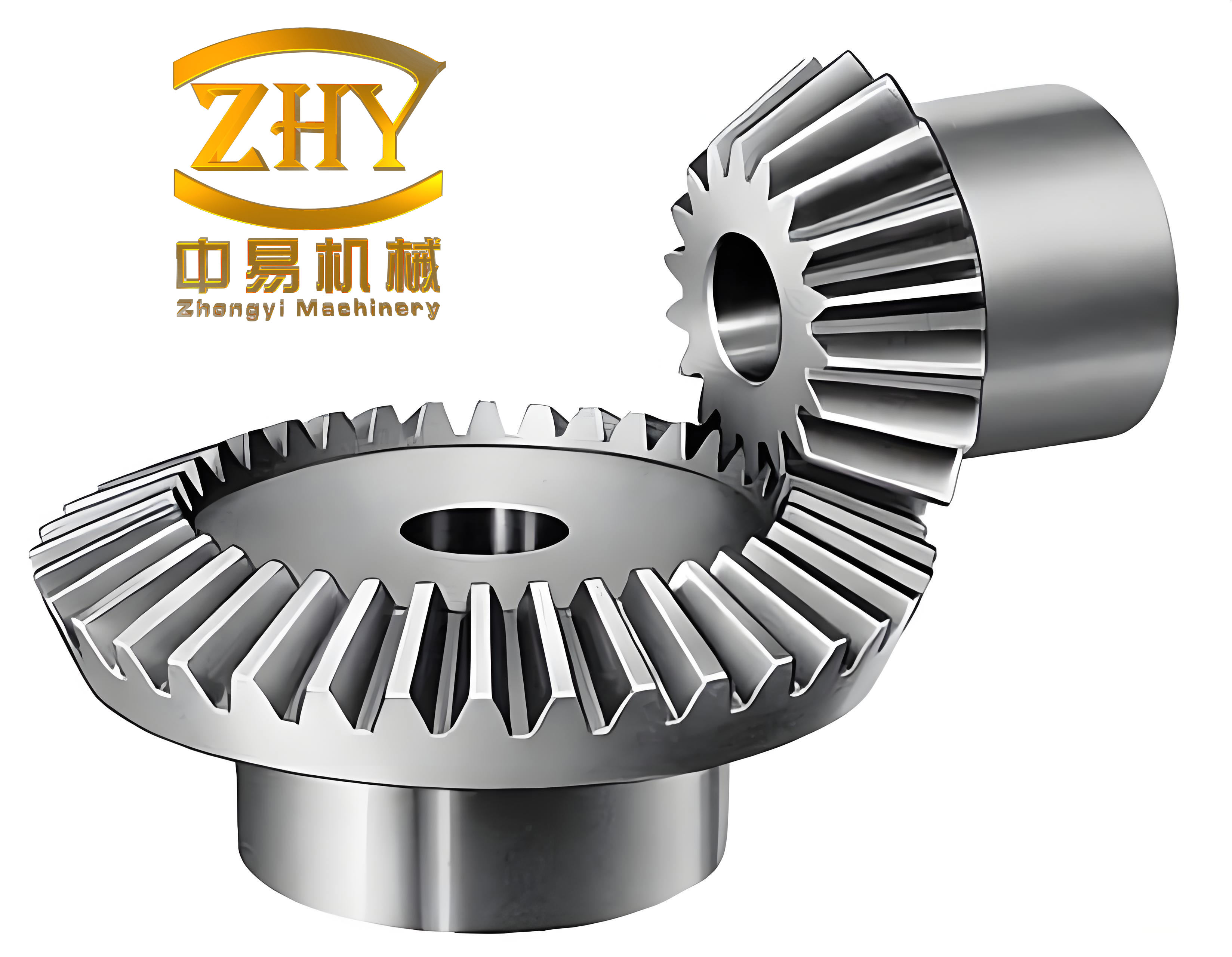
In this study, I investigate the impact of profile modification on the elastohydrodynamic lubrication (EHL) of straight bevel gears, which are commonly used in automotive differentials. Straight bevel gears often suffer from uneven load distribution along the tooth width, leading to end-meshing issues that cause stress concentration, reduced lifespan, and potential failure. Without modification, these gears experience meshing impacts due to base pitch errors and load fluctuations, hindering oil film formation and increasing the risk of film rupture. By applying profile modification, such as parabolic curves and tip relief, I aim to enhance oil film load capacity at the small end, distribute loads more evenly, and improve lubrication conditions. This research focuses on establishing an infinite line contact EHL model for straight bevel gears, solving pressure and film thickness using multigrid methods, and analyzing how modification parameters influence lubrication performance. Through numerical simulations, I demonstrate that profile modification reduces oil film pressure in the Hertzian contact zone, increases film thickness, and optimizes load distribution across the tooth width, thereby reducing friction, wear, and the likelihood of surface scoring.
To address the lubrication challenges in straight bevel gears, I first developed an equivalent contact model that simplifies the complex geometry of these gears. The straight bevel gear system is represented as an infinite line contact problem, where the contact between teeth is modeled considering the conical shape and varying parameters along the tooth width. Key geometric parameters include the cone distance, tooth width, and pitch diameter at the large end, which are derived from standard calculations based on the number of teeth and module. For instance, the equivalent radius of curvature at any meshing point is critical for accurately simulating the contact conditions. This approach allows me to analyze the EHL behavior under realistic operating conditions, focusing on how modifications alter the contact mechanics and fluid dynamics. The model accounts for the transient nature of gear meshing, dividing the engagement cycle into multiple instants to capture dynamic effects.
The foundation of my analysis relies on several fundamental equations governing elastohydrodynamic lubrication. These equations describe the relationship between pressure, film thickness, lubricant properties, and elastic deformation in the contact region. For straight bevel gears, the Reynolds equation is central to modeling the fluid flow and pressure generation within the lubricant film. It is expressed as:
$$\frac{\partial}{\partial x} \left( \frac{\rho h^3}{\eta} \frac{\partial p}{\partial x} \right) = 12 \frac{\partial (\rho u h)}{\partial x} + 12 \frac{\partial (\rho h)}{\partial t}$$
where \( p \) is the oil film pressure, \( h \) is the film thickness, \( \rho \) is the lubricant density, \( \eta \) is the dynamic viscosity, \( u \) is the entrainment velocity, \( x \) is the spatial coordinate along the contact, and \( t \) is time. This equation accounts for the squeeze film effect and the Poiseuille flow, which are essential for capturing the transient behavior during gear meshing. The film thickness equation incorporates the geometric profile, elastic deformation, and any modification applied to the tooth surface:
$$h = h_0 + \frac{x^2}{2R} – \frac{2}{\pi E} \int_{-\infty}^{x} p(s) \ln(x-s)^2 ds + \delta(x)$$
Here, \( h_0 \) is the central film thickness, \( R \) is the equivalent radius of curvature at the meshing point, \( E \) is the composite elastic modulus of the gear materials, and \( \delta(x) \) represents the profile modification function. For parabolic profile modification, \( \delta(x) \) is defined as \( \Delta_{\text{max}} (x/L)^b \), where \( \Delta_{\text{max}} \) is the maximum modification amount, \( L \) is the modification length, and \( b \) is an exponent set to 2 for a quadratic curve. The viscosity-pressure relationship is described using the Roelands equation:
$$\eta = \eta_0 \exp\left\{ (\ln \eta_0 + 9.67) \left[ (1 + 5.1 \times 10^{-9} p)^{z_0} – 1 \right] \right\}$$
with \( z_0 = \alpha / [5.1 \times 10^{-9} (\ln \eta_0 + 9.67)] \), where \( \eta_0 \) is the ambient viscosity and \( \alpha \) is the pressure-viscosity coefficient. The density-pressure relationship follows the Dowson-Higginson formula:
$$\rho = \rho_0 \left( \frac{1 + 0.6 \times 10^{-9} p}{1 + 1.7 \times 10^{-9} p} \right)$$
where \( \rho_0 \) is the ambient density. The load balance equation ensures that the integrated pressure over the contact area equals the applied load per unit length \( w \):
$$\int_{-\infty}^{\infty} p(x) dx = w$$
These equations form a coupled system that I solve numerically to analyze the EHL performance of straight bevel gears under various modification scenarios.
In my numerical approach, I employed the finite difference method to discretize the dimensionless forms of the governing equations. The pressure and film thickness are solved using the multigrid technique, which enhances computational efficiency and accuracy by iterating across multiple grid levels. For elastic deformation, I applied the multigrid integration method. The computational domain consists of six grid layers, with the finest grid having 961 nodes to ensure high resolution in the contact region. Pressure iteration involves Gauss-Seidel relaxation on each grid level, and the central film thickness \( h_0 \) is adjusted iteratively until the pressure convergence criterion (less than 0.001) is met. The meshing process of straight bevel gears is divided into 180 instantaneous points along the actual line of action, from the start to the end of engagement, to capture transient effects. This allows me to evaluate lubrication characteristics at critical points, such as the first and fourth meshing-in instants and the meshing-out instant, where issues like impact and high stress are most pronounced.
The parameters used in my simulations are based on typical straight bevel gear applications, such as those in automotive differentials. The table below summarizes the key input values for the gear system and lubricant properties:
| Parameter | Value |
|---|---|
| Number of teeth (pinion), \( z_1 \) | 21 |
| Number of teeth (gear), \( z_2 \) | 60 |
| Module at large end, \( m \) (mm) | 2 |
| Tooth width, \( b \) (mm) | 42 |
| Pressure angle at large end, \( \alpha \) (°) | 20 |
| Addendum coefficient, \( h_a^* \) | 1.0 |
| Elastic modulus, \( E \) (GPa) | 210 |
| Poisson’s ratio, \( \mu \) | 0.3 |
| Pinion speed, \( n_1 \) (r/min) | 1000 |
| Input power, \( P \) (kW) | 5.45 |
| Ambient viscosity, \( \eta_0 \) (Pa·s) | 0.08 |
| Pressure-viscosity coefficient, \( \alpha \) (Pa⁻¹) | 2.19 × 10⁻⁸ |
My results show that profile modification significantly improves the lubrication performance of straight bevel gears. For parabolic profile modification with \( \Delta_{\text{max}} = 0.05 \) and \( L = 0.3 \), at a speed of 1000 r/min and load of \( 5.0 \times 10^5 \) N, the oil film pressure in the Hertzian contact zone decreases, while the film thickness increases. This is particularly evident at the first meshing-in instant, where the modification reduces pressure peaks and enhances film formation. The comparison between unmodified and modified cases reveals that the minimum and central film thicknesses are higher after modification, which helps in reducing wear and surface damage. For example, at the first meshing-in point, the film thickness in the Hertzian zone increases by approximately 10-15% after parabolic modification, whereas tip relief only results in a marginal improvement. The following equation illustrates the general trend of film thickness enhancement due to modification:
$$h_{\text{modified}} = h_{\text{unmodified}} + \Delta h \quad \text{where} \quad \Delta h \propto \Delta_{\text{max}} \left( \frac{x}{L} \right)^2$$
Similarly, the maximum oil film pressure along the line of action decreases after modification, as shown in the table below for selected instants:
| Meshing Instant | Unmodified Pressure (GPa) | Modified Pressure (GPa) | Unmodified Thickness (μm) | Modified Thickness (μm) |
|---|---|---|---|---|
| First Meshing-In | 1.20 | 0.95 | 0.277 | 0.442 |
| Fourth Meshing-In | 1.15 | 0.90 | 0.278 | 0.443 |
| Meshing-Out | 1.10 | 1.05 | 0.280 | 0.445 |
I also examined the effect of different rotational speeds on the lubrication characteristics of modified straight bevel gears. At speeds of 1000 r/min, 1500 r/min, and 1800 r/min, the improvement in film thickness due to modification becomes more pronounced at higher speeds. This is because the entrainment velocity, which is a key factor in film formation, increases with speed, leading to thicker films. The relationship between speed \( u \) and film thickness \( h \) can be approximated by:
$$h \propto u^{0.7}$$
which indicates that higher speeds enhance lubricant entrainment, resulting in better separation of surfaces. At 1800 r/min, the minimum film thickness after modification stabilizes at a higher value, reducing the risk of metal-to-metal contact. Additionally, I analyzed how modification parameters, such as maximum modification amount \( \Delta_{\text{max}} \) and modification length \( L \), influence the EHL performance. Increasing \( \Delta_{\text{max}} \) from 0.05 to 0.08 further reduces pressure and increases film thickness, as the modification alters the contact geometry more significantly. Similarly, extending \( L \) from 0.3 to 0.6 spreads the modification over a larger area, leading to more uniform pressure distribution and thicker films. The optimal parameters depend on the specific application, but generally, larger modification amounts and lengths yield better lubrication outcomes for straight bevel gears.
Furthermore, profile modification affects the load distribution along the tooth width of straight bevel gears. Without modification, the load is concentrated at the ends, particularly the small end, causing high stress and potential failure. After modification, the load is transferred toward the center of the tooth width, as evidenced by the pressure distribution plots. The oil film pressure along the tooth width becomes more symmetric, with reduced disparity between the small and large ends. This redistribution enhances the overall load-carrying capacity and reduces the likelihood of end-meshing issues. The load per unit length \( w \) can be expressed as a function of position \( y \) along the tooth width:
$$w(y) = w_0 \left[ 1 – \beta \left( \frac{y}{b} \right)^2 \right]$$
where \( w_0 \) is the nominal load, \( b \) is the tooth width, and \( \beta \) is a modification factor that increases with \( \Delta_{\text{max}} \). This equation shows how modification shifts load away from the ends, promoting even distribution and improving lubrication.
In conclusion, my study demonstrates that profile modification, particularly using parabolic curves, significantly enhances the elastohydrodynamic lubrication of straight bevel gears. By reducing oil film pressure and increasing film thickness in the Hertzian contact zone, modification mitigates friction, wear, and surface scoring. The effects are more pronounced at higher speeds and with larger modification parameters. Moreover, modification optimizes load distribution along the tooth width, addressing end-meshing problems and extending gear life. These findings provide valuable insights for designing straight bevel gears with improved reliability and performance in applications like automotive differentials. Future work could explore thermal effects and more complex modification profiles to further optimize lubrication in straight bevel gears.