
The pursuit of precision motion control in advanced fields such as aerospace, robotics, and high-accuracy instrumentation has consistently driven the development of specialized transmission technologies. Among these, the harmonic drive gear, based on the principle of elastic dynamics, stands out due to its unique combination of high reduction ratios, compact form factor, exceptional positional accuracy, and minimal backlash. As these components are increasingly deployed in critical applications, a comprehensive and accurate understanding of their performance characteristics, particularly their mechanical efficiency, becomes paramount. Efficiency is not merely a number denoting output-to-input power ratio; it is a critical indicator of the transmission’s health, its thermal management requirements, its impact on overall system energy consumption, and a key parameter for validating theoretical models and guiding future optimization. This article presents a detailed exploration of the principles, design, implementation, and data analysis methodologies for a modern efficiency testing system dedicated to harmonic drive gear units, leveraging contemporary virtual instrumentation technology.
The mechanical efficiency, denoted by η, of a harmonic drive gear is fundamentally defined as the ratio of its output power, Pout, to its input power, Pin.
$$ \eta = \frac{P_{\text{out}}}{P_{\text{in}}} \times 100\% $$
While theoretical models exist to predict this value—incorporating factors like friction between the wave generator, flexspline, and circular spline; hysteresis losses in the flexspline; and lubrication drag—they inherently rely on simplifications and assumptions. For power levels typical of many harmonic drive applications (e.g., below 40 kW), empirical determination through controlled testing is not only feasible but is considered the most reliable method for obtaining true performance data. This testing provides indispensable data for design validation, quality assurance, and comparative analysis between different harmonic drive gear models or lubrication regimes.
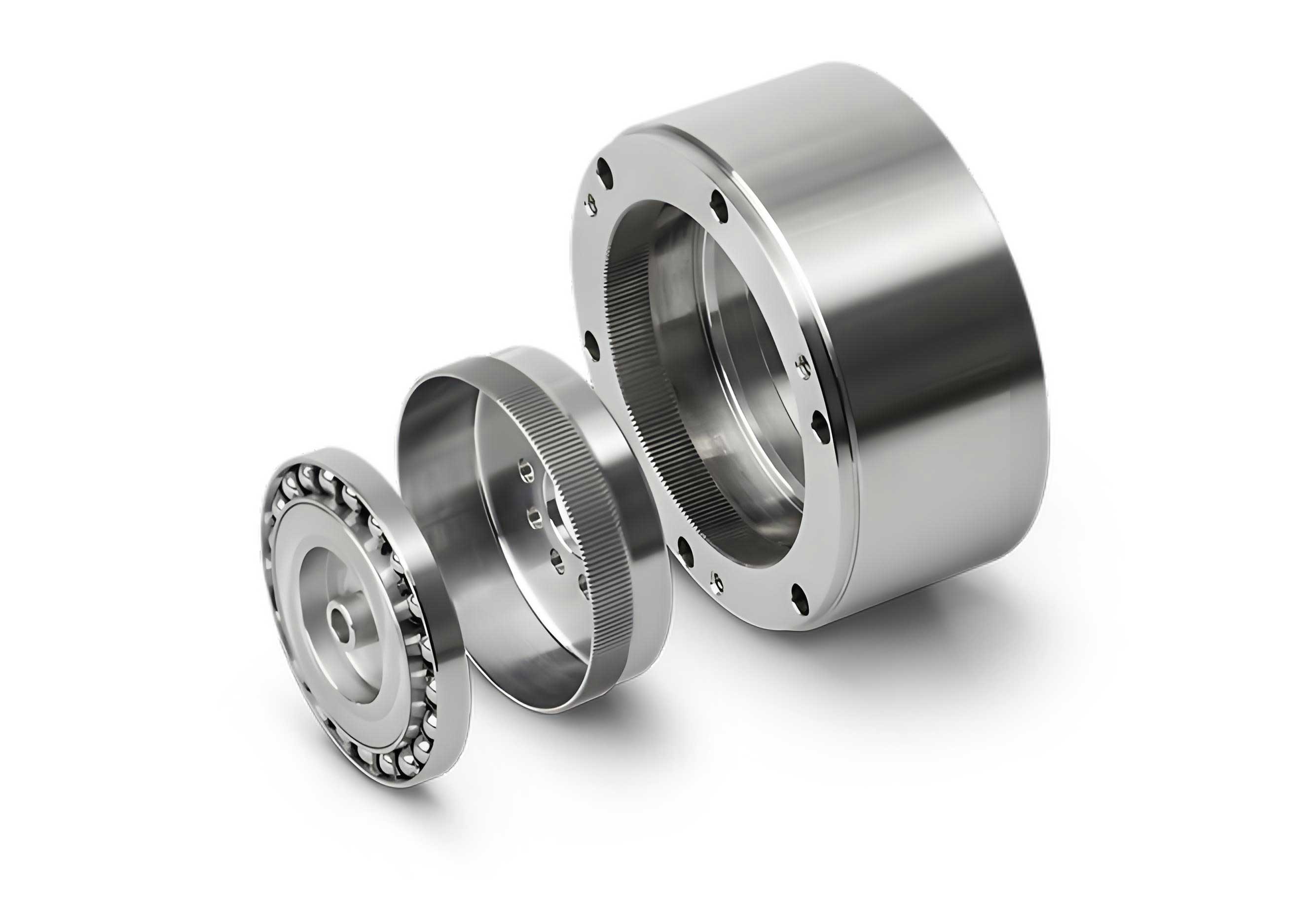
The core challenge in building an effective test system lies in the accurate, synchronized measurement of input and output power. The methodology can be broken down into two parallel measurement chains:
1. Input Power (Pin) Measurement: The input power to the harmonic drive gear is derived from the prime mover, typically an electric motor. For a DC motor, the electrical input power is the product of armature voltage (V) and current (I). However, this electrical power represents the input to the motor-drive system. To find the power actually delivered to the input shaft of the harmonic drive gear, the efficiencies of the driving motor (ηm) and the input coupling (ηc_in) must be accounted for.
$$ P_{\text{in}} = V \times I \times \eta_m \times \eta_{c\_in} $$
Therefore, high-accuracy voltage and current transducers are installed at the motor terminals. These sensors convert the electrical parameters into proportional analog signals (usually voltage or current) for data acquisition.
2. Output Power (Pout) Measurement: The mechanical output power of the harmonic drive gear is calculated from its output shaft’s rotational speed (n, in rpm) and torque (T, in N·m). The standard formula for mechanical power applies, with an additional factor for the efficiency of the output coupling (ηc_out).
$$ P_{\text{out}} = \frac{T \times n}{9550} \times \eta_{c\_out} $$
Here, the constant 9550 arises from unit conversion (kW from N·m and rpm). A key instrument here is a rotary torque transducer (or torque flange), which is installed in-line with the output shaft. Modern units often provide simultaneous, galvanically isolated signals for both torque and speed. Alternatively, a separate speed sensor, such as an optical encoder or a proximity probe reading from a keyphasor, can be used to measure ‘n’.
3. Final Efficiency Calculation: By integrating the above equations, the mechanical efficiency of the harmonic drive gear under test is computed in real-time by the data acquisition system.
$$ \eta_{\text{harmonic drive}} = \frac{P_{\text{out}}}{P_{\text{in}}} = \frac{ \left( \frac{T \times n}{9550} \times \eta_{c\_out} \right) }{ ( V \times I \times \eta_m \times \eta_{c\_in} ) } $$
The efficiencies of the motor and couplings (ηm, ηc_in, ηc_out) are typically determined from manufacturer datasheets or through separate calibration procedures and are treated as known constants within the test software.
| Measured Parameter | Sensor Type | Symbol | Role in Efficiency Calculation |
|---|---|---|---|
| Motor Input Voltage | Voltage Transducer / Signal Conditioner | V | Used to calculate electrical input power, later adjusted for motor & coupling loss. |
| Motor Input Current | Current Transducer (e.g., Hall-effect) | I | |
| Output Shaft Torque | Reaction or In-line Rotary Torque Sensor | T | Used to calculate mechanical output power, adjusted for coupling loss. |
| Output Shaft Speed | Torque Sensor (built-in), Optical Encoder, Tachometer | n |
The physical test stand is a carefully engineered mechanical structure designed to safely house and align all components while minimizing extraneous losses. A canonical layout for a harmonic drive gear efficiency test bed follows a back-to-back or power-recirculating design, but for direct efficiency measurement of a single unit, an open-loop test stand is common. The core components and their arrangement are described below.
Mechanical Power Train Layout:
1. Prime Mover: A variable-speed drive motor (AC/DC or servo) provides the input power. Its speed and, in some setups, torque are controllable.
2. Input Coupling: A flexible coupling connects the motor shaft to the input side of the torque sensor or directly to the harmonic drive gear’s input shaft. It compensates for minor misalignments.
3. Input Torque/Speed Measurement (Optional): An in-line torque sensor can be placed between the motor and the harmonic drive gear input to measure true input torque, useful for loss breakdown analysis.
4. Device Under Test (DUT): The harmonic drive gear unit is mounted on a rigid baseplate ensuring proper alignment.
5. Output Torque/Speed Measurement: A critical measurement point. A rotary torque sensor is connected to the output flange of the harmonic drive gear.
6. Loading Mechanism: This element absorbs the output power and provides the load torque. Common methods include:
– Eddy Current or Hysteresis Brake: Provides a controllable, contactless load.
– Powder Brake: Offers high torque at low speeds.
– Another Motor (Four-Quadrant Drive): Acts as a programmable dynamometer, capable of both driving and loading, enabling regenerative testing.
7. Control System: An industrial PLC or a software-based controller (e.g., via the data acquisition system) manages the setpoints for motor speed and load torque, enabling automated test profiles.
The selection of sensors is critical for measurement fidelity. Key specifications include range, accuracy, linearity, and thermal stability.
| Sensor | Key Selection Criteria | Typical Technology |
|---|---|---|
| Torque | Nominal & maximum torque rating, rotational speed limit, accuracy class (e.g., 0.1% FS), output signal (Analog ±10V, 4-20mA, or digital), non-linearity, hysteresis. | Strain-gauge based with wireless telemetry or slip rings. |
| Speed/Rotation | Pulses per revolution (PPR), maximum frequency, output type (TTL, HTL, sinusoidal). | Incremental optical encoder, magnetic encoder. |
| Current | Current range (RMS, peak), bandwidth, accuracy, isolation voltage, output type. | Closed-loop Hall-effect transducer (high accuracy), current shunt with isolation amplifier. |
| Voltage | Voltage range, bandwidth, accuracy, isolation. | Isolated voltage transducer, precision voltage divider with isolation amplifier. |
Signal Conditioning & Data Acquisition (DAQ): Raw signals from sensors often require conditioning before analog-to-digital conversion (ADC). This stage includes:
- Amplification: Scaling millivolt signals from strain gauges (torque) to a standard range (e.g., ±10V).
- Filtering: Applying low-pass anti-aliasing filters to remove high-frequency noise beyond the signal bandwidth of interest, which is crucial for preventing aliasing during sampling.
- Excitation: Providing stable voltage or current excitation for bridge-based sensors (torque).
The conditioned analog signals are digitized by a DAQ device. Key DAQ specifications for harmonic drive gear testing include:
- Number of simultaneous sampling analog input (AI) channels (for V, I, T, n).
- Sampling rate (should be at least 2x the highest frequency component per Nyquist theorem, but often 10x or more for good waveform definition).
- Resolution (16-bit or higher is recommended for precision).
- Analog output (AO) channels for sending control signals to the motor drive and load controller.
- Digital I/O for control signals (enable, fault reset) and encoder pulse counting.
The core innovation of modern test systems lies in the implementation of Virtual Instrumentation (VI). Instead of dedicated, fixed-function hardware meters and plotters, VI uses software on a standard computer to create a customizable user interface and define sophisticated data processing routines. National Instruments’ LabVIEW is a predominant graphical programming environment for this purpose. The software architecture for a harmonic drive gear efficiency tester is modular.
1. Main Control Loop & State Machine:
The software is built around a state machine that manages the test sequence: Initialization -> System Check -> Idle -> Ramp to Speed -> Apply Load -> Data Acquisition at Steady State -> Step to Next Load Point -> … -> Test Complete -> Ramp Down -> Safe Shutdown. This ensures repeatable and safe operation.
2. Data Acquisition Module:
This module configures the DAQ hardware (setting sample rates, ranges, triggers) and reads the raw voltage/current arrays from the AI channels. It performs real-time unit conversion, applying calibration coefficients (e.g., mV/N·m from the torque sensor) to transform voltages into physical engineering units.
3. Real-Time Processing & Calculation Engine:
This is the computational heart. For every acquired sample or block of samples, it executes the power and efficiency calculations.
$$ P_{\text{in}}(t) = V(t) \times I(t) \times \eta_m \times \eta_{c\_in} $$
$$ P_{\text{out}}(t) = \frac{T(t) \times n(t)}{9550} \times \eta_{c\_out} $$
$$ \eta(t) = \frac{P_{\text{out}}(t)}{P_{\text{in}}(t)} $$
It also computes derived statistics like average, minimum, maximum, and standard deviation over a user-defined averaging window once steady-state conditions are reached.
4. User Interface (Front Panel):
The VI’s front panel provides:
– Control Elements: Start/Stop buttons, input fields for setpoints (speed, torque load), test profile selectors.
– Real-Time Displays: Numerical indicators for all measured and calculated values (V, I, T, n, Pin, Pout, η, temperature).
– Graphical Displays: Trend charts showing efficiency vs. time, torque vs. speed, and power vs. time. An X-Y plot showing efficiency (η) as a function of output torque (T) at constant input speed is a fundamental result for any harmonic drive gear.
– Alarm/Status Indicators: Visual warnings for over-torque, over-temperature, or communication faults.
5. Data Logging & Reporting Module:
All raw and processed data is timestamped and streamed to disk in a structured format (e.g., TDMS, CSV). This module can generate summary reports, export graphs, and compare current test results with historical data or reference curves.
Test Execution and Data Analysis:
Following standards like JB/T 5077-91, a typical efficiency map for a harmonic drive gear is generated by testing at multiple operational points. A standard test procedure involves:
- Stabilization: Run the harmonic drive gear at a specified input speed with no load until thermal equilibrium is approached (monitored by temperature sensors).
- Load Stepping: Apply a sequence of increasing load torques (e.g., 10%, 25%, 50%, 75%, 100% of rated torque).
- Steady-State Measurement: At each load point, maintain constant speed and torque until conditions stabilize (typically 1-2 minutes). Then, acquire data over a period of 30-60 seconds.
- Repeat: Conduct this load sweep at several different input speeds (e.g., low, medium, rated speed).
The primary output is the efficiency-torque characteristic curve. A well-designed harmonic drive gear typically shows an efficiency curve that rises steeply from a lower value at very light load (where constant friction losses dominate) to a peak efficiency plateau, potentially declining slightly at very high loads due to increased elastic hysteresis and friction. The software can fit curves to this data, enabling precise interpolation.
| Test Phase | Controlled Parameter | Measured Parameters | Primary Output |
|---|---|---|---|
| No-Load Run | Input Speed (n_in) | Input Power (P_in_no_load) | No-load running loss (parasitic drag). |
| Load Step 1 (e.g., 10%) | Input Speed, Output Torque | V, I, T, n | Efficiency point η1. |
| Load Step 2 (e.g., 25%) | Input Speed, Output Torque | V, I, T, n | Efficiency point η2. |
| … Final Load Step (100%) | Input Speed, Output Torque | V, I, T, n | Efficiency point ηn. |
Advanced Analysis & Uncertainty:
A professional test system also quantifies measurement uncertainty. Using methods per ISO/IEC Guide 98-3, the combined standard uncertainty uc(η) in the efficiency result is calculated from the uncertainties of all input quantities.
$$ u_c(\eta) = \sqrt{ \left( \frac{\partial \eta}{\partial V} u(V) \right)^2 + \left( \frac{\partial \eta}{\partial I} u(I) \right)^2 + \left( \frac{\partial \eta}{\partial T} u(T) \right)^2 + \left( \frac{\partial \eta}{\partial n} u(n) \right)^2 + \ldots } $$
Where u(V), u(I), etc., are the standard uncertainties associated with each measurement chain (sensor accuracy, DAQ nonlinearity, noise). This analysis tells the user the confidence interval of the reported efficiency value, which is crucial for making comparative judgments. Furthermore, the system can perform spectral analysis on torque ripple signals to identify frequencies related to wave generator rotation, tooth meshing, or potential defects within the harmonic drive gear assembly.
The implementation of a virtual instrument-based efficiency test system for harmonic drive gears offers transformative advantages over traditional benchtop setups. The flexibility of software-defined measurement allows for rapid reconfiguration for different harmonic drive gear sizes or test protocols without hardware changes. The integration of measurement, control, and data analysis into a single platform streamlines the workflow, reduces human error in data transcription, and dramatically shortens the test cycle from setup to final report. The ability to perform high-speed data acquisition enables the study of transient efficiency behavior during start-up or load changes, which is often critical for dynamic applications like robotic joints. Finally, the architecture is inherently scalable; additional sensor channels for temperature, vibration, or acoustic emissions can be integrated to provide a holistic performance profile of the harmonic drive gear unit under test.
In conclusion, the accurate determination of mechanical efficiency is a cornerstone in the development and validation of harmonic drive gear technology. A modern test system, synergizing a precision mechanical test stand, high-fidelity sensors, and a flexible virtual instrumentation software core (exemplified by platforms like LabVIEW), provides a powerful, cost-effective, and future-proof solution. Such systems deliver not just a single efficiency number, but rich, multidimensional performance maps and insights into loss mechanisms. This empirical data is indispensable for driving innovation, ensuring quality, and enabling the reliable deployment of harmonic drive gears in the next generation of high-performance mechatronic systems. The continuous refinement of these testing methodologies, including the incorporation of real-time thermal models and advanced diagnostic algorithms, will further enhance our understanding and optimization of this unique and vital transmission technology.