
In the realm of mechanical engineering and computer-aided design, the accurate and efficient modeling of spur gears is crucial for simulation, manufacturing, and assembly processes. Traditional methods for creating spur gear models often involve complex steps, such as generating involute curves from equations, projecting them onto surfaces, and performing multiple extrusion cuts, which can be time-consuming and prone to errors. As a designer, I have explored an optimized approach that combines the variable section sweep feature and the spinal bend feature in modern CAD software, significantly simplifying the modeling operation and enhancing efficiency. This method not only streamlines the creation of spur gears but also offers extensibility to other gear types, making it a practical solution for industrial applications.
The core idea revolves around using a variable section sweep to directly cut the gear tooth slots on a flat plate, which is then bent into a cylindrical form using the spinal bend feature. This eliminates the need for intricate curve generation and multiple feature constructions, reducing the modeling steps to a minimal set. In this article, I will detail this methodology from a first-person perspective, incorporating formulas and tables to encapsulate key concepts. The spur gear, as a fundamental component in power transmission systems, serves as the primary focus, and its modeling efficiency is paramount for iterative design processes. Throughout the discussion, I will emphasize the applicability of this technique to spur gears, ensuring that the keyword ‘spur gear’ is recurrently highlighted to underscore its relevance.
To begin, let’s consider the basic parameters of a spur gear. The involute tooth profile, which ensures smooth meshing and constant velocity ratio, is defined by parameters such as module, number of teeth, and pressure angle. In my approach, I leverage mathematical relations to control the tooth geometry during the variable section sweep. For instance, the involute curve in polar coordinates can be expressed as:
$$ r = \frac{r_b}{\cos(\alpha)} $$
$$ \theta = \tan(\alpha) – \alpha $$
where \( r \) is the radial distance from the gear center, \( r_b \) is the base circle radius, and \( \alpha \) is the pressure angle at that point. For a standard spur gear with module \( m \) and tooth count \( z \), the base radius is given by \( r_b = \frac{m z \cos(\alpha_0)}{2} \), with \( \alpha_0 \) as the standard pressure angle (typically 20°). The full tooth height \( h \) is often calculated as \( 2.25m \), but adjustments may be needed based on the base circle constraints. Below is a table summarizing key parameters for a sample spur gear used in this modeling demonstration:
| Parameter | Symbol | Value | Description |
|---|---|---|---|
| Module | \( m \) | 3 mm | Determines tooth size |
| Number of Teeth | \( z \) | 40 | Total teeth on the spur gear |
| Pressure Angle | \( \alpha_0 \) | 20° | Standard angle for involute profile |
| Base Circle Radius | \( r_b \) | \( \frac{m z \cos(\alpha_0)}{2} \) | Radius where involute originates |
| Pitch Circle Diameter | \( d \) | \( m z \) | Reference circle for gear meshing |
| Tooth Height | \( h \) | Calculated based on geometry | Full height from root to tip |
The modeling process starts with creating a flat plate that represents the unfolded version of the spur gear’s cylindrical surface. This plate has a length equal to the circumference of the pitch circle, i.e., \( \pi m z \), ensuring that after bending, the gear attains the correct diameter. I select a front plane as the sketch plane and draw a rectangular profile with dimensions corresponding to the gear’s axial section. The top edge of this rectangle aligns with the future tooth tip line, and the distance from the origin is controlled to maintain the gear center after bending. Extruding this sketch gives the flat base feature, which serves as the canvas for tooth slot creation.
Next, I sketch a straight line on the same plane to act as the trajectory for the variable section sweep. This line’s length defines the tooth height, and one end is aligned with the top edge of the plate. For the sample spur gear, the tooth height is derived from the involute geometry: since the base circle radius might exceed the root circle calculated by \( 2.25m \), I use the relation \( h = \frac{m z (1 – \cos(20^\circ))}{2} \) to ensure the tooth profile remains valid within the involute region. This step is critical for accuracy in spur gear modeling, as it prevents issues in the non-involute root section.
With the trajectory ready, I initiate the variable section sweep feature to cut the first tooth slot. Instead of complex curves, I use a simple rectangular section whose width is controlled by a set of relations. This rectangle evolves along the trajectory, simulating the radial variation of the tooth slot width based on the involute equation. The relations incorporate a parameter \( \text{trajpar} \) that varies from 0 to 1, representing the normalized distance along the trajectory. The width \( W \) at any point is given by:
$$ r_b = \frac{m z \cos(\alpha_0)}{2} $$
$$ h = \frac{m z (1 – \cos(\alpha_0))}{2} $$
$$ r = r_b + h \cdot \text{trajpar} $$
$$ \alpha = \acos\left(\frac{r_b}{r}\right) $$
$$ \theta_0 = \frac{\pi}{z} – \tan(\alpha_0) + \frac{\alpha_0 \pi}{180} $$
$$ \theta_1 = \tan(\alpha) – \frac{\alpha \pi}{180} $$
$$ \theta = \theta_0 + \theta_1 $$
$$ W = 2 r_b \theta $$
Here, \( \theta_0 \) is the initial angle offset for the involute, \( \theta_1 \) is the incremental angle, and \( W \) corresponds to the width dimension in the sketch (denoted as sd8 in the original context). This set of equations ensures that the slot width accurately mirrors the involute tooth spacing for the spur gear. The variable section sweep directly cuts a single tooth slot into the flat plate, as previewed in the CAD software. This method bypasses the need for auxiliary surfaces or mirroring operations, streamlining the process significantly.
After creating the first tooth slot, I replicate it along the length of the plate to form all teeth. This is done through a linear pattern feature, where the number of instances equals the tooth count \( z \). For the sample spur gear with 40 teeth, I pattern the slot 40 times, evenly spaced along the plate. This step is efficient because the flat representation allows for simple linear duplication, unlike cylindrical arrays that require angular dimensions. The result is a flat gear pattern with all tooth slots pre-cut, ready for bending into the final spur gear form.
The final step involves using the spinal bend feature to transform the flat plate into a cylindrical spur gear. I select the plate as the entity to bend and sketch a circle on a top plane as the spine curve. The circle’s diameter is set to the pitch circle diameter \( m z \), and a coordinate system is placed at the intersection with the front plane to define the bending origin. By specifying the terminal face of the plate as the end plane, the software wraps the flat geometry around the spine, producing a fully formed spur gear. This bending process effectively maps the linear tooth slots onto the cylindrical surface, maintaining the involute profile accuracy. The efficiency of this approach is evident in the minimal feature count and reduced computational time.
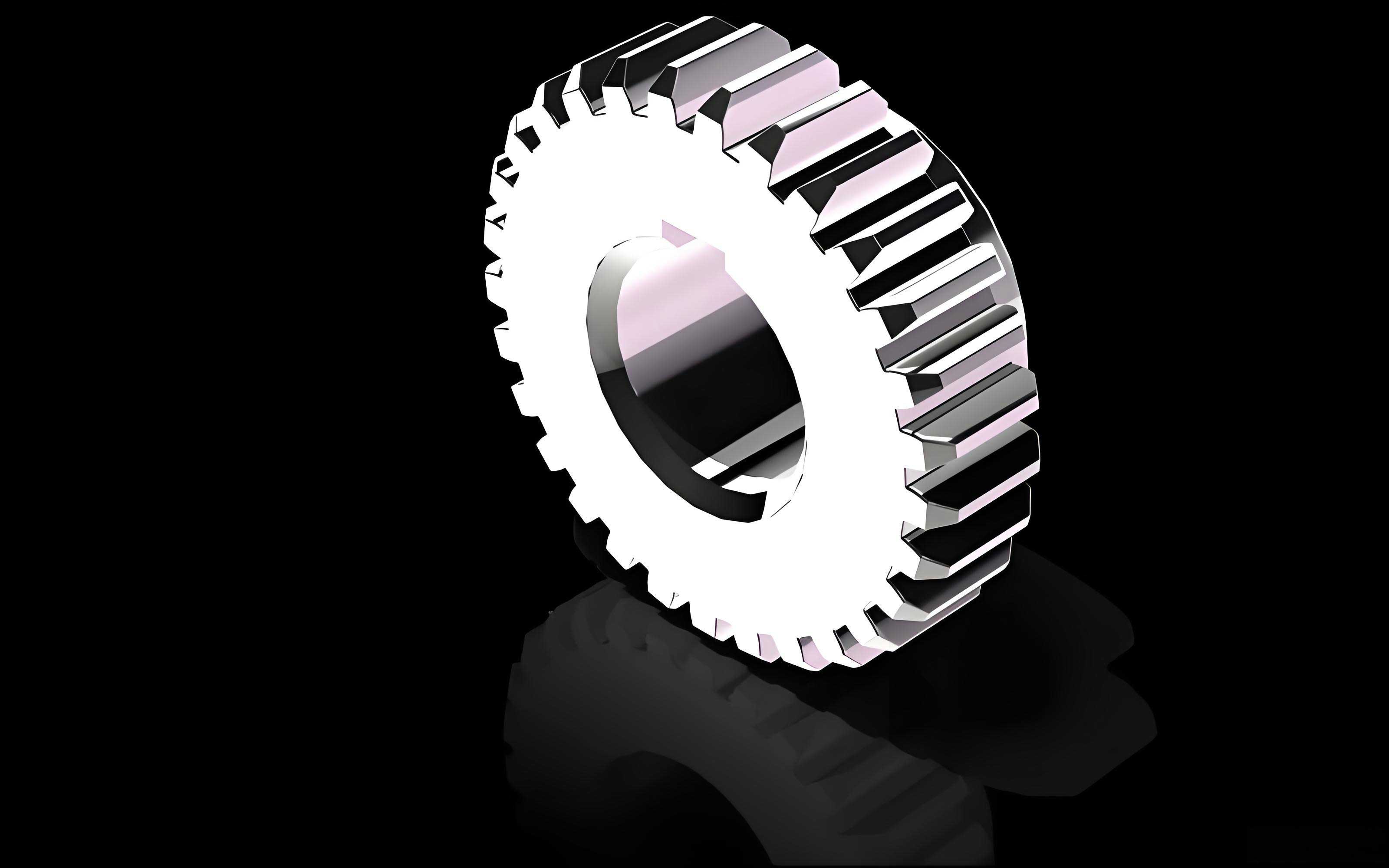
To illustrate the advantages, let’s compare this method with traditional spur gear modeling techniques. Traditional approaches often require generating involute curves via equations, projecting them onto surfaces, creating cuts through extrusions or sweeps, and then mirroring or patterning features. This can involve multiple steps, such as curve creation, surface generation, mirroring, and cut operations, leading to a complex feature tree. In contrast, the variable section sweep with spinal bend condenses the process into four main steps: flat plate extrusion, trajectory sketching, variable section sweep cutting, and spinal bending. The table below summarizes this comparison:
| Modeling Aspect | Traditional Method | Proposed Method | Efficiency Gain |
|---|---|---|---|
| Tooth Profile Generation | Equation-driven curves, often with projections | Direct control via relations in variable section sweep | Reduces curve management overhead |
| Number of Features | Multiple (e.g., curves, surfaces, cuts, mirrors) | Minimal (extrusion, sweep, pattern, bend) | Simplifies feature tree and edits |
| Computational Load | Higher due to complex geometry operations | Lower as it uses simple sections and bending | Enhances software performance |
| Flexibility for Modifications | Can be rigid if parameters are not well-linked | Parametric relations allow easy updates | Improves design iteration speed |
| Applicability to Other Gears | May require significant rework | Easily extended to helical, bevel gears | Increases method utility |
The true power of this methodology lies in its extensibility to other gear types. For instance, when modeling a helical spur gear—essentially a spur gear with angled teeth—the only modification needed is to change the rectangular section in the variable section sweep to a parallelogram. The angle of the parallelogram relative to the trajectory corresponds to the helix angle \( \beta \), and the relations can be adapted to account for the transverse module \( m_t \). This simplicity starkly contrasts with traditional helical gear modeling, which often requires complex sweep paths or twisted surfaces. Similarly, for bevel gears or worm gears, the flat plate approach can be adapted by adjusting the spine curve and section geometry, though detailed discussion is beyond this article’s scope. The key takeaway is that the core principle of using variable section sweep and spinal bend remains effective, making it a versatile tool for spur gear and beyond.
In terms of mathematical rigor, the relations used in the variable section sweep are derived from fundamental involute geometry. The involute function is central to spur gear design, and its parametric form ensures correct tooth engagement. For a spur gear, the tooth thickness on the pitch circle is given by \( s = \frac{\pi m}{2} \), and the space width is similar. During the sweep, the width \( W \) varies according to the radial position, mimicking the involute’s expansion. This can be expressed as:
$$ W(r) = 2 r_b \left( \frac{\pi}{2z} + \inv(\alpha) \right) $$
where \( \inv(\alpha) = \tan(\alpha) – \alpha \) is the involute function. By embedding this into the CAD relations, the model maintains geometric accuracy. Additionally, the bending transformation preserves lengths due to the constant circumference, ensuring that the tooth spacing on the cylindrical spur gear matches the design intent. This mathematical foundation underpins the efficiency and reliability of the method.
From a practical standpoint, this approach offers several benefits for engineers and designers. First, it reduces modeling time for spur gears, allowing rapid prototyping and simulation. Second, it minimizes errors by automating tooth profile generation through relations. Third, it enhances model stability because changes in parameters like module or tooth count automatically propagate through the relations, updating the entire spur gear geometry. This is particularly useful in custom gear design, where iterations are common. To further illustrate, consider a scenario where the spur gear parameters need adjustment: with this method, I simply modify the initial parameters in the relations, and the model regenerates accordingly, whereas traditional methods might require manual re-sketching or feature redefinition.
In conclusion, the integration of variable section sweep and spinal bend features presents a highly efficient strategy for spur gear modeling. By directly cutting tooth slots on a flat plate and then bending it into cylindrical form, this method simplifies operations, reduces feature count, and improves design agility. The use of parametric relations ensures accuracy based on involute geometry, while the extensibility to other gear types enhances its practical value. As mechanical systems evolve, such streamlined modeling techniques become increasingly important for innovation. I recommend adopting this approach for spur gear design in CAD environments, as it not only saves time but also fosters a deeper understanding of gear geometry through its mathematical integration. The spur gear, as a cornerstone of power transmission, deserves modeling solutions that are both robust and efficient, and this method delivers on that front.
To encapsulate the process, here is a summary table of the modeling steps for a spur gear:
| Step | Action | Key Parameters/Formulas | Outcome |
|---|---|---|---|
| 1 | Extrude flat plate | Length = \( \pi m z \), height from gear section | Base feature for unfolding |
| 2 | Sketch trajectory line | Length = tooth height \( h \), aligned to tip edge | Path for variable section sweep |
| 3 | Variable section sweep cut | Relations for width \( W \) based on involute equations | Single tooth slot on plate |
| 4 | Pattern tooth slots | Number of instances = \( z \), linear spacing | All tooth slots on flat gear |
| 5 | Spinal bend | Spine circle diameter = \( m z \), coordinate system placement | Cylindrical spur gear model |
This methodology underscores the importance of leveraging CAD features intelligently to overcome traditional limitations. For spur gears, which are ubiquitous in machinery, such advancements in modeling efficiency can accelerate product development cycles. I encourage further exploration into adapting this technique for complex gear systems, as the principles of variable section sweep and spinal bend offer a solid foundation for innovation. The spur gear, with its simple yet precise geometry, serves as an ideal testbed for these methods, and the results speak to their effectiveness in real-world applications.