
In my research, I focus on the intricate behavior of planetary roller screw assemblies under heavy loading conditions. These mechanical systems are pivotal for converting rotational motion to linear motion with high precision, and they are widely employed in aerospace,精密机床, and other high-demand industries due to their superior load-bearing capacity, rigidity, and compact design. A critical aspect of their performance is the contact interaction between the screw, rollers, and nut, which under extreme loads can transition from elastic to plastic deformation. This analysis delves into the弹塑性接触问题, combining theoretical frameworks like Hertzian contact theory and弹塑性力学 with advanced finite element simulations to understand yield initiation, stress distribution, and deformation characteristics. By examining the single-contact pair between the screw and a roller, I aim to establish a method for assessing yield onset and explore the relationship between applied loads and弹塑性接触变形, providing foundational insights for design optimization and reliability assessment of planetary roller screw assemblies.
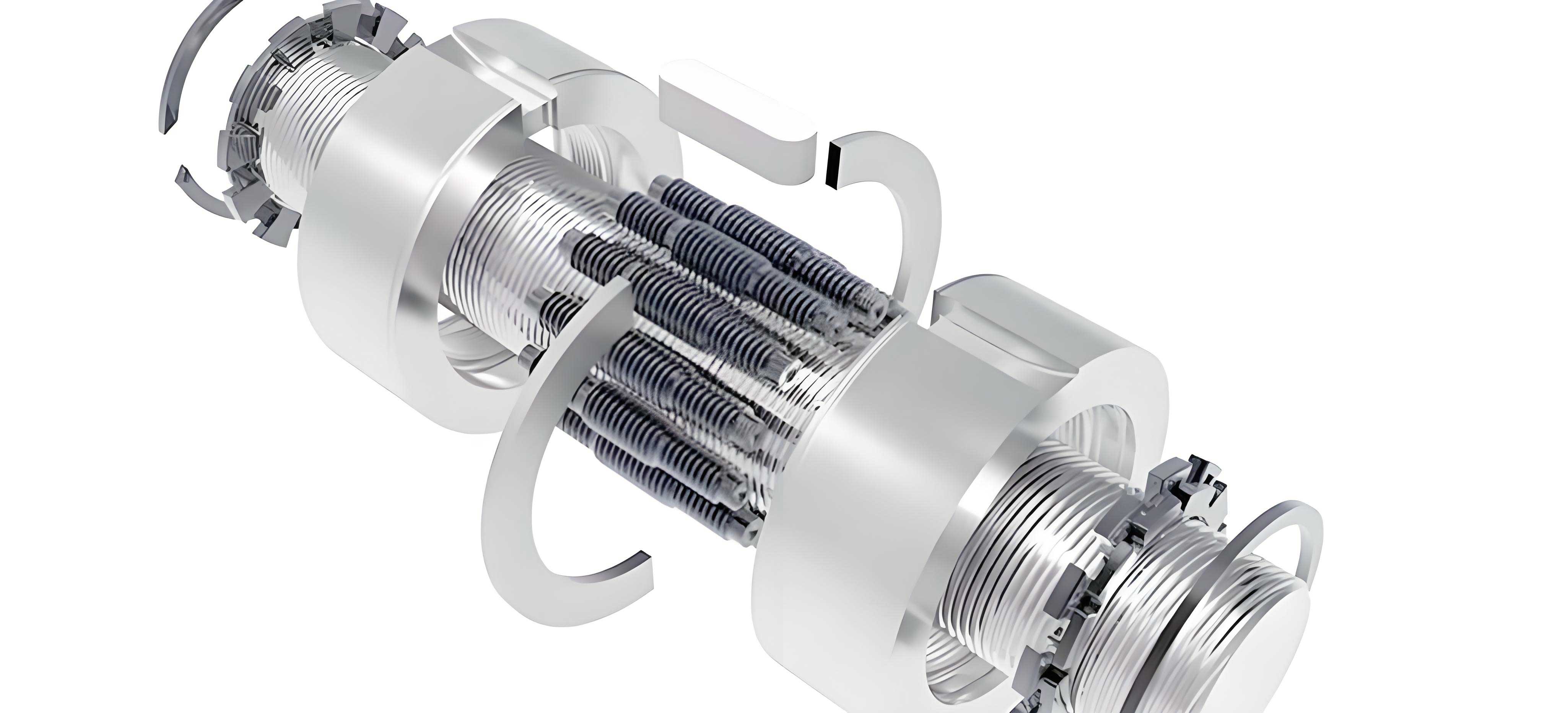
The planetary roller screw assembly operates through multiple threaded rollers that engage with both the screw and nut, creating numerous contact points. Under typical operational loads, these contacts remain within the elastic regime, but short-term overloads can induce plastic yielding, potentially affecting performance and longevity. My approach begins with a theoretical model based on Hertzian contact principles. For a single contact between the screw and a roller, the maximum contact stress, $\sigma_{Hmax}$, is given by:
$$ \sigma_{Hmax} = \frac{3Q}{2\pi ab} $$
where $Q$ is the normal contact force, and $a$ and $b$ are the semi-major and semi-minor axes of the contact ellipse, respectively. The elastic deformation, $\delta_H$, is expressed as:
$$ \delta_H = \frac{2K(e)}{\pi m_a} \sqrt[3]{\frac{9}{32} \frac{Q^2}{E’^2 \Sigma \rho}} $$
Here, $E’$ is the equivalent elastic modulus, $\Sigma \rho$ is the sum of principal curvatures, $K(e)$ is the complete elliptic integral of the first kind, and $m_a$ is a coefficient related to the ellipse eccentricity. The equivalent elastic modulus accounts for material properties of both the screw and roller:
$$ E’ = \frac{1}{\frac{1 – \mu_s^2}{E_s} + \frac{1 – \mu_r^2}{E_r}} $$
where $E_s$, $E_r$ are elastic moduli and $\mu_s$, $\mu_r$ are Poisson’s ratios for the screw and roller, respectively. The contact ellipse dimensions are derived as:
$$ a = m_a \sqrt[3]{\frac{3Q}{2\Sigma \rho E’}}, \quad b = m_b \sqrt[3]{\frac{3Q}{2\Sigma \rho E’}} $$
with $m_b$ as another eccentricity-related coefficient. To determine yield onset, I apply the Von Mises criterion, which is more accurate for ductile materials like the alloy steels used in planetary roller screw assemblies. The condition for plastic deformation initiation is when the maximum shear stress reaches the shear yield limit, $\tau_s$. For contact scenarios, the actual yield limit is modified by a coefficient $k_{st}$ that depends on the ellipse aspect ratio $b/a$:
$$ \sigma_{max} = \frac{\sigma_s}{\sqrt{3} k_{st}} $$
where $\sigma_s$ is the tensile yield strength. By equating $\sigma_{Hmax}$ to $\sigma_{max}$, I derive the critical deformation, $\delta’_H$, and subsequently the critical normal force, $Q_s$, at which yielding begins:
$$ \delta’_H = \frac{K \pi m_a m_b}{2\Sigma \rho} \left( \frac{\sigma_{max}}{E’} \right)^2, \quad Q_s = \frac{2(\pi m_a m_b)^3}{9\sqrt{3} (\Sigma \rho)^2 E’^2} \left( \frac{\sigma_s}{k_{st}} \right)^3 $$
This theoretical framework allows for predicting when a planetary roller screw assembly transitions into the弹塑性状态. For practical applications, the axial load corresponding to this critical state is essential. Considering the contact angle $\beta$ and lead angle $\lambda$, the axial force per roller, $F_{as}$, is:
$$ F_{as} = \tau \cdot Q_s \sin \beta \cos \lambda $$
where $\tau$ is the number of thread turns per roller. To account for load distribution unevenness among threads, I introduce a non-uniformity coefficient $K_v$, leading to the adjusted critical axial load per roller:
$$ F_{asv} = \frac{\tau \cdot Q_s \sin \beta \cos \lambda}{K_v} $$
For a planetary roller screw assembly with $z$ rollers, the overall critical axial load is $F_{nas} = z \times F_{asv}$. However, my analysis primarily focuses on a single screw-roller contact pair to simplify the弹塑性接触问题 while capturing essential physics.
To validate and extend these theoretical insights, I developed a detailed finite element model of the planetary roller screw assembly. The model simplifies the geometry to a扇形 section encompassing five thread turns of both the screw and a roller, reducing computational cost while maintaining accuracy. I utilized ABAQUS software with C3D8R elements—8-node linear brick elements with reduced integration—for meshing, refining the grid near contact regions to capture stress gradients effectively. The material properties are based on GCr15 bearing steel, modeled as an弹塑性线性强化 material but approximated as理想弹塑性 for simplicity, given the small plastic strains involved. The stress-plastic strain relationship is represented as bilinear, with properties summarized in the table below.
| Parameter | Screw | Roller |
|---|---|---|
| Elastic Modulus, E (MPa) | 2.12 × 10⁵ | 2.12 × 10⁵ |
| Poisson’s Ratio, μ | 0.29 | 0.29 |
| Tensile Yield Strength, σs (MPa) | 1617 | 1617 |
| Major Diameter (mm) | 49.43 | 17.6 |
| Pitch (mm) | 5 | 5 |
| Number of Threads | — | 20 |
| Contact Angle, β (°) | 45 | |
In the finite element analysis, I applied symmetric boundary conditions to the side faces of both the screw and roller, allowing only axial displacement, while fully constraining one end of the screw to simulate fixed support. Axial loads were applied to the roller’s end face, and contact pairs were defined between the screw and roller threads with frictionless interaction. This setup enables studying the弹塑性接触响应 under varying loads. For instance, at the theoretical critical axial load of approximately 1497.79 N per roller (based on calculations with $K_v = 1.8$), the finite element results showed initial plastic deformation in the roller’s first thread turn at around 1475 N, with the screw yielding slightly later at 1515 N. This indicates that in a planetary roller screw assembly, the roller tends to yield before the screw, which is crucial for design considerations. The contact stress from finite element analysis at 1475 N was about 2370-2429 MPa, closely matching the theoretical Hertzian prediction of 2345.54 MPa, with errors under 5%, validating the model’s accuracy in the near-yield regime.
To comprehensively assess the弹塑性接触行为, I simulated axial loads ranging from 1000 N to 10000 N. The relationship between load and contact stress, as well as plastic deformation, reveals key trends. The contact stress increases with load, but beyond a certain point, the growth rate deviates from Hertzian predictions due to plastic effects. The table below summarizes finite element results for contact stress and plastic deformation at selected loads.
| Axial Load (N) | Max Contact Stress (MPa) | Plastic Strain in Roller (PEEQ) | Plastic Strain in Screw (PEEQ) |
|---|---|---|---|
| 1000 | ~1500 | 0 | 0 |
| 1475 | 2370-2429 | >0 (first thread) | 0 |
| 3000 | ~3200 | Small | 0 |
| 4500 | ~3800 | Moderate | Emerging |
| 7000 | ~4200 | Significant (max in second thread) | Significant (max in first thread) |
| 10000 | ~4500 | Large | Large |
The data shows that up to around 4500 N, Hertzian theory remains applicable with minimal error, as plastic deformation is negligible. Beyond this, plastic effects become pronounced, and the theoretical overestimates stress due to its assumption of purely elastic behavior. Importantly, the plastic deformation evolution highlights a shift: below 7000 N, the roller’s first thread exhibits the maximum plastic strain, but above this threshold, the second thread surpasses it, suggesting load redistribution and potential performance degradation in the planetary roller screw assembly. This underscores the need to consider弹塑性接触 in overload scenarios.
From a design perspective, the concept of static load rating is vital for planetary roller screw assemblies. Based on my analysis, I propose that the rated static load corresponds to the axial load causing a plastic deformation approximately 0.02% of the roller diameter—akin to standards for rolling bearings. For the studied planetary roller screw assembly with a roller diameter of 16 mm, this deformation is about 3.147 μm, occurring at an axial load per roller near 18680 N (derived from an overall rating of 224.2 kN divided by 12 rollers). Within this range, the planetary roller screw assembly maintains functional integrity despite minor yielding. The mathematical expression for this deformation limit can be linked to the critical load formulas, but in practice, finite element analysis offers a direct assessment. For instance, the plastic deformation, $\delta_p$, under load $F_a$ can be approximated by extending the elastic relation with a plastic correction factor:
$$ \delta_p = \delta_H + \alpha \left( \frac{F_a – F_{asv}}{F_{asv}} \right)^n $$
where $\alpha$ and $n$ are material-dependent constants determined from simulation data. This empirical approach aids in predicting deformation beyond yield for planetary roller screw assemblies.
In conclusion, my investigation into the弹塑性接触 of planetary roller screw assemblies reveals that rollers yield prior to screws, and Hertzian theory is valid only for loads below the yield point. The finite element model confirms theoretical predictions with high accuracy in the elastic-plastic transition zone. For design, the static load rating can be associated with a permissible plastic deformation threshold, ensuring reliability under occasional overloads. Future work could explore temperature effects, fatigue life, and optimization of thread profiles to enhance the performance of planetary roller screw assemblies. This analysis provides a robust framework for engineers to evaluate and improve these critical mechanical components, leveraging both analytical and computational tools for comprehensive弹塑性接触分析.
To further elaborate, the planetary roller screw assembly’s behavior under弹塑性接触 is governed by complex interactions that my model simplifies effectively. The key equations derived from Hertzian theory, such as those for contact stress and deformation, form the backbone of this analysis. For example, the sum of principal curvatures, $\Sigma \rho$, for the screw-roller contact is calculated as:
$$ \Sigma \rho = \frac{1}{R} + \frac{1}{R} + 0 + \frac{2\cos \beta \cos \lambda}{d_s + d_r – 2R\cos \beta} $$
where $R$ is the equivalent spherical radius of the roller thread profile, $d_s$ and $d_r$ are screw and roller pitch diameters. With $\beta = 45^\circ$, $\lambda = \arctan(nP/\pi d_s)$ for $n$ thread starts and pitch $P$, this yields $\Sigma \rho = 0.2058 \, \text{mm}^{-1}$ for the given parameters. The non-uniform load distribution among threads, represented by $K_v$, is critical for accurate assessment; my finite element results align with a value of 1.8 for the first thread, reflecting stress concentration in planetary roller screw assemblies.
Moreover, the弹塑性接触 analysis highlights the importance of material modeling. Using GCr15 steel with its stress-strain curve, I approximated the plastic response, but for more severe deformations, a linear hardening model might be necessary. The finite element simulations captured this well, showing that at 10000 N load, both screw and roller experience substantial plastic strain, exceeding 0.01 in some regions, which could lead to permanent deformation and reduced accuracy in planetary roller screw assemblies. Therefore, design guidelines must incorporate safety factors based on these弹塑性接触 insights.
In practice, the planetary roller screw assembly is often subjected to dynamic loads, but my static analysis lays the groundwork for understanding yield initiation. Extending this to cyclic loading would involve fatigue criteria, but that is beyond the current scope. Nonetheless, the methods developed here—combining theoretical formulas like $Q_s$ for yield onset and finite element validation—offer a replicable approach for analyzing弹塑性接触 in various planetary roller screw assembly configurations. Engineers can use these results to select materials, dimensions, and load ratings that prevent excessive plastic deformation, ensuring long-term functionality. Overall, this study underscores the value of integrating弹塑性力学 with contact mechanics to address real-world challenges in planetary roller screw assembly design and application.