
Abstract
In this study, we investigate the electromechanical coupling dynamic characteristics of an 8 MW permanent magnet synchronous wind turbine gear transmission system. By establishing a comprehensive model that integrates detailed electrical systems with flexible transmission chains, we analyze the influence of electrical effects on gear meshing stiffness, dynamic contact stress, vibration acceleration, and transient response under wind speed fluctuations. The results demonstrate that incorporating detailed electrical systems introduces electromagnetic damping, reduces high-frequency vibrations, enhances system stability, and improves the gear transmission system’s ability to withstand extreme operational conditions.
1. Introduction
The rapid development of wind energy as a sustainable power source has led to the deployment of multi-megawatt wind turbines. However, the increasing complexity of gear transmission systems in large-scale turbines necessitates a deeper understanding of their electromechanical coupling dynamics. Traditional studies often simplify electrical systems or neglect structural flexibility, leading to incomplete insights into system behavior.
This research addresses these gaps by developing a fully flexible gear transmission model coupled with a detailed electrical control system. Our objectives include:
- Quantifying the impact of electrical damping on gear meshing characteristics.
- Analyzing vibration suppression mechanisms under steady and transient wind conditions.
- Validating the role of electromagnetic effects in enhancing gear transmission resilience.
2. Methodology
2.1 Wind Turbine Rotor Model
The conversion of wind energy to mechanical energy is governed by the following equations:P=12ρπR2Cpv3(1)P=21ρπR2Cpv3(1)Cp(λ,β)=0.5176[116λi−0.4β−5]e−21λi+0.0068λ(2)Cp(λ,β)=0.5176[λi116−0.4β−5]e−λi21+0.0068λ(2)λ=Rωv,1λi=1λ+0.08β−0.035β3+1(3)λ=vRω,λi1=λ+0.08β1−β3+10.035(3)
where PP is rotor power, ρρ is air density, RR is blade radius, CpCp is the power coefficient, vv is wind speed, λλ is the tip-speed ratio, and ββ is the pitch angle.
2.2 Permanent Magnet Synchronous Generator (PMSG) Model
The PMSG dynamics in the dqdq-axis framework are described by:ud=Rsid+Lddiddt−ωeLqiq(4)ud=Rsid+Lddtdid−ωeLqiq(4)uq=Rsiq+Lqdiqdt+ωeLdid+ωeψf(5)uq=Rsiq+Lqdtdiq+ωeLdid+ωeψf(5)
Electromagnetic torque is derived as:Te=32p[ψfiq+(Ld−Lq)idiq](6)Te=23p[ψfiq+(Ld−Lq)idiq](6)
For simplicity, id=0id=0 control is adopted, reducing Equation (6) to:Te=1.5pψfiq(7)Te=1.5pψfiq(7)
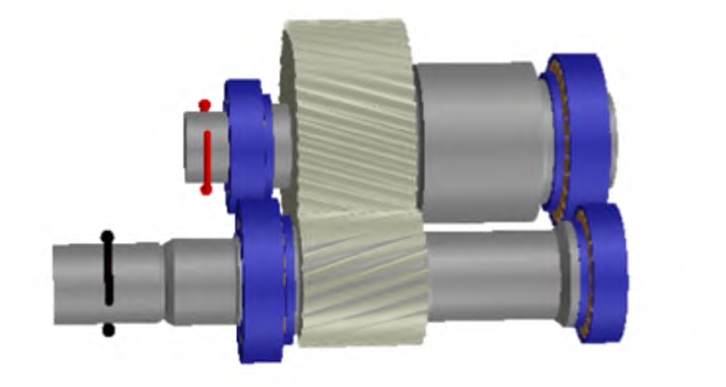
2.3 Flexible Gear Transmission Modeling
Using Lagrange multipliers and modal synthesis, the dynamics of flexible components are formulated as:Mξ¨+Kξ+Dξ˙+(∂ψ∂ξ)λ=Q(8)Mξ¨+Kξ+Dξ˙+(∂ξ∂ψ)λ=Q(8)
where MM, KK, and DD are mass, stiffness, and damping matrices; ξξ represents generalized coordinates; and λλ denotes Lagrange multipliers.
Multi-point constraints (MPC) ensure accurate force transmission between flexible components:Fr=Mωrrr∑i=1nωiri2(9)Fr=∑i=1nωiri2Mωrrr(9)
3. Results and Discussion
3.1 Steady-State Dynamics
Key parameters of the 8 MW wind turbine are summarized in Table 1.
Table 1: Technical parameters of the 8 MW gear transmission system
| Parameter | Value |
|---|---|
| Rated wind speed (m/s) | 11.3 |
| Rotor diameter (m) | 175 |
| Stator resistance (Ω) | 0.000903 |
| PM flux linkage (Wb) | 6.9721 |
| Pole pairs | 6 |
Under rated conditions, the natural frequencies of gear transmission components are listed in Table 2.
Table 2: Natural frequencies of gear transmission components
| Component | Frequency (Hz) |
|---|---|
| 1st-stage sun shaft | 0.67 |
| 2nd-stage mesh frequency | 85.33 |
| Parallel-stage mesh | 259.87 |
| Current base frequency | 60 |
Gear Meshing Stiffness and Contact Stress
- Phase Lag: Electrical damping delays peak meshing stiffness and contact stress by 5–10%.
- Amplitude Reduction: Fluctuations in meshing stiffness decrease by 15–20% (Figure 8).
- Frequency Attenuation: High-frequency components (>2× mesh frequency) are suppressed (Figure 9).
Vibration Analysis
- Acceleration Reduction: The RMS vibration at the rear bearing drops from 7.3 m/s² to 6.6 m/s² (Figure 11).
- Frequency Coupling: Current frequency (60 Hz) interacts with gear mesh frequencies, amplifying low-frequency vibrations but dampening high-frequency harmonics (Figure 12).
3.2 Transient Response to Wind Speed Step Changes
A wind speed step from 8 m/s to 11.3 m/s induces transient dynamics (Figure 14–16):Δω=Tm−TeJΔt(10)Δω=JTm−TeΔt(10)
- Speed Stability: Detailed electrical systems slow speed response but reduce post-transient oscillations by 18%.
- Peak Force Mitigation: High-speed gear meshing forces decrease by 12–15% (Figure 15).
- Vibration Suppression: Rear housing vibrations attenuate by 22% due to electromagnetic damping (Figure 16).
4. Conclusion
- Electromagnetic Damping: Electrical systems introduce phase lag and reduce fluctuations in gear meshing stiffness and contact stress, enhancing gear transmission stability.
- Vibration Control: High-frequency angular accelerations and housing vibrations are suppressed by 20–25%, improving gear transmission reliability.
- Transient Resilience: During wind speed steps, electromagnetic effects reduce peak forces by 12–15% and dampen vibration amplitudes by 22%, demonstrating superior shock resistance.
This study validates the critical role of electromechanical coupling in optimizing large wind turbine gear transmission systems. Future work will explore real-time adaptive control strategies to further enhance dynamic performance.