
In the heavy industrial sectors such as metallurgy, cement production, and chemical processing, the utilization of large-diameter, large-modulus straight bevel gears is commonplace. These critical components, often exceeding one meter in diameter with modules (M) of 16 or greater, are fundamental to the operation of massive machinery. However, a significant challenge arises in non-specialized gear manufacturing enterprises, particularly in repair and fabrication workshops, which frequently lack dedicated bevel gear planers or generators. Consequently, the machining of these large straight bevel gears is often performed on universal milling machines or specially adapted equipment using form-milling cutters with finger-type tools. This manufacturing constraint necessitates the precise design and fabrication of a set of templates: one for grinding the cutting tool itself and another for inspecting the finished gear tooth profile.
The design of the tool template for these large-modulus straight bevel gears presents unique difficulties. For smaller gears, standard tabulated data methods suffice. However, for large modules, the number of coordinate points obtained from standard tables is insufficient. When these sparse points are used to program a wire-cut Electrical Discharge Machining (EDM) machine for template production, the computer’s interpolation between points can lead to a faceted or “saw-tooth” approximation of the intended smooth involute curve, rendering the template useless for producing a high-quality gear. Therefore, the graphical calculation method becomes the preferred design approach. This method involves generating a large-scale layout of the tooth profile to derive a dense set of coordinate points.
The traditional implementation of this graphical method is fraught with inefficiency and inaccuracy. It relies entirely on manual drafting using drawing boards, followed by physical measurement of coordinates from the paper drawing using scales and protractors. This process introduces multiple layers of error: drafting inaccuracies, measurement parallax, and scaling mistakes. The cumulative effect is a significant deviation in the final template profile. When this imperfect template is used to manufacture a cutting tool, and that tool is in turn used to produce a straight bevel gear, the resulting gear exhibits poor meshing characteristics, elevated noise and vibration levels, and substantially reduced operational lifespan. Furthermore, the manual process is exceedingly time-consuming.
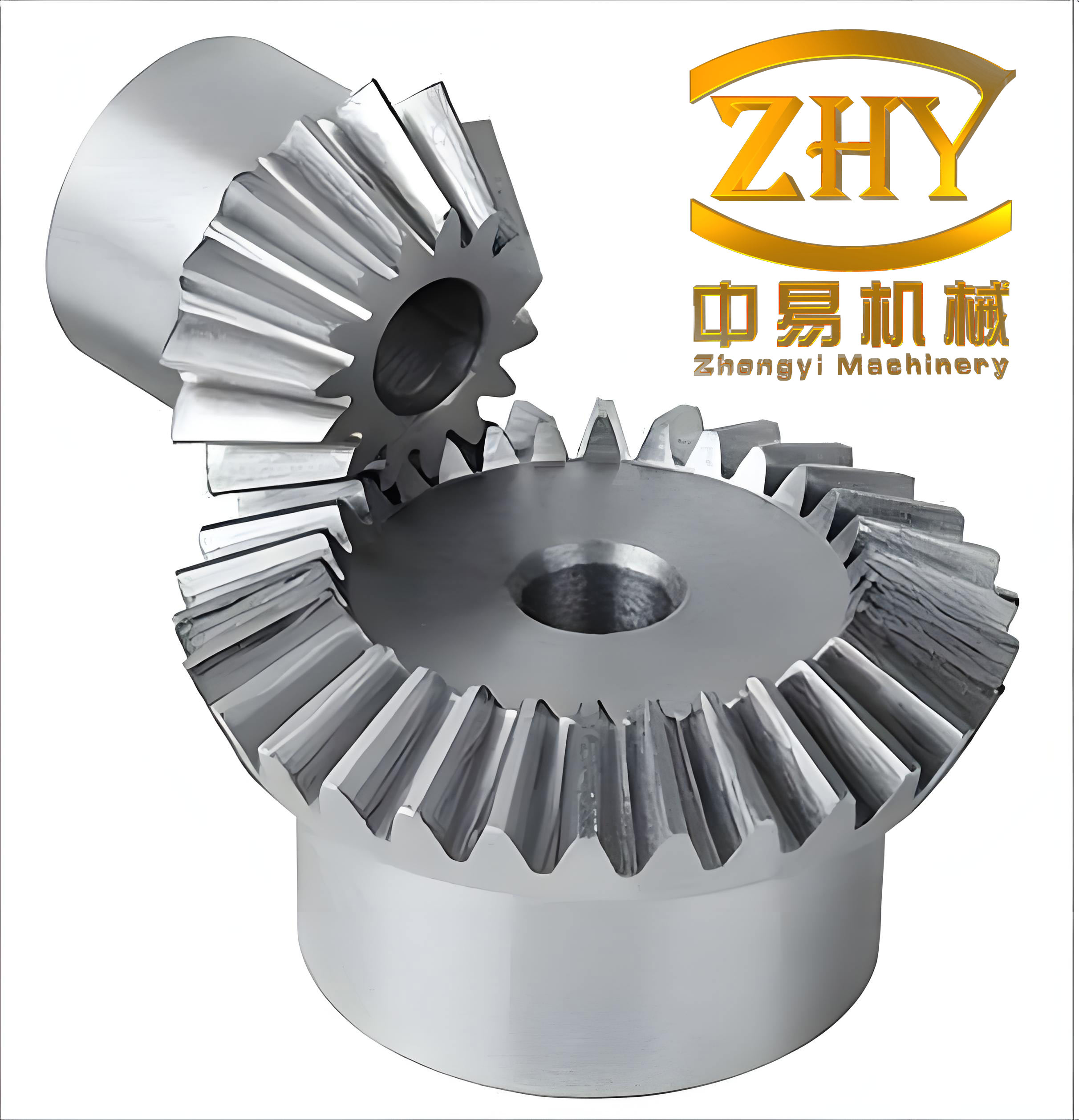
To overcome these critical limitations, a transformative integration of computer-aided design (CAD) technology, specifically using a platform like Auto CAD, into the graphical calculation workflow was pioneered. This integration fundamentally redefines the design process for templates of large-modulus straight bevel gears. The core principle involves leveraging the precision, scalability, and computational assistance of CAD software to execute the graphical constructions and measurements digitally, thereby eliminating manual error sources and dramatically accelerating the process. The following sections detail this enhanced methodology through a comprehensive design example.
Theoretical Foundation and Design Procedure for Straight Bevel Gear Tool Templates
The design of a form-milling cutter for a straight bevel gear is based on the concept of an “equivalent spur gear.” The tooth profile at the large end of the straight bevel gear is derived from the profile of a standard spur gear cutter, which is then transformed mathematically to account for the conical geometry. The graphical method effectively performs this transformation visually and metrically. Our enhanced CAD-based method follows a structured sequence, where critical parameters are calculated, and CAD is used for precise graphical operations.
Step 1: Define Gear Parameters and Calculate Equivalent Spur Gear Data
Consider a large straight bevel gear with the following specifications:
$$ \text{Module, } m = 20 \text{ mm} $$
$$ \text{Number of teeth, } z = 76 $$
$$ \text{Pitch cone angle, } \varphi = 75^\circ 35’17” $$
The first step is to calculate the number of teeth for the equivalent spur gear (\(z_i\)), which is vital for selecting the correct tool profile data.
$$ z_i = \frac{z}{\cos \varphi} = \frac{76}{\cos(75^\circ 35’17”)} \approx 305.3536 $$
Based on \(z_i\), the appropriate cutter number is selected from standard gear tooling handbooks. For this high equivalent tooth count, an #8 cutter is typically specified.
The coordinates \((x_g, y_g)\) for the basic rack profile of the #8 cutter are obtained from standard tables. These are scaled by the module to get the coordinates \((x, y)\) for the actual spur gear cutter profile of module 20. The scaling formulas are:
$$ x = \frac{m}{10} \cdot x_g $$
$$ y = \frac{m}{10} \cdot y_g $$
Given \(m=20\), this simplifies to \(x = 2x_g\) and \(y = 2y_g\). A subset of the resulting coordinate set is presented in the table below.
| Point ID | x (mm) | y (mm) |
|---|---|---|
| 1 | 5.2692 | -10.9794 |
| 2 | 5.63378 | -8.9821 |
| 3 | 6.03058 | -6.98522 |
| … | … | … |
| P (Pitch Point) | 15.708 | 24.000 |
| … | … | … |
| N | 32.29604 | 60.38432 |
In the traditional method, these points would be painstakingly plotted on paper to draw the spur gear involute. In our enhanced method, these coordinates are directly input into the CAD software. Using the “spline” or “polyline” command through these precise points generates a flawless, smooth involute curve, as shown in the conceptual figure. This digital curve forms the basis for all subsequent graphical constructions.
Step 2: Determine the Transformation Parameters for the Straight Bevel Gear
The straight bevel gear tooth profile is not identical to the spur gear profile; it requires a transformation that accounts for the taper. The graphical method finds a key intersection point (\(P_1\)) to define this transformation. This involves calculating and plotting a circular arc representing a limiting condition at the small end of the gear.
First, calculate the radius of the limiting small-end pitch circle (\(r’_f\)) for the #8 cutter:
$$ r’_f = \frac{m \cdot z’_i}{3} $$
where \(z’_i\) is the minimum number of teeth for the #8 cutter from handbooks (e.g., 135).
$$ r’_f = \frac{20 \times 135}{3} = 900 \text{ mm} $$
Next, calculate the small-end root radius (\(R’_i\)):
$$ R’_i = m \left( \frac{z’_i}{3} – \frac{13}{15} \right) = 20 \times \left( \frac{135}{3} – \frac{13}{15} \right) \approx 882.667 \text{ mm} $$
The arc to be drawn is defined by points satisfying the equation of a circle with radius \(r’_f\) and a center offset by \(R’_i\):
$$ (y + R’_i)^2 + x^2 = (r’_f)^2 $$
$$ (y + 882.667)^2 + x^2 = 900^2 $$
We solve for \(y\) for a series of \(x\) values within the range \(\frac{\pi m}{8} \leq x \leq \frac{\pi m}{4}\), i.e., \(7.854 \leq x \leq 15.708\) mm. This yields a set of coordinates \(A_1, A_2, …, A_{18}\).
| Arc Point | x (mm) | y (mm) |
|---|---|---|
| A1 | 15.708 | 17.196 |
| A2 | 15.208 | 17.2045 |
| … | … | … |
| A17 | 8.000 | 17.297 |
| A18 | 7.854 | 17.299 |
Step 3: CAD-Based Graphical Construction for Parameter Extraction
This is where the CAD integration delivers its primary advantage. Instead of manual plotting, the coordinates for the spur gear involute (from Step 1) and the circular arc points (from Step 2) are plotted in the CAD software on the same drawing with high precision. A smooth curve is fitted through the arc points \(A_1\) to \(A_{18}\). The software’s “intersection” snap command is then used to accurately locate the point \(P_1\), where this arc intersects the previously drawn spur gear involute curve.
The software directly reports the coordinates of \(P_1\), for example:
$$ P_1 = (13.500, 17.232) \text{ mm} $$
This step, prone to significant error in manual drafting and measurement, is now executed with sub-millimeter or even micron-level digital accuracy.
Step 4: Calculate the Transformation Parameters
With \(P_1\) and the known pitch point \(P\) of the spur gear (\(x_p=15.708, y_p=24.000\)), key parameters are calculated arithmetically with high precision.
The parameter \(g’\), which is the horizontal distance between \(P\) and \(P_1\), is:
$$ g’ = |x_p – x_{p1}| = |15.708 – 13.500| = 2.208 \text{ mm} $$
The vertical distance \(y_0\) from \(P_1\) to the root line is simply its y-coordinate:
$$ y_0 = 17.232 \text{ mm} $$
The cutter rotation angle \(\lambda\) for the straight bevel gear transformation is calculated as:
$$ \lambda = \frac{\pi}{2z’_i} – \frac{6g’}{m z’_i} $$
Substituting values:
$$ \lambda = \frac{\pi}{2 \times 135} – \frac{6 \times 2.208}{20 \times 135} \approx 0.011635 \text{ rad} \quad \text{or} \quad \approx 0.0001174 \text{ rad (for higher precision in subsequent steps)} $$
The small-end pitch point’s x-coordinate (\(x_0\)) is:
$$ x_0 = \frac{2}{3} x_p = \frac{2}{3} \times 15.708 \approx 10.477 \text{ mm} $$
Finally, the offset \(a\) for the coordinate transformation is determined:
$$ a = (x_p – g’ – y_0 \cdot \tan \lambda) \cos \lambda – x_0 \approx 3.02598 \text{ mm} $$
Step 5: Perform the Coordinate Transformation to Obtain the Straight Bevel Gear Profile
The core mathematical transformation converts the spur gear coordinates \((x, y)\) to the straight bevel gear cutter coordinates \((x’, y’)\). The transformation equations, accounting for a rotation by angle \(\lambda\) and a translation by offset \(a\), are:
$$ x’ = x \cos \lambda – y \sin \lambda – a $$
$$ y’ = x \sin \lambda + y \cos \lambda $$
Given the extremely small value of \(\lambda\), \(\cos \lambda \approx 1\) and \(\sin \lambda \approx \lambda\). The equations can be simplified for computation as:
$$ x’ \approx 1 \cdot x – \lambda \cdot y – a $$
$$ y’ \approx \lambda \cdot x + 1 \cdot y $$
Substituting \(\lambda = 0.000117443\) and \(a = 3.02598\):
$$ x’ = 0.999999993x – 0.000117443y – 3.02598 $$
$$ y’ = 0.000117443x + 0.999999993y $$
Every \((x, y)\) coordinate from the original spur gear table is processed through these equations. The resulting \((x’, y’)\) coordinates define the precise tooth profile of the form cutter for the large-modulus straight bevel gear. A portion of the results is shown below.
| Point ID | x’ (mm) | y’ (mm) |
|---|---|---|
| 1′ | 2.243 | -10.97878 |
| 2′ | 2.60886 | -8.98144 |
| 3′ | 3.00542 | -6.98451 |
| … | … | … |
| Pitch Pt’ | 10.477 | 24.000 |
| … | … | … |
| N’ | 29.26297 | 60.38811 |
Step 6: Final Profile Detailing and Template Generation
The non-working (root) portion of the tooth profile, including the fillet radius, must be added. The fillet radius \(R’\) is obtained from handbooks. For a module 20 gear and a #8 cutter, a typical value is \(R’ = 5 \text{ mm}\).
In the CAD environment, the transformed involute points \((x’, y’)\) are plotted to create the working portion of the straight bevel gear tooth profile. The fillet is then constructed digitally: a circle of radius \(R’=5\) mm is drawn tangent to the root line and tangent to the lower portion of the involute curve. The CAD software’s geometric constraint tools (like “tangent” snap) ensure perfect, repeatable tangency. The software can then directly output the coordinates of the fillet circle’s center and its two tangent points (B and C), for example:
$$ \text{Center} = (2.870, 5.000) \text{ mm} $$
$$ \text{Point B} = (6.0169, 4.997) \text{ mm} $$
$$ \text{Point C} = (2.870, 0.000) \text{ mm} $$
The complete, continuous digital profile—comprising the transformed involute from the calculated points and the perfectly fitted fillet—now exists in the CAD file. This digital model serves as the master geometry. The coordinate data for the entire profile (involute points and fillet points) is exported and used to program a wire-cut EDM machine. The machine then accurately produces the physical tool template from tool steel. This template is subsequently used to grind the actual form-milling cutter for machining the large straight bevel gear.
Quantitative and Qualitative Advantages of the CAD-Integrated Methodology
The benefits of applying CAD technology to the design of templates for large-modulus straight bevel gears are profound and multi-faceted, impacting both the design process and the final product performance.
1. Drastic Reduction in Design Error: The manual process is eliminated at the most error-prone stages: physical drawing and measurement. All constructions are performed in a precise digital coordinate space. Intersection points are found mathematically by the software, not visually estimated by the designer. Coordinate extraction is exact. The cumulative error, which could easily exceed 0.1 mm in the manual method, is reduced to the computational precision of the CAD software (typically on the order of \(1 \times 10^{-9}\) mm or better). This directly translates to a geometrically perfect template profile.
2. Significant Increase in Design Efficiency: What was a labor-intensive, day-long task of drafting and measuring is condensed into a process that can be completed in a few hours. Modifying a design parameter (e.g., module or pressure angle) and regenerating the entire profile is a matter of updating formulas and replotting, rather than starting the drawing from scratch. This allows for rapid iteration and optimization.
3. Enhanced Product Quality and Performance: The primary objective of any gear design is to achieve proper conjugate action between meshing teeth. The precision afforded by the CAD-generated template ensures the cutting tool produces a gear tooth profile that is a true, accurate involute. Gears manufactured using this method exhibit:
- Superior Meshing Performance: Reduced transmission error, leading to smoother torque transfer.
- Minimized Noise and Vibration: Accurate tooth profiles prevent premature contact and edge-loading, major sources of gear noise.
- Extended Operational Lifespan: Even load distribution across the tooth face reduces contact stress and minimizes pitting and wear failures. Field data from gears produced via this method, such as those used in mining crushers (\(m=20, z=76\)) or large mixer drives (\(m=15, z=76\)), has shown lifespan increases exceeding 75% compared to gears made from manually designed templates.
4. Facilitation of Modern Manufacturing: The digital output of the CAD process is perfectly suited for Computer-Aided Manufacturing (CAM). The dense point cloud or the direct CAD geometry can be fed into CNC machine tools (like 5-axis grinders for making the cutter or the gear itself) or wire-EDM machines for template fabrication, creating a seamless digital thread from design to production.
Conclusion and Forward Outlook
The integration of CAD technology into the graphical calculation method for designing cutting tool templates represents a critical evolution in the manufacturing of large-modulus straight bevel gears. It successfully bridges a gap where dedicated, expensive gear-generating machinery is unavailable. By replacing manual, analog processes with digital precision and automation, this methodology effectively solves the historical problems of high error and low efficiency associated with template design for these substantial components.
The result is not merely an incremental improvement but a fundamental enhancement in the capability to produce high-performance straight bevel gears in general engineering workshops. The significant gains in gear quality—manifested as smooth operation, quietness, and remarkable durability—directly contribute to increased reliability and reduced lifecycle costs for the heavy industrial equipment that depends on them. This approach underscores the powerful synergy between classical mechanical design principles and modern digital tools, proving that even established techniques can be revolutionized to meet contemporary standards of precision and productivity in the realm of gear manufacturing.