
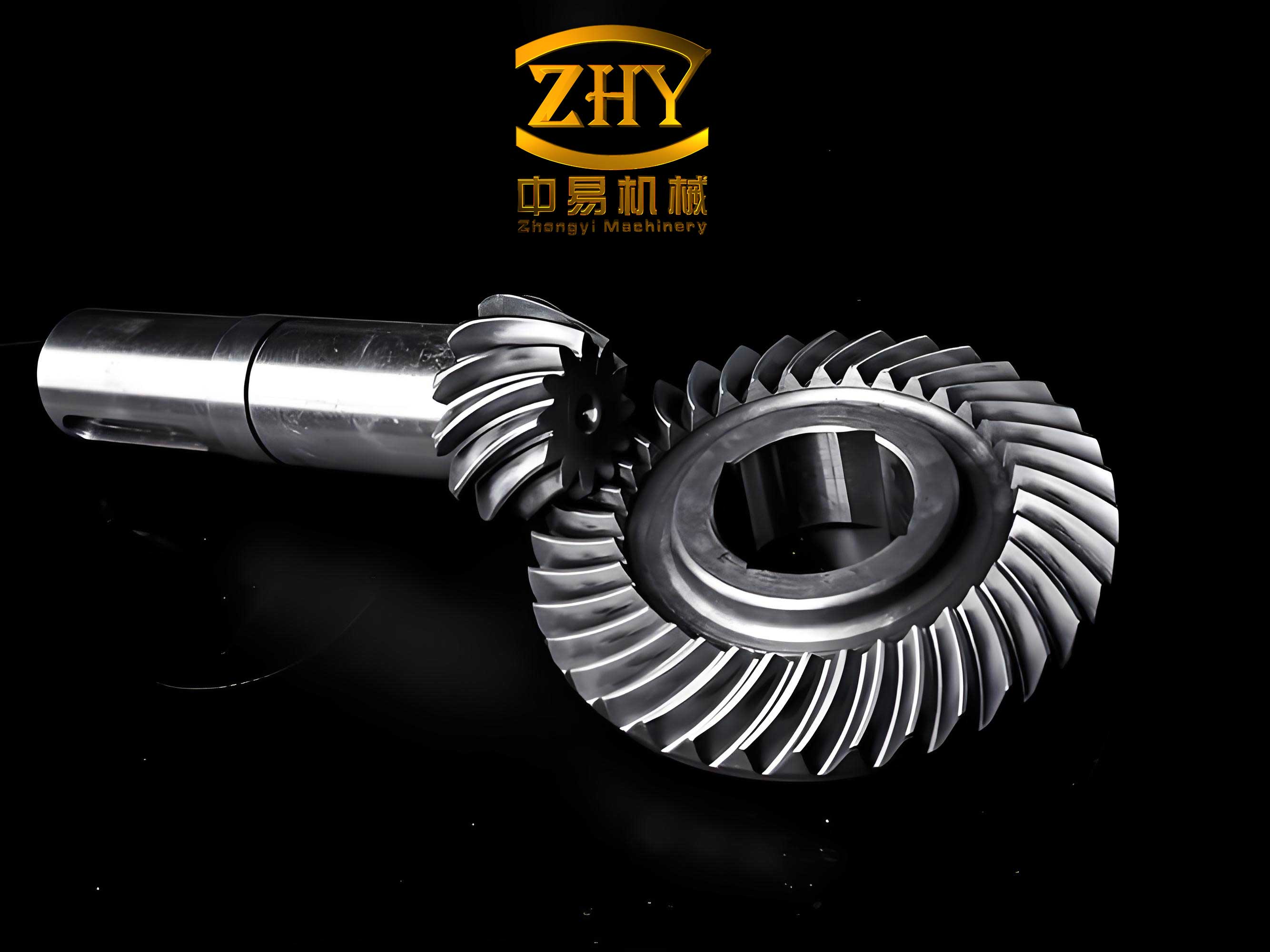
In the demanding world of heavy-duty machinery, the reliability of the power transmission system is paramount. As an engineer deeply involved in product development and failure analysis, I have encountered numerous challenges related to the final drive assembly, particularly the spiral bevel gear set. These gears are the heart of the main drive, responsible for transferring power at a right angle while managing tremendous torque and shock loads. A persistent issue observed in a specific loader model, the ZL40B, involved premature and catastrophic failures of its main drive spiral bevel gears. This report chronicles a comprehensive, first-hand investigation into the root causes of these failures, the subsequent analytical process, and the implementation of a successful redesign strategy, offering broader insights for engineering robust drive systems.
The primary failure modes observed in the field for the ZL40B spiral bevel gear set were statistically categorized into four distinct types. Each mode pointed towards specific weaknesses in material, design, or application.
| Failure Mode | Description & Visual Characteristics | Primary Root Cause |
|---|---|---|
| Case Crushing/Spalling | Large chunks of the hardened surface layer detach, often starting in the sub-surface transition zone. The exposed area appears rough and crater-like. | Insufficient case depth or poor microstructure (excessive retained austenite, coarse carbides) leading to high subsurface shear stresses exceeding material endurance limit. |
| Fatigue Root Fracture | Complete breakage of the tooth at the fillet region. The fracture surface exhibits classic fatigue features: smooth zones with beach marks radiating from the initiation point, followed by a final rapid fracture area. | Cyclic bending stresses at the root exceeding the corrected endurance limit of the material. Often initiated at stress concentrators like a small tool tip radius or non-metallic inclusions. |
| Overload Fracture | Sudden, catastrophic breakage at the tooth root. The fracture surface is generally coarse, granular, and perpendicular to the tooth axis, showing little to no evidence of progressive crack growth. | A single load event where the instantaneous bending stress surpasses the ultimate tensile strength of the material. Common during severe impact or blockage. |
| Impact Wear & Damage at Tooth Ends | Localized battering, deformation, micro-pitting, or chipping at the toe or heel of the gear teeth. Surfaces appear “mushroomed” or severely pocked. | Misalignment, improper gear pattern positioning, or extreme shock loading causing edge contact and high localized Hertzian contact stresses. |
A forensic analysis of failed components revealed a common narrative: the larger spiral bevel gear (the ring gear) was often the initiator of the failure cascade. A typical scenario involved the fracture of several teeth on the ring gear. This immediately created severe meshing disturbance, causing dynamic impact loads that led to the complete destruction of the smaller pinion gear. The root cause of the initial ring gear failure was frequently traced back to material and heat treatment inconsistencies from the supplier, such as shallow or deep case depths and unacceptable carbide morphology. This finding shifted our focus from purely operational abuse to fundamental design and manufacturing margins.
We then analyzed the operational context. Loaders are subjected to inherently harsh duty cycles with frequent directional changes, digging forces, and instances where the machine is used as a bulldozer, leading to sudden blockages. These events generate transient torque peaks far exceeding the nominal design torque. While a spiral bevel gear is designed for continuous contact stress, its root is simultaneously subjected to pulsating bending stress. The maximum bending stress ($\sigma_F$) at the root fillet is the critical parameter for fracture and can be estimated by the fundamental Lewis formula, augmented with dynamic and application factors:
$$
\sigma_F = \frac{F_t}{b \cdot m_n} \cdot Y_F \cdot Y_S \cdot K_A \cdot K_V \cdot K_{F\beta} \cdot K_{F\alpha}
$$
Where $F_t$ is the tangential force at the pitch circle, $b$ is the face width, $m_n$ is the normal module, $Y_F$ is the tooth form factor, $Y_S$ is the stress correction factor, $K_A$ is the application factor, $K_V$ is the dynamic factor, $K_{F\beta}$ is the face load factor for bending, and $K_{F\alpha}$ is the transverse load factor for bending. In overload conditions, $K_A$ can spike, potentially doubling or tripling $\sigma_F$, easily breaching the safety factor and initiating cracks.
Our investigation pointed to a critical conclusion: the existing spiral bevel gear design had insufficient overload capacity for the intended application. The original design parameters, largely inherited from automotive practices, were ill-suited for the low-speed, high-shock environment of an off-road loader. For instance, automotive designs prioritize noise reduction (favoring higher spiral angles) and high-speed efficiency, while loader gears prioritize pure strength and durability. A review of the original design calculations revealed a concerningly low safety factor, especially in bending. The allowable bending stress ($[\sigma_F]$) for the 20CrMnTi material was approximately 808 MPa, while the calculated service stress was already very close to this limit under nominal load, leaving minimal margin for shock loads.
| Parameter | Pinion | Ring Gear | Unit |
|---|---|---|---|
| Number of Teeth (z) | 7 | 37 | – |
| Module (m) | 10.5 | mm | |
| Spiral Angle (β) | 35° | deg | |
| Pressure Angle (α) | 20° | deg | |
| Face Width (b) | 60 | mm | |
| Tangential Correction Coefficient | 25% | – | – |
| Calculated Bending Stress ($\sigma_F$) | 479 | 717 | MPa |
| Calculated Contact Stress ($\sigma_H$) | 3399 | MPa | |
The contact stress $\sigma_H$ is calculated as:
$$
\sigma_H = Z_E \sqrt{\frac{F_t}{b \cdot d_1} \cdot \frac{u \pm 1}{u} \cdot K_A \cdot K_V \cdot K_{H\beta} \cdot K_{H\alpha}}
$$
Where $Z_E$ is the elasticity factor, $d_1$ is the pinion pitch diameter, $u$ is the gear ratio, $K_{H\beta}$ is the face load factor for contact, and $K_{H\alpha}$ is the transverse load factor for contact. The high calculated $\sigma_H$ was near the material’s allowable limit of ~3430 MPa, confirming a design operating at its theoretical edge.
Furthermore, manufacturing variances exacerbated the problem. The specified tool tip radius and cutter edge geometry directly influence the root fillet stress concentration factor. Deviations during production could weaken the tooth further. Our analysis showed that by simply adjusting the cutter tip distance (blade point width) from 7.52mm to 6.5mm during finishing, the tooth thickness balance shifted, slightly reducing the stress in the ring gear but increasing it in the pinion. This highlighted the sensitivity of the design and the need for a more robust parameter set.
The path to a solution required a fundamental re-evaluation of the key geometric parameters defining a spiral bevel gear. We established that a holistic, interdependent approach was necessary, moving away from automotive-centric standards. The primary goals were to increase the bending strength and reduce sensitivity to axial thrust forces, which can shift the contact pattern under load and lead to localized stress concentrations.
- Gear Ratio (u): While often a fixed system constraint, a high ratio (e.g., >5:1) results in a very small pinion with high curvature and contact stress. We advocated for exploring lower ratios (3-4:1) as seen in benchmarked machines, allowing for a pinion with more teeth, improved overlap ratio, and better balanced stresses.
- Pressure Angle (α): This is one of the most effective parameters for improving bending strength. Increasing the pressure angle significantly increases the tooth cross-section at the root without substantially affecting contact stress. The bending stress is inversely proportional to the square of the cosine of the pressure angle in simplified models. We targeted an increase from 20° to 22.5° or even 25°.
- Spiral Angle (β): While a large spiral angle (35°-40°) improves smoothness and contact ratio, it also generates high axial thrust forces $F_a = F_t \cdot (\tan \alpha \sin \delta \pm \cos \delta \tan \beta)$ (where $\delta$ is the pitch cone angle). These forces can deflect gears and housings, mislocating the contact pattern. A lower spiral angle reduces axial thrust dramatically, enhancing stability under shock load. Our finite element analysis (FEA) of bending stress versus spiral angle was revealing:
| Spiral Angle (β) | Pinion $\sigma_F$ (MPa) | Ring Gear $\sigma_F$ (MPa) | Reduction in Axial Force |
|---|---|---|---|
| 35° (Original) | 530 | 634 | Base |
| 30° | 528 | 562 | ~16% |
| 25° | 459 | 553 | ~31% |
| 15° | 419 | 493 | ~60% |
4. Working Depth / Addendum: A larger tooth depth increases the sliding velocity and can reduce surface durability. However, with a lower gear ratio enabling more pinion teeth, a fuller tooth profile can be adopted without undercutting, slightly improving bending capacity.
Based on this analysis, we pursued two parallel redesign schemes for the spiral bevel gear set:
Scheme A (Parametric Optimization): Maintain the 10.5mm module but change core geometry.
– Pressure Angle (α): Increased to 22.5°.
– Spiral Angle (β): Reduced to 30° (a compromise for manufacturability and contact pattern stability).
– Tooth Thickness Balance: Adjusted to achieve a nominal bending stress ratio (Ring Gear : Pinion) of about 1.2 : 1.
– Tooling: Utilized a cutter head specification compatible with the new pressure angle.
– Heat Treatment: Implemented stricter process controls for case depth, carbon potential, and tempering to ensure consistent core toughness and case hardness.
Scheme B (Scaled-Up Design): Increase the fundamental size.
– Module (m): Increased from 10.5mm to 11.0mm.
– All other dimensions scaled accordingly, leading to inherently stronger teeth due to increased cross-section.
Both new spiral bevel gear designs were manufactured on a modern Gleason 640 machine to ensure high geometric accuracy and consistent tooth flank topography. The contact pattern was engineered to be slightly bias-mounted to account for anticipated deflection under high torque.
| Critical Parameter | Original Design | Optimized Design (Scheme A) | Impact |
|---|---|---|---|
| Pressure Angle (α) | 20° | 22.5° | Major increase in root bending strength, reduced risk of fatigue fracture. |
| Spiral Angle (β) | 35° | 30° | Significant reduction in axial thrust, stabilizing contact pattern under load, moderate gain in bending strength. |
| Bending Stress Ratio (R:G / P) | ~1.5 : 1 (Unbalanced) | ~1.2 : 1 | More balanced strength, protecting the historically weaker ring gear. |
| Manufacturing Precision | Standard | High (Gleason 640) | Reduced noise, more predictable stress distribution, better contact pattern control. |
| Heat Treatment Control | Variable (Supplier Dependent) | Strict In-house Specification | Consistent case depth (~1.0-1.3mm) and core hardness, eliminating early spalling. |
The final design choice was driven by both performance and economics. Field trials were conclusive:
- Scheme A (Optimized Geometry): 102 units deployed, with only one failure reported well beyond the warranty period.
- Scheme B (Increased Module): 43 units deployed, with zero failures reported.
Both spiral bevel gear designs were technically successful. However, Scheme B required significant changes to the housing and related components (bridge, differential carrier) due to the increased gear outer diameter. This broke interchangeability with existing platforms and added over 800 USD per unit in cost. Scheme A, achieving remarkable reliability through intelligent parameter changes while maintaining component interchangeability, was clearly the superior and economically viable solution.
The financial and reputational impact was substantial. Prior to the redesign, the failure rate of the spiral bevel gear sets was unacceptably high, leading to significant warranty costs and customer dissatisfaction. The implementation of the new design effectively eliminated this chronic failure mode.
| Metric | Pre-Redesign (Example Year) | Post-Redesign Implementation |
|---|---|---|
| Annual Unit Sales (Loader Model) | ~900 units | ~900 units |
| Gear Set Failure Rate | ≈ 20% (based on field data trends) | < 1% |
| Estimated Annual Failures | ~180 gear sets | ~9 gear sets |
| Cost per Failure (Parts + Logistics + Labor) | ~1,250 USD | ~1,250 USD |
| Total Annual Warranty Cost Avoidance | – | > 210,000 USD |
| Key Benefit | Enhanced brand reputation for reliability, reduced downtime for customers, and elimination of a major quality pain point. | |
In conclusion, the journey to solve the persistent spiral bevel gear failures was a textbook exercise in root-cause analysis and systematic engineering redesign. It underscored that designing for an application is profoundly different from adapting a design from another field. For heavy-duty spiral bevel gears in off-road equipment, the optimization vector points decisively towards: increased pressure angle for bending strength, moderate-to-low spiral angle for reduced axial thrust and stable contact patterns, balanced tooth strength between mating gears, and flawless control of material and heat treatment. The successful outcome validates that a deep, physics-based understanding of gear geometry and its interaction with the system is essential for developing durable and reliable power transmission components. The lessons learned are directly applicable to the design and development of future drivetrains, ensuring that the spiral bevel gear—a critical and complex component—is a source of strength, not failure.