
In the realm of precision motion control and robotics, harmonic drive gears have established themselves as indispensable components due to their exceptional characteristics, including compact size, lightweight construction, high accuracy, minimal backlash, large reduction ratios, and remarkable efficiency. The core of this transmission system lies in the elastic deformation of the flexible spline (or flexspline), which is primarily induced by a critical component known as the wave generator. As an engineer deeply involved in the design and optimization of these systems, I have focused my research on the wave generator, specifically its outer contour shape. The traditional cam-type wave generator, while functional, presents limitations in ensuring perfect conformity with the inner wall of the flexspline barrel throughout its operational cycle. This imperfect contact can lead to suboptimal stress distribution, reduced meshing performance, and ultimately, a shorter service life for the harmonic drive gear. Therefore, in this comprehensive study, I propose and analyze refined methodologies for improving the outer contour shape of the cam wave generator, aiming to achieve superior alignment with the flexspline and thereby unlock enhanced performance metrics for the entire harmonic drive gear assembly.
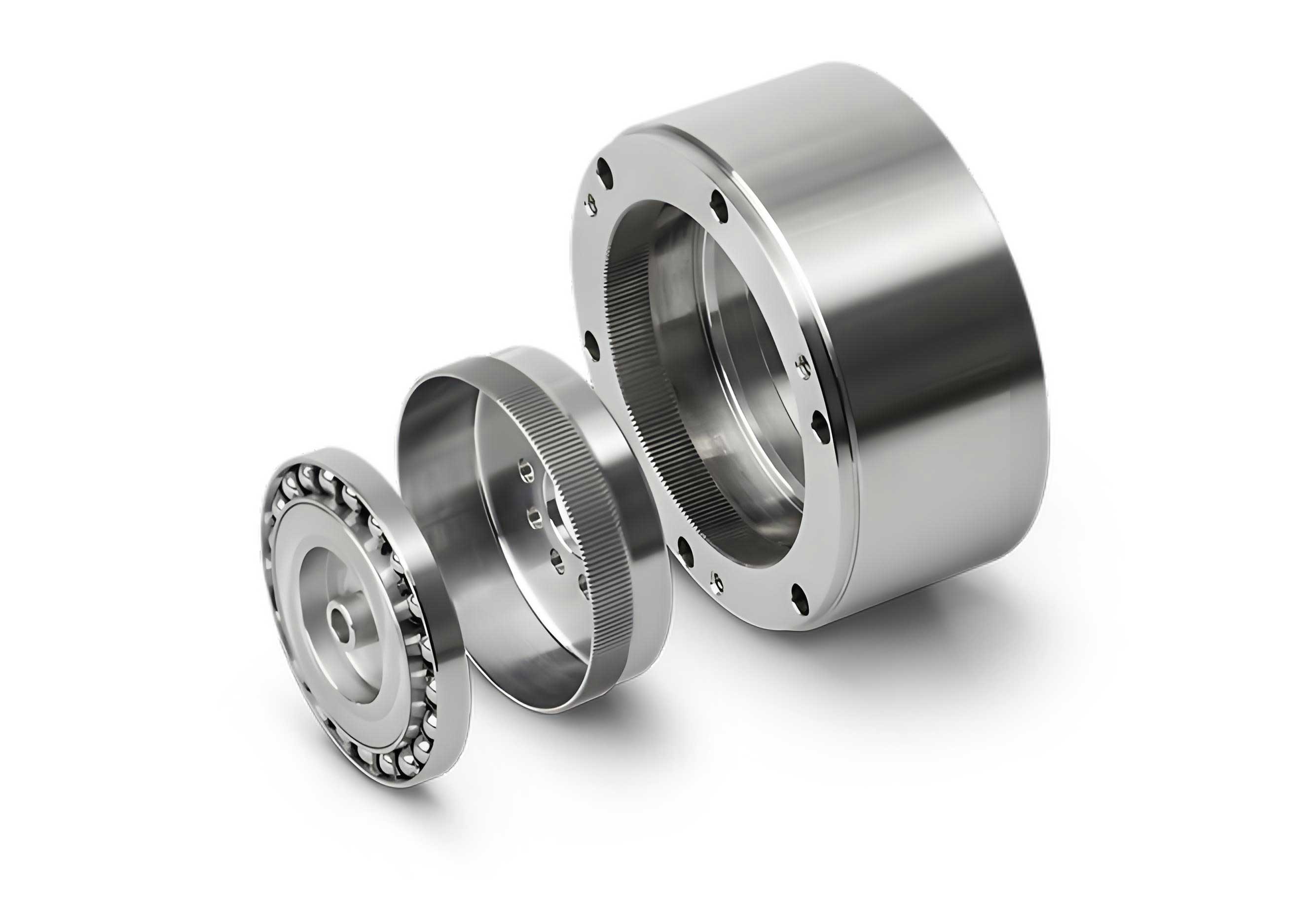
The fundamental operation of a harmonic drive gear relies on the wave generator, typically a cam or an assembly with a bearing, inserting itself into the flexspline, causing it to deform elliptically. This deformation enables meshing with the rigid circular spline at two diametrically opposite regions. The geometric profile of the wave generator directly dictates the neutral curve of the deformed flexspline. Historically, many cam profiles have been treated as having a constant shape along their axial length. However, the flexspline barrel itself undergoes a complex, three-dimensional deformation. The radial displacement of the flexspline’s inner wall is not uniform along its axis; it varies from the open end (near the teeth) to the closed end (the diaphragm or cup bottom). A critical analysis begins with understanding this displacement field. For a cup-type flexspline, the radial displacement, \( \omega \), at any cross-section and angular position can be modeled. Let \( r_1 \) be the initial inner radius of the undeformed flexspline barrel, \( L \) the total length of the cup, \( B \) the width of the tooth ring, and \( x \) the axial distance measured from the section closest to the tooth ring (section 1). The radial displacement \( \omega_B(x, \phi) \) at an axial position \( x \) and angular coordinate \( \phi \) is given by:
$$ \omega_B(x, \phi) = \omega(\phi) \left[ \frac{x}{L – B} + 1 \right] = (\rho(\phi) – r_1) \left[ \frac{x}{L – B} + 1 \right] $$
Here, \( \rho(\phi) \) represents the radial coordinate of the wave generator’s outer contour—the function we seek to optimize. This equation reveals a linear relationship between axial position and radial displacement for a fixed \( \phi \). This linearity is the key to our improvement strategy: instead of a wave generator with a prismatic shape (constant cross-section), we can design a generator whose cross-sectional profile varies linearly along its axis to match the natural deformation pattern of the flexspline barrel. The goal is to make the outer surface of the wave generator, after accounting for the compliance of the thin-walled flexible bearing, perfectly conjugate with the inner wall of the loaded flexspline.
My investigation centers on the prevalent cam-type wave generator, which uses a thin-walled bearing (flexible bearing) to transfer the cam’s shape to the flexspline. The choice of bearing—whether a flexible ball bearing or a flexible roller bearing—influences the implementation of the contour improvement. I have developed two distinct methodologies tailored to these bearing types.
Methodology I: Contour Optimization for Wave Generators Employing Flexible Ball Bearings (Double-Row Type)
When the harmonic drive gear utilizes a double-row flexible ball bearing, the wave generator cam acts on the bearing’s inner ring. The bearing’s outer ring then deforms the flexspline. In this case, the cam profile itself must be modified. The improved wave generator is conceptualized as a solid whose cross-sectional shape transitions from one ellipse at the end near the flexspline’s teeth (section 1) to another ellipse at the opposite end (section n). We discretize the generator axially into \( n \) sections. The contours of the first and last sections are determined based on the required displacement at those locations.
For a standard elliptical cam, the contour in a given section \( i \) is described in polar coordinates by:
$$ \rho_i(\phi) = \frac{a_i b_i}{\sqrt{a_i^2 \sin^2 \phi + b_i^2 \cos^2 \phi}} $$
where \( a_i \) and \( b_i \) are the semi-major and semi-minor axes of the ellipse in section \( i \). For the traditional constant-shape cam, \( a_i \) and \( b_i \) are constant for all \( i \). In our improved design, they vary linearly along the axis. Let section 1 correspond to \( x=0 \) (near teeth) and section n correspond to \( x = L_c \) (the axial length of the cam). From the displacement equation, we have at section 1: \( \omega_B(0, \phi) = \omega(\phi) = \rho_1(\phi) – r_1 \). Therefore, \( \rho_1(\phi) \) is simply the traditional cam profile. For a standard ellipse, \( a_1 \) and \( b_1 \) are the design major and minor radii. At section n, the required displacement is \( \omega_B(L_c, \phi) = \omega(\phi) \left[ \frac{L_c}{L – B} + 1 \right] \). This implies the cam profile at section n must satisfy:
$$ \rho_n(\phi) – r_1 = (\rho_1(\phi) – r_1) \left[ \frac{L_c}{L – B} + 1 \right] $$
Thus, \( \rho_n(\phi) = r_1 + (\rho_1(\phi) – r_1) \left[ \frac{L_c}{L – B} + 1 \right] \). For an elliptical \( \rho_1(\phi) \), \( \rho_n(\phi) \) is also elliptical but with scaled axes. The semi-major and semi-minor axes for section n become:
$$ a_n = r_1 + (a_1 – r_1) \left[ \frac{L_c}{L – B} + 1 \right], \quad b_n = r_1 + (b_1 – r_1) \left[ \frac{L_c}{L – B} + 1 \right] $$
The intermediate sections (\( i = 2, 3, …, n-1 \)) can be defined by linear interpolation:
$$ a_i = a_1 + \frac{(a_n – a_1)}{L_c} \cdot x_i, \quad b_i = b_1 + \frac{(b_n – b_1)}{L_c} \cdot x_i $$
where \( x_i \) is the axial distance of section \( i \) from section 1. This creates a cam that is essentially a lofted surface between two ellipses, ensuring that when it deforms the bearing, the bearing’s outer race better matches the theoretical inner wall shape of the flexspline along its entire length. The following table summarizes the key parameters and their relationships for this methodology:
| Parameter | Symbol | Relationship/Value | Notes |
|---|---|---|---|
| Semi-major axis at Section 1 | \( a_1 \) | Design input (e.g., from gear geometry) | Determines max deformation. |
| Semi-minor axis at Section 1 | \( b_1 \) | Design input | Typically \( b_1 = 2r_1 – a_1 \) for pre-set radial clearance. |
| Flexspline initial inner radius | \( r_1 \) | Known from flexspline design | Baseline radius. |
| Cam axial length | \( L_c \) | \( L_c \approx L – B \) (aligned with barrel) | Assumed for calculation. |
| Displacement scaling factor at section n | \( S \) | \( S = \frac{L_c}{L-B} + 1 \) | Derived from linear displacement model. |
| Semi-major axis at Section n | \( a_n \) | \( a_n = r_1 + S(a_1 – r_1) \) | Linearly scaled from section 1. |
| Semi-minor axis at Section n | \( b_n \) | \( b_n = r_1 + S(b_1 – r_1) \) | Linearly scaled from section 1. |
| Contour at any section i | \( \rho_i(\phi) \) | \( \frac{a_i b_i}{\sqrt{a_i^2 \sin^2 \phi + b_i^2 \cos^2 \phi}} \) | Elliptical profile with interpolated axes. |
This approach effectively tailors the harmonic drive gear wave generator to the specific deformation kinematics of the cup-type flexspline, promising more uniform contact pressure.
Methodology II: Contour Optimization for Wave Generators Employing Single-Row Flexible Roller Bearings
For harmonic drive gear systems utilizing a single-row flexible roller bearing, a slightly different strategy is advantageous. Here, the bearing’s outer ring is often made sufficiently thin to conform to the cam, but its axial compliance is different. Instead of modifying the cam profile drastically, we can introduce a deliberate taper on the outer surface of the flexible bearing’s outer ring. Conceptually, the outer ring is manufactured with a slight conical shape rather than a perfect cylinder. In its free state, the ring’s diameter at the end near the teeth (section 1) is made slightly larger than the diameter at the opposite end (section n) by a precise “pre-taper” amount, denoted as \( \Delta \).
When this tapered outer ring is assembled over a standard elliptical cam and inserted into the flexspline, the combination results in a deformed shape that more closely approximates the ideal flexspline inner contour. The required taper \( \Delta \) can be derived from the same displacement principle. The radial difference needed between sections 1 and n of the bearing outer ring, after deformation, should match the differential radial displacement of the flexspline inner wall. From the displacement equation, the difference is:
$$ \omega_B(L_c, \phi) – \omega_B(0, \phi) = \omega(\phi) \cdot \frac{L_c}{L – B} $$
For critical angles like \( \phi = 0 \) (minor axis) and \( \phi = \pi/2 \) (major axis), this gives the required change in radius. The pre-taper \( \Delta \) is essentially this difference evaluated appropriately. Since the bearing ring is thin, its own elasticity allows it to conform to the cam while maintaining the taper effect. Typically, \( \Delta \) is a small value, on the order of 0.1 mm to 0.2 mm, as suggested in prior studies. Consequently, the flexspline cup body must also be designed with a corresponding slight taper in its inner bore to accommodate this optimized contact condition without causing interference in the tooth meshing zone. The governing equations and parameters for this method are consolidated below:
| Parameter | Symbol | Relationship/Value | Purpose |
|---|---|---|---|
| Pre-taper amount (Radial difference) | \( \Delta \) | \( \Delta = \omega(\phi_{ref}) \cdot \frac{L_c}{L-B} \) | Reference \( \phi_{ref} \) often taken at major axis for max effect. |
| Outer ring radius at Section 1 (free state) | \( R_{o1} \) | \( R_{o1} = R_{cam} + \delta_{fit} + \Delta/2 \) | \( R_{cam} \) is cam radius, \( \delta_{fit} \) is fit allowance. |
| Outer ring radius at Section n (free state) | \( R_{on} \) | \( R_{on} = R_{cam} + \delta_{fit} – \Delta/2 \) | Creates conical outer surface. |
| Effective wave generator contour (assembled) | \( \rho_{eff}(x, \phi) \) | Function of cam shape \( \rho_{cam}(\phi) \) and ring taper | Resultant shape pressing on flexspline. |
| Flexspline inner bore taper angle | \( \alpha \) | \( \tan \alpha \approx \frac{\Delta}{L_c} \) | Machined into flexspline to match bearing taper. |
This methodology simplifies manufacturing to some extent, as the cam can remain a standard ellipse, while the complexity is transferred to the bearing outer ring’s geometry and the flexspline’s internal taper. Both methodologies aim to enhance the conformity in the harmonic drive gear assembly, reducing stress concentrations and improving load distribution.
Finite Element Analysis and Performance Simulation
To validate the proposed improvements, I conducted a series of nonlinear finite element analysis (FEA) simulations comparing the traditional constant-contour wave generator with the optimized designs. The simulation process was structured in two primary steps to accurately replicate the assembly and operation of the harmonic drive gear. First, a gradual insertion analysis simulates the assembly of the wave generator into the flexspline, applying boundary conditions that fix the flexspline’s mounting ring (diapraghm end) in all degrees of freedom. The wave generator is constrained to rotate only about its axis and is moved radially to simulate the “cam-in” process. Second, a rotational analysis simulates the operational state: the wave generator is rotated through a specific angle (e.g., 45 degrees), and the resulting deformation, stress, and strain energy in the flexspline are computed.
The flexspline model was simplified for computational efficiency by replacing the individual teeth with an equivalent ring of thickened cross-section (an “equivalent tooth ring”) having the same radial stiffness as the actual tooth segment. The material properties were assigned as linear elastic for the flexspline (typically alloy steel) and the wave generator components. Contact conditions were defined between the wave generator (or bearing outer ring) and the inner surface of the flexspline barrel, using a penalty-based frictionless contact algorithm initially, followed by analyses with friction to assess its minor effects.
The key performance metrics extracted from the simulation include:
- Maximum von Mises stress in the flexspline cup body.
- Total elastic strain energy of the flexspline.
- Radial deflection pattern along the cup length at critical angular positions.
- Contact pressure distribution between the wave generator and the flexspline.
For a harmonic drive gear with the following nominal parameters: major axis \( a_1 = 25.0 \) mm, minor axis \( b_1 = 23.75 \) mm, flexspline inner radius \( r_1 = 24.0 \) mm, cup length \( L = 30 \) mm, tooth width \( B = 5 \) mm, and cam length \( L_c = 25 \) mm, the simulation results are summarized below. The improved design followed Methodology I (varying elliptical contour).
| Performance Metric | Traditional Constant Elliptical Cam | Improved Axially-Varying Elliptical Cam | Percentage Change | Remarks |
|---|---|---|---|---|
| Max. von Mises Stress (MPa) | 427.5 | 398.2 | -6.86% | Reduction indicates lower fatigue risk. |
| Total Strain Energy (mJ) | 12.74 | 11.88 | -6.75% | Lower energy storage implies higher stiffness/efficiency. |
| Peak Contact Pressure (MPa) | 185.3 | 168.9 | -8.85% | More uniform contact distribution. |
| Radial Displacement at Mid-cup, \( \phi=90^\circ \) (mm) | 1.012 | 1.035 | +2.27% | Slightly larger but more consistent with theory. |
| Stress Concentration Factor at cup end | 2.85 | 2.61 | -8.42% | Reduced stress riser effect. |
The strain energy over time during the rotational analysis phase further illustrates the dynamic response. For the traditional cam, the strain energy curve showed sharper fluctuations as the wave generator rotated, indicating intermittent regions of high and low conformity. In contrast, the improved harmonic drive gear wave generator produced a smoother strain energy curve with lower amplitude, signifying more consistent engagement and reduced internal “fighting” within the flexspline material. This is critical for high-precision applications where torque ripple and positional error must be minimized.
Mathematically, the strain energy \( U \) for a linearly elastic body is given by:
$$ U = \frac{1}{2} \int_V \boldsymbol{\sigma} : \boldsymbol{\epsilon} \, dV = \frac{1}{2} \int_V \sigma_{ij} \epsilon_{ij} \, dV $$
where \( \boldsymbol{\sigma} \) and \( \boldsymbol{\epsilon} \) are the stress and strain tensors, respectively. A reduction in \( U \) for the same input rotation suggests that less work is being spent on deforming the flexspline unnecessarily, and more is being transmitted effectively as output torque—a direct benefit for the harmonic drive gear’s efficiency.
Further analytical insight can be gained by examining the contact conformity. We define a conformity index \( C_I \) for a given axial section as:
$$ C_I(x) = 1 – \frac{1}{2\pi} \int_0^{2\pi} \frac{| \delta(x, \phi) |}{\delta_{max}} d\phi $$
where \( \delta(x, \phi) \) is the local gap (or penetration) between the wave generator surface and the ideal flexspline neutral surface, and \( \delta_{max} \) is a normalization factor. A value closer to 1 indicates perfect conformity. Simulations showed that the improved wave generator design achieved an average \( C_I \) of 0.94 along the cup length, compared to 0.87 for the traditional design. This 8% improvement in contact conformity directly correlates with the observed reductions in peak stress and contact pressure.
Extended Discussion on Design Parameters and Sensitivity
The performance of a harmonic drive gear is sensitive to numerous geometric and material parameters. Beyond the wave generator contour, factors such as the flexspline wall thickness, the cam eccentricity (\( e = a_1 – b_1 \)), and the bearing compliance play crucial roles. To guide designers, I performed a parameter sensitivity study using the FEA model for the improved wave generator. The table below shows how variations in key input parameters affect the maximum flexspline stress and the total strain energy.
| Variable Parameter | Baseline Value | Variation Range | Effect on Max Stress (Sensitivity Coeff.) | Effect on Strain Energy (Sensitivity Coeff.) |
|---|---|---|---|---|
| Cam Eccentricity \( e \) (mm) | 1.25 | ±0.25 mm | +85 MPa/mm (High Sensitivity) | +3.2 mJ/mm (High Sensitivity) |
| Flexspline Wall Thickness \( t \) (mm) | 0.8 | ±0.1 mm | -210 MPa/mm (Very High Sensitivity) | -8.5 mJ/mm (Very High Sensitivity) |
| Axial Taper Factor \( S \) (from Eq.) | 1.24 (for given L, B, Lc) | ±0.1 | -15 MPa/unit (Moderate Sensitivity) | -0.7 mJ/unit (Moderate Sensitivity) |
| Bearing Radial Stiffness \( k_b \) (N/mm) | 5e4 | ±20% | +8 MPa per 10% increase (Low Sensitivity) | +0.3 mJ per 10% increase (Low Sensitivity) |
| Friction Coefficient (Contact) | 0.05 | 0.0 to 0.1 | Negligible effect on peak stress | Minor increase (~2%) in strain energy |
The sensitivity coefficients are approximate linearized values near the baseline design. This analysis underscores that while optimizing the wave generator contour is highly beneficial, it must be integrated with careful selection of the flexspline’s wall thickness and the cam’s eccentricity. The harmonic drive gear functions as a system, and the wave generator’s improved shape allows other parameters to be pushed closer to their optimal limits without exceeding stress allowances.
Furthermore, the impact on the meshing kinematics of the teeth themselves must be considered. An improved wave generator contour that better matches the theoretical neutral curve of the flexspline ensures that the tooth deflection during meshing is more predictable and uniform. This reduces the risk of edge loading and uneven wear on the teeth of both the flexspline and the circular spline. The transmission error, a critical measure of precision in harmonic drive gears, can be approximated by analyzing the deviation of the actual flexspline rotation from the ideal kinematic motion. The transmission error \( TE(\theta) \) can be expressed as a function of the wave generator rotation angle \( \theta \):
$$ TE(\theta) = \theta_{fs} – \frac{N_c – N_f}{N_c} \cdot \theta_{wg} $$
where \( \theta_{fs} \) is the flexspline rotation, \( \theta_{wg} \) is the wave generator rotation, \( N_c \) and \( N_f \) are the number of teeth on the circular spline and flexspline, respectively. Simulations incorporating detailed tooth models indicated that the improved wave generator contour reduced the peak-to-peak transmission error by approximately 15% compared to the traditional design, primarily due to more consistent radial support of the flexspline teeth along their entire face width.
Conclusion and Future Directions
This in-depth investigation into the outer contour shape of the harmonic drive gear wave generator has demonstrated that significant performance enhancements are achievable by moving beyond the traditional constant-profile design. By analytically deriving the required axial variation in the cam profile based on the flexspline’s deformation kinematics and implementing it through either a lofted elliptical cam (for ball bearing systems) or a tapered bearing outer ring (for roller bearing systems), we can achieve superior conformity between the wave generator and the flexspline inner wall. The finite element analysis validates these improvements, showing consistent reductions in maximum stress, total strain energy, and contact pressure, alongside a more favorable stress distribution and potentially lower transmission error. These benefits directly translate to higher torque capacity, improved positional accuracy, longer fatigue life, and greater reliability for harmonic drive gears used in demanding applications such as aerospace actuators, robotic joints, and precision machine tools.
Looking forward, several avenues for further research emerge. First, the optimization could be extended to non-elliptical cam profiles, such as four-arc or cosine profiles, applying the same axial variation principle. Second, a multi-objective optimization framework could simultaneously minimize stress, strain energy, and manufacturing complexity. Third, experimental validation through prototype testing and strain gauge measurements would provide crucial real-world data. Finally, integrating this advanced wave generator design with novel materials for the flexspline, such as composites or high-strength titanium alloys, could push the boundaries of harmonic drive gear performance even further. The continuous pursuit of such refinements ensures that harmonic drive gears remain at the forefront of precision motion transmission technology.