
In the realm of mechanical power transmission, the spur and pinion gear pair stands as a fundamental and widely utilized component. Its popularity stems from inherent advantages such as straightforward manufacturing, high load-bearing capacity, excellent transmission efficiency, and relatively low maintenance costs. These gears find critical applications across diverse industries including automotive systems, precision machine tools, and heavy machinery. The primary function of a spur and pinion gear system is to transmit rotational motion and torque between parallel shafts reliably and efficiently.
However, the long-term service performance of a spur and pinion gear pair is not without challenges. During meshing, the cyclic engagement and disengagement of teeth subjects the contact surfaces to repeated Hertzian contact stresses. Furthermore, relative sliding motion between the conjugate tooth profiles inevitably leads to friction and wear. Over time, these factors can degrade the tooth surface geometry, leading to a cascade of undesirable effects. The precision of motion transmission can diminish, vibrations and noise levels may increase, and eventually, premature failure through mechanisms like pitting, spalling, or tooth bending fatigue can occur. These issues are often exacerbated by practical installation imperfections, such as shaft misalignment, which causes uneven load distribution across the tooth face.
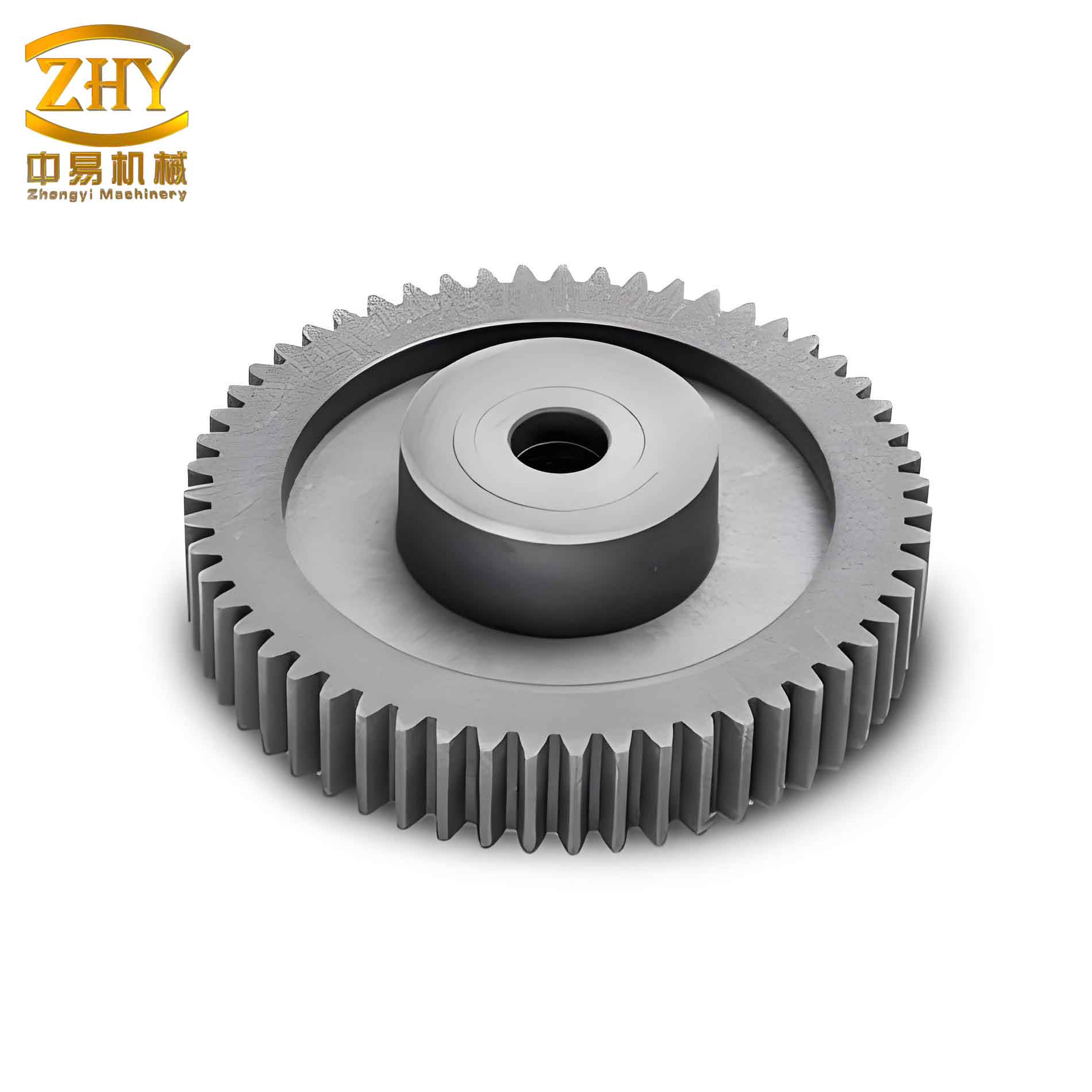
To mitigate these problems and enhance the durability and performance of spur and pinion gear drives, engineers often employ a technique known as profile modification or “tooth crowning.” This process involves intentionally and slightly altering the ideal involute tooth geometry. The goal is not to correct manufacturing errors but to proactively design a shape that compensates for deflections under load, accommodates small misalignments, and optimizes the load distribution pattern. By carefully modifying the tooth profile, it is possible to reduce stress concentrations, minimize transmission error fluctuations, and consequently, extend the operational fatigue life of the gear set. This paper presents a detailed investigation into the effects of intentional profile modification—specifically drum-shaped crowning—on the transient contact dynamics and predicted fatigue lifetime of a parallel-axis spur and pinion gear pair, considering both ideal and misaligned installation conditions.
Modeling and Methodology for Spur Gear Analysis
Geometric Foundation of the Involute Spur Gear
The study begins with the precise geometric definition of a standard involute spur and pinion gear. The tooth flank of such a gear is generated from an involute curve, which is the trace of a point on a taut string as it unwinds from a base circle. This geometry ensures a constant pressure angle during meshing, leading to smooth motion transfer. The coordinates of any point K on this involute curve in a plane can be expressed parametrically as:
$$
x_k = r_b \sin u_k – r_b u_k \cos u_k
$$
$$
y_k = r_b \cos u_k + r_b u_k \sin u_k
$$
where \( r_b \) is the base circle radius and \( u_k \) is the parameter representing the sum of the roll angle and the pressure angle at that point.
For this analysis, a symmetric gear pair was designed. Both the driving pinion and the driven spur gear share identical geometrical parameters to isolate the effects of modification, assuming a 1:1 speed ratio. The key design parameters are listed in Table 1.
| Parameter | Symbol | Value | Unit |
|---|---|---|---|
| Number of Teeth | \( z \) | 40 | – |
| Module | \( m \) | 2 | mm |
| Pressure Angle | \( \alpha \) | 20 | ° |
| Face Width | \( b \) | 20 | mm |
| Addendum Coefficient | \( h_a^* \) | 1.0 | – |
| Dedendum Coefficient | \( c^* \) | 0.25 | – |
| Pitch Circle Diameter | \( d \) | 80 | mm |
| Tip Diameter | \( d_a \) | 84 | mm |
| Root Diameter | \( d_f \) | 75 | mm |
Based on these parameters, the three-dimensional solid model of the spur and pinion gear pair was meticulously constructed using SolidWorks software. The involute profile was generated according to the parametric equations, extruded to the specified face width, and arrayed to form the complete gear. Fillet radii (0.5 mm) were applied at the tooth root to reduce stress concentration, a critical area for bending fatigue.
Principles of Drum-Shaped Tooth Modification
Drum-shaped modification, or crowning, is applied to both the profile (along the tooth height) and the lead (along the tooth width) directions. The purpose is to create a slightly convex tooth surface, ensuring that under load and potential misalignment, contact initiates near the center of the tooth face and spreads optimally, rather than concentrating at the edges. For this study, a parabolic crowning curve was employed. A local coordinate system is defined on the tooth surface with its origin at the intersection of the pitch cylinder and the tooth centerline. The x-axis is normal to the nominal tooth surface, the y-axis is along the profile direction (from root to tip), and the z-axis is along the lead direction (across the face width).
The parabolic modification in the profile and lead directions is described by the following equations, respectively:
$$
\Delta x = \Delta x_{max,\alpha} \left( \frac{y – y_0}{y_0} \right)^2, \quad -(h_f – c) \le y \le h_a
$$
$$
\Delta x = \Delta x_{max,\beta} \left( \frac{z – z_0}{z_0} \right)^2, \quad -b_f \le z \le b_r
$$
Here, \( \Delta x \) is the amount of material removed (negative) or added (positive) normal to the surface. \( \Delta x_{max,\alpha} \) and \( \Delta x_{max,\beta} \) are the maximum crown amounts in the profile and lead directions, denoted as \( C_\alpha \) and \( C_\beta \). The parameters \( y_0 \) and \( z_0 \) define the symmetry points of the parabolic curve, typically set at the center of the modification zone. For the symmetric gears in this study, \( y_0 = h_f – c = 2 \) mm and \( z_0 = b_f = b/2 = 10 \) mm.
To investigate the influence of modification magnitude, six distinct modification schemes were defined, ranging from no modification to a substantial crown, as detailed in Table 2. The goal of the spur and pinion gear modification is to find an optimal value that balances improved contact with minimal life reduction.
| Modification Case | Profile Crown \( C_\alpha \) (μm) | Lead Crown \( C_\beta \) (μm) |
|---|---|---|
| Case 1 (Unmodified) | 0 | 0 |
| Case 2 | 2 | 2 |
| Case 3 | 4 | 4 |
| Case 4 | 6 | 6 |
| Case 5 | 8 | 8 |
| Case 6 | 10 | 10 |
Finite Element Modeling and Material Properties
The three-dimensional models for all six spur and pinion gear cases were imported into ANSYS for finite element analysis. A high-performance alloy steel, 40Cr, was selected as the gear material due to its common use in demanding applications. Its key mechanical properties are summarized in Table 3, which are essential for both stress and fatigue calculations.
| Material Property | Symbol | Value | Unit |
|---|---|---|---|
| Density | \( \rho \) | 7870 | kg/m³ |
| Young’s Modulus | \( E \) | 211 | GPa |
| Poisson’s Ratio | \( \nu \) | 0.277 | – |
| Yield Strength | \( \sigma_{0.2} \) | 785 | MPa |
| Tensile Strength | \( \sigma_b \) | 980 | MPa |
A high-fidelity mesh was generated using 10-node tetrahedral elements (Tet10). Special attention was paid to the contact zones on the tooth flanks, where the mesh was significantly refined to accurately capture the high stress gradients. The contact between all potential tooth pairs of the spur and pinion gear was defined using a frictional formulation with a coefficient of 0.15. Transient dynamic analysis was performed to simulate a full engagement cycle. The pinion was driven with a constant angular velocity of 2 rad/s, while a resisting torque of 15,000 N·mm was applied to the spur gear. For misalignment studies, this torque was reduced to 14,000 N·mm to ensure numerical stability. The rotational degrees of freedom about the shaft axis were free, while all other translational and rotational motions were constrained. A summary of the FE model characteristics is provided in Table 4.
| Modification Case | Element Type | Number of Elements | Number of Nodes |
|---|---|---|---|
| Case 1 | Tet10 | 223,961 | 383,685 |
| Case 2 | Tet10 | 246,221 | 419,235 |
| Case 3 | Tet10 | 246,458 | 419,563 |
| Case 4 | Tet10 | 245,773 | 418,609 |
| Case 5 | Tet10 | 246,392 | 419,390 |
| Case 6 | Tet10 | 246,660 | 419,513 |
Analysis Under Ideal Installation Conditions
Transient Contact Stress and Load Distribution
The analysis of the spur and pinion gear pair under perfect alignment reveals significant insights into the role of modification. For the unmodified gears (Case 1), the contact pattern shows clear signs of “edge loading” or interference at the tips and roots of the teeth, indicating non-ideal contact transitions. The maximum von Mises equivalent stress is 107.37 MPa, located along the pitch line and root areas.
Introducing a small amount of crowning (Case 2, \( C_\alpha = C_\beta = 2 \mu m \)) immediately improves the situation. The contact area becomes more centralized on the tooth flank, and the interference is notably reduced. The maximum stress decreases to 103.13 MPa, representing a 3.95% reduction. This demonstrates the primary benefit of modification for a perfectly aligned spur and pinion gear: smoothing the engagement to reduce impact and localized high stress.
As the modification amount increases further, the contact area continues to shrink and concentrate towards the center of the tooth face. For Cases 3, 4, 5, and 6, the maximum contact stresses rise to 158.35 MPa, 201.54 MPa, 165.8 MPa, and 247.52 MPa, respectively. The fluctuation in stress for Case 5 is attributed to a broader stress distribution in the tooth root region, which slightly alleviates the surface contact pressure. The fundamental trend, however, is clear: while larger crown amounts effectively eliminate edge contact and meshing interference, they do so at the cost of reducing the nominal contact area, which increases the average and peak contact (Hertzian) pressure on the spur and pinion gear teeth.
The time-history of the contact stress during meshing provides another perspective. The unmodified gear pair exhibits relatively stable stress variation. With modification, the stress curves show different characteristics. Case 2 shows a slightly elevated but smooth stress range (56.89 – 103.13 MPa). Larger modifications (Cases 3-6) lead to more pronounced fluctuations in contact stress over the engagement cycle. This increased dynamic variation, stemming from a more abrupt change in contact geometry as teeth engage and disengage, can contribute to higher dynamic loads and potentially accelerate fatigue damage.
Predicted Contact Fatigue Life
Fatigue life prediction was performed using the ANSYS Fatigue Tool module, based on the stress results from the transient analysis and the material’s S-N (Stress-Life) curve. For 40Cr steel, the S-N relationship is characterized by the following three-parameter equation derived from experimental data fitting:
$$
N_f = C (\sigma_m – \sigma_{ac})^{-m}
$$
where \( N_f \) is the fatigue life (cycles), \( \sigma_m \) is the mean stress, \( \sigma_{ac} \) is the theoretical fatigue limit parameter, and \( C \), \( m \) are material constants. The fitted equation for the spur and pinion gear material is:
$$
N_f = 1.82524 \times 10^{11} (\sigma_m – 250)^{-2.12613}
$$
The predicted fatigue lives under ideal alignment and a 15,000 N·mm load are summarized conceptually in Table 5. The unmodified spur and pinion gear (Case 1) paradoxically shows the highest predicted life (23.73 million cycles) under these perfect conditions, as it avoids the stress concentration induced by a small contact patch. Even a modest 2 μm crown (Case 2) reduces the life to 19.94 million cycles. The life drops sharply for Case 3 (6.10 million cycles) and Case 4 (2.30 million cycles). Case 5 shows a slight recovery to 2.55 million cycles, consistent with its lower peak contact stress, while the aggressive 10 μm crown in Case 6 leads to a drastic life reduction to below 50,000 cycles. This highlights a critical trade-off: modification improves meshing smoothness but can severely penalize contact fatigue life under ideal alignment if over-applied.
| Condition | Modification Case | Trend in Max. Stress | Trend in Predicted Fatigue Life |
|---|---|---|---|
| Ideal Alignment | 1 (Unmodified) | Baseline (107.4 MPa) | Highest |
| 2 (2 μm) | Decreases slightly | High, but reduced | |
| 3 (4 μm) | Increases significantly | Sharply lower | |
| 4 (6 μm) | Increases further | Very low | |
| 5 (8 μm) | Moderate increase | Low, slight recovery | |
| 6 (10 μm) | Highest | Lowest |
Analysis Under Shaft Misalignment (Axis Offset)
Impact on Contact Stress and Pattern
Real-world installations of a spur and pinion gear pair often involve some degree of misalignment, modeled here as a small angular offset (α) between the gear shafts. This condition dramatically changes the contact mechanics. For an unmodified gear (Case 1) with a 0.2° offset, severe edge loading occurs. Contact is forced to one side of the tooth face, creating a highly concentrated and stressful contact patch. The maximum von Mises stress soars to 366.98 MPa, more than triple the value under ideal alignment.
The introduction of tooth crowning proves highly beneficial in this scenario. With a 2 μm crown (Case 2), the maximum stress drops to 283.79 MPa, and the contact patch shifts away from the very edge. As the crown amount increases to 4, 6, 8, and 10 μm (Cases 3-6), the maximum stresses are further reduced to 168.23, 176.56, 190.87, and 189.94 MPa, respectively. Crucially, the contact patch migrates progressively towards the center of the tooth face. This demonstrates the primary purpose of lead crowning: to tolerate misalignment by ensuring the load is carried centrally, even when the gears are not perfectly parallel.
The relationship between axis offset, modification amount, and peak stress is complex. For unmodified and lightly modified spur and pinion gears, stress increases monotonically with offset. However, for sufficiently modified gears (approximately ≥ 4 μm), the peak stress becomes less sensitive to the offset magnitude. It may even decrease slightly with initial offset as the crown actively recenters the load, before potentially rising again under very large offsets. This insensitivity to installation error is a key advantage of a well-crowned spur and pinion gear design.
Fatigue Life Under Misaligned Conditions
The fatigue life predictions under misalignment tell a compelling story that contrasts sharply with the ideal alignment results. For the unmodified spur and pinion gear, any misalignment catastrophically reduces life due to extreme edge stresses. A small 2 μm crown offers some protection at minor offsets (0.1°, 0.2°) but fails at larger ones (0.4°), where life plummets.
The most significant finding is that with adequate crown amounts (≥ 4 μm), the spur and pinion gear pair regains robust fatigue performance. For instance, a gear with 4-6 μm of crowning can maintain a predicted life in the range of 20-25 million cycles even with offsets up to 0.3°. While life may decrease at 0.4° offset, it remains orders of magnitude higher than that of an unmodified gear under the same condition. This robust performance is summarized in Table 6. The modification effectively “trades” a potential life reduction under perfect conditions (which are rare) for a massive life increase under the imperfect conditions almost always encountered in practice.
| Condition | Modification Case | Effect on Contact Pattern | Effect on Predicted Fatigue Life |
|---|---|---|---|
| With Axis Offset | 1 (Unmodified) | Severe edge loading, high stress. | Catastrophically low, highly sensitive to offset. |
| 2 (2 μm) | Edge loading reduced but not eliminated. | Improved at small offsets, poor at large offsets. | |
| 3 (4 μm) | Load recentered significantly. | Robust and high for small/medium offsets. | |
| 4 (6 μm) | Load well-centered on face. | Robust and high, less sensitive to offset. | |
| 5 (8 μm) | Load centered on a smaller area. | Remains reasonably high and robust. | |
| 6 (10 μm) | Load centered on a very small area. | Good, but may decrease due to high pressure. |
Conclusions and Design Implications
This comprehensive investigation into the effects of drum-shaped profile modification on a spur and pinion gear pair yields several key conclusions with direct implications for gear design and application:
- Trade-off Under Ideal Conditions: For a perfectly aligned spur and pinion gear system, tooth crowning is a double-edged sword. While it successfully eliminates meshing interference and smoothens the transmission of motion, it simultaneously reduces the nominal contact area. This reduction leads to increased contact pressure and, consequently, a decrease in the predicted contact fatigue life. The unmodified gear exhibits the longest life under these idealized circumstances.
- Essential for Real-World Conditions: The true value of modifying the spur and pinion gear profile becomes unequivocally clear when installation imperfections like shaft misalignment are considered. An unmodified gear suffers from destructive edge loading under misalignment, leading to very high stresses and extremely short service life. Crowning is not merely beneficial but essential to counteract this effect.
- Optimization is Critical: The amount of crown is a crucial design parameter. An insufficient crown (e.g., 2 μm) provides limited protection against misalignment. An excessive crown (e.g., 10 μm) can lead to prohibitively high contact pressures even under misalignment, negating its benefits. An intermediate range (e.g., 4-8 μm in this study) appears optimal, offering excellent misalignment tolerance without excessively compromising the contact area. This range effectively recenters the load patch and maintains a robust, high fatigue life across a range of practical offset conditions.
- Design Recommendation: The selection of the optimal crown amount for a spur and pinion gear must be a balanced decision based on the expected operating environment. For applications where exceptional alignment can be guaranteed and maintained, minimal or no crowning may be preferable to maximize fatigue life. However, for the vast majority of practical applications where some misalignment is inevitable, a deliberate, moderate amount of profile and lead crowning is strongly recommended. This design choice sacrifices a marginal amount of potential life under perfect conditions to gain a tremendous increase in life, reliability, and robustness under real-world, imperfect conditions.
In summary, the performance of a spur and pinion gear pair is profoundly influenced by micro-geometry. Drum-shaped tooth modification is a powerful design tool that allows engineers to tailor the gear’s response to load and alignment. By understanding the trade-offs and strategically selecting the modification parameters, it is possible to design spur and pinion gear drives that are not only smoother and quieter but also significantly more durable and reliable in service, ultimately leading to more robust and longer-lasting mechanical systems.