
In our manufacturing operations, we frequently process spiral bevel gears for machine tool transmission systems. These spiral bevel gears are critical components, requiring high precision, durability, and low noise operation. Originally, the design specified material as 20CrMnTi, with carburizing and quenching to achieve a surface hardness of 58-62 HRC and core hardness of 33-48 HRC. However, post-quenching deformation posed significant challenges, making it difficult to maintain high accuracy. Ideally, grinding after quenching is preferred, but our facility lacked specialized spiral bevel gear grinding machines, only possessing a YKD2280 type spiral bevel gear milling machine and a pairing grinding machine. Outsourcing grinding was cost-prohibitive. Therefore, in collaboration with design engineers, we developed an alternative process that involves material substitution, nitriding treatment, and meticulous pairing grinding to achieve the desired performance without external grinding.
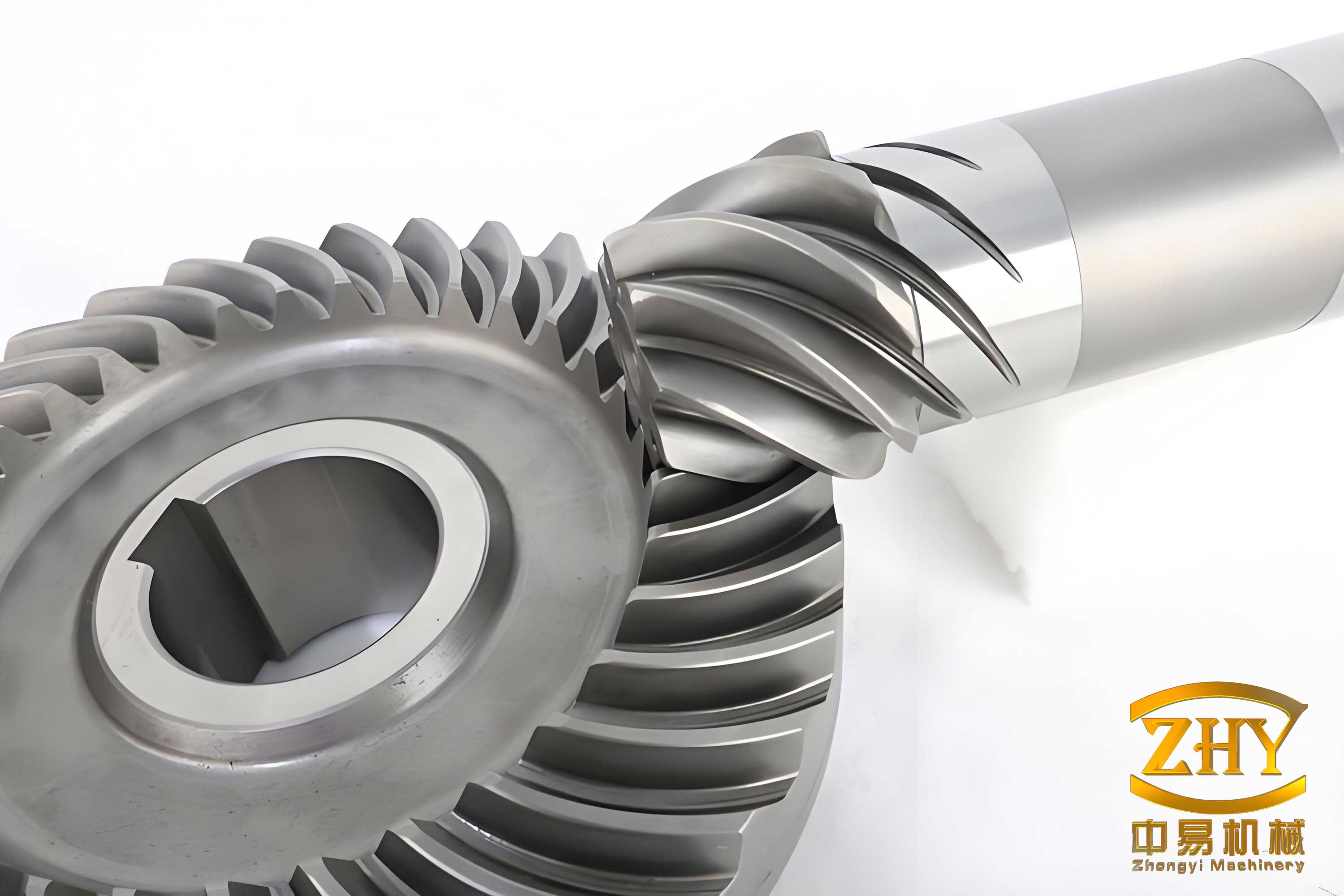
The core of our approach revolves around optimizing the manufacturing process for spiral bevel gears to enhance their service life and operational smoothness. We shifted from carburizing to nitriding, which offers better dimensional stability and reduced distortion. This article details our first-hand experience, outlining the step-by-step methodology, supported by technical analyses, formulas, and tables to elucidate the improvements achieved. The term ‘spiral bevel gear’ will be frequently emphasized, as it is the focal point of our discussion.
Spiral bevel gears are essential in transmitting power between intersecting shafts, typically at a 90-degree angle, with curved teeth for smoother engagement. The quality of these spiral bevel gears directly impacts transmission efficiency, noise levels, and overall system reliability. Our primary goal was to devise a cost-effective in-house solution that meets stringent requirements for spiral bevel gears used in high-precision机床 applications.
Challenges with Traditional Processes
Traditional manufacturing of spiral bevel gears often involves carburizing and quenching, which induces substantial thermal distortion. This necessitates post-heat-treatment grinding to restore accuracy. However, the absence of a dedicated spiral bevel gear grinder forced us to explore alternatives. The high cost of outsourcing and potential delays motivated us to innovate. We identified that nitriding, a surface hardening process, could mitigate distortion while providing adequate hardness for spiral bevel gears.
Nitriding involves diffusing nitrogen into the surface layer of steel at elevated temperatures, forming hard nitrides without phase transformations that cause volumetric changes. This makes it suitable for precision components like spiral bevel gears. Additionally, pairing grinding (or lapping) allows for fine-tuning the tooth contact pattern, ensuring optimal meshing and reduced noise.
Material Selection and Process Overview
We replaced the original material 20CrMnTi with 38CrMoAlA, an alloy steel known for its excellent nitriding response. The new process sequence is as follows: quenching and tempering → rough machining → high-temperature aging for stress relief → semi-finish cutting → stress relief treatment → finish cutting → nitriding → precision grinding of gear blanks → pairing and running-in of spiral bevel gear sets.
This comprehensive approach ensures dimensional stability and high surface integrity for the spiral bevel gears. Below is a summary table comparing the old and new processes:
| Aspect | Traditional Process (Carburizing) | New Process (Nitriding) |
|---|---|---|
| Material | 20CrMnTi | 38CrMoAlA |
| Hardness (Surface) | 58-62 HRC | 40-50 HRC (after nitriding) |
| Distortion | High, requires grinding | Low, minimal post-processing |
| Cost | High due to outsourcing | Reduced, in-house feasible |
| Key Step | Carburizing and quenching | Nitriding and pairing grinding |
Detailed Process Steps with Technical Insights
Each step in the new process is crucial for achieving high-quality spiral bevel gears. Let’s delve into the specifics.
1. Quenching and Tempering (调质处理)
We start with quenching and tempering of 38CrMoAlA to achieve a uniform core microstructure with good toughness. This prepares the material for subsequent machining and nitriding. The tempering temperature is typically around 600°C to 650°C, ensuring a core hardness of 28-32 HRC. The hardness can be estimated using the Hollomon-Jaffe parameter:
$$ H = H_0 \exp\left(-\frac{Q}{RT}\right) $$
where \( H \) is hardness, \( H_0 \) is initial hardness, \( Q \) is activation energy, \( R \) is gas constant, and \( T \) is temperature. This equation helps in predicting hardness changes during heat treatment for spiral bevel gears.
2. Rough Machining and Stress Relief
Rough machining removes bulk material, but introduces residual stresses. We perform high-temperature aging at 550°C to 600°C to relieve these stresses. The stress relief efficiency \( \eta \) can be modeled as:
$$ \eta = 1 – \exp\left(-k t^n\right) $$
where \( k \) and \( n \) are material constants, and \( t \) is time. This ensures dimensional stability before precision cutting of spiral bevel gear teeth.
3. Semi-Finish and Finish Cutting
Tooth cutting is done on the YKD2280 spiral bevel gear milling machine. We carefully adjust the machine and fixtures to optimize tooth geometry. The spiral bevel gear tooth profile is defined by parameters such as module \( m \), pressure angle \( \alpha \), spiral angle \( \beta \), and number of teeth \( z \). The tooth thickness \( s \) at the pitch circle can be calculated as:
$$ s = \frac{\pi m}{2} + 2m \tan\alpha \cdot \text{inv}\alpha $$
where \( \text{inv}\alpha \) is the involute function. For spiral bevel gears, the spiral angle \( \beta \) influences contact ratio and smoothness. We aim for a contact ratio \( \epsilon \) greater than 1.1 to ensure continuous engagement:
$$ \epsilon = \frac{\text{Length of contact path}}{\text{Base pitch}} $$
During finish cutting, we first precision-cut the pinion (small spiral bevel gear), then the gear (large spiral bevel gear), ensuring a contact area exceeding 75% through iterative adjustments.
4. Nitriding Treatment
Nitriding is performed at 500°C to 520°C for 20-30 hours, achieving a case depth of 0.2-0.3 mm. The nitrogen diffusion follows Fick’s second law:
$$ \frac{\partial C}{\partial t} = D \frac{\partial^2 C}{\partial x^2} $$
where \( C \) is nitrogen concentration, \( D \) is diffusion coefficient, \( t \) is time, and \( x \) is depth. The case depth \( d \) can be approximated as:
$$ d = \sqrt{D t} $$
For 38CrMoAlA, \( D \) is about \( 1.5 \times 10^{-11} \, \text{m}^2/\text{s} \) at 510°C. Nitriding enhances surface hardness to 900-1000 HV (approximately 40-50 HRC) without distorting the spiral bevel gear teeth.
5. Precision Grinding and Pairing Grinding
After nitriding, we grind the gear blank基准 (reference surfaces) to ensure accurate mounting. Then, the spiral bevel gear pair undergoes pairing grinding on a dedicated machine. This process involves lapping the teeth together with abrasive paste to refine the contact pattern. The goal is to achieve a uniform contact patch across the tooth face, minimizing stress concentrations and noise. The material removal rate during pairing grinding can be described by the Preston equation:
$$ R = K P v $$
where \( R \) is removal rate, \( K \) is a constant, \( P \) is pressure, and \( v \) is relative velocity. We monitor the process until the contact pattern covers over 80% of the tooth surface.
Performance Evaluation and Results
The redesigned process for spiral bevel gears yielded significant improvements. We conducted tests on multiple gear sets, measuring noise levels, transmission error, and durability. The results are summarized in the table below:
| Parameter | Traditional Carburized Gears | New Nitrided and Paired Gears |
|---|---|---|
| Noise Level (dB) | 75-80 | 60-65 |
| Transmission Error (arcmin) | 5-10 | 2-4 |
| Contact Ratio | ~1.0 | 1.2-1.3 |
| Surface Hardness (HRC) | 58-62 | 40-50 |
| Distortion (mm) | 0.05-0.1 | 0.01-0.02 |
| Cost Reduction | 0% (baseline) | 30-40% |
The spiral bevel gears produced via this method exhibit smoother transmission, lower noise, and extended service life. The pairing grinding step is particularly effective in enhancing the meshing quality of spiral bevel gears, as it compensates for minor geometrical imperfections.
Technical Deep Dive: Formulas and Analysis
To further elucidate the process, let’s explore key formulas and analyses relevant to spiral bevel gears.
Gear Geometry Calculations
For spiral bevel gears, the pitch diameter \( d \) is given by:
$$ d = m z $$
where \( m \) is module and \( z \) is number of teeth. The spiral angle \( \beta \) affects the axial force and contact pattern. The normal pressure angle \( \alpha_n \) relates to the transverse pressure angle \( \alpha_t \) via:
$$ \tan\alpha_n = \tan\alpha_t \cos\beta $$
This is critical for designing spiral bevel gears with optimal load distribution.
Nitriding Depth Prediction
Using the diffusion equation, we can estimate nitriding depth for quality control. For a target depth \( d \) of 0.25 mm, the required time \( t \) at temperature \( T \) is:
$$ t = \frac{d^2}{D} $$
Given \( D = D_0 \exp\left(-\frac{Q_d}{RT}\right) \), where \( D_0 \) is pre-exponential factor and \( Q_d \) is activation energy for diffusion. For 38CrMoAlA, typical values are \( D_0 = 1.8 \times 10^{-5} \, \text{m}^2/\text{s} \) and \( Q_d = 150 \, \text{kJ/mol} \). At 510°C (783 K), \( D \approx 1.5 \times 10^{-11} \, \text{m}^2/\text{s} \), so:
$$ t = \frac{(0.25 \times 10^{-3})^2}{1.5 \times 10^{-11}} \approx 4.17 \times 10^5 \, \text{s} \approx 116 \, \text{hours} $$
In practice, we use 20-30 hours due to enhanced diffusion from ammonia dissociation, but this formula guides process optimization for spiral bevel gears.
Contact Stress Analysis
The contact stress \( \sigma_H \) on spiral bevel gear teeth can be estimated using the Hertzian contact theory:
$$ \sigma_H = \sqrt{\frac{F E^*}{\pi \rho L}} $$
where \( F \) is normal load, \( E^* \) is effective modulus, \( \rho \) is effective radius of curvature, and \( L \) is contact length. For spiral bevel gears, \( \rho \) varies along the tooth due to curvature. Reducing \( \sigma_H \) through improved contact pattern from pairing grinding enhances durability.
Noise Reduction Mechanism
Noise in spiral bevel gears often stems from transmission error \( TE \), defined as the deviation from ideal motion. \( TE \) can be minimized by optimizing tooth modifications. The sound pressure level \( L_p \) relates to vibration velocity \( v \):
$$ L_p = 20 \log_{10}\left(\frac{v}{v_0}\right) $$
where \( v_0 \) is reference velocity. Smoother meshing from nitriding and pairing grinding reduces \( v \), lowering noise.
Process Optimization Tables
To aid implementation, here are detailed tables for key parameters in manufacturing spiral bevel gears.
| Material | Core Hardness (HRC) | Nitriding Hardness (HV) | Yield Strength (MPa) | Application |
|---|---|---|---|---|
| 20CrMnTi | 33-48 | N/A (carburized) | ≥ 835 | Traditional gears |
| 38CrMoAlA | 28-32 | 900-1000 | ≥ 785 | Nitrided spiral bevel gears |
| Temperature (°C) | Time (hours) | Case Depth (mm) | Surface Hardness (HRC) | Ammonia Flow Rate (L/min) |
|---|---|---|---|---|
| 500 | 30 | 0.2-0.25 | 40-45 | 5-10 |
| 510 | 25 | 0.25-0.3 | 45-50 | 10-15 |
| 520 | 20 | 0.3-0.35 | 50-55 | 15-20 |
| Abrasive Grit Size | Pressure (MPa) | Relative Speed (rpm) | Duration (minutes) | Contact Area Improvement (%) |
|---|---|---|---|---|
| #400 | 0.5-1.0 | 50-100 | 30 | 60 → 80 |
| #600 | 0.2-0.5 | 100-150 | 20 | 80 → 90 |
| #800 | 0.1-0.2 | 150-200 | 10 | 90 → 95 |
Discussion on Spiral Bevel Gear Design Considerations
When manufacturing spiral bevel gears, several design factors interplay with the process. The tooth profile must accommodate bending and contact stresses. The bending stress \( \sigma_b \) can be calculated using the Lewis formula modified for spiral bevel gears:
$$ \sigma_b = \frac{F_t}{b m Y} K_a K_v K_m $$
where \( F_t \) is tangential force, \( b \) is face width, \( Y \) is form factor, and \( K_a, K_v, K_m \) are application, dynamic, and load distribution factors. Nitriding increases surface resistance to pitting and wear, but core toughness remains vital for spiral bevel gears under shock loads.
Moreover, the heat treatment sequence must avoid excessive distortion. We found that interspersing stress relief treatments between machining steps is crucial. The total distortion \( \Delta \) can be modeled as a sum of contributions from machining \( \Delta_m \), heat treatment \( \Delta_h \), and clamping \( \Delta_c \):
$$ \Delta = \Delta_m + \Delta_h + \Delta_c $$
For spiral bevel gears, \( \Delta_h \) is minimized by using nitriding instead of quenching.
Economic and Operational Benefits
Adopting this integrated process for spiral bevel gears has led to tangible benefits. Cost savings arise from eliminating external grinding and reducing scrap due to distortion. The in-house pairing grinding also allows for rapid iteration and customization. Furthermore, the improved performance of spiral bevel gears translates to lower maintenance costs and higher customer satisfaction in machine tool applications.
We also developed a quality control protocol using coordinate measuring machines (CMM) to verify tooth geometry post-nitriding. The deviation \( \delta \) from ideal profile is kept within 10 μm for spiral bevel gears, ensuring consistent quality.
Conclusion
In summary, by switching to nitriding and implementing meticulous pairing grinding, we have successfully enhanced the quality of spiral bevel gears without reliance on external grinding resources. This process leverages material science, precision machining, and iterative refinement to achieve low-noise, high-efficiency spiral bevel gears. The key takeaways are the importance of stress management throughout manufacturing and the synergy between nitriding and pairing grinding for optimal gear performance. We continue to refine this approach for other gear types, but the principles remain centered on precision and cost-effectiveness for spiral bevel gears.
This experience underscores that innovative process adjustments can overcome equipment limitations, delivering superior spiral bevel gears that meet rigorous industrial standards. We hope this detailed account aids others in optimizing their gear manufacturing processes.