
The planetary roller screw assembly (PRSA) represents a critical advancement in precision linear actuation, offering superior load capacity, stiffness, and operational life compared to traditional ball screws. Its unique mechanism, where multiple threaded rollers orbit and mesh with a central screw and a surrounding nut, distributes load across numerous contact points. This technology finds indispensable applications in demanding sectors such as aerospace, where actuation systems require extreme reliability under high loads; robotics, demanding precision and compactness; and industrial automation, where longevity and maintenance intervals are paramount. The pursuit of even higher performance, particularly in load-bearing capacity and fatigue life, drives continuous research into optimizing the core geometry of the planetary roller screw assembly. This work delves into a fundamental redesign of the thread profile, proposing and rigorously analyzing a concave-convex contact paradigm to push the boundaries of what a planetary roller screw assembly can achieve.
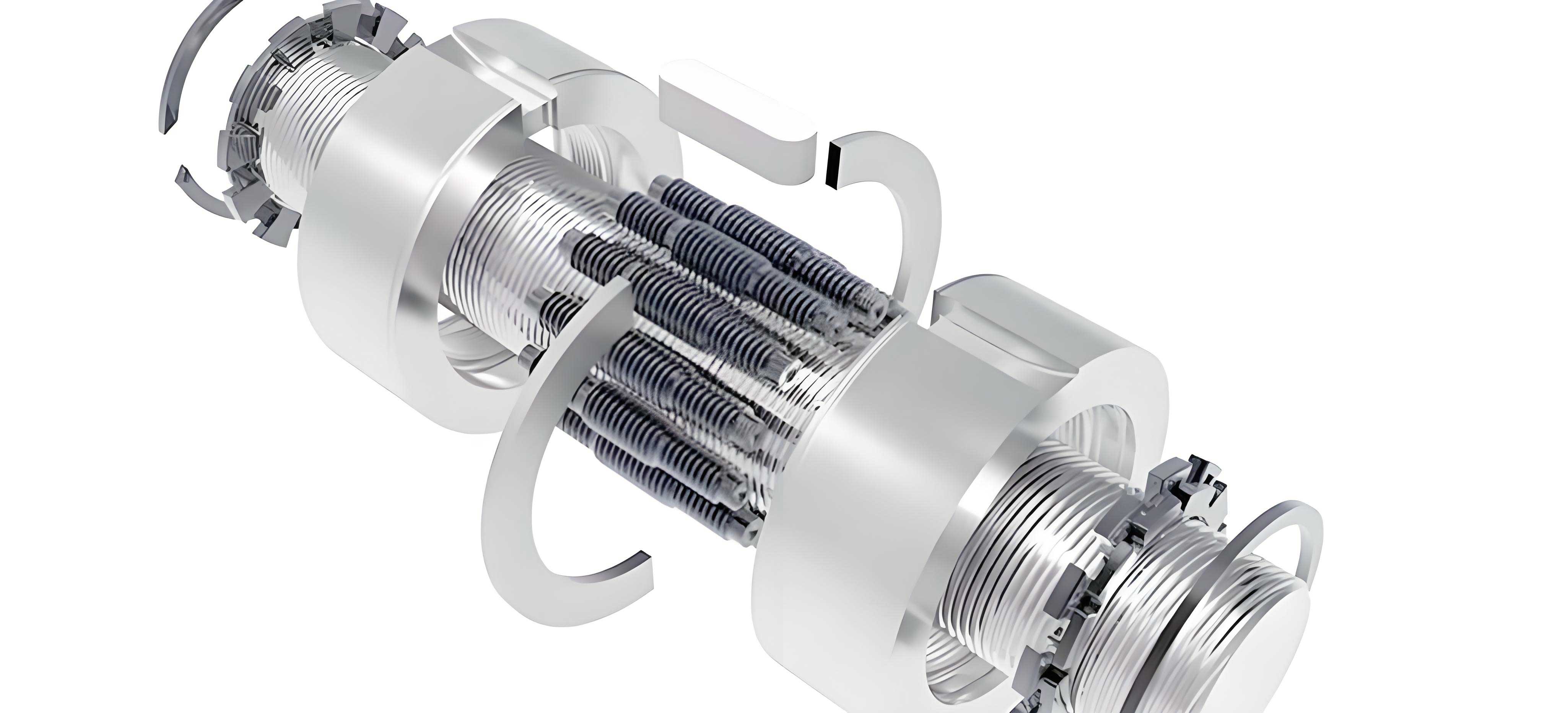
Conventional planetary roller screw assembly designs typically employ a straight-sided (or slightly modified) V-thread profile for both the screw and the nut, while the rollers feature a convex circular arc profile. This configuration results in a convex-to-flat or convex-to-inclined-plane contact condition at the meshing interfaces. While effective, this traditional geometry imposes inherent limits on contact stress distribution. The primary focus of prior research has been on modeling the complex spatial meshing, calculating load distribution among the numerous threads, and analyzing stiffness and efficiency for this standard configuration. Studies have established foundational meshing models, calculated contact points and clearances, and developed load distribution models using Hertzian contact theory combined with deformation coordination equations. Finite Element Analysis (FEA) has further been employed to validate these models and investigate stress fields. However, the potential of radically altering the screw and nut profile to create a conformal, concave-convex contact has remained a significant yet less explored avenue for fundamental performance enhancement in the planetary roller screw assembly.
This paper introduces a transformative design principle for the planetary roller screw assembly: the concave-convex meshing system. Herein, the thread flanks of both the screw and the nut are meticulously machined to a precise concave circular arc profile. The roller threads retain their convex circular arc profile. This deliberate pairing creates a conformal contact where the convex roller surface nestles into the concave screw and nut surfaces. The anticipated benefits are profound: a significant increase in the effective contact area at each meshing point, leading to a drastic reduction in contact pressure for a given load, and consequently, enhanced load-carrying capacity and prolonged service life of the planetary roller screw assembly. We present a complete theoretical framework, from the derivation of the spatial geometry and meshing conditions to the establishment of a comprehensive load distribution model, specifically tailored for this novel concave-convex planetary roller screw assembly.
Geometric and Meshing Model of the Concave-Convex Planetary Roller Screw Assembly
The analysis begins with defining the precise geometry of the novel thread profiles. The standard planetary roller screw assembly uses a trapezoidal-like form. Our modified design specifies profiles in the axial cross-section plane for each component.
Let us define the key geometric parameters for a general thread profile, which will be specialized for each component. For a component \(i\) (where \(i = s, r, n\) denoting screw, roller, and nut respectively), we have:
– \(r_i\): Pitch radius.
– \(P_i\): Pitch. For a multi-start thread, \(P_i = n_i \cdot p_i\), where \(n_i\) is the number of starts and \(p_i\) is the lead.
– \(\alpha_i\): Thread flank angle (half-angle).
– \(R_i\): Radius of the circular arc defining the thread flank. For the roller (convex), \(R_r > 0\). For the screw and nut (concave), \(R_s\) and \(R_n\) are also positive, but their centers are positioned to create a concave surface.
– \(c_i\): Half-thread thickness at the pitch line.
The coordinates of the arc center \((x_{i0}, z_{i0})\) in the component’s axial plane coordinate system are crucial. For the roller with a convex arc:
$$ x_{r0} = 0 $$
$$ z_{r0} = -R_r \cos(\alpha_r) + c_r $$
For the screw with a concave arc:
$$ x_{s0} = r_s + R_s \sin(\alpha_s) $$
$$ z_{s0} = c_s + R_s \cos(\alpha_s) $$
For the nut with a concave arc:
$$ x_{n0} = r_n – R_n \sin(\alpha_n) $$
$$ z_{n0} = -R_n \cos(\alpha_n) + c_n $$
The surface of any thread flank is a helicoid generated by sweeping its cross-sectional profile along a helix. A point on this surface can be described in a coordinate system attached to the component. Let \((r_{P}, \theta)\) be the polar coordinates of a point projected onto the axial plane. The \(z\)-coordinate (along the component axis) of a point on the flank is a function of its radial distance \(r_P\) from the axis, modified by the helical motion. For a concave flank (screw/nut), the \(z\)-coordinate in the profile plane is:
$$ z_{profile} = z_{i0} – \rho_i \sqrt{R_i^2 – (r_P – x_{i0})^2} $$
where \(\rho_i = +1\) for the “upper” flank (e.g., load-bearing flank of a right-hand thread) and \(\rho_i = -1\) for the “lower” flank.
For a convex flank (roller), the profile \(z\)-coordinate is:
$$ z_{profile} = z_{r0} + \rho_r \sqrt{R_r^2 – (r_P – x_{r0})^2} $$
The final helicoidal surface equation for component \(i\), incorporating the helix lead \(L_i\), is:
$$ \mathbf{R}_i(r_P, \theta) = \begin{bmatrix} r_P \cos \theta \\ r_P \sin \theta \\ z_{profile}(r_P) + \frac{L_i}{2\pi}\theta \end{bmatrix} $$
Spatial Meshing Condition
For the planetary roller screw assembly to transmit motion smoothly, the screw-roller and nut-roller surfaces must maintain continuous tangency. In a real assembly, a small axial clearance, \(e\), exists between meshing surfaces to prevent binding and allow for lubrication. The condition for two surfaces \(\Pi_1\) and \(\Pi_2\) to be in contact at a point, considering this clearance, is given by the spatial meshing theory:
$$ \mathbf{R}_2(u_2, \theta_2) = \mathbf{R}_1(u_1, \theta_1) + \mathbf{\Delta}_{12} $$
$$ \mathbf{n}_2 = \mu_{12} \mathbf{n}_1 $$
where \(\mathbf{\Delta}_{12} = [0, 0, e_{12}]^T\) is the clearance vector, and \(\mathbf{n}\) denotes the surface normal vector at the contact point. This leads to a system of equations. For the screw-roller (s-r) meshing pair:
$$
\begin{aligned}
&r’_s \cos \theta’_s = -r’_r \cos \theta’_r \\
&r’_s \sin \theta’_s = r’_r \sin \theta’_r \\
&T^z_s(r’_s, \theta’_s) = T^z_r(r’_r, \theta’_r) + e_{sr} \\
&\mathbf{n}_s \times \mathbf{n}_r = 0 \quad \text{(Condition for parallel normals)}
\end{aligned}
$$
Here, \((r’_s, \theta’_s)\) and \((r’_r, \theta’_r)\) are the polar coordinates of the contact point on the screw and roller surfaces, respectively. \(T^z\) is the axial coordinate from the surface equation. The specific forms for the concave-convex design are:
$$
\begin{aligned}
T^z_s &= \rho_s \left[ z_{s0} – \sqrt{R_s^2 – (r’_s – x_{s0})^2} \right] + \frac{L_s}{2\pi}\theta’_s \\
T^z_r &= -\rho_r \left[ z_{r0} + \sqrt{R_r^2 – (r’_r – x_{r0})^2} \right] + \frac{L_r}{2\pi}\theta’_r
\end{aligned}
$$
Similarly, for the nut-roller (n-r) pair:
$$
\begin{aligned}
&r’_n \cos \theta’_n = r’_r \cos \theta’_r \\
&r’_n \sin \theta’_n = r’_r \sin \theta’_r \\
&T^z_n(r’_n, \theta’_n) = T^z_r(r’_r, \theta’_r) + e_{nr} \\
&\mathbf{n}_n \times \mathbf{n}_r = 0
\end{aligned}
$$
with:
$$
\begin{aligned}
T^z_n &= -\rho_n \left[ z_{n0} + \sqrt{R_n^2 – (r’_n – x_{n0})^2} \right] + \frac{L_n}{2\pi}\theta’_n \\
T^z_r &= \rho_r \left[ z_{r0} + \sqrt{R_r^2 – (r’_r – x_{r0})^2} \right] + \frac{L_r}{2\pi}\theta’_r
\end{aligned}
$$
These systems of nonlinear equations are solved numerically (e.g., using the Newton-Raphson method) to determine the precise contact point coordinates \((r’, \theta’)\) and the inherent axial clearance \(e\) for each meshing pair in the concave-convex planetary roller screw assembly. The choice of \(\rho\) values (+1 or -1) depends on which specific flanks are in contact (e.g., screw drive flank with roller return flank).
Load Distribution Model for the Planetary Roller Screw Assembly
Under an external axial load, the load is not uniformly distributed across all engaged threads of the planetary roller screw assembly. The load distribution is governed by the elastic deformations of the components. Our model considers: 1) Hertzian contact deformation at each screw-roller and nut-roller interface, 2) axial tensile/compressive deformation of the screw, rollers, and nut segments, and 3) bending and shear deformation of the thread teeth themselves.
Hertzian Contact Analysis
The concave-convex contact modifies the principal curvatures at the contact point. For a convex roller (radii \(R_{r1}, R_{r2}\)) and a concave screw (radii \(-R_s, R_{s2}\)), the effective curvature sum \(\sum \rho\) changes significantly compared to the standard convex-flat contact. The principal curvatures for the screw-roller contact are:
$$
\begin{aligned}
\rho_{11} &= \frac{1}{R_r}, \quad \rho_{12} = \frac{1}{R_r} \quad \text{(Roller, convex)} \\
\rho_{21} &= -\frac{1}{R_s}, \quad \rho_{22} = \frac{2\cos\alpha_s \cos\lambda_s}{d_m – 2R_s\cos\alpha_s} \quad \text{(Screw, concave)}
\end{aligned}
$$
where \(d_m\) is the pitch diameter of the roller orbit, and \(\lambda_s\) is the helix angle at the contact radius. The contact force \(F_n\) causes an elliptical contact area. The Hertzian contact deformation \(\delta\) and the maximum contact pressure \(\sigma_{max}\) are given by:
$$ \delta = C_{Hz} \cdot F_n^{2/3} $$
$$ \sigma_{max} = \frac{3F_n}{2\pi a b} $$
where \(a\) and \(b\) are the semi-major and semi-minor axes of the contact ellipse:
$$ a = m_a \left( \frac{3F_n}{2E^* \sum \rho} \right)^{1/3}, \quad b = m_b \left( \frac{3F_n}{2E^* \sum \rho} \right)^{1/3} $$
Here, \(E^*\) is the equivalent elastic modulus, and \(m_a, m_b\) are coefficients dependent on the curvature difference. The contact stiffness \(C_{Hz}\) is a function of the ellipsoidal coefficients and the curvature sum. The key insight is that for the concave-convex planetary roller screw assembly, a properly chosen \(R_s \approx R_r\) leads to a much larger effective radius of curvature in the axial plane, reducing \(\sum \rho\), increasing \(a\) and \(b\), and thus drastically lowering \(\sigma_{max}\) for the same \(F_n\).
Deformation Coordination and Load Distribution Equations
Consider a single roller engaged with \(M\) threads on both the screw and nut. The axial force on the \(m\)-th screw thread, \(F_{a,m}\), is related to the normal contact force \(F_{n,m}\) by the helix angle \(\lambda\) and the flank pressure angle \(\alpha\):
$$ F_{a,m} = F_{n,m} \sin(\alpha) \cos(\lambda) $$
The total axial force on one roller, \(F_N\), is the sum over all engaged threads:
$$ F_N = \sum_{i=1}^{M} F_{n,i} \sin(\alpha) \cos(\lambda) $$
The total axial deformation at the \(m\)-th contact point on the screw side, \(\Delta S_m\), must equal the total axial deformation at the corresponding point on the roller side, \(\Delta R_m\), for compatibility. These deformations include:
- Hertzian contact deformation \(\delta_{m}\) between screw and roller.
- Thread tooth deflection \(\sigma_{m}\) for both the screw tooth and the roller tooth. This deflection comprises bending, shear, base tilting, and radial compression components, calculated based on the thread geometry and load.
- Axial body deformation \(\tau_{m}\) of the screw and roller shafts between adjacent threads.
The deformation compatibility equation \(\Delta S_m = \Delta R_m\) for the \(m\)-th pair leads to a recursive relationship between the axial forces on successive threads. This can be expressed as a system of equations involving the contact stiffness \(K_{C}\), thread tooth stiffness \(K_{T}\), and axial body stiffness \(K_{A}\):
$$
\frac{F_{a,m} – F_{a,m-1}}{K_{C}} + \frac{F_N – \sum_{j=1}^{m-1} F_{a,j}}{K_{A,s}} + \frac{F_{a,m} – F_{a,m-1}}{K_{T,s}} = \frac{\sum_{j=1}^{m-1} F_{a,j} – \sum_{j=1}^{m-1} F_{a-n,j}}{K_{A,r}} + \frac{F_{a,m} – F_{a,m-1}}{K_{T,r}}
$$
where \(F_{a-n,j}\) is the axial force on the \(j\)-th nut thread. Solving this system for \(m = 1, 2, …, M\) yields the axial load \(F_{a,m}\) on each screw thread, from which the normal contact force \(F_{n,m}\) and thus the contact stress \(\sigma_{max,m}\) for each thread in the planetary roller screw assembly can be determined.
Parametric Analysis and Results
We now present a systematic numerical analysis of the concave-convex planetary roller screw assembly. A baseline set of geometric parameters is defined for computation.
| Component | Pitch Radius (mm) | Number of Starts | Flank Angle, \(\alpha\) | Arc Radius (mm) |
|---|---|---|---|---|
| Screw (s) | 21.0 | 5 | 45° | \(R_s = 1.10 \cdot R_r\) |
| Roller (r) | 7.0 | 1 | 45° | \(R_r = r_r / \sin(\alpha)\) |
| Nut (n) | 35.0 | 5 | 45° | \(R_n = 1.10 \cdot R_r\) |
Note: The number of rollers is 10. Pitch \(P = 2.0\) mm for all components unless varied.
Influence of Design Parameters on Meshing Characteristics
The solution of the meshing equations provides the contact point location \((r’, \phi’)\), where \(\phi’\) is the angular position from the line of centers, and the axial clearance \(e\).
1. Flank Angle (\(\alpha\)): Varying \(\alpha\) from 30° to 75° significantly impacts the meshing. As \(\alpha\) increases, the contact point on the roller moves towards a smaller radius and a smaller angle \(\phi’\), i.e., closer to the line connecting the screw and roller axes. Concurrently, the axial clearance \(e_{sr}\) increases monotonically. A small \(\alpha\) (e.g., 30°) may lead to negative clearance (interference), while a large \(\alpha\) (e.g., 75°) results in excessive clearance, which can cause backlash and noise in the planetary roller screw assembly.
| Flank Angle, \(\alpha\) | Screw Contact Radius, \(r’_s\) (mm) | Contact Angle, \(\phi’_s\) (deg) | Axial Clearance, \(e_{sr}\) (10⁻³ mm) |
|---|---|---|---|
| 30° | 10.4415 | 4.59 | -1.5* |
| 45° | 10.5015 | 2.83 | 15.8 |
| 60° | 10.5310 | 1.41 | 30.5 |
| 75° | 10.5034 | 0.71 | 40.9 |
*Negative value indicates geometric interference.
2. Pitch (\(P\)): Increasing the pitch from 0.5 mm to 3.0 mm primarily affects the contact angle \(\phi’\). The contact radius remains largely unchanged near the pitch line, but the contact point moves to a larger \(\phi’\), away from the line of centers. The axial clearance shows a weak dependence on pitch for this configuration in the planetary roller screw assembly.
3. Roller Convex Radius (\(R_r\)): Increasing \(R_r\) makes the roller flank flatter. The contact point shifts slightly towards the root of the screw thread, and the axial clearance decreases very modestly.
4. Screw/Nut Concave Radius (\(R_s, R_n\)): A critical finding is that the ratio \(k = R_s / R_r\) (or \(R_n / R_r\)) has a negligible effect on the contact point location and axial clearance, provided \(k > 1\) to avoid interference. The meshing is primarily governed by the pressure angle and pitch geometry. However, as will be shown, this ratio \(k\) is the dominant factor governing the load-bearing performance of the concave-convex planetary roller screw assembly.
Influence of Design Parameters on Load Distribution and Contact Stress
Using the load distribution model, the contact stress for each engaged thread under a total axial load of 30 kN is calculated for a planetary roller screw assembly with 20 engaged threads per roller.
1. Flank Angle (\(\alpha\)): Higher flank angles lead to increased maximum contact stress. This is because for a given axial force \(F_a\), the normal force \(F_n = F_a / (\sin\alpha \cos\lambda)\) is larger when \(\alpha\) is larger. The load distribution shape remains similar, but the stress level rises uniformly. Therefore, a smaller \(\alpha\) is beneficial for load capacity but must be balanced against meshing interference risks.
2. Pitch (\(P\)) and Number of Engaged Threads (\(M\)): A smaller pitch leads to a more uniform load distribution across the threads, reducing the peak stress on the first few engaged threads. Increasing the total number of engaged threads \(M\) reduces the average load per thread but makes the distribution less uniform, with a higher proportion of the load carried by the first few threads. The helix angle \(\lambda\), derived from pitch and radius, plays a key role in this distribution behavior within the planetary roller screw assembly.
| Pitch, \(P\) (mm) | Helix Angle, \(\lambda\) (deg) | Stress Ratio (Peak/Avg) | Max Contact Stress (GPa) |
|---|---|---|---|
| 0.5 | 2.05 | 1.12 | 1.82 |
| 1.0 | 4.09 | 1.25 | 1.88 |
| 2.0 | 8.13 | 1.41 | 1.95 |
| 3.0 | 12.09 | 1.58 | 2.05 |
Performance Comparison: Standard vs. Concave-Convex Planetary Roller Screw Assembly
The paramount advantage of the concave-convex design is demonstrated by comparing contact stresses. The “Standard” PRSA uses a straight screw/nut flank (\(R_s, R_n \to \infty\)). The concave-convex designs are defined by the ratio \(k = R_s / R_r\).
| Planetary Roller Screw Assembly Type | Description (Screw/Nut Profile) | Max Stress – Screw Side (GPa) | Max Stress – Nut Side (GPa) | Stress Reduction vs. Standard |
|---|---|---|---|---|
| Standard | Straight Flank (Convex-Flat) | 3.22 | 3.18 | 0% |
| Concave-Convex (k=1.06) | Near-Conformal Concave | 1.52 | 1.49 | ~53% |
| Concave-Convex (k=1.10) | Moderate Concave | 1.65 | 1.62 | ~49% |
| Concave-Convex (k=2.00) | Shallow Concave | 2.41 | 2.38 | ~25% |
The results are striking. A near-conformal design with \(k = 1.06\) reduces the maximum contact stress by approximately half compared to the standard planetary roller screw assembly. This translates directly to a potential four-fold increase in fatigue life (based on the inverse cubic relationship between contact stress and fatigue life typical for rolling contacts). The load distribution pattern remains similar, but the stress magnitude is dramatically lowered. As \(k\) increases, the contact condition approaches the standard convex-flat case, and the benefit diminishes. It is crucial to select \(k\) as close to 1.0 as manufacturing and assembly tolerances allow, while ensuring a positive oil film thickness and avoiding edge loading, to maximize the performance gain in the planetary roller screw assembly.
Conclusions
This study has comprehensively investigated a novel concave-convex thread profile design for enhancing the performance of the planetary roller screw assembly. A complete analytical framework, encompassing spatial meshing theory and a deformation-based load distribution model, was developed specifically for this new configuration. The systematic parametric analysis yielded the following key conclusions:
- The proposed concave-convex design fundamentally improves the contact mechanics of the planetary roller screw assembly by creating a conformal contact patch between the roller and the screw/nut, significantly reducing the contact pressure for a given load.
- The thread flank angle (\(\alpha\)) is the most influential parameter on axial meshing clearance. Smaller angles minimize clearance but risk interference, while larger angles increase clearance and contact stress. An optimal angle must balance meshing quality with load capacity.
- The pitch (\(P\)) and number of engaged threads (\(M\)) primarily affect the uniformity of load distribution. Smaller pitches and an optimal number of threads lead to a more even distribution, mitigating stress concentration on the first engaged threads.
- The ratio of the screw/nut concave radius to the roller convex radius (\(k = R_s/R_r\)) has a negligible effect on the kinematic meshing point location but is the dominant factor determining contact stress and thus the load-carrying capacity. A value of \(k\) approaching 1.0 (near-conformal contact) yields the greatest benefit.
- Compared to a standard planetary roller screw assembly, the concave-convex design can reduce maximum contact stress by up to 50% or more under identical operating conditions. This dramatic reduction promises a substantial increase in fatigue life, overload capacity, and overall reliability, making the concave-convex planetary roller screw assembly a superior candidate for the most demanding high-load, long-life applications.
This research provides a foundational design and analysis methodology for developing next-generation high-performance planetary roller screw assemblies. Future work will focus on detailed tribological analysis, including lubrication film formation in the concave-convex contact, experimental validation of the load distribution and life, and optimization of the arc radius ratio \(k\) considering manufacturing constraints and system stiffness.