
The relentless pursuit of higher performance, reliability, and efficiency in modern aerospace transmission systems places extraordinary demands on critical components. Among these, straight bevel gears, a fundamental type of miter gear where shafts intersect at 90 degrees, serve as indispensable elements in angular gearboxes for altering power transmission direction and transmitting torque. Their application is particularly crucial in high-lift systems and actuation mechanisms of commercial aircraft, where failure is not an option. Traditional manufacturing methods, such as gear shaping, often fall short of meeting the stringent requirements for precision, contact pattern control, and consistency demanded by next-generation platforms. This article delves into the pivotal factors influencing the machining quality of high-precision miter gears, with a focused analysis on the transformative impact of advanced milling cutter technology and sophisticated metrological practices. The integration of these advancements has successfully elevated the manufacturing precision of such miter gears from a national standard Grade 7 to Grade 5, providing essential support for advanced aerospace applications.
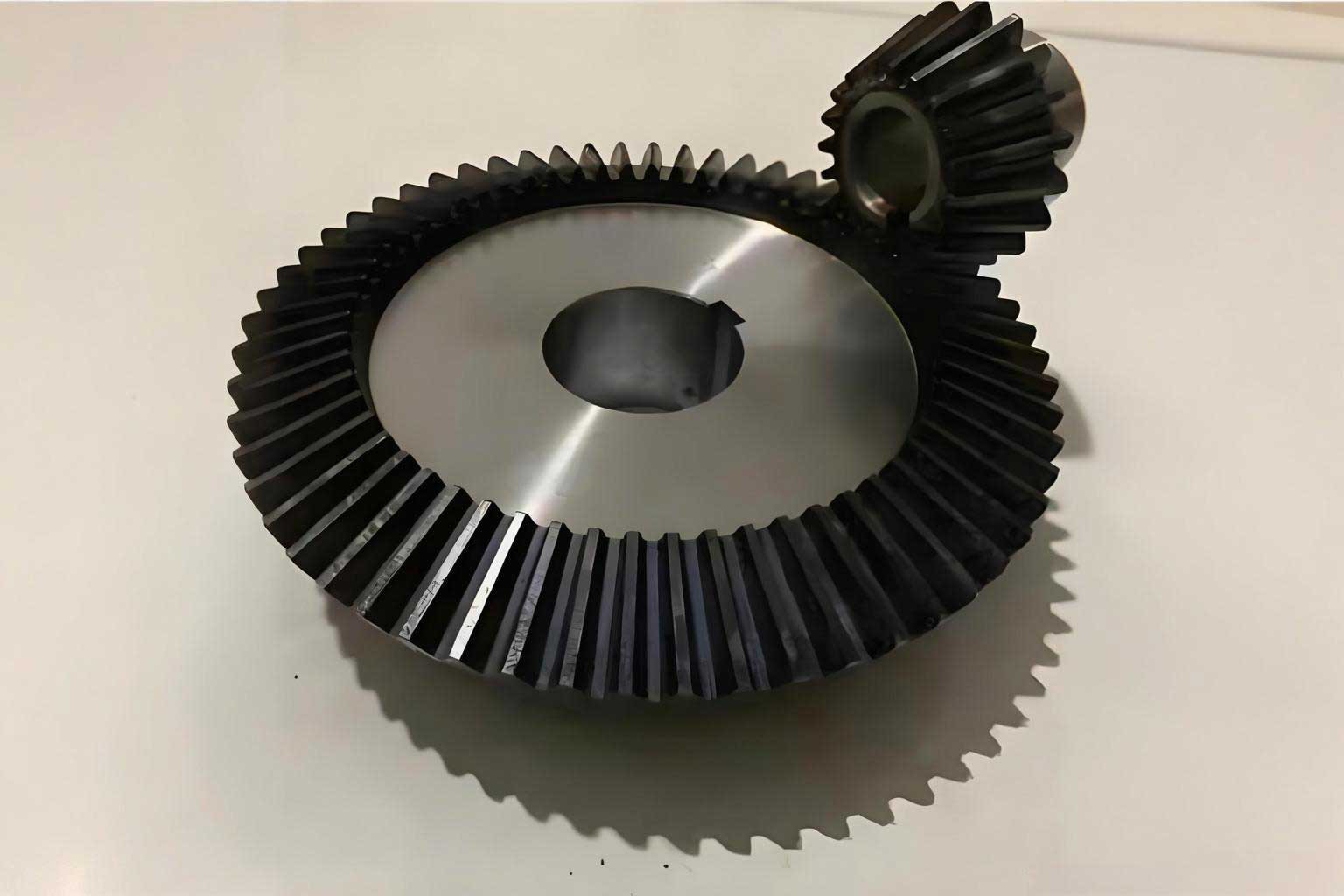
The machining of miter gears, especially those requiring high positional accuracy and load capacity, presents unique challenges. The ideal tooth form is based on spherical involute geometry, which is complex to generate and control. Conventional straight bevel gear production via shaping or basic milling results in a theoretically line-contact pattern along the entire face width. This full-length contact is highly sensitive to minute assembly errors and load-induced deformations, often leading to detrimental edge-loading, accelerated wear, and reduced fatigue life. Consequently, achieving a localized, elliptical contact area—typically positioned towards the heel (smaller end) of the tooth—is paramount. This “crowned” or “profile-modified” tooth design, introducing intentional longitudinal mismatch, dramatically reduces sensitivity to misalignment and ensures stable contact under operational loads. Producing these sophisticated crowned miter gears with high consistency and interchangeability necessitates a leap forward from traditional machining and inspection paradigms.
Critical Factors Influencing Miter Gear Machining Precision
The final quality of a miter gear is the culmination of numerous interacting factors within the manufacturing system. Isolating and controlling these variables is key to achieving and surpassing precision benchmarks.
- Machine Tool Integrity: The geometric and dynamic accuracy of the multi-axis CNC bevel gear milling machine forms the foundation. Modern machines offer the necessary precision in linear axes, rotary axes (cradle), and spindle runout to support the generation of high-grade miter gears.
- Workholding and Fixturing: Rigid, repeatable, and precise fixturing is non-negotiable. Hydraulic expansion mandrels or precision collet chucks with minimal runout (typically < 5 μm) ensure the gear blank is located identically for both machining and subsequent measurement, directly tying machining accuracy to part datum.
- Gear Blank Preparation: The pre-machined blank’s quality, defined by tolerances on mounting bores, back faces, and datum diameters, is a primary contributor to final gear accuracy. Tighter blank tolerances (corresponding to higher gear grades) are essential as they form the basis for all subsequent tooth generation operations.
- Cutting Tool Design and Material: This is arguably the most influential and actively controllable factor for precision and surface finish. The cutter’s parameters directly govern the tooth flank form, crown amount, and root fillet. The tool material dictates achievable cutting parameters, wear resistance, and ultimately, the consistency of the gear tooth geometry over a production batch.
- Metrology and Process Control: The ability to accurately measure the gear defines the ability to make it. Advanced inspection techniques are required to verify not just traditional gear parameters but also the complex crowned flank topography and functional contact patterns. This data is critical for closed-loop process adjustment.
- Manufacturing Process Design: The entire process chain, including cutting strategy, sequence, coolant application, and post-heat-treatment handling, must be optimized to minimize distortion and preserve the precision imparted during the soft-state machining of hardened miter gears.
Among these, the evolution of the milling cutter and the implementation of high-resolution metrology stand out as the primary levers for achieving a quantum leap in miter gear quality, moving from empirical “trial-and-error” to a predictable, science-based manufacturing process.
Evolution and Optimization of the Milling Cutter for Crowned Miter Gears
The transition to producing crowned miter gears is enabled by specialized face-milling cutter systems, such as the Coniflex principle, which employs a pair of synchronized, tilted cutter heads. The key to generating the essential longitudinal crowning lies in the precise design and execution of the cutter itself.
Fundamental Cutter Parameters and Their Influence
The geometry of the indexable carbide insert or the grinding wheel (for solid cutters) is defined by several interlinked parameters that directly map to the gear’s contact characteristics.
- Cutter Blade Dish Angle (δ): This is the concavity angle ground into the cutting edge. It is the primary parameter responsible for generating the longitudinal crowning on the miter gear tooth flank. The dish angle creates a curved cutting path, leading to a tooth flank with a controlled radius of curvature rather than a straight line. The relationship between the dish angle (δ), cutter diameter (Du), and the resulting crowning amount (ΔS) over the face width (B) can be approximated as:
$$ \Delta S \approx \frac{B^2 \sin \delta}{4 D_u} $$
This formula reveals that crowning increases with a larger face width or a larger dish angle, and decreases with a larger cutter diameter. Controlling ΔS is fundamental to controlling the size of the elliptical contact pattern on the miter gear. - Cutter Diameter (Du): Selected based on the module and face width of the miter gear, the cutter diameter interacts with the dish angle as shown in the formula above. It also influences the form of the gear tooth root fillet. A systematic approach to standardizing cutter diameters for a range of gear sizes is crucial for reducing tooling inventory and improving process control.
- Cutter Pressure Angle (αf): This is related to the machine tool’s cradle angle (ψ) and the blade dish angle (δ) by the fundamental setup equation:
$$ \alpha_f = \psi – \delta $$
Accurate realization of the designed pressure angle is vital for achieving the correct tooth profile and ensuring proper meshing action of the miter gear pair. - Blade Toprem (WT): This refers to the width of the blade’s top cutting edge. It must be carefully calculated to ensure clean cutting at both the toe and heel of the tooth slot without leaving uncut material or causing excessive notch stress. The calculation must account for the slot width at the heel (WLi) and toe (WLo), which vary due to the conical geometry of the miter gear:
$$ W_{Li} = \frac{A_0 – B}{A_0} \times (T_{on} – 2 \times b_0 \times \tan \alpha_f) – C $$
$$ W_{Lo} = (T_{on} – 2 \times b_0 \times \tan \alpha_f) – C $$
The maximum allowable blade toprem (WT.max) must satisfy: \( (0.5 \times W_{Lo}) < W_{T.max} < W_{Li} \), where \( C \) is a clearance constant, \( A_0 \) is the outer cone distance, \( T_{on} \) is the mating gear’s toe normal tooth thickness, and \( b_0 \) is the dedendum.
The Revolutionary Shift to Carbide Tooling
The material of the cutting tool has a profound impact on the achievable quality and consistency of miter gears. A comparative analysis highlights the transformative effect of adopting modern carbide tooling over traditional high-speed steel (HSS) or powder metallurgy (PM) steels.
| Aspect | Powder Metallurgy / HSS Tooling | Carbide Insert Tooling |
|---|---|---|
| Cutting Speed (Vc) | 50 – 70 m/min | > 200 m/min |
| Surface Finish (Ra) | 1.1 – 1.4 μm | 0.4 – 0.6 μm |
| Tooth Profile Consistency | ±10 μm, degrading with wear | ±5 μm, stable over long runs |
| Mid-point Tooth Thickness Tolerance | ~0.140 mm | ~0.025 mm |
| Tool Life (Parts per edge/body) | 15 – 30 parts | |
| Achievable Gear Grade (GB/T 11365) | Grade 7 | Grade 5 |
The superior hardness, wear resistance, and thermal properties of carbide allow for significantly higher cutting speeds and feeds. This results in multiple benefits for miter gear production: a dramatic improvement in surface finish reduces the need for lengthy run-in periods and minimizes initial wear; exceptional dimensional stability over hundreds of parts ensures unparalleled batch consistency and interchangeability; and the reduced tool change frequency enhances overall equipment effectiveness (OEE). The transition to carbide tooling is, therefore, a cornerstone in the production of high-precision, Grade 5 miter gears.
Advanced Metrology: The Bedrock of High-Precision Miter Gear Verification
As machining capabilities advance, metrology must keep pace to provide meaningful feedback. The inspection of modern crowned miter gears extends far beyond simple tooth thickness checks, encompassing full topological mapping and functional simulation.
Comprehensive Flank Topology Measurement with CMM
Coordinate Measuring Machines (CMM) equipped with specialized gear software are used to perform a detailed deviation analysis of the actual tooth flank against its theoretical digital model. A grid of points (e.g., 5 points along the profile height and 9 points along the face width) is measured on several teeth. The software calculates the normal deviation at each point, generating a color-coded topography map. This “signature” of the tooth flank reveals form errors, twist, and the accuracy of the applied crowning. The permissible flank form deviation (VΦT) for high-precision miter gears is tightly controlled, often according to standards like AGMA 2009-B01, which defines it as:
$$ V_{ΦT} = K \cdot N^{0.154} \cdot P_d^{-0.589} \cdot 1.4^{(B-8)} \cdot 0.00254 $$
where K is a constant, N is the number of teeth, Pd is the diametral pitch, and B is the AGMA quality number. For aerospace-grade miter gears, achieving a flank form tolerance of ±5 μm is a common target, enabling predictable contact behavior.
Functional Contact Pattern Rolling Test
While CMM measures geometry, the rolling test assesses function. The miter gear is meshed with a master gear or its mating counterpart under a lightly loaded condition with fixed mounting distances. A marking compound (e.g., Prussian blue) is applied to the flanks. The gears are rotated through several cycles, transferring the compound to areas of contact. The resulting pattern is evaluated for:
- Size: Typically specified as a percentage of the face width and tooth depth (e.g., 50-60% of tooth length).
- Location: Ideally centered in the tooth depth and biased towards the heel (e.g., 65% from the toe) for optimal load-bearing and alignment tolerance.
- Shape: A well-defined ellipse or modified rectangle.
- Consistency: Uniformity of the pattern across all teeth in the gear.
Modern CNC rolling testers automate this process, applying precise torque and recording angular position errors (transmission error), which provides a digital, quantitative measure of meshing smoothness—a critical factor for noise and vibration performance in miter gear assemblies.
Precision Measurement of Tooth Thickness and Backlash
For interchangeable miter gears, controlling the tooth thickness at a specific reference point is essential. The traditional method of using gear tooth calipers at the heel is insufficient due to crowning and limited accuracy. Instead, the chordal tooth thickness is precisely measured at the “dT point”—a defined point along the face width corresponding to the center of the target contact pattern. High-precision gear inspection systems (e.g., Klingelnberg P series, Gleason GMS) use motorized probes to automatically find and measure this dimension with micron-level repeatability. Controlling the mid-point tooth thickness to a tolerance of 0.025 mm is a key enabler for achieving consistent and specified operational backlash in the miter gear pair. The theoretical backlash at the heel (Bo.cal) can be derived from the measured contact center and the measured tooth thicknesses at that center:
$$ B_{o.cal} = \frac{\pi}{P_d} – \left[ d \cdot \arcsin\left(\frac{A_0 \cdot t_{cc.mea}}{d (A_0 – x_0)}\right) + D \cdot \arcsin\left(\frac{A_0 \cdot T_{cc.mea}}{D (A_0 – x_0)}\right) \right] $$
where \( d, D \) are pitch diameters, \( A_0 \) is outer cone distance, \( x_0 \) is contact center offset, and \( t_{cc.mea}, T_{cc.mea} \) are measured chordal thicknesses at the contact center for pinion and gear respectively.
The Role of Master Gears
To anchor the manufacturing process and ensure true interchangeability, a high-precision master miter gear is often employed. This master, manufactured to the highest possible grade (e.g., Grade 4 or better), has its flank topography meticulously measured and defined as the “zero” reference. All production miter gears are then inspected relative to this master’s digital twin during CMM measurement, and rolling tests are conducted against it. This approach decouples process control from any single mating part and establishes an absolute, stable standard for the entire production run of miter gears.
Synthesis and Conclusion
The journey to producing ultra-precision, crowned miter gears for demanding aerospace applications is a multifaceted engineering challenge. It requires moving beyond conventional machining wisdom and embracing an integrated system approach. The analysis confirms that two elements are disproportionately impactful: the cutting tool and metrology.
The strategic optimization of cutter geometry—dish angle, diameter, and profile—coupled with the revolutionary adoption of carbide insert technology, directly addresses the core limitations of surface finish, wear life, and batch consistency. This shift enables the stable and efficient generation of the precise crowned flank forms necessary for robust, localized contact patterns in miter gears.
Simultaneously, the deployment of advanced metrology closes the quality control loop. High-resolution CMM flank mapping, automated CNC rolling tests, and micron-level tooth thickness measurement transform quality assurance from a passive checkpoint into an active, data-rich feedback mechanism for process refinement. The use of a master gear solidifies this system, providing an unchanging datum for interchangeability.
In conclusion, the synergistic advancement of milling cutter technology and comprehensive inspection capabilities forms the cornerstone of modern high-precision miter gear manufacturing. This integrated approach has demonstrably enabled the production of miter gears that meet stringent Grade 5 specifications, characterized by superior surface integrity, predictable elliptical contact patterns, and true interchangeability. These capabilities are essential for supporting the development of reliable, high-performance transmission systems, such as those required for next-generation commercial aviation platforms, where every component must perform with flawless precision.