
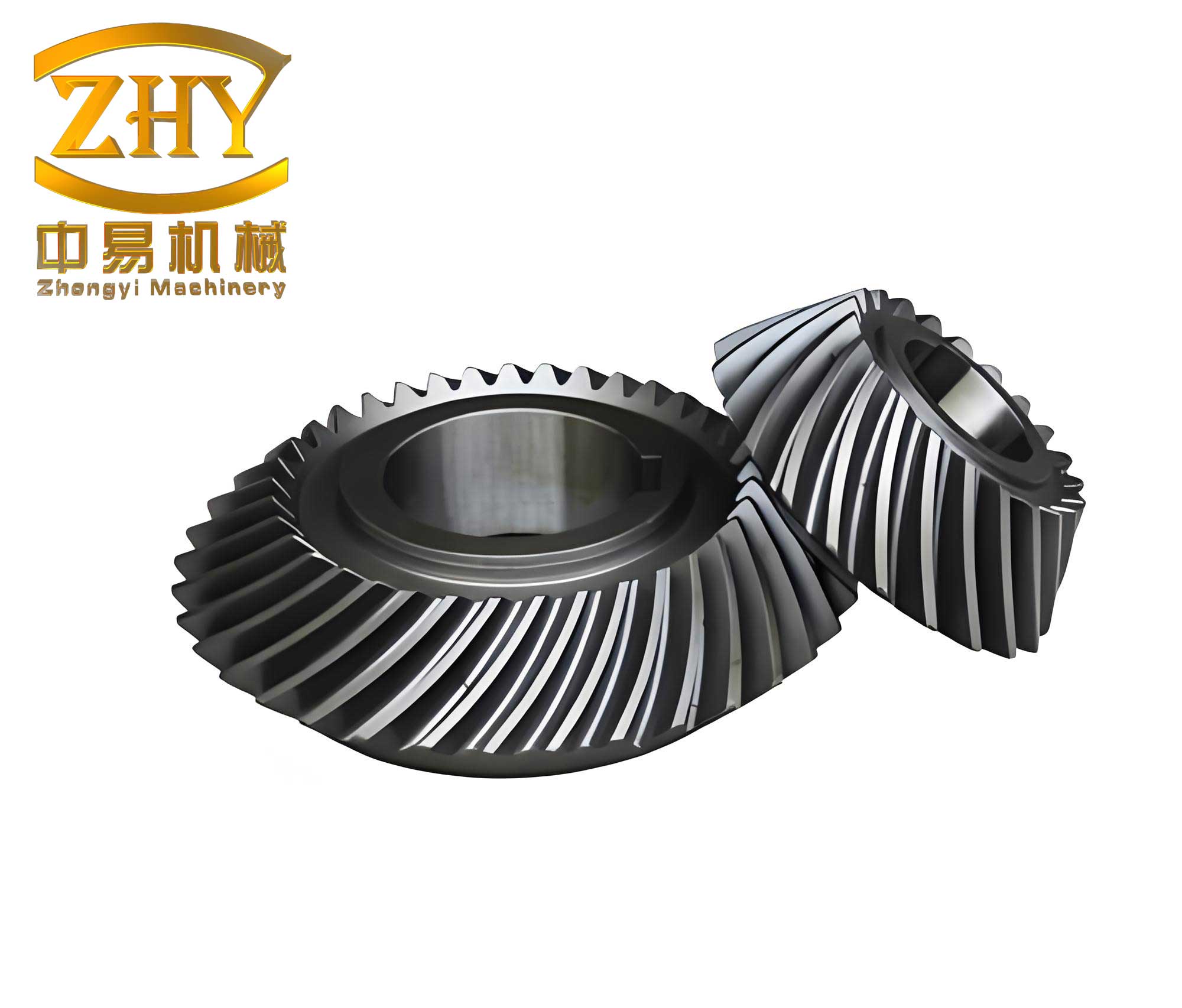
The quality of spiral gears, characterized by their curvilinear tooth trace, is paramount to the performance and longevity of mechanical transmission systems. Gear accuracy grading is a fundamental method for quality assessment. The manufacturing process of a spiral gear is complex, involving a kinematic chain comprising the cutter, machine tool, and workpiece. Errors arising from tool clamping, machine tool geometry, and workpiece fixturing significantly impact the final gear quality, which in turn dictates its meshing and transmission performance during operation. Therefore, establishing a comprehensive error model, understanding the evolution of errors, and investigating their effects on meshing dynamics are critical for controlling manufacturing quality and enhancing the operational performance of spiral gears.
Establishment of a Spatial Error Model for Spiral Gears
A spatial error model for spiral gears that incorporates errors from the hob, machine tool, and workpiece was developed based on multi-body system theory, gear hobbing principles, and meshing theory. The coordinate transformation matrices along the hob-machine-workpiece chain, including various error elements, were derived. For an example machine tool structure, the overall transformation matrix from the hob coordinate system to the workpiece coordinate system is given by:
$$ T_{wc} = (T_{12} \cdot T_{23} \cdot T_{34})^{-1} \cdot T_{15} \cdot T_{56} \cdot T_{67} \cdot T_{78} $$
where each $T_{ij}$ represents the homogeneous transformation matrix between bodies. The mathematical model of the Archimedes hob’s cutting surface was established. According to gear meshing theory, the meshing equation for generating the gear tooth surface is:
$$ (\vec{V}_{12}) \cdot \vec{N}_1 = 0 $$
where $\vec{V}_{12}$ is the relative velocity vector between the hob and the workpiece at the potential contact point, and $\vec{N}_1$ is the normal vector of the hob surface in the machine coordinate system. Solving this equation yields the mathematical model of the manufactured spiral gear tooth surface, inclusive of the systematic errors.
Mathematical Models for Spiral Gear Error Evaluation
Based on the established spatial error model and according to gear accuracy standards (e.g., ISO 1328), mathematical models for key evaluation parameters were developed.
Pitch Deviation Models
Pitch deviations are evaluated on the transverse plane. For a theoretical point $A(x_1, y_1)$ and an actual point $B(x_2, y_2)$ on the spiral gear, the single pitch deviation $f_p$ is calculated as:
$$ \alpha = \arccos\left(\frac{x_1 x_2 + y_1 y_2}{\sqrt{x_1^2 + y_1^2} \sqrt{x_2^2 + y_2^2}}\right) $$
$$ f_p = \alpha \cdot r – p_t $$
where $r$ is the reference circle radius and $p_t$ is the theoretical transverse pitch. The cumulative pitch deviation $F_p$ over $Z_0$ teeth is calculated similarly using corresponding points.
Profile Deviation Models
Profile deviation is defined as the normal distance between the actual and design profile. For a theoretical point $B$ on the involute and its corresponding point $C$ on the actual profile along the common normal (tangent to the base circle), the deviation $D_L$ is:
$$ D_L = \sqrt{x’^2 + y’^2 – r_b^2} – \sqrt{x^2 + y^2 – r_b^2} $$
The profile total deviation $F_\alpha$ is the range of $D_L$ over the evaluation range. The profile form deviation $ff_\alpha$ is the minimum distance between two lines parallel to the mean line that envelope the actual profile deviation curve. The profile slope deviation $f_{H\alpha}$ is the distance between the mean line and the design profile at the endpoints of the evaluation range.
Helix Deviation Models
Helix deviation is assessed along the tooth trace. The deviation $E_m$ at an axial position $z$ is the axial distance between the actual and theoretical helix lines, measured in a plane perpendicular to the axis:
$$ E_m(z) = \int_0^z \left( \sqrt{\left(\frac{dX’}{dz}\right)^2 + \left(\frac{dY’}{dz}\right)^2} – \sqrt{\left(\frac{dX}{dz}\right)^2 + \left(\frac{dY}{dz}\right)^2} \right) dz $$
The helix total deviation $F_\beta$ is the range of $E_m(z)$. The helix form deviation $ff_\beta$ and helix slope deviation $f_{H\beta}$ are evaluated analogous to their profile counterparts.
Influence of Process System Errors on Spiral Gear Accuracy
Numerical analysis was conducted to investigate the influence of individual error elements from the hob, machine tool, and workpiece on the evaluation parameters of the spiral gear. The error elements considered include linear displacement errors $\delta$, angular errors $\varepsilon$, and squareness errors $S$ for each axis of motion and rotation. A summary of the most influential errors is presented in the table below.
| Evaluation Parameter | Most Influential Error Elements | Secondary Influential Error Elements |
|---|---|---|
| Single Pitch Deviation $f_p$ | $\delta_y(\alpha), \delta_y(\beta), \delta_y(z), \delta_y(y), \delta_y(\phi_2)$ | $\varepsilon_z(\alpha), \varepsilon_z(\phi_2)$ |
| Cumulative Pitch Deviation $F_p$ | $\delta_y(\alpha), \delta_y(\beta), \delta_y(z), \delta_y(y), \delta_y(\phi_2)$ | $\varepsilon_z(\alpha), \varepsilon_z(\phi_2)$ |
| Profile Total Deviation $F_\alpha$ | $\varepsilon_z(\alpha), \varepsilon_z(\phi_2)$ | $\delta_x(\gamma), \delta_x(\phi_1)$ |
| Profile Form Deviation $ff_\alpha$ | $\delta_x(\gamma), \delta_x(\phi_1)$ | $\delta_x(y)$ |
| Profile Slope Deviation $f_{H\alpha}$ | $\varepsilon_z(\alpha), \varepsilon_z(\phi_2)$ | $\delta_x(y)$ |
| Helix Total Deviation $F_\beta$ | $\varepsilon_y(y), S_{xzc}$ | $S_{xz}$ |
| Helix Form Deviation $ff_\beta$ | $S_{yz}$ | $\varepsilon_x(y), S_{yzc}$ |
| Helix Slope Deviation $f_{H\beta}$ | $\varepsilon_y(y), S_{xzc}$ | $S_{xz}$ |
The results indicate that for most error elements, the values of the spiral gear deviations increase with the magnitude of the error element. However, the sensitivity varies significantly. The errors $\delta_y$ (linear Y-direction errors) dominantly affect pitch deviations, while errors $\varepsilon_z$ (angular errors about the Z-axis) and $\delta_x$ (linear X-direction errors) are critical for profile deviations. Helix deviations are primarily sensitive to guideway squareness errors ($S$) and specific angular errors ($\varepsilon_y$).
Influence of Profile Deviations on Meshing Performance of Spiral Gears
A universal mathematical model for spiral gears incorporating defined profile deviations was established based on the fundamental property of the involute curve (its normal is tangent to the base circle). The model for an error-modified tooth surface point $D$, corresponding to a theoretical point on the involute defined by parameter $\theta_1$, is:
$$ \begin{bmatrix} X(\gamma, \theta_1) \\ Y(\gamma, \theta_1) \\ Z(\gamma, \theta_1) \end{bmatrix} = \begin{bmatrix} (r_b \cdot \sigma + \Delta(f))\cos(\gamma + \theta_0 + \theta_1) + r_b \sin(\gamma + \theta_0 + \theta_1) \\ -(r_b \cdot \sigma + \Delta(f))\sin(\gamma + \theta_0 + \theta_1) + r_b \cos(\gamma + \theta_0 + \theta_1) \\ p \cdot \gamma \end{bmatrix} $$
where $\sigma = \theta_0 + \theta_1$, $p$ is the spiral parameter, and $\Delta(f)$ is the profile deviation function defined along the length of the generating line $f = r_b \theta_1$.
Five distinct types of profile deviation $\Delta(f)$ were investigated:
- Constant Type: $\Delta(f) = -\Delta$
- Linear Increase Type: $\Delta(f) = -\Delta \cdot (f / L_g)$
- Linear Reduction Type: $\Delta(f) = -\Delta \cdot (1 – f / L_g)$
- Parabolic Convex Type: $\Delta(f) = a_1 \cdot (f – L_p \cdot f)^2$ for $f \leq L_p$, and a mirrored function for $f > L_p$.
- Parabolic Concave Type: $\Delta(f) = -a_2 \cdot (L_p – f)^2$ for $f \leq L_p$, and a similar function for $f > L_p$.
Here, $\Delta$ is the maximum error magnitude, $L_g$ is the total generating line length, and $L_p$ is the length at the pitch point. Three-dimensional and finite element (FE) models of a spiral gear pair were created based on this mathematical model. The FE model’s reliability was validated by comparing its predicted contact patterns with those from theoretical gear contact analysis. The meshing performance was then evaluated under different profile deviation types and magnitudes (simulating accuracy grades 4, 6, 8, and 10). The key findings are summarized below.
| Profile Deviation Type | Effect on Contact Pattern | Effect on Meshing Stiffness & Transmission Error | Overall Impact on Meshing Performance |
|---|---|---|---|
| Constant | Negligible change. | Minimal effect on mean value and waveform. | Minor influence. |
| Linear Increase | Contact shifts toward one end of the tooth face; reduces initial edge contact. | Reduces mean mesh stiffness; increases transmission error. | Generally deteriorates performance. |
| Linear Reduction | Contact shifts toward the opposite end of the tooth face. | Reduces mean mesh stiffness; increases transmission error. | Generally deteriorates performance. |
| Parabolic Convex | Severe edge contact at both ends; can cause a loss of contact in the middle region for large errors. | Drastically reduces and destabilizes mesh stiffness; causes large jumps in transmission error. | Significantly deteriorates performance; worst-case scenario. |
| Parabolic Concave | Eliminates or greatly reduces initial and final edge contact; contact area may decrease. | Provides the smoothest, least fluctuating mesh stiffness and transmission error. | Improves smoothness and can enhance dynamic performance despite reduced contact area. |
The parabolic concave type of profile deviation consistently led to the smoothest variations in contact pressure, contact stress, bending stress, transmission error, and torsional mesh stiffness throughout the mesh cycle. This smoothing effect mitigates vibration and noise, suggesting that a controlled, intentional parabolic concave modification could be beneficial for the meshing performance of spiral gears in high-precision applications.
Conclusion
This investigation established a comprehensive framework for modeling and analyzing errors in spiral gears. A spatial error model successfully integrates the influence of process system errors from hobbing. Numerical analysis identified the most critical error elements affecting pitch, profile, and helix deviations, providing guidance for precision control in manufacturing. Furthermore, a versatile model for introducing specific profile deviations was developed and used in finite element analysis to assess their impact on meshing dynamics. The results demonstrate that the type of profile deviation is as crucial as its magnitude. While convex errors are highly detrimental, a parabolic concave deviation can unexpectedly improve meshing smoothness. This work provides valuable insights for both controlling spiral gear manufacturing quality and designing intentional tooth modifications to optimize their operational performance.