
In the field of mechanical transmission, cylindrical gears are fundamental components due to their widespread application and reliability. Among these, involute spur gears are particularly prevalent because of their smooth operation and low noise characteristics. However, the precision of these cylindrical gears is critical, as deviations can lead to reduced performance, increased wear, and operational instability. Traditional contact-based measurement methods, while accurate, suffer from limitations such as prolonged inspection times, low universality, and potential damage to both the measuring probe and the gear surface. To address these issues, we have developed a non-contact measurement approach using laser displacement sensors, focusing on error correction to enhance accuracy for cylindrical gears.
The evolution of gear measurement technology has seen a shift from mechanical methods to integrated information systems. Modern techniques include gear overall error measurement, which combines design and manufacturing data for closed-loop systems. Our research aligns with this trend by leveraging laser triangulation for non-contact measurement of cylindrical gears. This method avoids physical contact, thereby eliminating probe wear and surface damage, making it ideal for high-volume inspection of cylindrical gears. In this article, we detail our experimental setup, error calibration, correction model, and application to involute spur gears, demonstrating significant improvements in measurement precision.
Laser triangulation is a well-established principle for displacement sensing. It involves projecting a laser beam onto a target surface, with the reflected light captured by a CCD array. The displacement $\Delta z$ of the surface along the laser axis is related to the image position shift $\Delta x$ on the CCD. For a typical setup with incident angle $\theta$ and baseline distance $L$, the relationship can be expressed as:
$$ \Delta z = \frac{L \cdot \Delta x}{f \cdot \sin(\theta)} $$
where $f$ is the focal length of the lens. However, in practice, errors arise due to factors like surface inclination, which we define as the angle between the laser beam and the surface normal. For cylindrical gears, the tooth profile curvature introduces varying inclinations during measurement, leading to systematic errors that must be corrected.
Our experimental apparatus is based on a four-coordinate measurement center developed in collaboration with industry partners. It consists of linear axes X, Y, Z and a rotary C-axis. A laser displacement sensor is mounted on the X-axis, while the cylindrical gear specimen is fixed on the C-axis using centers, allowing 360° rotation. The axes are equipped with Renishaw gratings for feedback, achieving accuracies of 1 μm for linear axes and 0.001° for the rotary axis. The sensor used is a Keyence LK-H050 laser displacement sensor, with key parameters summarized in Table 1.
| Parameter | Value |
|---|---|
| Measurement Method | Diffuse Reflection |
| Reference Distance | 50 mm |
| Measuring Range | ±10 mm |
| Spot Diameter | 50 μm |
| Linearity | ±0.02% F.S. |
| Repeatability | 0.025 μm |
| Temperature Characteristic | 0.01% F.S./°C |
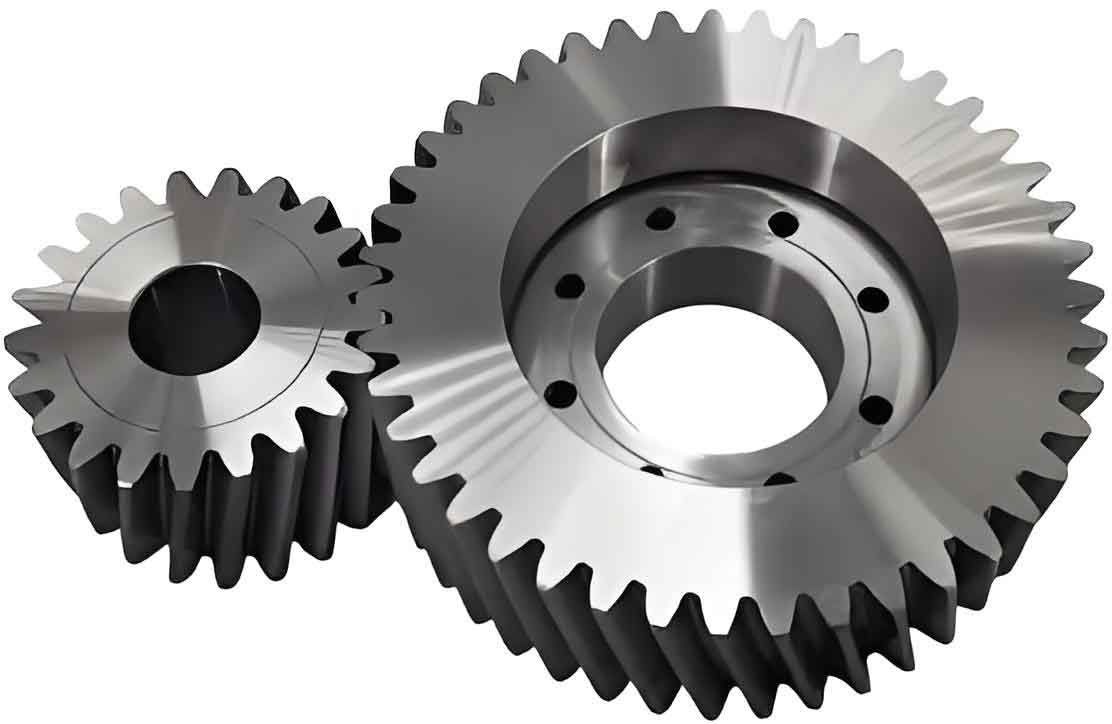
The measurement of cylindrical gears requires precise path planning to ensure the laser beam scans the tooth profile effectively. For involute spur gears, the theoretical profile is defined by the involute equation:
$$ x = r_b (\cos(\phi) + \phi \sin(\phi)) $$
$$ y = r_b (\sin(\phi) – \phi \cos(\phi)) $$
where $r_b$ is the base radius and $\phi$ is the roll angle. During measurement, the gear is rotated while the sensor moves along a predefined path, capturing data points at high frequency. The laser sensor operates at a cycle of 10 ms, yielding 100 data points per second. However, errors due to inclination effects must be addressed to achieve accurate results for cylindrical gears.
To calibrate the sensor errors, we conducted an error proofing experiment using a setup comprising a CNC machining center, the laser displacement sensor, a laser interferometer, a sine bar, gauge blocks, and a rotary table. The sensor was mounted on the Z-axis, and a sine bar placed on the rotary table beneath it allowed controlled inclination angles. The laser interferometer provided reference displacement values. We adjusted the sensor to ensure vertical incidence initially, then varied the inclination angle $\alpha$ from 0° to 40° in steps, and for each angle, moved the Z-axis over the sensor’s range from -10 mm to 10 mm, recording both sensor and interferometer readings at 1 mm intervals. The difference between these readings gave the error $E(\alpha, z)$ as a function of inclination $\alpha$ and measurement depth $z$.
The results showed that error magnitude increases with inclination angle and is also influenced by depth. For instance, at $\alpha = 0°$, errors were negligible, but at $\alpha = 40°$, errors exceeded 50 μm at certain depths. This is critical for cylindrical gears, where tooth profiles involve inclinations ranging from -45° to 45°. We collected data for $\alpha = 10°, 20°, 30°, 40°$ and at depths $z = -8, -4, 0, 4, 8$ mm, as summarized in Table 2.
| Depth z (mm) | α=10° | α=20° | α=30° | α=40° |
|---|---|---|---|---|
| -8 | -12.3 | -25.6 | -38.9 | -52.1 |
| -4 | -6.1 | -12.8 | -19.5 | -26.0 |
| 0 | 0.0 | 0.0 | 0.0 | 0.0 |
| 4 | 6.2 | 12.9 | 19.6 | 26.2 |
| 8 | 12.5 | 25.8 | 39.1 | 52.4 |
From this data, we observed that the error $E$ is approximately linear with depth $z$ for a fixed $\alpha$, but the slope depends on $\alpha$. A model can be formulated as:
$$ E(\alpha, z) = k(\alpha) \cdot z + b(\alpha) $$
where $k(\alpha)$ is a slope coefficient and $b(\alpha)$ an offset. Using polynomial fitting, we derived $k(\alpha) = 0.015\alpha – 0.001$ and $b(\alpha) = 0.002\alpha^2$ (with $\alpha$ in degrees). However, for more accurate correction, we employed MATLAB to create an error interpolation model over the full range of $\alpha$ from 0° to 45° and $z$ from -10 to 10 mm. This model uses bicubic interpolation to generate a continuous error surface, enabling real-time compensation during gear measurement.
The error correction process involves several steps. First, during measurement of cylindrical gears, we plan the scan path based on the gear geometry. For each data point, we compute the theoretical surface normal vector at that point on the gear tooth. The inclination angle $\alpha$ is then the angle between the laser beam direction (assumed fixed) and the surface normal. Using the measured raw laser value $z_{raw}$, we query the error model to obtain $E(\alpha, z_{raw})$, and the corrected value $z_{corr}$ is:
$$ z_{corr} = z_{raw} – E(\alpha, z_{raw}) $$
This compensation accounts for systematic errors due to inclination, which is essential for accurate profile assessment of cylindrical gears. To implement this, we developed MATLAB scripts that simulate gear rotation, calculate normals, and apply correction. The involute profile generation in MATLAB uses the parametric equations above, with parameters such as module $m$, number of teeth $Z$, and pressure angle $\phi_0$. For a standard spur gear, the base radius $r_b = \frac{mZ \cos(\phi_0)}{2}$.
In our gear measurement experiment, we used a cylindrical gear with module 2 mm, 20 teeth, and pressure angle 20°. The gear was mounted on the rotary table, and the sensor positioned such that the laser beam scanned the tooth flank. We collected data for one full rotation, capturing approximately 1000 points per tooth. After applying error correction, we extracted the effective profile section, typically around 95 points per tooth after trimming non-relevant regions. The corrected data was then analyzed for gear errors, focusing on tooth profile deviation and pitch deviation, which are key indicators for cylindrical gears.
Tooth profile deviation $F_\alpha$ is defined as the maximum difference between the actual profile and the theoretical involute over the evaluation range. We computed this by fitting the corrected data to the theoretical involute using least squares. The deviation at each point $i$ is $d_i = |z_{corr,i} – z_{theory,i}|$, and $F_\alpha = \max(d_i) – \min(d_i)$. For our cylindrical gear sample, the results are shown in Table 3 for a subset of points on one tooth.
| Data Point Index | Deviation d_i |
|---|---|
| 1 | 1.1 |
| 2 | 4.7 |
| 3 | 4.8 |
| 4 | 6.1 |
| 5 | 7.6 |
| 6 | 7.8 |
| 7 | 8.7 |
| 8 | 6.3 |
| 9 | 6.1 |
| 10 | 5.6 |
| 11 | 4.7 |
| 12 | 3.5 |
| 13 | -1.1 |
| 14 | 2.4 |
| 15 | 2.8 |
| 16 | 3.3 |
| 17 | 3.9 |
From this, $F_\alpha = 8.7 – (-1.1) = 9.8$ μm. According to the GB/T10095.1-2008 standard for cylindrical gears, this falls within the Grade 6 tolerance band (up to 13 μm), indicating acceptable precision.
Pitch deviation analysis involves single pitch deviation $f_{pt}$ and cumulative pitch deviation $F_p$. For cylindrical gears, pitch is measured at the reference circle. We determined the intersection points of the fitted profile with the reference circle (radius $r = mZ/2$) and computed the arc distances. The single pitch deviation for tooth $j$ is $f_{pt,j} = L_{actual,j} – L_{theory,j}$, where $L_{theory} = \pi m$ for spur gears. The cumulative deviation $F_p$ is the maximum absolute value of the sum of deviations over a full rotation. Our results for a 17-tooth segment are in Table 4.
| Tooth Index j | Single Pitch Deviation f_{pt,j} | Cumulative Pitch Deviation Σf_{pt} |
|---|---|---|
| 1 | -4.3 | -4.3 |
| 2 | -4.1 | -8.4 |
| 3 | -1.9 | -10.3 |
| 4 | -2.7 | -13.0 |
| 5 | -6.7 | -19.6 |
| 6 | -3.2 | -22.8 |
| 7 | -4.5 | -27.3 |
| 8 | 3.5 | -23.8 |
| 9 | 7.7 | -16.1 |
| 10 | 8.2 | -7.9 |
| 11 | 7.5 | -0.4 |
| 12 | 5.1 | 4.7 |
| 13 | 4.5 | 9.2 |
| 14 | 3.4 | 12.6 |
| 15 | -4.9 | 7.7 |
| 16 | -3.8 | 3.9 |
| 17 | -3.6 | 0.3 |
The maximum single pitch deviation is $|f_{pt,max}| = 8.2$ μm, and the cumulative pitch deviation $F_p = 27.3$ μm. Both values meet Grade 6 requirements for cylindrical gears (single pitch tolerance up to 9 μm and cumulative up to 28 μm), validating the effectiveness of our error correction method.
To further illustrate the impact of correction, we compared the uncorrected and corrected laser measurements for cylindrical gears. The uncorrected data exhibited errors up to 50 μm, which would degrade the gear grade assessment. After applying the inclination error model, the deviations reduced significantly, bringing the measurements within acceptable limits. This highlights the necessity of error compensation in non-contact measurement systems for cylindrical gears, especially when high precision is required.
In addition to profile and pitch, other error elements like helix deviation and runout can be assessed with this setup. For cylindrical gears, the laser sensor can scan along the tooth width if the Y-axis is utilized, allowing 3D profile reconstruction. The general form for a point on the gear surface in Cartesian coordinates is:
$$ \mathbf{r}(u,v) = \begin{bmatrix} x(u) + v \sin(\beta) \\ y(u) + v \cos(\beta) \\ v \end{bmatrix} $$
where $u$ is the profile parameter, $v$ is the lead direction parameter, and $\beta$ is the helix angle (zero for spur gears). This parametric representation aids in path planning and data fusion.
The error model we developed is not limited to cylindrical gears; it can be adapted to other gear types like helical or bevel gears by adjusting the inclination calculations. However, for cylindrical gears, the simplicity of the involute profile makes the normal vector computation straightforward. The surface normal for an involute at parameter $\phi$ is given by:
$$ \mathbf{n} = \begin{bmatrix} -\sin(\phi) \\ \cos(\phi) \\ 0 \end{bmatrix} $$
assuming the gear lies in the XY-plane. The inclination angle $\alpha$ between the laser direction (assumed along Z-axis) and the normal is then $\alpha = \arccos(|\mathbf{n} \cdot \mathbf{z}|)$, but since the laser is incident at an angle, we consider the actual beam vector. In our setup, the laser is fixed vertically, so the incidence angle relative to the normal varies with tooth curvature.
We also investigated the effect of measurement depth on error. The error function $E(\alpha, z)$ shows that for larger depths, the error magnitude increases linearly. This is consistent with the triangulation geometry, where displacement error scales with distance. To mitigate this, we ensure that the sensor operates near the center of its range (0 mm depth) when possible, but for cylindrical gears, the full range is often needed due to tooth height variations.
Future work could involve automating the correction process using real-time feedback. By integrating the error model into the CNC controller, we could adjust measurements on-the-fly, further improving efficiency for inspecting cylindrical gears. Additionally, machine learning techniques could be employed to refine the error model based on large datasets from various cylindrical gears.
In conclusion, our non-contact laser measurement method with error correction provides a viable alternative to contact-based techniques for cylindrical gears. The inclination error model, built from calibrated data, effectively compensates for systematic deviations, enabling accurate assessment of profile and pitch errors. This approach reduces inspection time, avoids wear, and is adaptable to high-volume production environments. For cylindrical gears, achieving Grade 6 precision demonstrates the method’s robustness, paving the way for broader adoption in gear manufacturing quality control.