
As a researcher deeply immersed in the field of precision mechanics, I have witnessed and contributed to the ongoing evolution of harmonic drive gear technology. The unique operating principle of this system, which relies on controlled elastic deformation of a flexible spline to transmit motion and torque, offers unparalleled advantages in compactness, high reduction ratios, zero-backlash capability, and high positional accuracy. At the heart of this performance lies the geometry of the meshing teeth. The search for an optimal tooth profile that maximizes load capacity, efficiency, longevity, and manufacturing economy has been a central theme in the development of harmonic drive gears. This article delves into the research and development journey of major tooth profiles, analyzing their characteristics, trade-offs, and the underlying kinematic principles.
The fundamental components of a harmonic drive gear are the wave generator (often an elliptical cam), the flexible spline (or flexspline), and the circular spline. The wave generator deforms the flexible spline, causing its external teeth to progressively engage and disengage with the internal teeth of the circular spline. Due to the difference in the number of teeth between the two splines, a significant speed reduction is achieved. The kinematic relationship governing this motion is crucial for tooth profile design. If we denote the rotation of the wave generator as $\theta_w$, the rotation of the flexible spline as $\theta_f$, and the rotation of the circular spline (typically fixed) as $\theta_c = 0$, the reduction ratio $i$ is given by:
$$i = \frac{\theta_w}{\theta_f} = \frac{N_c}{N_c – N_f}$$
where $N_c$ and $N_f$ are the number of teeth on the circular spline and flexible spline, respectively. The relative motion path of a flexible spline tooth tip relative to the circular spline is not a simple circle but a complex curve approximated by an epitrochoid or a closed curve dependent on the wave generator’s shape and the deformation function.
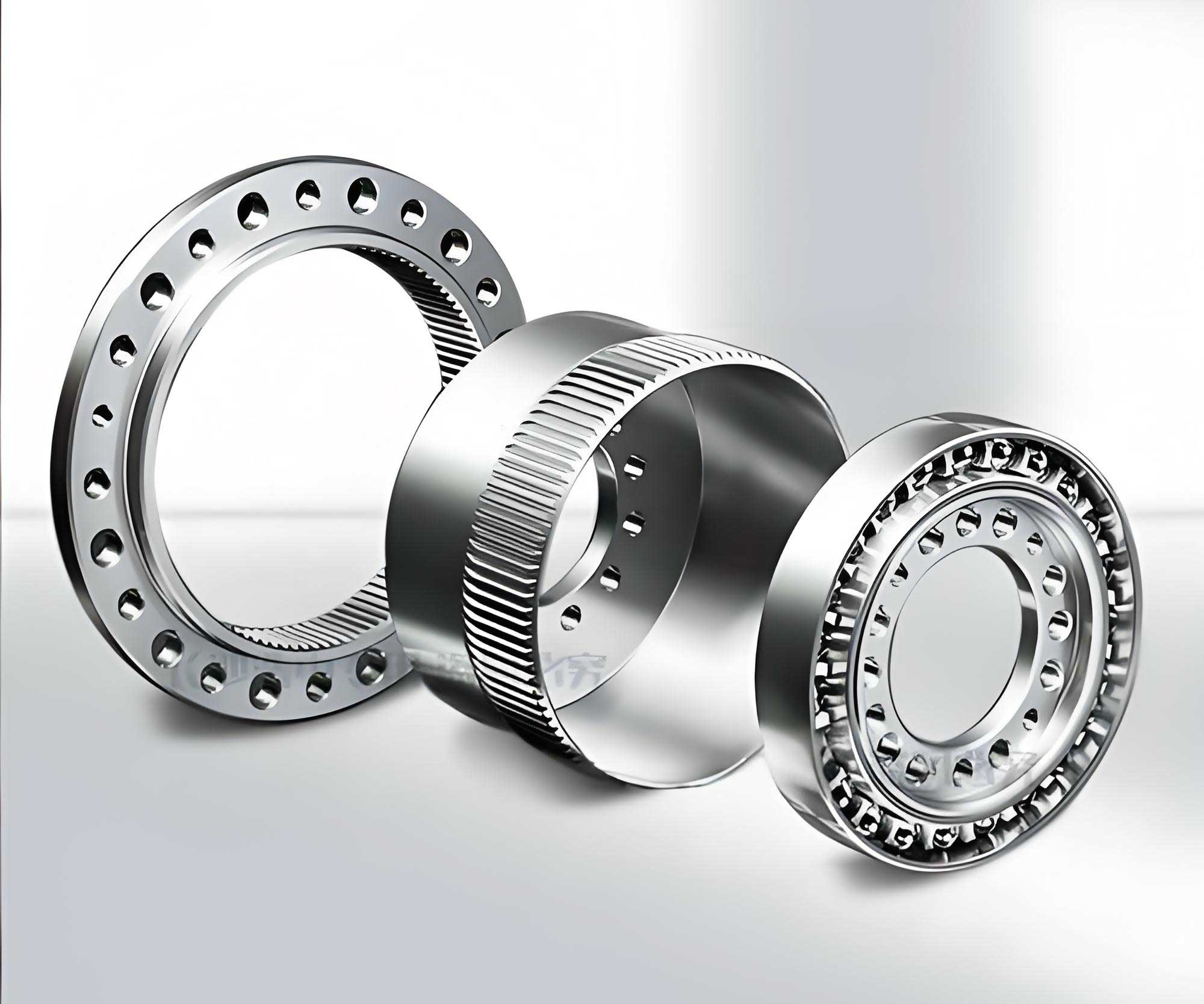
The image above provides a clear cross-sectional view of a harmonic drive gear assembly, illustrating the interaction between the elliptical wave generator, the deformed flexible spline, and the rigid circular spline. This visual context is essential for understanding the mechanical environment in which the tooth profiles must operate.
Involute Tooth Profile: The Established Baseline
The involute tooth profile, borrowed from conventional gear theory, was the first and remains one of the most widely used profiles in harmonic drive gears. Its popularity stemmed from well-understood manufacturing processes, readily available tooling, and established design handbooks. In a harmonic drive context, involute teeth are primarily categorized into two types based on the space width at the root circle relative to the tooth thickness: narrow-space and wide-space teeth.
Despite its manufacturing advantages, the application of the standard involute profile to harmonic drives reveals significant theoretical and practical compromises. Under no-load conditions, kinematic analysis shows that only a limited number of tooth pairs are in simultaneous contact, confined to a specific zone along the major axis of the wave generator. This contradicts the often-cited benefit of multi-tooth engagement for harmonic drives. True multi-pair contact only occurs under load, where elastic deformation of the flexible spline body and teeth forces additional pairs into contact, often resulting in detrimental edge or point contact at the tips or roots of the teeth. This condition increases contact stress, hinders lubricant film formation, and can accelerate wear and fatigue.
To mitigate these issues, various modifications or “crowning” techniques have been applied to the basic involute form. These modifications aim to localize and optimize the contact pattern under load, transforming potentially harmful edge contact into a controlled area contact. A common approach involves altering the tooth profile or applying lead crowning. While these improvements enhance performance, they underscore the fact that the standard involute is not a conjugate profile for the specific kinematic conditions of a harmonic drive gear. The reliance on system elasticity to achieve acceptable load distribution is a fundamental limitation. The nominal contact ratio $C_R$ for an involute harmonic drive under load can be empirically related to the deformation and load, but it is not inherently high from pure geometry.
| Profile Type | Root Space Width vs. Tooth Thickness | Primary Advantage | Key Disadvantage in Harmonic Drive | Typical Application |
|---|---|---|---|---|
| Narrow-Space Involute | Space width << Tooth thickness | Simplified manufacturing, strong tooth root | Prone to root interference, requires precise crowning | General purpose, low-to-medium torque |
| Wide-Space Involute (Modified) | Space width ≥ Tooth thickness (Reduced addendum) | Lower root stress, reduced risk of interference | Reduced contact ratio potential, edge contact issues persist | Applications prioritizing flexspline fatigue life |
The S-Tooth Profile: A Kinematic Breakthrough
A significant conceptual leap in harmonic drive gear tooth design was the introduction of the S-shaped tooth profile (often called the “S-tooth”). This profile was developed from a fundamentally different premise: to define a tooth shape that ensures continuous, multi-pair contact along the entire path of engagement without relying on load-induced deformation. The methodology involves a curve mapping process, using the theoretical path traced by a point on the flexible spline relative to the circular spline as a generating curve.
The core principle is to design a flexible spline tooth profile such that its flank is precisely tangent to this relative motion path at every point within the engagement arc. When successfully implemented, this guarantees that as the wave generator rotates, multiple teeth on the flexible spline maintain smooth, sliding contact with the circular spline teeth across an extended zone. The profile is often constructed from two conjugate circular arcs, resulting in its characteristic “S” shape. The fundamental equation for the generating path $P(\phi)$ for a point on the flexspline, assuming a simple elliptical deformation, can be expressed as:
$$ P(\phi) = \left[ (R_f + \Delta \cos(2\phi)) \cos\left(\frac{N_f}{N_c – N_f}\phi\right), (R_f + \Delta \cos(2\phi)) \sin\left(\frac{N_f}{N_c – N_f}\phi\right) \right] $$
where $R_f$ is the nominal radius of the flexible spline, $\Delta$ is the radial deformation amplitude, and $\phi$ is the angular position relative to the wave generator. The S-tooth profile is then derived as the envelope of this family of curves.
The advantages of this approach are substantial. It theoretically eliminates intermittent contact and the associated vibration and noise. It provides a larger, more favorable contact area from the moment of initial engagement, leading to significantly higher torsional stiffness and load capacity compared to modified involute designs under identical conditions. The stress distribution is also more uniform, potentially enhancing the fatigue life of the flexible spline.
However, the S-tooth profile is not without challenges. Its design is computationally intensive and highly sensitive to the assumed kinematic model (wave generator shape, deformation function). The initial formulations often simplified the problem by treating the gear pair as rack-and-pinion equivalents, which introduced errors, especially in designs with lower tooth counts. Furthermore, achieving perfect conjugate action requires extremely precise manufacturing tolerances. Any deviation in the wave generator’s shape, bearing compliance, or tooth profile machining can degrade the ideal contact conditions. The design and tooling for S-tooth profiles are also proprietary and complex, increasing initial cost.
| Aspect | Description & Implication |
|---|---|
| Design Philosophy | Kinematic conjugate profile based on the relative motion path. Aims for load-independent multi-tooth contact. |
| Contact Pattern | Theoretically continuous line contact across multiple teeth in the engagement zone under zero load. |
| Primary Strength | High torsional stiffness, high load capacity, smooth motion transmission, low wear. |
| Primary Weakness | High sensitivity to manufacturing errors and assembly tolerances; complex and costly tooling. |
| Optimal Use Case | High-performance applications where stiffness, precision, and load capacity are paramount, and cost is secondary (e.g., aerospace actuators, high-end robotics). |
Circular Arc Tooth Profiles: The Performance-Oriented Compromise
Circular arc profiles represent a highly successful middle ground between the manufacturable involute and the kinematically ideal S-tooth. The development of these profiles was driven by the empirical observation that under load, the contact in a harmonic drive gear tends to localize, and a convex tooth flank on the circular spline mating with a concave flank on the flexible spline can provide excellent stress distribution. The most common implementations are the double circular arc (DCA) profile and its variations, such as the tangential double circular arc and the stepped double circular arc.
In a typical DCA design for a harmonic drive gear, the circular spline tooth has a convex circular arc near its tip, while the flexible spline tooth has a conjugate concave circular arc. Often, a second, shallower arc is used near the root or tip to facilitate engagement and disengagement. The profile is not perfectly conjugate across the entire range of motion like the S-tooth but is optimized for the loaded condition in the primary engagement zone. The design parameters include the arc radii $R_{arc}$, the pressure angles at different points, and the center positions of the arcs. The contact stress $\sigma_H$ for two circular arcs in contact can be estimated using a simplified Hertzian formula:
$$ \sigma_H = \sqrt{ \frac{F_n}{\pi L} \cdot \frac{\frac{1}{R_1} \pm \frac{1}{R_2}}{\frac{1-\nu_1^2}{E_1} + \frac{1-\nu_2^2}{E_2}} } $$
where $F_n$ is the normal load, $L$ is the face width, $R_1$ and $R_2$ are the radii of curvature (positive for convex, negative for concave), $E$ is Young’s modulus, and $\nu$ is Poisson’s ratio. The “±” becomes “-” when one surface is concave and the other convex, leading to a lower effective curvature and thus lower contact stress—a key benefit of the circular arc design.
The advantages of circular arc profiles are compelling. They offer a significantly larger and more robust contact area under load than involute teeth, leading to higher load capacity and improved fatigue resistance of the tooth flanks and the flexible spline body. The convex-concave pairing is inherently better at accommodating minor misalignments and manufacturing variations compared to the S-tooth. While not achieving zero-load multi-tooth contact, they reach a high number of contacting pairs quickly under minimal load. Japan has been a pioneer in mass-producing harmonic drive gears with circular arc teeth, particularly for robotics, where high stiffness and compact size are critical.
The main drawback is manufacturing complexity. Cutting circular arc teeth, especially the internal teeth of the circular spline, requires specialized and expensive form tools or CNC gear grinding machines with precise arc interpolation capabilities. This has historically been a barrier to widespread adoption. Some “substitute” profiles, like certain cycloidal modifications, have been explored to approximate the benefits of circular arcs with simpler cutting tools, but with compromised performance.
| Profile Type | Spline Application | Geometry | Advantages | Manufacturing Challenge |
|---|---|---|---|---|
| Single Circular Arc | Primarily on one spline (e.g., convex on circular spline) | Single radius arc per flank. | Simple concept, easier tooling than DCA. | Limited optimization, shorter effective contact line. |
| Tangential Double Circular Arc (DCA) | Both splines (Convex on circular, Concave on flex) | Two circular arcs per flank, connected tangentially. | Excellent load distribution, high stiffness, good tolerance to misalignment. | Complex tool design and grinding process; high precision required. |
| Stepped Double Circular Arc | Both splines | Two arcs with a discrete step or transition. | Can optimize engagement/disengagement separately from main load zone. | Most complex to manufacture and inspect. |
Application-Driven Development and Future Trajectories
The advancement of harmonic drive gear tooth profiles is inextricably linked to the demands of high-tech applications. In aerospace, for instance, the requirements are extreme: minimal weight, ultra-high reliability, vacuum compatibility, and the ability to operate across a vast temperature range. Here, the marginal gains in stiffness, efficiency, and wear life offered by advanced profiles like the S-tooth or precision circular arcs are not just beneficial but often necessary. They are used in satellite antenna deployment mechanisms, solar array drives, and robotic manipulators on space stations. The success of new profile designs in these critical applications validates their technological superiority and drives further refinement.
In industrial and collaborative robotics, the need for compact, high-torque, zero-backlash joints makes the harmonic drive gear the actuator of choice. The shift from involute to circular arc profiles in many high-end robotic joints has directly resulted in smaller, more powerful, and more precise robots. The improved torsional stiffness provided by these modern profiles enhances the robot’s positioning accuracy under variable loads, which is crucial for tasks like precision assembly or machining.
The future of harmonic drive gear tooth profile research is multi-faceted and promising. Key directions include:
- Advanced Modeling and Optimization: Leveraging high-fidelity finite element analysis (FEA) and multi-body dynamics simulation to model the complete system—including tooth contact, flexible spline cup deformation, and wave generator bearing compliance. This allows for the optimization of profile geometry for specific performance metrics (e.g., minimize peak stress, maximize stiffness-to-weight ratio) using topological and parametric optimization algorithms. The objective function $F_{obj}$ for such an optimization might be:
$$ F_{obj} = w_1 \cdot \sigma_{max}^{-1} + w_2 \cdot K_t + w_3 \cdot \eta – w_4 \cdot C_{manufacture} $$
where $\sigma_{max}$ is maximum stress, $K_t$ is torsional stiffness, $\eta$ is efficiency, $C_{manufacture}$ is manufacturing cost factor, and $w_i$ are weighting coefficients. - Additive Manufacturing (AM): The rise of metal AM technologies like Selective Laser Melting (SLM) could revolutionize harmonic drive gear production. AM allows for the creation of complex, optimized tooth profiles that are impossible to machine with traditional cutting tools, such as internally reinforced lattice structures within the flexible spline or truly topology-optimized tooth forms that vary along the face width. This could lead to a new generation of lightweight, high-performance custom harmonic drive gears.
- Integrated Design: Moving beyond isolated tooth profile design to a holistic “system-optimized” approach. This involves co-designing the wave generator shape (beyond simple ellipses), the flexible spline cup geometry (stress-relieving features), and the tooth profile as a single, integrated system to achieve unprecedented performance levels.
- Material Science Synergy: Developing new high-strength, high-fatigue limit alloys or composites specifically tailored for the flexible spline. The optimal tooth profile for a maraging steel flexible spline may differ from that for a titanium alloy or a composite one, as material properties influence the deformation behavior and contact mechanics.
In conclusion, the journey from the standard involute to sophisticated S-tooth and circular arc profiles reflects the relentless pursuit of performance in harmonic drive gear technology. Each profile represents a different balance between kinematic perfection, load distribution efficiency, and manufacturing practicality. The choice of profile is fundamentally application-dependent. For cost-sensitive, volume applications, a well-crowned involute may suffice. For high-performance robotics and precision aerospace mechanisms, the investment in advanced circular arc or S-tooth profiles is justified by the substantial gains in compactness, stiffness, and reliability. As computational power, manufacturing technologies, and material science continue to advance, the next generation of harmonic drive gear tooth profiles will likely be custom-generated, system-optimized geometries that push the boundaries of what is possible in precision motion control. The continued research and development in this domain are not merely academic but are essential for enabling future technological breakthroughs in fields from space exploration to advanced automation.