
In the realm of mechanical power transmission, spiral bevel gears hold a pivotal role due to their ability to transmit motion between intersecting axes with high efficiency and smooth operation. The manufacturing of these gears has undergone a remarkable transformation over the past century, largely driven by advancements in machine tool technology. In this comprehensive review, we delve into the historical progression, current status, and future prospects of spiral bevel gear cutting machines, emphasizing the integration of new technologies and theories. The keyword ‘spiral bevel gear’ will be frequently revisited to underscore its centrality in this discourse. We will employ tables and mathematical formulations to encapsulate key concepts, aiming to provide a thorough understanding of the subject.
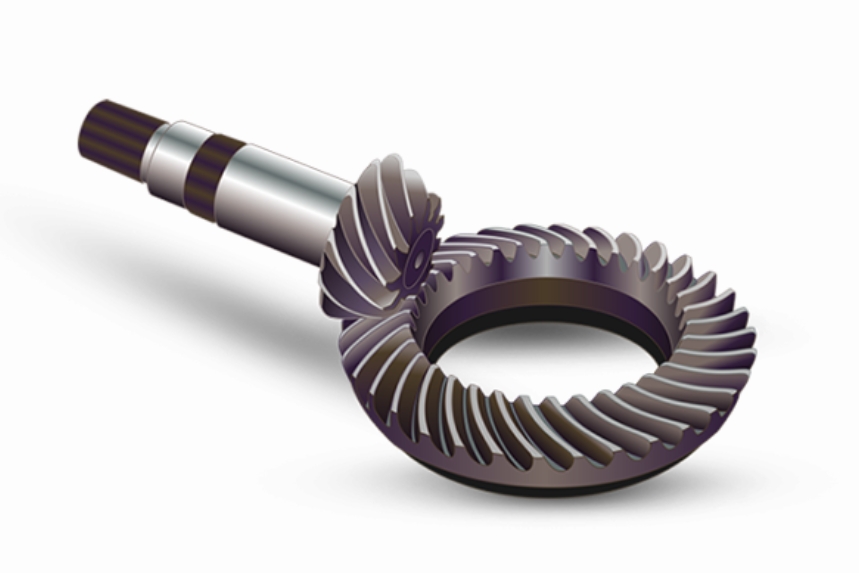
The journey of spiral bevel gear manufacturing began with theoretical concepts in the early 19th century, but it was not until the 20th century that practical machining methods emerged. The initial breakthrough came from the development of mechanical cradle-type machines, which relied on complex kinematic chains to simulate the gear generation process. These machines, such as the iconic Gleason No. 116, established the foundation for mass production of spiral bevel gears. However, the advent of numerical control (NC) and computer numerical control (CNC) technologies revolutionized the field, leading to the creation of fully数控 machines that offer unprecedented flexibility, precision, and efficiency. Today, spiral bevel gear cutting machines are characterized by multi-axis CNC systems capable of free-form machining, enabling the production of highly optimized gear profiles for various applications, including automotive, aerospace, and industrial machinery.
To contextualize the evolution, we can summarize the key milestones in a tabular format. Table 1 outlines the major phases in the development of spiral bevel gear cutting machines, highlighting the technological shifts and representative models.
| Phase | Time Period | Key Characteristics | Representative Machines | Impact on Spiral Bevel Gear Manufacturing |
|---|---|---|---|---|
| Mechanical Cradle-Type | 1910s-1970s | Reliance on mechanical linkages, cradle mechanism, limited adjustability, need for skilled operators. | Gleason No. 16, Gleason No. 116, Oerlikon S17 (early models). | Enabled practical production of spiral bevel gears; introduced concepts like hypoid offset and tooth profile modifications. |
| Transition to NC | 1970s-1980s | Introduction of programmable logic controllers (PLCs) and basic NC systems; simplification of some mechanical drives. | Oerlikon S17 (with PLC), Gleason G-MAXX2010, Gleason No. 116 CNC. | Improved repeatability and reduced setup times; paved the way for full CNC integration. |
| Full CNC / Free-Form | 1989-Present | Elimination of cradle and complex adjustments; use of multi-axis (e.g., 6-axis) CNC systems; direct drive motors; software-driven machining. | Gleason Phoenix Series (I and II), Klingelnberg KNC40, domestic models like YH2240 and YKD2212. | Unprecedented flexibility in gear design and manufacturing; support for dry cutting; ability to machine various gear tooth geometries. |
The mathematical underpinnings of spiral bevel gear generation have evolved alongside the machines. In traditional cradle-type machines, the tooth surface is generated through a simulated gear meshing process, often described by complex kinematic equations. For instance, the relationship between the cutter head (representing the generating gear) and the workpiece can be modeled using coordinate transformations. Let us consider a basic formulation: the position vector of a point on the spiral bevel gear tooth surface in the workpiece coordinate system can be expressed as a function of machine settings and cutter geometry. A simplified representation is:
$$ \mathbf{r}_w = \mathbf{T}_{cw} \cdot \mathbf{r}_c $$
where $\mathbf{r}_w$ is the position vector in the workpiece system, $\mathbf{r}_c$ is the position vector in the cutter system, and $\mathbf{T}_{cw}$ is the transformation matrix that accounts for machine settings such as cradle angle, tool tilt, and workpiece rotation. In cradle-type machines, this matrix is derived from mechanical linkages, leading to constraints in achievable tooth geometries.
In contrast, modern CNC machines for spiral bevel gear cutting employ a free-form approach. These machines, often referred to as Universal Motion Control (UMC) or Free-form machines, decouple the machining motions from mechanical constraints. The tool (cutter head) position and orientation relative to the workpiece are controlled independently via multiple linear and rotary axes. Typically, a 6-axis configuration is used, where three linear axes (X, Y, Z) define the tool center position, and two rotary axes (A, B or similar) define the tool orientation, with an additional rotary axis (C) for workpiece rotation. The transformation for such a system can be generalized as:
$$ \mathbf{r}_w = \mathbf{R}_z(\theta_c) \cdot \mathbf{T}_{xyz}(x,y,z) \cdot \mathbf{R}_y(\beta) \cdot \mathbf{R}_x(\alpha) \cdot \mathbf{r}_c $$
Here, $\mathbf{R}_z(\theta_c)$ represents rotation of the workpiece about its axis, $\mathbf{T}_{xyz}(x,y,z)$ is the translation to the tool center, and $\mathbf{R}_y(\beta)$ and $\mathbf{R}_x(\alpha)$ are rotations defining tool orientation. This flexibility allows for the machining of complex spiral bevel gear tooth surfaces that may not be feasible with traditional methods.
The transition from mechanical to CNC machines was not merely a hardware upgrade; it involved a paradigm shift in gear design and manufacturing philosophy. With traditional machines, the spiral bevel gear tooth geometry was largely dictated by the machine’s kinematic capabilities. Adjustments were made through physical settings like cradle roll, tool tilt, and eccentricity, which required extensive expertise and trial-and-error. The introduction of CNC enabled the concept of “active design,” where the tooth surface can be precisely defined based on performance requirements (e.g., contact pattern, transmission error, load distribution) and then machined directly via CNC tool paths. This is encapsulated in the digital manufacturing systems, such as the Gleason Expert Manufacturing System (GEMS), which integrate design, simulation, and machining into a seamless workflow.
To illustrate the capabilities of modern spiral bevel gear cutting machines, we can examine the specifications of contemporary models. Table 2 provides a comparative overview of some advanced CNC machines used for spiral bevel gear production.
| Machine Model | Manufacturer | Number of Axes | Key Features | Typical Application for Spiral Bevel Gears |
|---|---|---|---|---|
| Phoenix II | Gleason | 6-axis (5-axis联动) | Direct drive motors, hinged B-axis, compact design, support for dry cutting, high rigidity. | High-volume automotive differential gears, aerospace components. |
| KNC 40 / KNC 60 | Klingelnberg | 6-axis (5-axis联动) | Universal machining capability, integrated measuring system, software for cycle optimization. | Precision gears for wind turbines, industrial gearboxes. |
| YKD2212 / YKD2280 | Domestic (e.g., Tianjin No.1 Machine Tool Plant) | 6-axis (5-axis联动) | Cost-effective alternative, suitable for medium to large spiral bevel gears,湿式 or dry cutting options. | General industrial machinery, heavy equipment. |
| YH2240 / YH6012 | Domestic (e.g., Qinchuan Machine Tool Group) | 6-axis (5-axis联动) | Large work capacity, ability to process gears up to 1250 mm diameter, closed-loop manufacturing line integration. | Large-scale gear drives for mining, marine applications. |
The mathematical models for spiral bevel gear tooth surfaces have also advanced with CNC technology. In active design approaches, the desired tooth surface is defined parametrically. For example, a logarithmic spiral bevel gear, which offers potential advantages in load distribution and noise reduction, can be described by a surface equation. The tooth flank may be represented as a ruled surface generated by a line moving along a logarithmic spiral curve. The parametric equations might take the form:
$$ x(u,v) = r(u) \cos(\theta(u)) + v \cdot d_x(u) $$
$$ y(u,v) = r(u) \sin(\theta(u)) + v \cdot d_y(u) $$
$$ z(u,v) = z_0(u) + v \cdot d_z(u) $$
where $u$ is the parameter along the tooth length, $v$ is the parameter along the tooth depth, $r(u)$ and $\theta(u)$ define the logarithmic spiral, and $\mathbf{d}(u) = (d_x, d_y, d_z)$ is the direction vector of the ruling line. Such surfaces can be machined on free-form CNC machines by approximating the surface with tool paths calculated via CAM software.
The current state of spiral bevel gear cutting machines is characterized by high levels of automation and digital integration. The manufacturing process often involves virtual prototyping, where gear designs are simulated for meshing performance using software like Gleason CAGE or KIMoS. The machine tool paths are then generated offline and transmitted to the CNC controller. Additionally, in-process or post-process measurement systems are employed to ensure quality, forming closed-loop control systems that correct deviations in real-time. This digital thread significantly reduces lead times and enhances the consistency of spiral bevel gear production.
Looking ahead, several trends are poised to shape the future of spiral bevel gear cutting machines. First, the full exploitation of free-form machining capabilities will lead to the development of novel tooth geometries. Beyond traditional spiral bevel gear designs, we may see wider adoption of asymmetric teeth, optimized micro-geometry modifications, and even non-standard curves like logarithmic spirals. The mathematical optimization of these geometries often involves complex objective functions, such as minimizing transmission error (TE), which can be expressed as:
$$ TE(\phi) = \Delta \theta_2(\phi) – \frac{N_1}{N_2} \Delta \theta_1(\phi) $$
where $\phi$ is the rotation angle of the pinion, $\Delta \theta_1$ and $\Delta \theta_2$ are angular deviations of pinion and gear, and $N_1$, $N_2$ are tooth numbers. CNC machines enable the realization of surfaces that minimize TE across the entire mesh cycle.
Second, dry cutting technology is gaining traction as an environmentally friendly and cost-effective alternative to wet cutting. Modern spiral bevel gear cutting machines are being designed with thermal stability, chip removal systems, and advanced tool coatings to support dry machining. This eliminates coolant usage, reduces waste, and can increase cutting speeds. The challenges lie in managing heat generation and tool wear, which are addressed through machine design (e.g., high rigidity, efficient散热) and cutting parameters optimization.
Third, there is a growing interest in using general-purpose 5-axis CNC machining centers for spiral bevel gear production, especially for prototyping or small batch sizes. While dedicated spiral bevel gear cutting machines offer superior efficiency and precision for mass production, general 5-axis machines provide flexibility for job shops. The key is developing post-processors and CAM strategies that can generate accurate tool paths for spiral bevel gear tooth surfaces. The kinematic transformation from gear design coordinates to machine tool coordinates becomes crucial. For a 5-axis machine with tool orientation control, the tool path generation involves solving inverse kinematics. Given a desired tool position $\mathbf{P}_w$ and orientation $\mathbf{O}_w$ in workpiece coordinates, the machine axes values (e.g., linear coordinates and rotary angles) are computed. This often requires iterative numerical methods due to nonlinearities.
Another promising direction is the integration of additive manufacturing (AM) with subtractive machining for spiral bevel gears. Hybrid machines that combine AM (e.g., laser metal deposition) and CNC milling could enable the production of gears with customized material properties or complex internal structures, though this is still in research stages for high-precision gears.
In terms of software and digitalization, artificial intelligence (AI) and machine learning are expected to play larger roles in optimizing spiral bevel gear manufacturing processes. AI algorithms can analyze data from sensors on cutting machines to predict tool wear, optimize cutting parameters, and even adaptively adjust machining strategies to compensate for disturbances. This will further enhance the quality and efficiency of spiral bevel gear production.
To summarize the technological progression, we can formulate the evolution as a shift from constrained kinematics to unconstrained parametric control. In traditional machines, the spiral bevel gear surface generation was governed by a set of machine settings $\mathbf{M}$ that indirectly defined the surface $\mathbf{S}$ through kinematic chains: $\mathbf{S} = f(\mathbf{M})$, where $f$ is a complex, often implicit function determined by mechanical linkages. In CNC free-form machines, the surface is directly specified as a parametric model $\mathbf{S}(u,v)$, and the machine tool path is computed as $\mathbf{T}(t) = g(\mathbf{S})$, where $g$ is a mapping from design space to machine motion space, enabled by multi-axis interpolation. This direct control facilitates innovations in spiral bevel gear design.
In conclusion, the development of spiral bevel gear cutting machines has been a journey from mechanical ingenuity to digital mastery. The spiral bevel gear, as a critical component in power transmission systems, has benefited immensely from these advancements. The future holds exciting possibilities with further integration of digital technologies, novel geometries, and sustainable manufacturing practices. As we continue to push the boundaries, the spiral bevel gear will remain at the forefront of precision gear engineering, driven by machines that are smarter, more flexible, and more efficient than ever before.