
In the field of precision motion control, harmonic drive gears play a pivotal role due to their high reduction ratios, compact size, and minimal backlash. As a researcher deeply involved in the mechanics of harmonic drive systems, I have long been intrigued by the challenges in accurately modeling the conjugate tooth profiles under assembly deformation. Traditional approaches often rely on approximations that, while serviceable for general engineering, fall short in high-precision applications. This paper presents my comprehensive investigation into an exact conjugate algorithm that rigorously accounts for the elastic deformation of the flexspline in harmonic drive gears. The goal is to eliminate the discrepancies introduced by approximate methods, particularly in calculating the rotation angles due to tangential displacement and the orientation of the tooth symmetry line relative to the radial vector. Through detailed derivations, numerical examples, and comparative analyses, I demonstrate that this exact algorithm significantly refines the determination of conjugate zones and profiles, thereby enhancing the design and performance of harmonic drive gears.
The harmonic drive gear, a revolutionary transmission technology, operates on the principle of elastic deformation. It typically consists of three main components: a rigid circular spline (or simply “rigid spline”), a flexible spline (flexspline), and a wave generator. In its unassembled state, the flexspline is circular with a tooth count slightly less than that of the rigid spline. The wave generator, when inserted, deforms the flexspline into a non-circular shape, forcing teeth into and out of mesh in a controlled manner. This interaction enables precise speed reduction and torque multiplication. The core of achieving optimal meshing performance lies in accurately determining the conjugate tooth profiles—the shapes that ensure continuous, smooth contact during operation. Historically, simplified models have been employed, neglecting certain deformation effects for computational ease. However, for advanced applications such as aerospace robotics or precision instrumentation, these approximations can lead to non-negligible errors in predicting meshing behavior and stress distribution.
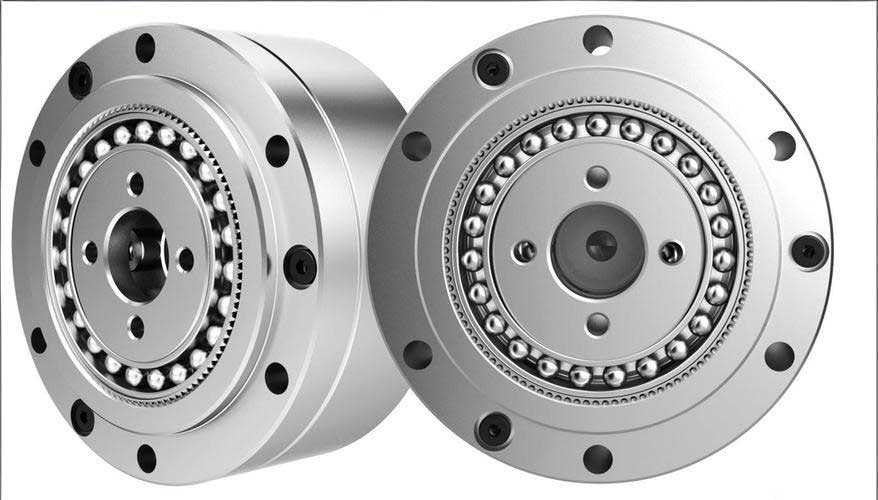
My work focuses on the exact mathematical treatment of the flexspline’s deformation. The neutral curve of the flexspline, which represents its middle layer during bending, is central to this analysis. Under the influence of the wave generator, this curve undergoes radial displacement \( w(\phi) \), tangential displacement \( v(\phi) \), and a rotation \( \mu(\phi) \) of the tooth symmetry line relative to the radial direction. Here, \( \phi \) is the angular coordinate relative to the wave generator’s major axis. The exact algorithm I propose meticulously calculates these parameters without resorting to the small-angle or constant-radius approximations common in prior literature. This involves solving integral equations derived from the condition of inextensibility of the neutral curve and employing iterative methods to locate the precise conjugate positions of the tooth profiles after deformation.
To establish a rigorous framework, I define coordinate systems as follows. A fixed coordinate system \( OXY \) is attached to the rigid spline, with the Y-axis aligned with the symmetry line of a rigid spline tooth space. A moving coordinate system \( S_1 \{O_1 x_1 y_1\} \) is attached to the flexspline tooth at the meshing end, with its origin on the deformed neutral curve and the \( y_1 \)-axis aligned with the tooth symmetry line. Another moving system \( S_2 \{O x_2 y_2\} \) is attached to the wave generator. The relationships between these systems and the various angular displacements are crucial. Let \( \phi_2 \) be the rotation angle of the wave generator, \( \theta_E \) the rotation of the flexspline’s non-deformed (output) end, and \( \phi_1 \) the angular coordinate on the deformed neutral curve at the meshing end. For a harmonic drive gear with \( z_1 \) flexspline teeth and \( z_2 \) rigid spline teeth, the kinematic relation under the assumption of no slip is:
$$ \theta_E = \frac{z_2 – z_1}{z_1} \phi_2 $$
Furthermore, the overall parameter \( \phi \) is defined as \( \phi = \phi_2 + \theta_E = \frac{z_2}{z_1} \phi_2 \). The deformed neutral curve in polar coordinates is given by:
$$ \rho(\phi) = r_m + w(\phi) $$
where \( r_m \) is the radius of the undeformed flexspline neutral circle. The tangential displacement \( v(\phi) \) is obtained from the radial displacement by:
$$ v(\phi) = -\int_0^\phi w(\phi) \, d\phi $$
The angle \( \gamma(\phi_1) \) that the position vector \( O_1 \) makes with the Y-axis, and the angle \( \psi(\phi_1) \) that the tooth symmetry line (y₁-axis) makes with the Y-axis, are derived from geometric and deformation constraints. Specifically:
$$ \gamma(\phi_1) = \phi_1 – \phi_2 $$
$$ \psi(\phi_1) = \mu(\phi) + \gamma(\phi_1) $$
In the approximate method commonly used, the rotation \( \mu(\phi) \) and the relationship between \( \phi_1 \) and \( \phi \) are simplified. For instance, \( \mu(\phi) \) is approximated as \( \dot{w}(\phi)/r_m \), and \( \phi_1 \) is approximated as \( \phi + v(\phi)/r_m \). These simplifications assume \( w(\phi) \ll r_m \) and neglect higher-order terms. My exact algorithm removes these assumptions. The exact expression for the tooth symmetry line rotation is derived from differential geometry:
$$ \mu(\phi) = -\arctan\left( \frac{\dot{\rho}}{\rho} \right) = -\arctan\left( \frac{\dot{w}(\phi)}{r_m + w(\phi)} \right) $$
where \( \dot{\rho} = d\rho/d\phi \). The condition of inextensibility of the neutral curve—that its length remains unchanged during deformation—provides the integral equation linking \( \phi_1 \) and \( \phi \):
$$ \phi = \int_0^{\phi_1} \sqrt{ \left(1 + \frac{w(\phi)}{r_m}\right)^2 + \left( \frac{\dot{w}(\phi)}{r_m} \right)^2 } \, d\phi_1 = F(\phi_1) $$
This equation is fundamental. Instead of approximating it, I treat \( \phi_1 \) as the independent variable. The derivative is:
$$ \frac{d\phi}{d\phi_1} = \sqrt{ \left(1 + \frac{w(\phi_1)}{r_m}\right)^2 + \left( \frac{\dot{w}(\phi_1)}{r_m} \right)^2 } $$
Given a tooth profile of the flexspline defined parametrically in \( S_1 \) as:
$$ x_1 = x_1(u), \quad y_1 = y_1(u) $$
where \( u \) is a parameter (e.g., related to the pressure angle), the conjugate tooth profile on the rigid spline in coordinate system \( OXY \) is obtained via envelope theory. The transformation from \( S_1 \) to \( OXY \) involves rotation by \( \psi \) and translation by \( \rho \sin\gamma \) and \( \rho \cos\gamma \). The coordinates \( (X, Y) \) of the conjugate profile are:
$$
\begin{pmatrix} X(u, \phi_1) \\ Y(u, \phi_1) \\ 1 \end{pmatrix} =
\begin{pmatrix}
\cos\psi & \sin\psi & \rho \sin\gamma \\
-\sin\psi & \cos\psi & \rho \cos\gamma \\
0 & 0 & 1
\end{pmatrix}
\begin{pmatrix} x_1(u) \\ y_1(u) \\ 1 \end{pmatrix}
$$
The conjugate points satisfy the envelope condition:
$$ \frac{\partial X}{\partial u} \frac{\partial Y}{\partial \phi_1} – \frac{\partial X}{\partial \phi_1} \frac{\partial Y}{\partial u} = 0 $$
Substituting the derivatives and expressing everything in terms of \( \phi_1 \) leads to a nonlinear equation that must be solved for \( \phi_1 \) for each tooth profile parameter \( u \). This is where the iterative method comes into play. The derivatives involved are:
$$
\begin{aligned}
\frac{\partial X}{\partial u} &= \frac{\partial x_1}{\partial u} \cos\psi + \frac{\partial y_1}{\partial u} \sin\psi, \\
\frac{\partial Y}{\partial u} &= -\frac{\partial x_1}{\partial u} \sin\psi + \frac{\partial y_1}{\partial u} \cos\psi, \\
\frac{\partial X}{\partial \phi_1} &= (-x_1 \sin\psi + y_1 \cos\psi) \frac{d\psi}{d\phi_1} + \frac{d\rho}{d\phi_1} \sin\gamma + \rho \cos\gamma \frac{d\gamma}{d\phi_1}, \\
\frac{\partial Y}{\partial \phi_1} &= (-x_1 \cos\psi – y_1 \sin\psi) \frac{d\psi}{d\phi_1} + \frac{d\rho}{d\phi_1} \cos\gamma – \rho \sin\gamma \frac{d\gamma}{d\phi_1}.
\end{aligned}
$$
The terms \( \frac{d\rho}{d\phi_1} \), \( \frac{d\gamma}{d\phi_1} \), and \( \frac{d\psi}{d\phi_1} \) are computed using the chain rule and the exact expressions for \( \mu(\phi) \) and the kinematic relations. For instance:
$$
\frac{d\gamma}{d\phi_1} = 1 – \frac{z_1}{z_2} \frac{d\phi}{d\phi_1}, \quad \frac{d\mu}{d\phi_1} = -\frac{ \frac{\ddot{w}}{r_m + w} – \left( \frac{\dot{w}}{r_m + w} \right)^2 }{ 1 + \left( \frac{\dot{w}}{r_m + w} \right)^2 } \frac{d\phi}{d\phi_1}
$$
where \( \ddot{w} = d^2 w/d\phi^2 \). These formulas require the radial displacement function \( w(\phi) \) and its first and second derivatives. The form of \( w(\phi) \) depends on the type of wave generator. In my analysis, I consider five common types: four-roller, two-roller, double-disk, cosine cam, and standard elliptical. For the four-roller wave generator, a piecewise function derived from equivalent ring theory is often used for computational efficiency. Over the interval \( 0 \leq \phi \leq \beta \) (where \( \beta \) is the angle from the major axis to the roller force application point):
$$
w_1(\phi) = \frac{w_0}{A – 4/\pi} \left( A \cos\phi + \phi \sin\beta \sin\phi – \frac{4}{\pi} \right)
$$
and for \( \beta < \phi \leq \pi/2 \):
$$
w_2(\phi) = \frac{w_0}{A – 4/\pi} \left[ B \sin\phi + \left( \frac{\pi}{2} – \phi \right) \cos\beta \cos\phi – \frac{4}{\pi} \right]
$$
with \( A = \sin\beta + (\pi/2 – \beta)\cos\beta \) and \( B = \cos\beta + \beta \sin\beta \). Here, \( w_0 \) is the maximum radial displacement, typically a multiple of the module \( m \). The derivatives \( \dot{w}(\phi) \) and \( \ddot{w}(\phi) \) are obtained accordingly. This piecewise representation allows for fast numerical evaluation, which is essential for the iterative solution of the envelope condition.
To validate the exact algorithm and quantify the impact of approximations, I conducted extensive numerical simulations. The following tables summarize key results for different harmonic drive gear parameters and wave generator types. The first example involves a harmonic drive gear with \( z_1 = 200 \), \( z_2 = 202 \), module \( m = 0.5 \, \text{mm} \), pressure angle \( \alpha_0 = 20^\circ \), flexspline addendum modification coefficient \( x_1 = 3.0 \), and \( \beta = 30^\circ \) for the four-roller wave generator. The conjugate zone (the angular range over which proper conjugation occurs) was computed using both the exact algorithm and the approximate method for various \( w_0 \) values.
| \( w_0 \) | Approximate Method Conjugate Zone | Exact Algorithm Conjugate Zone | Angular Shift | Zone Size | Relative Deviation |
|---|---|---|---|---|---|
| 0.9m | [6.26235°, 11.332°] | [6.62437°, 11.4073°] | 0.36202° | 4.78293° | 7.569% |
| 1.0m | [-0.308058°, 4.44352°] | [0.183228°, 4.83815°] | 0.491286° | 4.654922° | 10.554% |
| 1.1m | [-4.45489°, 0.160741°] | [-3.90564°, 0.699977°] | 0.54925° | 4.605617° | 11.928% |
| 1.2m | [-7.39234°, -2.85194°] | [-6.84679°, -2.27007°] | 0.54555° | 4.57672° | 11.919% |
The table clearly shows that the conjugate zone predicted by the exact algorithm is systematically shifted compared to the approximate method. The shift varies with \( w_0 \), reaching a maximum of about 0.55°. Since the conjugate zone itself is relatively small (around 4.5° to 4.8°), the relative deviation—defined as the ratio of the angular shift to the zone size—is significant, ranging from 7.5% to nearly 12%. This indicates that for precision harmonic drive gears, especially those with tight tolerances, the approximate method could lead to a misjudgment of the active meshing region.
Next, I compared the conjugate zones for all five wave generator types under the same gear parameters (with \( w_0 = 1.0m \)). The results are consolidated in Table 2. The conjugate zone is characterized by its starting angle \( \phi_{\text{start}} \) and ending angle \( \phi_{\text{end}} \). The angular shift is calculated as the difference in the midpoint of the zones between the two methods.
| Wave Generator Type | Approximate Method Zone [°] | Exact Algorithm Zone [°] | Angular Shift [°] | Zone Size [°] | Relative Deviation |
|---|---|---|---|---|---|
| Four-Roller | [-0.308, 4.444] | [0.183, 4.838] | 0.4917 | 4.655 | 10.56% |
| Two-Roller | [1.225, 5.586] | [1.529, 5.890] | 0.3041 | 4.361 | 6.97% |
| Double-Disk | [-1.045, 3.629] | [-0.624, 4.050] | 0.4207 | 4.674 | 9.00% |
| Cosine Cam | [-1.532, 3.040] | [-0.993, 3.579] | 0.5385 | 4.572 | 11.78% |
| Standard Elliptical | [-1.518, 3.047] | [-0.992, 3.573] | 0.5257 | 4.565 | 11.52% |
The behavior of the shift differs among wave generator types. For the four-roller and two-roller types, the shift decreases slightly as \( \phi \) increases within the zone. For the double-disk, cosine cam, and standard elliptical types, the shift tends to increase with \( \phi \). The absolute shifts range from about 0.30° to 0.54°, and with zone sizes around 4.4° to 4.7°, the relative deviations are between 7% and 12%. This underscores that the approximation error is not uniform and depends on the wave generator’s deformation characteristics.
While the conjugate zone is notably affected, the actual shape of the conjugate tooth profile—the curve generated on the rigid spline—shows much smaller differences between the two methods. For the same gear parameters, I computed the conjugate profiles for all five wave generator types. The profiles were virtually indistinguishable when plotted on a common scale, with maximum deviations on the order of micrometers. This can be attributed to the fact that the profile generation is an integrated outcome over the entire meshing motion, and local angular errors tend to average out. However, for ultra-high-precision harmonic drive gears, even micron-level deviations might be critical for load distribution and wear characteristics.
To further stress-test the algorithm, I analyzed a small-module harmonic drive gear designed for motion transmission rather than power. The parameters are: \( z_1 = 140 \), \( z_2 = 142 \), \( m = 0.2 \, \text{mm} \), \( \alpha_0 = 20^\circ \), \( w_0 = 1.0m \), \( x_1 = 2.13 \), rigid spline addendum modification coefficient \( x_2 = 1.925 \), and flexspline wall thickness \( \delta = 0.3 \, \text{mm} \). For the four-roller wave generator, the conjugate zones computed are presented in Table 3.
| Method | Conjugate Zone [°] | Zone Size [°] | Angular Shift [°] | Relative Deviation |
|---|---|---|---|---|
| Approximate | [-0.891, -0.035] | 0.856 | 0.614 | 71.7% |
| Exact | [-0.277, 0.579] | 0.856 | – | – |
In this case, the conjugate zone is extremely narrow—less than 1°—which is typical for fine-pitch harmonic drive gears used in positioning systems. The angular shift between the methods is about 0.614°, leading to a staggering relative deviation of over 70%. This dramatic result highlights that for small-module harmonic drive gears, the approximate method can be highly misleading, potentially placing the expected meshing zone completely outside the actual operating range. The conjugate profiles, again, showed minimal shape difference, but the location of conjugation is critically offset.
The mathematical core of the exact algorithm can be summarized in a set of key equations. For quick reference, the essential formulas are listed below:
1. Neutral Curve Polar Coordinates: $$ \rho(\phi) = r_m + w(\phi) $$
2. Tangential Displacement: $$ v(\phi) = -\int_0^\phi w(\phi) \, d\phi $$
3. Tooth Symmetry Line Rotation (Exact): $$ \mu(\phi) = -\arctan\left( \frac{\dot{w}(\phi)}{r_m + w(\phi)} \right) $$
4. Inextensibility Condition: $$ \phi = \int_0^{\phi_1} \sqrt{ \left(1 + \frac{w(\phi)}{r_m}\right)^2 + \left( \frac{\dot{w}(\phi)}{r_m} \right)^2 } \, d\phi_1 $$
5. Derivative Relation: $$ \frac{d\phi}{d\phi_1} = \sqrt{ \left(1 + \frac{w(\phi_1)}{r_m}\right)^2 + \left( \frac{\dot{w}(\phi_1)}{r_m} \right)^2 } $$
6. Angular Relationships: $$ \gamma(\phi_1) = \phi_1 – \frac{z_1}{z_2} F(\phi_1), \quad \psi(\phi_1) = \mu(\phi) + \gamma(\phi_1) $$
7. Envelope Condition for Conjugation: $$ \frac{\partial X}{\partial u} \frac{\partial Y}{\partial \phi_1} – \frac{\partial X}{\partial \phi_1} \frac{\partial Y}{\partial u} = 0 $$
These equations form a system that is solved numerically. The iterative procedure for a given tooth profile point \( (x_1(u), y_1(u)) \) involves: (a) guessing an initial \( \phi_1 \), (b) computing \( \phi \) from the inextensibility integral (or using the derivative relation in a differential equation solver), (c) evaluating all displacement and angle functions, (d) computing the envelope condition residual, and (e) adjusting \( \phi_1 \) until convergence. This process is repeated for multiple \( u \) values to generate the full conjugate profile.
In conclusion, the exact conjugate algorithm I have developed for harmonic drive gears provides a significant improvement over traditional approximate methods. The primary advantage lies in the accurate determination of the conjugate zone—the angular region where teeth are in proper mesh. For harmonic drive gears with moderate to high precision requirements, the approximate method can induce angular shifts of 0.3° to 0.8° in the conjugate zone, with relative deviations of 5% to over 70% depending on the module and wave generator type. This has direct implications for design: an erroneous conjugate zone prediction could lead to suboptimal tooth contact patterns, increased stress concentrations, or even unanticipated backlash. On the other hand, the shape of the conjugate tooth profile itself is less sensitive to the approximation, with differences being minimal for most practical purposes. This suggests that for profile generation in CAD or manufacturing, the approximate method might suffice, but for kinematic analysis, load sharing calculations, and precision alignment, the exact algorithm is indispensable.
Future work could involve integrating this exact algorithm into finite element analysis tools to couple the elastic deformation of the flexspline more realistically with tooth contact dynamics. Additionally, experimental validation using strain gauges or optical measurement on prototype harmonic drive gears would further corroborate the theoretical findings. The pursuit of zero-backlash and high-torque-density harmonic drive gears continues to drive research in accurate modeling, and this exact conjugate algorithm represents a step forward in that direction. By embracing the full complexity of the flexspline’s assembly deformation, we can unlock new levels of performance and reliability in harmonic drive gear systems.