
As a mechanical engineer specializing in gear manufacturing, I have always been fascinated by the intricacies of gear grinding processes. Gear grinding, particularly gear profile grinding, plays a pivotal role in enhancing the precision and surface quality of hardened gears. In this article, I will share my insights and experimental findings on the factors influencing flank roughness and the occurrence of grinding cracks in gear profile grinding. The goal is to develop a comprehensive understanding of how dressing and grinding parameters interact to affect surface integrity, with a focus on minimizing defects like grinding cracks while achieving optimal roughness.
Gear grinding is a critical finishing process for gears after heat treatment, as it eliminates distortions and improves dimensional accuracy. However, improper grinding conditions can lead to undesirable outcomes such as high surface roughness and grinding cracks. These cracks are micro-fractures that compromise the fatigue life and load-bearing capacity of gears. Through systematic experiments, I aimed to quantify the relationship between key parameters and surface quality, emphasizing gear profile grinding due to its widespread use in industry.
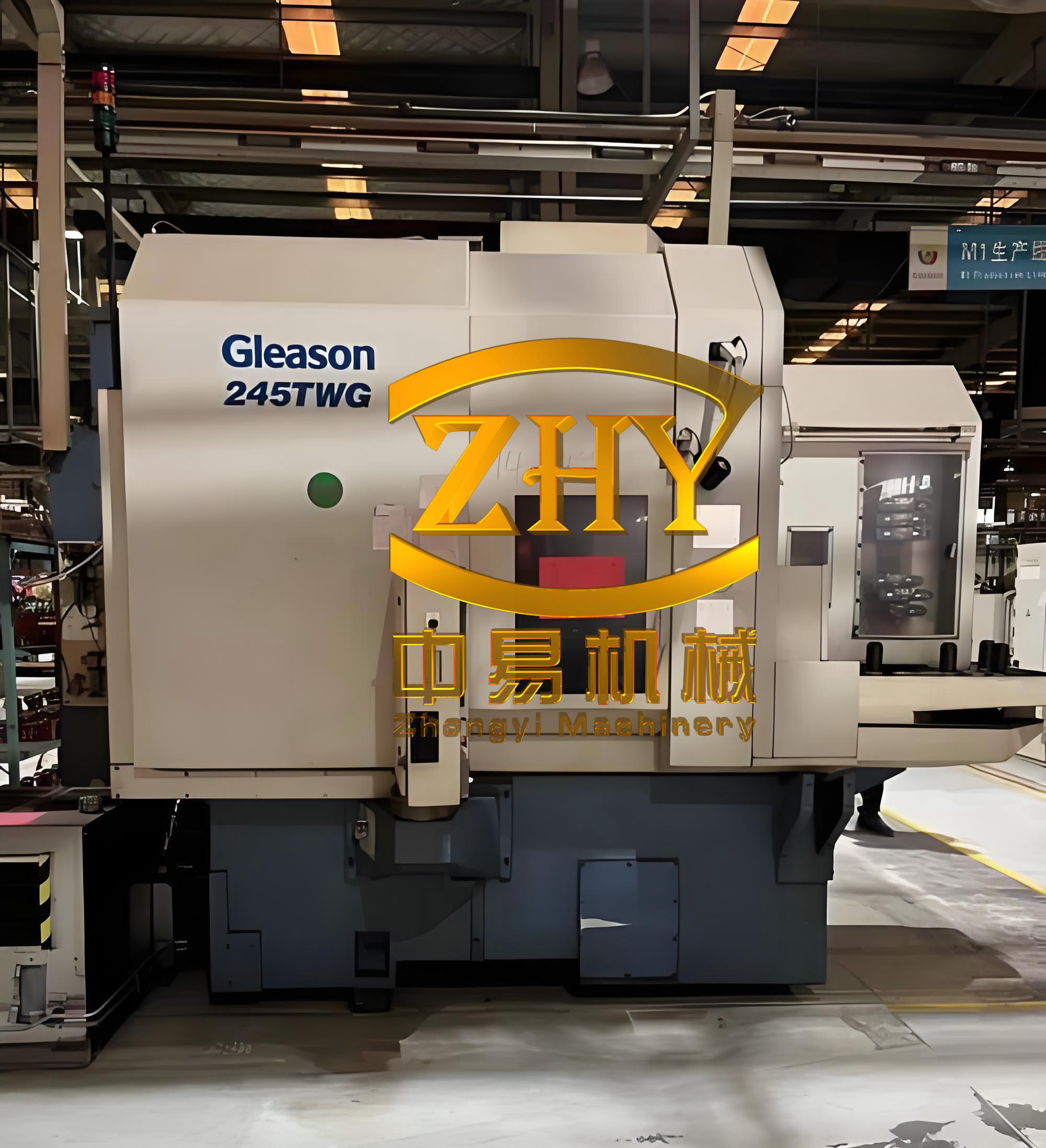
The surface texture in gear profile grinding is characterized by the interaction between the grinding wheel and the gear flank. As shown in the figure below, the grinding process leaves distinct patterns that influence roughness and potential crack initiation sites. Understanding these patterns is essential for optimizing the process.
In gear profile grinding, the grinding wheel is dressed using a diamond roll to achieve the desired profile. The dressing parameters significantly impact the wheel’s cutting ability and, consequently, the ground surface. Key dressing parameters include the dressing feed rate (a_d), dressing speed ratio (q_d), and dressing overlap ratio (U_d). Similarly, grinding parameters such as grinding feed rate (a_e), stroke speed (v_w), and wheel speed (v_s) play crucial roles. My investigation focused on how these variables collectively influence flank roughness and the propensity for grinding cracks.
To begin, let me elaborate on the dressing parameters. The dressing feed rate (a_d) determines the depth of material removed from the wheel during dressing, affecting the sharpness of abrasive grains. A higher a_d can lead to a rougher wheel surface, potentially increasing the risk of grinding cracks due to aggressive cutting. The dressing speed ratio (q_d), defined as the ratio of the diamond roll’s peripheral speed to the wheel’s speed, can be positive or negative. Negative q_d values often result in a finer wheel topography, reducing roughness and mitigating grinding cracks. The dressing overlap ratio (U_d) relates to the coverage of the dressing tool over the wheel surface; higher U_d values promote a more uniform wheel surface, which is beneficial for minimizing irregularities that could cause cracks.
In terms of grinding parameters, the grinding feed rate (a_e) controls the depth of cut during each stroke. Excessive a_e can induce thermal and mechanical stresses, leading to grinding cracks. The stroke speed (v_w) affects the time of interaction between the wheel and gear, influencing heat generation and surface finish. Lastly, the wheel speed (v_s) determines the cutting velocity; optimal v_s helps in achieving a balance between material removal rate and surface quality, reducing the likelihood of defects like grinding cracks.
To quantitatively analyze these effects, I designed a series of experiments using an orthogonal array to vary the parameters systematically. The objective was to measure flank roughness (Ra) and observe any grinding cracks under different conditions. The experimental setup involved a standard gear profile grinding machine, and roughness measurements were taken using a surface profilometer. Additionally, microscopic examination was conducted to detect grinding cracks.
The table below summarizes the experimental parameters and the resulting flank roughness values. Each combination was tested to ensure reproducibility, and the presence of grinding cracks was noted qualitatively.
| Experiment No. | a_d (mm) | q_d | U_d | a_e (mm) | v_w (mm/min) | v_s (m/s) | Flank Ra (μm) | Grinding Cracks Observed |
|---|---|---|---|---|---|---|---|---|
| 1 | 0.02 | 0.6 | 1 | 0.02 | 1000 | 20 | 0.860 | No |
| 2 | 0.02 | -0.5 | 3 | 0.05 | 2000 | 28 | 0.378 | No |
| 3 | 0.02 | -0.6 | 4 | 0.08 | 3000 | 32 | 0.362 | Yes |
| 4 | 0.03 | 0.6 | 2 | 0.05 | 3000 | 35 | 0.665 | No |
| 5 | 0.03 | -0.5 | 4 | 0.10 | 1000 | 25 | 0.257 | No |
| 6 | 0.04 | 0.6 | 3 | 0.10 | 1500 | 32 | 0.478 | Yes |
| 7 | 0.04 | -0.8 | 2 | 0.08 | 1000 | 28 | 0.400 | No |
| 8 | 0.05 | 0.8 | 5 | 0.05 | 1000 | 32 | 0.462 | No |
| 9 | 0.05 | -0.5 | 1 | 0.08 | 1500 | 35 | 0.483 | Yes |
| 10 | 0.05 | -0.6 | 2 | 0.10 | 2000 | 20 | 0.439 | No |
| 11 | 0.07 | 0.8 | 1 | 0.10 | 3000 | 28 | 1.216 | Yes |
| 12 | 0.07 | -0.8 | 4 | 0.05 | 1500 | 20 | 0.275 | No |
From the data, it is evident that grinding cracks tend to occur under specific conditions, such as high grinding feed rates or inappropriate dressing parameters. For instance, in experiments 3, 6, 9, and 11, grinding cracks were observed, often coinciding with higher roughness values. This highlights the interplay between surface quality and defect formation in gear grinding processes.
To model the flank roughness, I employed a multiple linear regression approach. The proposed mathematical model is based on a power function that relates Ra to the dressing and grinding parameters. The general form of the model is:
$$ Ra = K \cdot a_e^{\alpha} \cdot (1 + q_d)^{\beta} \cdot (1 – q_d)^{\theta} \cdot U_d^{\gamma} \cdot a_d^{\eta} \cdot v_w^{\lambda} \cdot v_s^{\mu} $$
where K is a correction factor, and α, β, θ, γ, η, λ, μ are the exponents representing the influence of each parameter. Taking logarithms of both sides, the equation becomes linear:
$$ \log Ra = \log K + \alpha \log a_e + \beta \log (1 + q_d) + \theta \log (1 – q_d) + \gamma \log U_d + \eta \log a_d + \lambda \log v_w + \mu \log v_s $$
Using the experimental data, I performed regression analysis to estimate the coefficients. The results are as follows:
| Coefficient | Value |
|---|---|
| K | -0.9289 |
| α | -0.2202 |
| β | -0.2730 |
| θ | -0.5784 |
| γ | -0.4898 |
| η | 0.0573 |
| λ | 0.2158 |
| μ | -0.1798 |
Substituting these values back into the original equation, the roughness prediction model for gear profile grinding is:
$$ Ra = 0.117788 \cdot a_e^{-0.2202} \cdot (1 + q_d)^{-0.273} \cdot (1 – q_d)^{-0.5874} \cdot U_d^{-0.4898} \cdot a_d^{0.0573} \cdot v_w^{0.2158} \cdot v_s^{-0.1798} $$
This can be simplified to:
$$ Ra = \frac{0.117788 \cdot a_d^{0.0573} \cdot v_w^{0.2158}}{a_e^{0.2202} \cdot (1 + q_d)^{0.273} \cdot (1 – q_d)^{0.5874} \cdot U_d^{0.4898} \cdot v_s^{0.1798}} $$
To validate the model, I conducted significance tests. First, the goodness-of-fit was assessed using the R-squared value, which was calculated as 0.9982, indicating a high degree of explanation. An F-test was performed to check the overall significance of the regression model. The results are summarized below:
| Variance Source | Value | Degrees of Freedom | F-ratio | Significance |
|---|---|---|---|---|
| Regression Sum of Squares (ESS) | 0.8590 | 7 | 315.27 | Highly significant (F(7,4) = 6.09 at α=0.05) |
| Residual Sum of Squares (RSS) | 0.0016 | 4 | – | – |
The F-ratio of 315.27 exceeds the critical value of 6.09, confirming that the model is statistically significant. Next, I tested the significance of individual coefficients using F-tests for each parameter. The null hypothesis H0: bi = 0 was evaluated, and the F-statistic for each coefficient is given by:
$$ F = \frac{b_i^2 / C_{ii}}{RSS / (n – m – 1)} $$
where n=12 (number of experiments), m=7 (number of variables), and C_ii is the diagonal element of the correlation matrix. The results are as follows:
| Coefficient | F-value | Significance |
|---|---|---|
| b1 (α for a_e) | 124.577 | Significant (F(1,4)=7.71 at α=0.05) |
| b2 (β for (1+q_d)) | 191.483 | Significant |
| b3 (θ for (1-q_d)) | 859.529 | Significant |
| b4 (γ for U_d) | 616.370 | Significant |
| b5 (η for a_d) | 8.436 | Significant |
| b6 (λ for v_w) | 119.648 | Significant |
| b7 (μ for v_s) | 83.058 | Significant |
All coefficients are statistically significant, with dressing parameters (q_d and U_d) showing the highest influence, followed by grinding parameters. This underscores the importance of optimizing dressing conditions in gear profile grinding to control roughness and prevent grinding cracks.
In discussion, the negative exponents for q_d and U_d in the model indicate that negative speed ratios and higher overlap ratios reduce roughness. This aligns with the observation that negative q_d promotes a finer wheel surface, reducing the aggressiveness of cutting and minimizing thermal damage that can lead to grinding cracks. Similarly, high U_d ensures uniform dressing, which distributes cutting forces evenly and reduces stress concentrations. For instance, in experiment 2, with q_d = -0.5 and U_d = 3, Ra was low (0.378 μm) and no cracks were observed, whereas experiment 11, with positive q_d and low U_d, resulted in high Ra (1.216 μm) and visible grinding cracks.
Moreover, the positive exponent for v_w suggests that higher stroke speeds increase roughness, possibly due to reduced contact time and increased vibration. This can exacerbate the formation of grinding cracks by inducing cyclic stresses. Conversely, higher wheel speeds (v_s) have a mitigating effect, as indicated by the negative exponent, likely due to improved cutting efficiency and reduced heat generation.
To minimize grinding cracks in gear profile grinding, it is crucial to adopt a negative dressing speed ratio and a high dressing overlap ratio during the final finishing strokes. Additionally, reducing stroke speed and optimizing grinding feed rate can further enhance surface integrity. For example, in practical applications, I recommend setting q_d between -0.6 and -0.8, U_d above 3, and v_w below 1500 mm/min for critical finishing operations. Regular monitoring of wheel condition and dressing parameters can help in early detection of issues that might lead to grinding cracks.
In conclusion, this study provides a robust mathematical model for predicting flank roughness in gear profile grinding, validated through rigorous statistical analysis. The findings emphasize the dominant role of dressing parameters, particularly speed ratio and overlap ratio, in determining surface quality and the occurrence of grinding cracks. By implementing the optimized parameters, manufacturers can achieve superior gear performance with reduced defects. Future work could explore the thermal aspects of grinding cracks and integrate real-time monitoring systems for adaptive control in gear grinding processes.
Throughout this investigation, the terms gear grinding, grinding cracks, and gear profile grinding have been central to understanding the process dynamics. As the industry moves towards higher precision and reliability, continued research in gear profile grinding will be essential for advancing gear manufacturing technologies and mitigating challenges like grinding cracks.