
In the field of mechanical power transmission, hypoid gears hold a pivotal position due to their ability to transmit motion between non-intersecting, non-parallel axes with high efficiency and compact design. These gears are integral components in automotive rear axles, industrial machinery, and aerospace applications, where their meshing quality directly dictates the overall system performance, including noise, vibration, durability, and efficiency. The complex, localized contact nature of hypoid gear tooth surfaces makes their design, analysis, and optimization a challenging endeavor. Over the decades, extensive theoretical research has been conducted to understand and predict their behavior. Methods such as Tooth Contact Analysis (TCA), Loaded Tooth Contact Analysis (LTCA), three-dimensional contact stress analysis, elastohydrodynamic lubrication (EHL) analysis, and the more comprehensive Lubrication and Loaded Tooth Contact Analysis (LLTCA) have been developed. These theoretical frameworks provide deep insights into contact patterns, stress distributions, lubrication conditions, and dynamic responses. However, experimental validation remains crucial to bridge the gap between theory and practice, especially when assessing the influence of specific design parameters like the contact path orientation on actual running performance.
This work stems from a fundamental inquiry: how does the contact path strategy on the tooth surface of a hypoid gear pair influence its operational performance metrics, such as running stability and lubrication condition? Theoretical predictions, particularly from LLTCA simulations, suggested that the common heuristic favoring a contact path along the tooth height might not be optimal. Instead, paths along the tooth length or with a significant inward bias (inward diagonal) could yield superior performance in terms of smoother operation and better load distribution. To test these theoretical assertions, a comprehensive experimental study was designed and executed. The core objective was to employ a quantitative, comparative testing methodology on a mechanical closed-loop gear test rig, using specific evaluation parameters to objectively assess the performance of hypoid gear pairs with distinct, classic contact path orientations.
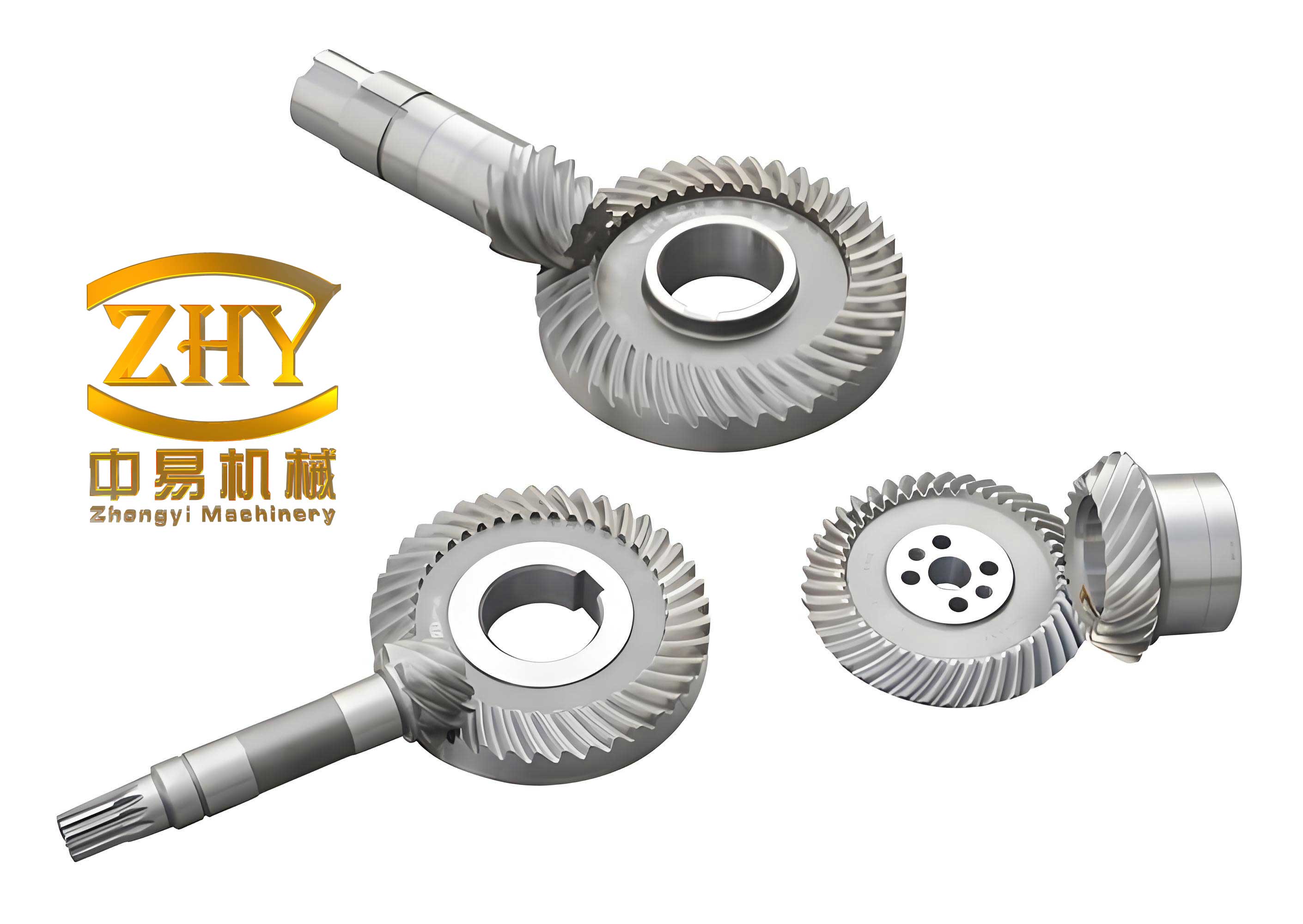
The evaluation of hypoid gear performance hinges on measurable parameters that correlate with functional requirements. In this investigation, two primary parameters were selected: the steady-state operating temperature of the lubricating oil and the root mean square (RMS) value of the vibration acceleration measured on the housing. The oil temperature is a direct indicator of the overall thermal load and frictional power losses within the gear mesh. Elevated temperatures can signal poor lubrication, high friction, and increased risk of failure modes like scuffing or thermal degradation of the lubricant. The vibration acceleration RMS value, on the other hand, is a statistical measure of the dynamic excitations generated by the meshing process. It serves as a proxy for running smoothness, noise, and structural excitations. A lower RMS value generally indicates smoother, more stable operation with fewer transients and impacts during tooth engagement. The relationship between contact path geometry and these parameters is not trivial, as the path influences the load distribution across the tooth flank, the effective contact ellipse, the entrainment velocity for lubricant film formation, and the transmission error under load.
To delve into the theoretical underpinnings, consider the basic geometry of a hypoid gear pair. The tooth surfaces are generated via a complex process, and the contact pattern under light load (often called the bearing pattern) is typically adjusted during manufacturing. The orientation of this pattern—whether it runs along the tooth height (profile direction), along the tooth length (lengthwise direction), or diagonally across the face—defines the contact path strategy. The loaded contact analysis involves solving for the deformation and contact pressure distribution when torque is applied. A simplified representation of the contact pressure \( p(x,y) \) over the potential contact area \( A \) can be related to the transmitted load \( W \) by:
$$ W = \iint_A p(x,y) \, dx \, dy $$
The lubrication performance is often assessed using models of elastohydrodynamic lubrication (EHL). The central film thickness \( h_c \) in a point contact, which is relevant for hypoid gear teeth, can be estimated using formulas like the Hamrock and Dowson equation:
$$ \frac{h_c}{R_x} = 2.69 \left( \frac{U \eta_0}{E’ R_x} \right)^{0.67} \left( \alpha E’ \right)^{0.53} \left( \frac{W}{E’ R_x^2} \right)^{-0.067} (1 – 0.61 e^{-0.73k}) $$
where \( U \) is the entrainment velocity, \( \eta_0 \) is the dynamic viscosity at atmospheric pressure, \( \alpha \) is the pressure-viscosity coefficient, \( E’ \) is the reduced modulus of elasticity, \( R_x \) is the effective radius of curvature in the entrainment direction, and \( k \) is the ellipticity parameter of the contact ellipse. The contact path orientation directly affects \( R_x \), \( k \), and the kinematics influencing \( U \), thereby altering the predicted film thickness and friction.
The dynamic transmission error (TE), a major source of vibration, is defined as the difference between the actual angular position of the output gear and its theoretical position based on a perfect conjugate motion. For a hypoid gear pair, TE is a function of the gear geometry, load, and misalignments. A common representation is:
$$ TE(\theta) = \Delta \phi_2(\theta) – \frac{N_1}{N_2} \Delta \phi_1(\theta) $$
where \( \Delta \phi_1 \) and \( \Delta \phi_2 \) are the rotational displacements of the pinion and gear from their rigid-body positions, \( N_1 \) and \( N_2 \) are the tooth numbers, and \( \theta \) is the pinion rotation angle. The contact path influences how the mesh stiffness varies during roll, which in turn affects TE. A smoother mesh stiffness function typically leads to lower vibration. The vibration acceleration measured on the housing, \( a(t) \), is the system’s response to this excitation. Its root mean square value over a time period \( T \) is calculated as:
$$ a_{\text{rms}} = \sqrt{\frac{1}{T} \int_{0}^{T} a^2(t) \, dt } $$
For discrete sampled data with \( N \) points, this becomes:
$$ a_{\text{rms}} = \sqrt{\frac{1}{N} \sum_{i=1}^{N} a_i^2 } $$
This \( a_{\text{rms}} \) value serves as our quantitative metric for running stability.
The experimental setup was centered around a mechanically closed-loop (or power recirculating) gear testing rig. This type of rig is highly efficient for endurance and performance testing as it requires only enough motor power to overcome losses, allowing for high torque loading without massive prime movers. The specific rig used was a multifunctional, digitally controlled dynamic simulation test stand for gear transmissions. The system featured a DC motor drive with a thyristor-based digital-analog hybrid speed control system and a separate digital hydraulic loading control system. This decoupling of speed and torque control provided excellent flexibility and responsiveness in simulating various operational conditions. A schematic representation of the test stand’s composition is shown in the block diagram below, illustrating the power flow from the drive motor, through the test gearbox (the unit under test), the slave gearbox (which closes the loop and reacts the torque), and back, with the hydraulic actuator applying the torsional load within the loop.
| Component | Description / Specification |
|---|---|
| Rig Type | Mechanical Closed-Loop (Power Re-circulating) |
| Prime Mover | DC Motor with Thyristor Speed Control |
| Loading System | Digital Hydraulic Actuator (Independent Control) |
| Control Interface | Digital CNC System for Speed and Load |
| Data Acquisition | Multi-channel system for temperature, vibration, torque, speed |
| Test Gearbox Mounting | Standardized fixture for rear axle assembly |
The test specimens were hypoid gear sets intended for the rear axle final drive of a popular microcar model. This choice ensured practical relevance. The basic geometric parameters of the gear pair are summarized in the following table. The pinion and gear were manufactured with great care to achieve four distinct, classic contact path patterns on the drive side (convex side of the pinion tooth and concave side of the gear tooth). For each of these four patterns, two identical gear sets were produced, yielding a total of eight sets for preliminary screening. From each pattern category, one set was randomly selected for the final detailed performance tests reported here, resulting in four test sets labeled for reference as Gear Set A, B, C, and D.
| Parameter | Gear (Ring) | Pinion |
|---|---|---|
| Number of Teeth, \( N \) | 35 | 7 |
| Mean Spiral Angle, \( \beta \) | 34° 13′ | 50° 11′ |
| Whole Tooth Depth, \( h_t \) (mm) | 7.19 | 7.32 |
| Hand of Spiral | Right | Left |
| Face Width (approx.) (mm) | ~28 | ~28 |
| Mean Module (mm) | 4.167 | |
The four targeted contact path strategies were: (A) Path primarily along the tooth height direction (profile contact); (B) Path primarily along the tooth length direction (lengthwise contact); (C) Inward diagonal contact (from the toe towards the top on the concave gear flank); and (D) Outward diagonal contact (from the heel towards the top on the concave gear flank). These patterns were achieved through precise control of the machine tool settings during the finishing process (likely lapping or grinding) and were verified on a gear rolling tester prior to installation. The gear sets were installed into a standard production rear axle housing complete with its differential carrier. Since the test rig employed a “half-axle” closed-loop configuration, the differential’s planetary gearset was locked to prevent any speed differentiation, effectively making the axle assembly a simple, solid one-input-one-output gearbox.
The test procedure followed a structured matrix of operating conditions. Two distinct load levels were chosen, representing a medium load and a relatively heavy load for this specific hypoid gear application. At each load level, tests were conducted at three different rotational speeds of the input pinion shaft. This resulted in six distinct operational points, designated as K1 through K6. The specific conditions are detailed in the table below. For each test run, the gearbox was started and run until all parameters stabilized—typically indicated by a steady oil temperature reading. Data was then recorded over a sustained period. The process involved switching from one condition to another, also monitoring the transient temperature rise during the changeover.
| Condition Label | Pinion Torque, \( M \) (Nm) | Pinion Speed, \( n \) (rpm) |
|---|---|---|
| K1 | 100 | 500 |
| K2 | 100 | 1000 |
| K3 | 100 | 1400 |
| K4 | 175 | 500 |
| K5 | 175 | 1000 |
| K6 | 175 | 1400 |
The primary data acquired were: 1) The stabilized bulk oil temperature in the axle housing, measured using a thermocouple immersed in the oil sump. The same grade of automotive gear oil (likely an SAE 80W-90 GL-5 type) was used for all tests. 2) Vibration acceleration signals from two key locations on the axle housing: one on the bearing cap near the inner bearing of the pinion shaft (Channel A, or Ch-A), and another on the bearing cap of the differential carrier on the ring gear side (Channel B, or Ch-B). Accelerometers with appropriate frequency ranges were used, and signals were digitized and stored for offline analysis. The steady-state oil temperature for each gear set at each of the six conditions is presented in a consolidated table. The vibration data was processed to compute the RMS value of the acceleration time-history for each test run.
| Test Condition | Oil Temperature, \( T \) (°C) for Gear Set A | Oil Temperature, \( T \) (°C) for Gear Set B | Oil Temperature, \( T \) (°C) for Gear Set C | Oil Temperature, \( T \) (°C) for Gear Set D |
|---|---|---|---|---|
| K1 (100 Nm, 500 rpm) | 71.5 | 71.5 | 78.5 | 80.0 |
| K2 (100 Nm, 1000 rpm) | 85.5 | 88.0 | 98.0 | 101.0 |
| K3 (100 Nm, 1400 rpm) | 94.7 | 97.7 | 106.0 | 110.5 |
| K4 (175 Nm, 500 rpm) | 86.5 | 93.2 | 88.8 | 91.0 |
| K5 (175 Nm, 1000 rpm) | 103.7 | 109.0 | 108.5 | 109.0 |
| K6 (175 Nm, 1400 rpm) | 114.5 | 121.0 | 123.0 | 123.5 |
Analysis of the oil temperature data reveals clear trends. Under the medium load condition (M = 100 Nm), the hypoid gear sets with contact paths along the height (Set A) and along the length (Set B) operated at significantly lower temperatures compared to the diagonally contacting sets (C and D). The average temperature difference across the three speeds was approximately 10°C. This suggests that for this load range, the lengthwise and profile contact strategies promoted better lubrication conditions, leading to lower frictional losses and heat generation. The superior performance of the lengthwise path hypoid gear, in particular, aligns with theoretical LLTCA predictions which indicated more favorable load distribution and possibly better entrainment kinematics for film formation. However, when the load increased to 175 Nm, the temperature differences between the four hypoid gear types diminished considerably. At the higher speeds (K5 and K6), the temperatures converged to within a few degrees, with only Set A showing a marginally lower temperature (about 6-9°C lower) at the highest speed and load (K6). This convergence implies that under heavier loading, the influence of contact path geometry on the overall lubrication state becomes less pronounced. One plausible explanation is that with increased contact pressures, the lubricant film thickness decreases for all hypoid gear configurations, pushing the system closer to or into the boundary lubrication regime where the specific geometry’s advantage in promoting fluid film formation is attenuated. The frictional heat generation then becomes dominated by asperity contact, which may be less sensitive to the precise path orientation.
To formalize the heat generation, one can consider the total frictional power loss \( P_{\text{loss}} \) in the gear mesh, which is primarily dissipated as heat, leading to the temperature rise. It can be approximated as:
$$ P_{\text{loss}} \approx \mu \cdot W \cdot v_s $$
where \( \mu \) is the effective coefficient of friction, \( W \) is the normal load, and \( v_s \) is the sliding velocity. The steady-state oil temperature \( T_{\text{oil}} \) is a result of the balance between this heat generation and the heat dissipation capability of the housing \( Q_{\text{diss}} \), often modeled as \( Q_{\text{diss}} = h_c A_s (T_{\text{oil}} – T_{\text{ambient}}) \), where \( h_c \) is a heat transfer coefficient and \( A_s \) is the surface area. The data indicates that for the medium load, the product \( \mu \cdot v_s \) (or the integral over the contact) is lower for Sets A and B, implying a more favorable tribological condition inherent to those hypoid gear contact paths.
The vibration data provides even more striking evidence of the performance differences. The raw time-domain acceleration signals showed visibly different characteristics. For instance, at condition K2, the signal from the housing near the ring gear bearing (Ch-B) for the lengthwise contact hypoid gear (Set B) exhibited a relatively steady, low-amplitude waveform, whereas the signal for the outward diagonal hypoid gear (Set D) showed pronounced impacts and higher variability. To quantify this, the RMS values were computed for all channels and conditions. The results are tabulated below. Note that the values are given in milligravitational units (10⁻³ g, where g is the acceleration due to gravity).
| Measurement Location & Condition | RMS for Set A | RMS for Set B | RMS for Set C | RMS for Set D |
|---|---|---|---|---|
| Channel A (Pinion Bearing Housing) | ||||
| K1 (100 Nm, 500 rpm) | 18.54 | 8.75 | 10.60 | — |
| K2 (100 Nm, 1000 rpm) | 44.00 | 32.80 | 36.49 | 58.84 |
| K3 (100 Nm, 1400 rpm) | 139.20 | 83.46 | 76.86 | 291.80 |
| K4 (175 Nm, 500 rpm) | 21.75 | 12.55 | 14.81 | 38.34 |
| K5 (175 Nm, 1000 rpm) | 55.87 | 30.24 | 29.30 | 100.20 |
| K6 (175 Nm, 1400 rpm) | 146.60 | 131.90 | 140.90 | 276.50 |
| Channel B (Differential/Ring Gear Bearing Housing) | ||||
| K1 (100 Nm, 500 rpm) | 29.62 | 14.35 | 26.21 | — |
| K2 (100 Nm, 1000 rpm) | 94.43 | 60.48 | 68.95 | 122.30 |
| K3 (100 Nm, 1400 rpm) | 319.00 | 350.00 | 215.30 | 398.90 |
| K4 (175 Nm, 500 rpm) | 34.06 | 22.00 | 39.49 | 79.57 |
| K5 (175 Nm, 1000 rpm) | 85.56 | 58.49 | 82.03 | 191.60 |
| K6 (175 Nm, 1400 rpm) | 275.30 | 313.80 | 275.40 | 440.00 |
The data unequivocally demonstrates that the hypoid gear with a lengthwise contact path (Set B) consistently exhibited the lowest vibration levels across most conditions, particularly at low and medium speeds. At the highest speed (1400 rpm), the performance of the lengthwise hypoid gear (B) and the inward diagonal hypoid gear (C) became comparable and were superior to the profile (A) and outward diagonal (D) types. The outward diagonal hypoid gear (Set D) consistently showed the highest vibration levels, indicating the poorest running smoothness. This ranking aligns remarkably well with theoretical LTCA and LLTCA predictions. The lengthwise contact path in a hypoid gear generally promotes a larger loaded contact ratio and a more gradual engagement/disengagement process, leading to a smoother variation in mesh stiffness and lower transmission error excitation. The inward diagonal path can offer a compromise, sometimes reducing the axial separating force on the pinion that can be pronounced in a pure lengthwise design, which might explain its similar high-speed performance. The profile contact path, while traditionally considered desirable for ease of assembly tolerance, appears to generate higher dynamic excitation, likely due to a less favorable load distribution across the face width.
To further elucidate, the loaded transmission error \( \text{TE}_L(\theta) \) can be conceptually broken down into a static component due to tooth deflections and a variable component due to pitch errors and contact path-induced stiffness fluctuations. A smoother \( \text{TE}_L \) spectrum results in lower vibration. The experimental RMS values correlate with the magnitude of these dynamic forces. One can postulate a simplified relationship between the housing vibration acceleration and the dynamic mesh force \( F_m(t) \). For a linearized system, the acceleration response at a point can be related to the force via the system’s frequency response function \( H(\omega) \):
$$ A(\omega) = H(\omega) \cdot F_m(\omega) $$
where \( A(\omega) \) and \( F_m(\omega) \) are the Fourier transforms of acceleration and mesh force, respectively. The RMS acceleration is then related to the integral of \( |A(\omega)|^2 \) over frequency. The data suggests that the hypoid gear with lengthwise contact generates a mesh force \( F_m(t) \) with a lower harmonic content or magnitude.
An equally important finding concerns the relationship between running stability (vibration) and the applied load. The data was analyzed to see if vibration monotonically increases with load. For a specific hypoid gear set (Set C, the inward diagonal type), the \( a_{\text{rms}} \) values from Channel A were plotted against load for the three different speeds. The resulting curves are non-monotonic. They show a distinct minimum at or near the 100 Nm load condition, regardless of speed. This indicates the existence of an “optimal” load for minimal vibration for this particular hypoid gear design. A similar trend, though with different absolute values, was observed when comparing Sets B and C at 500 rpm; both showed a vibration minimum at 100 Nm. This phenomenon can be attributed to the interplay between several factors: at very light loads, geometric transmission error and minor misalignments might dominate, causing impact. As load increases, tooth deflections help to smooth out these errors by bringing more of the tooth flank into contact, improving the contact ratio and damping. However, beyond a certain load, non-linear effects such as increased friction, altered contact ellipse size and position, and excitation of higher structural modes might lead to increased vibration again. This optimal load point appears to be more a function of the specific hypoid gear pair’s design and the surrounding system dynamics (housing stiffness, bearing clearances) than of the contact path alone, as both Sets B and C exhibited the minimum at the same load.
This finding has significant practical implications for the design and application of hypoid gears. It suggests that simply designing for the maximum possible load capacity might not yield the quietest or smoothest operation under typical driving conditions. Instead, a holistic approach that considers the dynamic performance across the expected load spectrum is warranted. The contact path strategy is a powerful design variable that can be tuned to shift this optimal performance zone or to improve the baseline smoothness. For instance, the lengthwise contact hypoid gear not only had the lowest overall vibration but also maintained good performance over a wider load range compared to the outward diagonal type.
To synthesize the results from both lubrication and dynamics perspectives, we can propose a combined performance index \( \Pi \) for a hypoid gear pair, which one might seek to minimize. It could be a weighted sum of normalized temperature rise and vibration level:
$$ \Pi = w_T \cdot \frac{T – T_{\text{ref}}}{T_{\text{ref}}} + w_V \cdot \frac{a_{\text{rms}}}{a_{\text{ref}}} $$
where \( w_T \) and \( w_V \) are weighting factors reflecting the importance of thermal and vibration criteria, and \( T_{\text{ref}} \), \( a_{\text{ref}} \) are reference values. Based on our experimental data, for medium loads, the lengthwise contact hypoid gear would score best on this index. For heavy loads, the differences in \( \Pi \) would be smaller, with the lengthwise and inward diagonal hypoid gears being competitive.
In conclusion, this experimental investigation provides strong empirical support for theoretical predictions regarding the influence of contact path strategy on the running performance of hypoid gears. The key takeaways are: Firstly, hypoid gears with a contact path oriented along the tooth length direction exhibit superior running stability (lowest vibration) and, under medium loads, better lubrication conditions (lower operating temperatures) compared to profile or diagonal paths. This advantage in lubrication diminishes under heavier loads, likely due to a transition in lubrication regime. Secondly, the running stability of a hypoid gear pair is not a monotonic function of the applied load; an optimal load exists for minimal vibration, which appears to be inherent to the specific gear design and system dynamics. These findings underscore the importance of moving beyond traditional rule-of-thumb contact patterns and employing advanced design and analysis tools like LLTCA to optimize hypoid gear performance for specific applications. The lengthwise contact strategy, in particular, emerges as a highly promising design direction for hypoid gears where smooth, quiet, and efficient operation is paramount. Future work should involve more extensive testing with a larger sample size, investigation of wear and pitting performance over long durations, and correlation with full vehicle noise and durability tests to fully validate these bench-test conclusions for real-world hypoid gear applications.