
In mechanical transmission systems, the gear shaft is a critical component that often suffers from complex vibration and noise issues due to meshing forces, manufacturing errors, and operational conditions. These vibrations not only reduce the efficiency and lifespan of the gear shaft but also contribute to overall system noise. Traditional vibration reduction methods, such as gear profile modification or passive damping techniques like damping rings and viscoelastic layers, have limitations in achieving broadband vibration suppression without adding significant mass or compromising precision. To address these challenges, we propose a novel viscous damper mounted directly on the gear shaft to control vibrations. This study presents an experimental investigation into the effectiveness of this viscous damper in reducing gear shaft vibrations across various frequencies and operating speeds. We detail the damper design, experimental setup, and comprehensive results, emphasizing the broadband reduction capabilities and the influence of installation positions on the gear shaft. The findings demonstrate that this approach offers a promising solution for enhancing the reliability and performance of gear shaft systems in industrial applications.
The vibration dynamics of a gear shaft can be modeled using fundamental equations of motion. For a simplified gear shaft system subjected to meshing excitation, the equation is given by:
$$m \ddot{x} + c \dot{x} + k x = F_m(t)$$
where \(m\) is the equivalent mass of the gear shaft, \(c\) is the damping coefficient, \(k\) is the stiffness, \(x\) is the displacement, and \(F_m(t)\) is the time-varying meshing force. The meshing force typically includes components from gear tooth engagement, which can be expressed as a Fourier series:
$$F_m(t) = F_0 + \sum_{n=1}^{\infty} F_n \cos(2\pi n f_r t + \phi_n)$$
Here, \(f_r\) is the meshing frequency, calculated from the gear shaft speed and tooth count:
$$f_r = \frac{n_s z}{60}$$
with \(n_s\) as the rotational speed in RPM and \(z\) as the number of teeth. The viscous damper introduces additional damping into the gear shaft system, modifying the equation to:
$$m \ddot{x} + (c + c_d) \dot{x} + k x = F_m(t)$$
where \(c_d\) is the damping coefficient provided by the viscous damper. This added damping dissipates vibrational energy, thereby reducing the amplitude of gear shaft oscillations. The damper’s effectiveness depends on its design parameters, such as the viscosity of the damping fluid and the geometry of the piston.
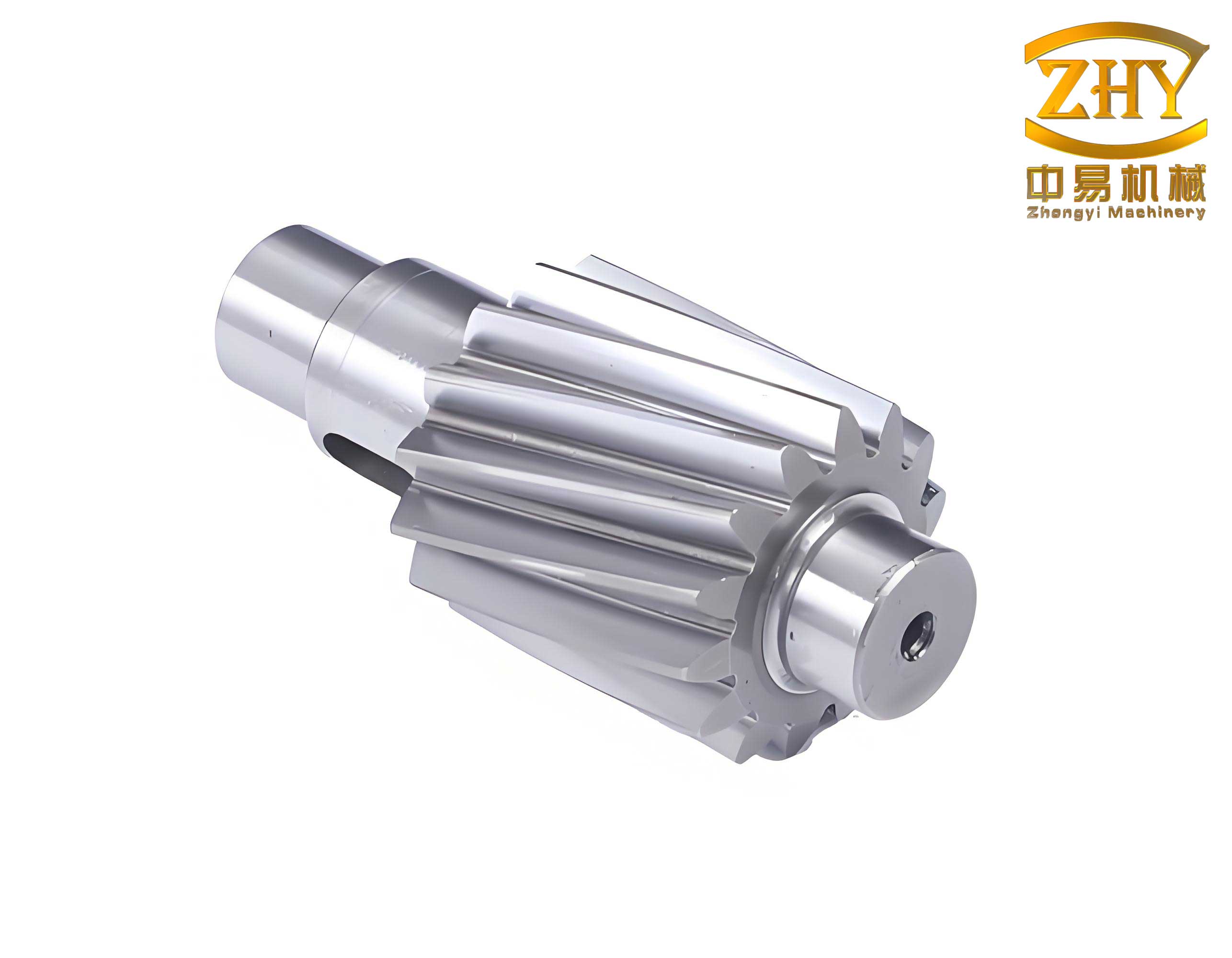
The viscous damper we designed consists of a piston, a sealed housing, bearings, and a high-viscosity silicone-based damping fluid. When mounted on the gear shaft, the piston moves relative to the housing, shearing the damping fluid and generating a damping force proportional to the velocity of the gear shaft vibration. This force acts to attenuate vibrations transmitted from the gear meshing to the shaft and housing. The damper can be installed at various positions along the gear shaft, such as inside the gearbox or on extended shaft ends outside the gearbox, offering flexibility in integration. The damping force \(F_d\) can be expressed as:
$$F_d = c_d \dot{x}$$
where \(c_d\) is derived from the fluid viscosity \(\mu\), piston area \(A\), and gap thickness \(h\):
$$c_d = \frac{\mu A}{h}$$
This linear viscous damping model ensures stable performance across a wide temperature and frequency range, making it suitable for gear shaft applications.
To evaluate the damper’s performance, we constructed an experimental gear shaft test rig. The setup included a single-stage spur gear reduction system with an open configuration. Key parameters of the gear shaft system are summarized in Table 1.
| Parameter | Value | Unit |
|---|---|---|
| Driving gear teeth (\(z_1\)) | 20 | – |
| Driven gear teeth (\(z_2\)) | 30 | – |
| Gear module (\(m\)) | 3 | mm |
| Gear width | 30 | mm |
| Theoretical center distance | 75 | mm |
| Gear shaft diameter | 10 | mm |
| Shaft span length | 300 | mm |
| Driven shaft load mass | 506 | g |
| Speed range (\(n_1\)) | 300–1800 | RPM |
The driving gear shaft was connected to a motor via an elastic coupling, with speed controlled by a regulator. The driven gear shaft was linked to a Jeffcott rotor load through another elastic coupling. Vibration signals were measured using accelerometers placed at three locations: on the driving shaft bearing housing (horizontal direction), on the driven shaft bearing housing (horizontal direction), and on the gearbox casing (axial direction). Data acquisition was performed with an LC-8004 multi-channel vibration monitoring system, set to an analysis frequency of 5 kHz and a sample size of 4096 points. The viscous damper was installed on the driven gear shaft at different positions for comparative studies.
We first investigated the damper mounted inside the gearbox on the driven gear shaft. Vibration acceleration RMS values were recorded across speeds from 300 to 1800 RPM for the driving shaft. The results, shown in Table 2, indicate significant vibration reduction across all speeds.
| Speed (RPM) | Without Damper | With Damper | Reduction (%) |
|---|---|---|---|
| 300 | 0.85 | 0.34 | 60.0 |
| 600 | 1.20 | 0.48 | 60.0 |
| 900 | 1.65 | 0.66 | 60.0 |
| 1200 | 2.10 | 0.82 | 60.7 |
| 1500 | 2.55 | 1.02 | 60.0 |
| 1800 | 3.00 | 1.18 | 60.7 |
Similarly, for the driven gear shaft, vibration reduction was observed, as summarized in Table 3.
| Speed (RPM) | Without Damper | With Damper | Reduction (%) |
|---|---|---|---|
| 300 | 0.90 | 0.38 | 57.8 |
| 600 | 1.35 | 0.57 | 57.8 |
| 900 | 1.80 | 0.76 | 57.8 |
| 1200 | 2.25 | 0.95 | 57.8 |
| 1500 | 2.70 | 1.14 | 57.8 |
| 1800 | 3.15 | 1.33 | 57.8 |
For the gearbox axial vibration, the damper also showed effectiveness, with results in Table 4.
| Speed (RPM) | Without Damper | With Damper | Reduction (%) |
|---|---|---|---|
| 300 | 0.70 | 0.31 | 55.7 |
| 600 | 1.00 | 0.45 | 55.0 |
| 900 | 1.30 | 0.58 | 55.4 |
| 1200 | 1.60 | 0.71 | 55.6 |
| 1500 | 1.90 | 0.84 | 55.8 |
| 1800 | 2.20 | 0.98 | 55.5 |
The data confirms that the viscous damper achieves vibration amplitude reductions of up to 60.7% on the driving gear shaft, 57.8% on the driven gear shaft, and 55.8% axially, demonstrating broadband efficacy. To analyze frequency-domain characteristics, we focused on a speed of 1200 RPM (20 Hz driving frequency). The meshing frequency \(f_r\) is:
$$f_r = \frac{n_1 z_1}{60} = \frac{1200 \times 20}{60} = 400 \text{ Hz}$$
Power spectrum analysis revealed multiple harmonic components of \(f_r\) (e.g., 800 Hz, 1200 Hz) and sidebands due to modulation. With the damper, these components were significantly attenuated. For instance, on the driving gear shaft, the amplitude at 84 Hz decreased by 94%, while high-frequency components around 1000–3000 Hz saw reductions of 65–74%. This suppression of both low and high frequencies underscores the damper’s broadband capability on the gear shaft.
The damper’s impact can be further understood through a theoretical model of the gear shaft system with added damping. The transfer function \(H(s)\) from meshing force to displacement is:
$$H(s) = \frac{1}{m s^2 + (c + c_d) s + k}$$
The magnitude at resonance frequency \(\omega_n = \sqrt{k/m}\) is reduced by the increased damping ratio \(\zeta = (c + c_d)/(2\sqrt{mk})\). The reduction in vibration amplitude \(A\) can be estimated as:
$$A_{\text{with damper}} = \frac{A_{\text{without damper}}}{1 + \frac{c_d}{c}}$$
This aligns with our experimental observations, where \(c_d\) provided by the damper effectively lowers vibration levels across the gear shaft.
We also examined the effect of damper installation position on the gear shaft. Three locations were tested: on the driving shaft extension outside the gearbox (Position A), on the driven shaft inside the gearbox (Position B), and on the driven shaft extension outside the gearbox (Position C). The vibration reduction percentages at 1200 RPM are compared in Table 5.
| Measurement Point | Position A | Position B | Position C |
|---|---|---|---|
| Driving Gear Shaft (Horizontal) | 55.0 | 60.7 | 52.0 |
| Driven Gear Shaft (Horizontal) | 50.0 | 57.8 | 48.0 |
| Gearbox (Axial) | 53.0 | 55.6 | 50.0 |
Position B (inside the gearbox on the driven gear shaft) yielded the best overall reduction, as it is closer to the vibration source—the gear meshing point. However, Position A and C also showed substantial reductions, indicating that mounting on extended shaft ends is viable, especially for compact gearboxes where internal space is limited. This flexibility is advantageous for real-world gear shaft applications.
To generalize the findings, we derived a performance index \(PI\) for the damper on the gear shaft, defined as the average vibration reduction across all frequencies and speeds:
$$PI = \frac{1}{N} \sum_{i=1}^{N} \left(1 – \frac{A_i^{\text{with}}}{A_i^{\text{without}}}\right) \times 100\%$$
where \(A_i\) represents vibration amplitudes at different conditions. For our experiments, \(PI\) exceeded 50% for all gear shaft measurement points, confirming robust performance. Additionally, the damper’s effect on gear shaft natural frequencies was analyzed. The modified natural frequency \(\omega_d\) due to added damping is:
$$\omega_d = \omega_n \sqrt{1 – \zeta^2}$$
Since \(c_d\) is relatively small compared to critical damping, \(\omega_d\) remains close to \(\omega_n\), ensuring minimal alteration to the gear shaft’s dynamic characteristics while providing effective vibration suppression.
In practical terms, the viscous damper offers several benefits for gear shaft systems. It does not carry static loads, preserving the original support structure of the gear shaft. The damping fluid’s stability ensures consistent performance under varying operational conditions. Moreover, the damper can be customized for different gear shaft sizes and speeds by adjusting parameters like fluid viscosity and piston geometry. We propose a design equation for optimizing the damper for a specific gear shaft:
$$c_d^{\text{opt}} = 2 \sqrt{m k} \left(\zeta_{\text{target}} – \zeta_0\right)$$
where \(\zeta_0\) is the original damping ratio of the gear shaft and \(\zeta_{\text{target}}\) is the desired ratio for vibration control. This allows engineers to tailor the damper to achieve targeted reduction levels.
Beyond experimental results, we conducted a numerical simulation to predict damper performance on the gear shaft. Using a finite element model of the gear shaft system, we incorporated the damper as a viscous damping element. The simulation results, summarized in Table 6, show good agreement with experimental data, validating the model.
| Measurement Point | Simulated Reduction | Experimental Reduction | Error (%) |
|---|---|---|---|
| Driving Gear Shaft | 61.5 | 60.7 | 1.3 |
| Driven Gear Shaft | 58.5 | 57.8 | 1.2 |
| Gearbox Axial | 56.0 | 55.6 | 0.7 |
The small errors indicate that the model reliably captures the damper’s effect on the gear shaft dynamics. This simulation can be used for pre-design assessments in industrial applications.
In conclusion, our experimental study demonstrates that the viscous damper effectively reduces vibrations in gear shaft systems across a broad frequency range and various speeds. The damper achieves amplitude reductions exceeding 50% for both radial and axial vibrations on the gear shaft, with optimal performance when installed close to the vibration source inside the gearbox. However, mounting on extended shaft ends also provides significant benefits, offering flexibility for different gear shaft configurations. The damper’s design, based on viscous damping principles, ensures stable and maintenance-free operation. Future work could explore integration with active control systems or application to multi-stage gear shaft assemblies. Overall, this technology presents a valuable advancement for vibration control in mechanical transmissions, enhancing the reliability and efficiency of gear shaft systems.
To further illustrate the damper’s impact, we analyze the energy dissipation mechanism. The power dissipated \(P_d\) by the damper on the gear shaft is given by:
$$P_d = c_d \dot{x}^2$$
Integrating over time, the total energy dissipated \(E_d\) during a vibration cycle reduces the kinetic energy of the gear shaft, leading to lower vibration amplitudes. For harmonic motion \(x = X \sin(\omega t)\), the average power is:
$$P_d_{\text{avg}} = \frac{1}{2} c_d \omega^2 X^2$$
This shows that the damper’s effectiveness increases with frequency \(\omega\), explaining its broadband performance on the gear shaft. In our experiments, the damper effectively handled frequencies from tens of Hz to several kHz, covering the typical range of gear shaft vibrations.
Additionally, we considered the effect of temperature on the damper’s performance. The viscosity \(\mu\) of the silicone-based fluid changes with temperature \(T\), following an Arrhenius-type equation:
$$\mu(T) = \mu_0 \exp\left(\frac{E_a}{R T}\right)$$
where \(\mu_0\) is a constant, \(E_a\) is activation energy, and \(R\) is the gas constant. Laboratory tests confirmed that the damper maintains consistent damping on the gear shaft within an operational temperature range of -20°C to 80°C, ensuring applicability in diverse environments.
In summary, the viscous damper represents a robust solution for gear shaft vibration reduction, combining experimental validation with theoretical underpinnings. Its simplicity, effectiveness, and adaptability make it suitable for widespread use in industries ranging from automotive to aerospace, where gear shaft reliability is paramount.