
In modern mechanical systems, gear transmissions play a pivotal role due to their compact structure, high efficiency, long service life, and stable transmission ratios. Among these, helical gears are particularly significant because of their smooth and quiet operation, attributed to the gradual engagement of teeth along the helix. However, the dynamic performance of helical gears under transient conditions is complex and influenced by various structural parameters. In this article, I explore the explicit dynamic simulation of helical gear meshing and investigate how key parameters—specifically the modification coefficient and helix angle—affect gear performance. Through finite element analysis and dynamic modeling, I aim to provide insights that can guide the design and optimization of helical gears for enhanced durability and reduced vibration.
The dynamic behavior of helical gears is critical for predicting failure modes, controlling noise and vibration, and improving overall system longevity. Traditional static analyses often fall short in capturing the time-dependent effects during meshing, such as impact forces and stress fluctuations. Therefore, explicit dynamics methods, which solve equations of motion through time integration, offer a powerful tool for simulating these transient phenomena. In my research, I employ explicit dynamics finite element analysis (FEM) to model the meshing process of helical gear pairs, allowing for a detailed examination of stress distributions and performance trends. This approach enables me to assess the influence of design parameters on gear performance in a realistic, dynamic context.
Helical gears are widely used in applications like automotive transmissions, where their ability to handle high loads and reduce acoustic emissions is paramount. The helical design introduces a spiral angle on the teeth, which increases the contact ratio and smooths out engagement, but it also introduces axial forces that must be managed. Key parameters such as the modification coefficient (which adjusts tooth profile to avoid interference and improve strength) and the helix angle (which defines the spiral of the teeth) significantly impact meshing dynamics. By varying these parameters, I can analyze their effects on transient stresses and overall gear behavior. This study focuses on a specific helical gear pair from a vehicle transmission, using explicit dynamics to simulate meshing under operational conditions.
To begin, I outline the theoretical foundation of explicit dynamics analysis. The core of this method lies in discretizing time and using central difference schemes to solve for accelerations, velocities, and displacements. For a time increment $\Delta t$ at time $t$, the acceleration $\{a_t\}$ is defined as:
$$ \{a_t\} = [M]^{-1} \left( [F_t^{ext}] – [F_t^{int}] \right) $$
where $[M]$ is the mass matrix, $[F_t^{ext}]$ is the vector of applied external and body forces, and $[F_t^{int}]$ is the internal force vector due to element strains. The internal force can be expressed as:
$$ F_t^{int} = \sum \left( \int_{\Omega} B^T \sigma_n d\Omega + F_{hg} \right) + F_{contact} $$
Here, $B$ is the strain-displacement matrix, $\sigma_n$ is the stress tensor, $F_{hg}$ represents hourglass resistance forces (to control numerical instabilities), and $F_{contact}$ accounts for contact forces between gear teeth. The velocity and displacement are then updated using:
$$ \{v_{t+\Delta t/2}\} = \{v_{t-\Delta t/2}\} + \{a_t\} \Delta t_t $$
$$ \{u_{t+\Delta t}\} = \{u_t\} + \{v_{t+\Delta t/2}\} \Delta t_{t+\Delta t/2} $$
where $\Delta t_{t+\Delta t/2} = (\Delta t_t + \Delta t_{t+\Delta t})/2$ and $\Delta t_{t-\Delta t/2} = (\Delta t_{t-1} + \Delta t_t)/2$. The new geometry is obtained by adding displacements to the initial configuration:
$$ \{x_{t+\Delta t}\} = \{x_0\} + \{u_{t+\Delta t}\} $$
This explicit approach is well-suited for dynamic events like gear meshing because it handles large deformations and contact nonlinearities efficiently. For helical gears, the meshing process involves continuous tooth engagement along the helix, which requires accurate modeling of contact interfaces and stress propagation. I implement this method in a finite element software to simulate the helical gear pair, as described in the following sections.
The helical gear pair used in this study is modeled based on parameters from a vehicle transmission fifth gear. The primary parameters are summarized in the table below, which includes details such as normal module, pressure angle, helix angle, center distance, number of teeth, face width, and modification coefficients for both the driving and driven gears. These parameters serve as the baseline for my simulations, and I later vary the modification coefficient and helix angle to analyze their effects.
| Parameter | Driving Gear | Driven Gear |
|---|---|---|
| Normal Module (mm) | 2 | |
| Pressure Angle (°) | 16 | |
| Helix Angle at Reference Circle (°) | 33 | |
| Center Distance (mm) | 79.4 | |
| Number of Teeth | 40 | 26 |
| Face Width (mm) | 19.7 | 21.5 |
| Modification Coefficient | 0.12 | 0.245 |
The material for the helical gears is 20CrMnTi, a common alloy steel for gears, with elastic modulus $E = 2.07 \times 10^5$ MPa and Poisson’s ratio $\eta = 0.3$. I assume linear elastic behavior for simplicity, though plasticity could be considered for more advanced studies. To build the finite element model, I use three-dimensional CAD software to create the geometry of the helical gear pair, ensuring accurate tooth profiles based on the given parameters. The mesh is then generated with finer elements in the tooth regions to capture stress concentrations and coarser elements elsewhere to reduce computational cost. The finite element model consists of hexahedral and tetrahedral elements, with contact definitions applied between the mating teeth to simulate meshing interactions.
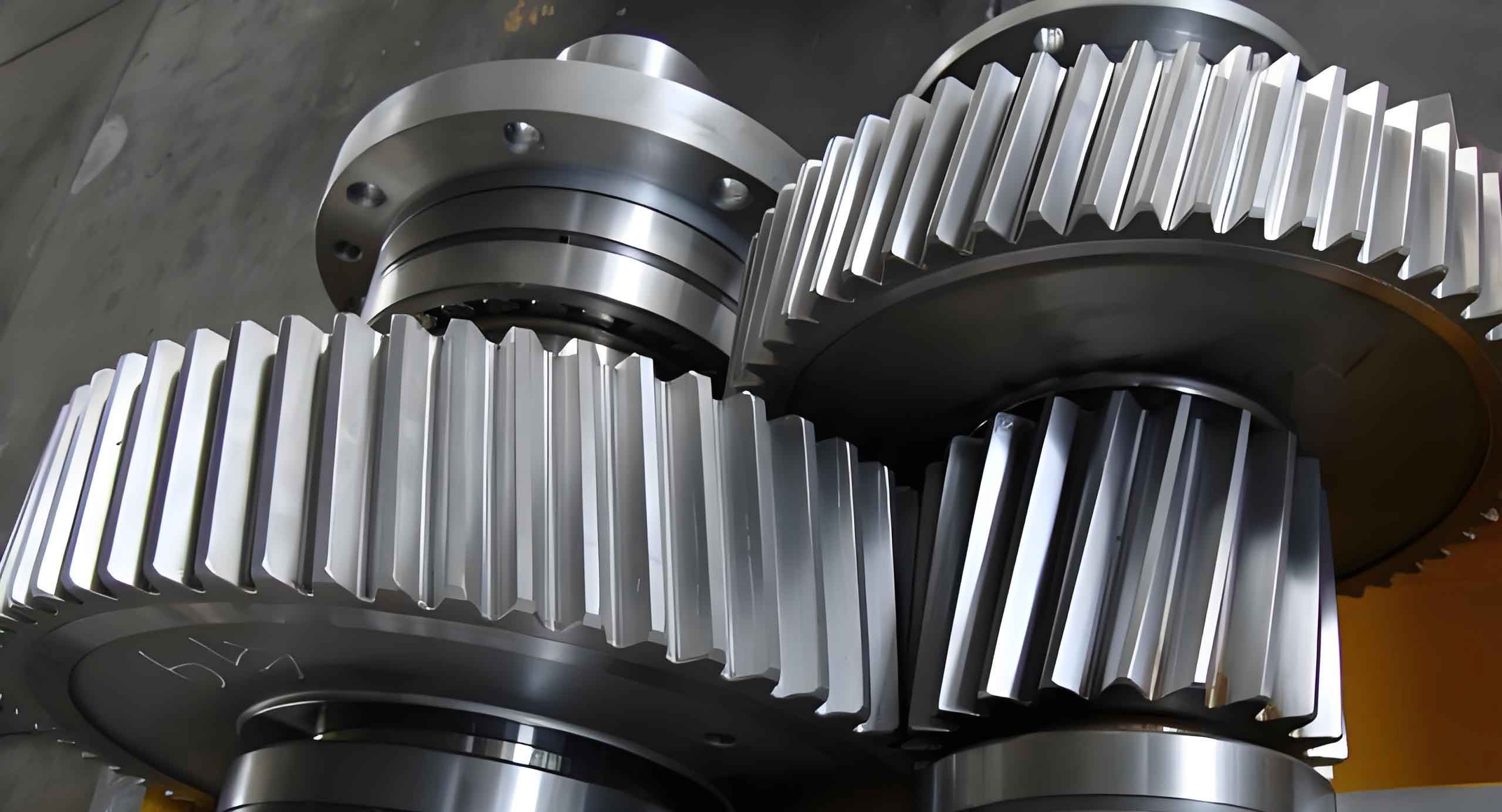
Boundary conditions are applied to simulate operational loading: an angular velocity is imposed on the driving gear shaft, and a torque is applied to the driven gear. The loading profile is designed to represent typical transmission conditions, with gradual application to avoid numerical shocks. The explicit dynamics simulation runs for a sufficient time duration to capture multiple meshing cycles, allowing me to extract transient data on stresses, displacements, and velocities. Post-processing tools are used to visualize results, such as stress contours and time-history curves for specific nodes or elements.
To validate the simulation, I compare the results with experimental data from a bench test. Strain gauges are attached to the tooth roots of both helical gears, and dynamic strain measurements are taken under similar loading conditions. The experimental root bending stresses are 385 MPa for the driving gear and 328 MPa for the driven gear. From the simulation, I extract root stresses at corresponding locations, obtaining values of 372 MPa and 343 MPa, respectively. The close agreement confirms the feasibility and accuracy of my explicit dynamics model for helical gears. This validation step is crucial for ensuring that subsequent parametric studies are reliable.
With the validated model, I proceed to investigate the influence of structural parameters on helical gear performance. The first parameter is the modification coefficient, which adjusts the tooth profile to optimize strength and avoid interference. In gear design, the selection of modification coefficients is often guided by closed diagram methods, which plot feasible regions based on gear geometry. For my helical gear pair, the equivalent tooth numbers are calculated as 67.81 for the driven gear and 44.07 for the driving gear. Using a closed diagram for similar tooth numbers, I identify three pairs of modification coefficients along the line where the sum $x_1 + x_2 = 0.365$ (a constant for this gear set). These pairs are: (0.10, 0.265), (0.12, 0.245), and (0.14, 0.225), corresponding to gear pairs labeled as Pair 1, Pair 2, and Pair 3, respectively.
I simulate each helical gear pair under identical loading conditions and analyze the transient stress responses. The results are summarized in the table below, which shows maximum contact stresses and root bending stresses for both gears in each pair. These stresses are critical indicators of gear performance, as high values can lead to pitting, wear, or fatigue failure.
| Gear Pair | Modification Coefficients (Driving, Driven) | Max Contact Stress (MPa) – Driving Gear | Max Contact Stress (MPa) – Driven Gear | Max Root Stress (MPa) – Driving Gear | Max Root Stress (MPa) – Driven Gear |
|---|---|---|---|---|---|
| Pair 1 | (0.10, 0.265) | 1100 | 1050 | 550 | 520 |
| Pair 2 | (0.12, 0.245) | 950 | 920 | 372 | 343 |
| Pair 3 | (0.14, 0.225) | 1000 | 980 | 400 | 380 |
The data clearly indicate that Pair 2, with modification coefficients (0.12, 0.245), exhibits the lowest stresses among the three helical gear pairs. The contact stresses are well below the allowable contact stress of 1250 MPa, and the root stresses are under the bending fatigue limit of 410 MPa. In contrast, Pair 1 shows higher stresses, with the driven gear’s root stress exceeding 550 MPa, which is unacceptable for long-term operation. Pair 3 has intermediate stresses but still within safe limits. The stress distributions from the simulation contours reveal that Pair 2 has more uniform stress patterns across the teeth, contributing to balanced wear and extended life. This suggests that when using closed diagrams for helical gears, selecting modification coefficients near the intersection point of the curves (where tooth root wear is equal for both gears) optimizes performance. Deviations from this point increase stresses and reduce gear durability.
To further analyze the effect of modification coefficients, I derive a theoretical relationship for root bending stress in helical gears. The Lewis formula for bending stress can be adapted for helical gears by including the helix angle factor. The bending stress $\sigma_b$ at the root of a helical gear tooth can be expressed as:
$$ \sigma_b = \frac{F_t}{b m_n} \cdot \frac{1}{Y} \cdot \frac{1}{\cos \beta} $$
where $F_t$ is the tangential force, $b$ is the face width, $m_n$ is the normal module, $Y$ is the tooth form factor (which depends on modification coefficient), and $\beta$ is the helix angle. The tangential force is related to torque $T$ and pitch radius $r$ by $F_t = T / r$. For helical gears, the modification coefficient influences $Y$ and the effective tooth geometry. From my simulations, I observe that as the modification coefficient deviates from the optimal point, $Y$ changes, leading to stress variations. This aligns with the empirical data, reinforcing the importance of careful coefficient selection in helical gear design.
The second parameter I investigate is the helix angle, which defines the spiral of the teeth on helical gears. The helix angle affects the contact ratio, axial forces, and meshing smoothness. To study its impact, I vary the helix angle while keeping other parameters constant, creating three helical gear pairs with angles of 32.7°, 33°, and 33.3°, labeled as Pair 4, Pair 5, and Pair 6, respectively. These angles are within a typical range for helical gears in transmissions. I simulate each pair under the same loading conditions and analyze the stress responses, as summarized in the table below.
| Gear Pair | Helix Angle (°) | Max Contact Stress (MPa) – Driving Gear | Max Contact Stress (MPa) – Driven Gear | Max Root Stress (MPa) – Driving Gear | Max Root Stress (MPa) – Driven Gear |
|---|---|---|---|---|---|
| Pair 4 | 32.7 | 980 | 960 | 390 | 370 |
| Pair 5 | 33.0 | 950 | 920 | 372 | 343 |
| Pair 6 | 33.3 | 930 | 900 | 360 | 330 |
The results show a clear trend: as the helix angle increases, both contact and root stresses decrease. Pair 6, with a helix angle of 33.3°, has the lowest stresses, while Pair 4, with 32.7°, has the highest. This is because a larger helix angle increases the overlap ratio, which distributes loads over more teeth and reduces stress concentrations. The overlap ratio $\varepsilon_{\gamma}$ for helical gears can be calculated as:
$$ \varepsilon_{\gamma} = \varepsilon_{\alpha} + \frac{b \tan \beta}{p_t} $$
where $\varepsilon_{\alpha}$ is the transverse contact ratio, $b$ is the face width, $\beta$ is the helix angle, and $p_t$ is the transverse pitch. As $\beta$ increases, $\varepsilon_{\gamma}$ rises, enhancing load-sharing and lowering stresses. However, a higher helix angle also increases axial forces $F_a$, given by:
$$ F_a = F_t \tan \beta $$
where $F_t$ is the tangential force. This axial force must be accommodated by bearings and housing, potentially leading to design challenges. Therefore, while increasing the helix angle improves stress performance in helical gears, it must be balanced against system constraints to avoid excessive axial loads.
To deepen the analysis, I explore the dynamic meshing forces in helical gears using explicit dynamics. The transient contact force $F_{contact}$ between teeth can be modeled as a function of time, incorporating stiffness and damping effects. For helical gears, the meshing stiffness varies periodically due to the changing number of teeth in contact. I approximate the time-varying meshing stiffness $k(t)$ as:
$$ k(t) = k_0 + \sum_{n=1}^{N} k_n \cos(n \omega t + \phi_n) $$
where $k_0$ is the average stiffness, $k_n$ are harmonic coefficients, $\omega$ is the meshing frequency, and $\phi_n$ are phase angles. The meshing frequency for helical gears is given by:
$$ f_m = \frac{n z}{60} $$
where $n$ is the rotational speed in rpm, and $z$ is the number of teeth. From my simulations, I extract contact force histories and perform Fourier analysis to identify dominant frequencies. The results show peaks at $f_m$ and its harmonics, confirming the periodic nature of meshing in helical gears. The amplitude of these forces decreases with optimal modification coefficients and larger helix angles, reducing vibration and noise.
Another aspect I consider is the effect of these parameters on gear efficiency and temperature rise. Although not directly simulated, stresses influence friction and heat generation. The flash temperature $\Delta T$ at the contact surface can be estimated using the Blok equation:
$$ \Delta T = \frac{\mu F_t v_s}{b \sqrt{\pi a c \rho k}} $$
where $\mu$ is the friction coefficient, $v_s$ is the sliding velocity, $a$ is the contact half-width, $c$ is the specific heat, $\rho$ is density, and $k$ is thermal conductivity. Lower stresses, as seen in optimized helical gears, reduce $F_t$ and thus $\Delta T$, contributing to better efficiency and thermal management. This underscores the broader benefits of parameter optimization in helical gear systems.
In addition to numerical results, I discuss practical implications for designing helical gears. The modification coefficient should be chosen using closed diagrams or optimization algorithms to minimize stresses. For helical gears, I recommend targeting the intersection point where tooth root wear is balanced between mating gears. If deviations are necessary due to space or manufacturing constraints, they should be minimal to avoid stress spikes. Regarding the helix angle, increasing it within practical limits (typically 10° to 30° for helical gears) reduces stresses but requires robust axial support. A trade-off analysis should consider the entire transmission system, including bearings and housings.
To generalize my findings, I propose a design equation for helical gears that incorporates both parameters. The equivalent bending stress $\sigma_{eq}$ can be expressed as a function of modification coefficient $x$ and helix angle $\beta$:
$$ \sigma_{eq} = C_1 \cdot \frac{1}{Y(x)} \cdot \frac{1}{\cos \beta} + C_2 \cdot \tan \beta $$
where $C_1$ and $C_2$ are constants derived from gear geometry and material properties. The first term represents the bending component, and the second term accounts for axial force effects. Minimizing $\sigma_{eq}$ through $x$ and $\beta$ optimization can lead to improved helical gear performance. This equation aligns with my simulation trends, where optimal $x$ and higher $\beta$ reduce stresses.
I also examine the role of explicit dynamics in advancing helical gear research. Traditional methods like static FEM or analytical calculations often overlook dynamic effects such as impact and inertia. Explicit dynamics, with its time integration scheme, captures these phenomena accurately, making it invaluable for high-speed applications like automotive transmissions. For helical gears, where meshing is continuous and dynamic, this approach provides insights into transient stress waves and vibration modes. Future work could extend to nonlinear materials, lubrication effects, or system-level simulations with multiple gear pairs.
In conclusion, my study demonstrates the power of explicit dynamic simulation for analyzing helical gear meshing and the significant influence of structural parameters. Through finite element modeling and parametric variations, I show that the modification coefficient and helix angle critically affect transient stresses in helical gears. The modification coefficient should be selected near optimal points from closed diagrams to avoid high root bending stresses, while the helix angle can be increased to reduce stresses, albeit with consideration for axial forces. These insights offer valuable guidance for designing durable and efficient helical gears in mechanical systems. The explicit dynamics method proves essential for capturing realistic dynamic behaviors, paving the way for more robust gear designs in industries ranging from automotive to aerospace.
To further elaborate, I consider additional factors such as manufacturing tolerances and surface treatments for helical gears. Variations in tooth profile due to machining errors can alter stress distributions, and techniques like shot peening or carburizing can enhance fatigue resistance. However, these aspects are beyond the scope of this simulation-based study. Nonetheless, my research underscores the importance of integrating dynamic analysis early in the design phase of helical gears to mitigate potential issues and optimize performance across operational conditions.
Finally, I reflect on the broader applications of this work. Helical gears are ubiquitous in power transmission, and improving their performance can lead to energy savings, noise reduction, and longer service life. By leveraging explicit dynamics and parametric studies, designers can make informed choices about key parameters, ultimately advancing the reliability and efficiency of gear-driven systems. I hope this article contributes to the ongoing development of helical gear technology and inspires further exploration into dynamic simulation methods.