
In the realm of heavy-duty machinery, the reliable performance of power transmission components is paramount. Spiral bevel gears, critical for transmitting power between intersecting shafts in final drive axles, are often subjected to extreme loading conditions. A prevalent and catastrophic failure mode observed in such applications is tooth breakage, which leads to unscheduled downtime and significant repair costs. This analysis delves into the root causes of fracture in spiral bevel gears fabricated from 20CrMnTi alloy carburizing steel, commonly used in loaders, and proposes comprehensive optimization strategies to enhance their service life.
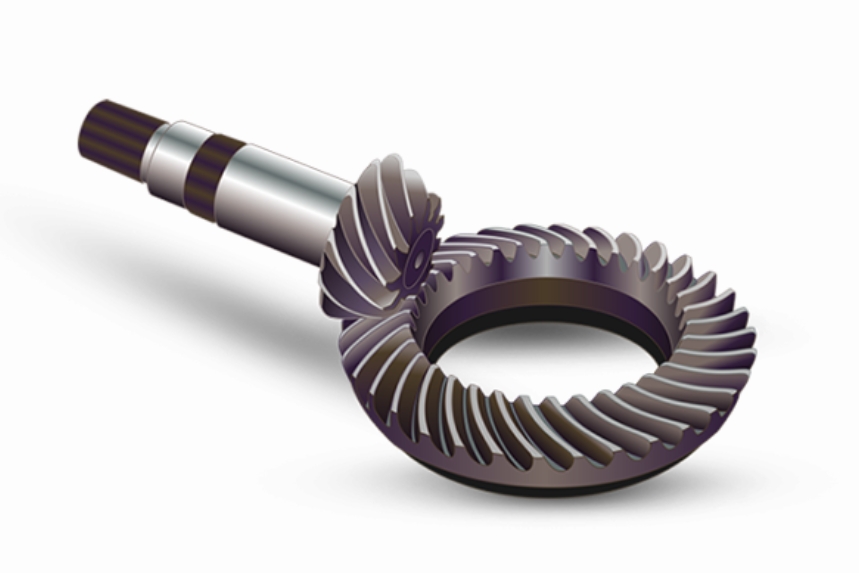
The investigation focuses on a pair of spiral bevel gears (driver and driven) that failed after approximately 1000 hours of operation under full-load conditions. The primary material, 20CrMnTi steel, was selected for its favorable combination of hardenability, core toughness, and ability to develop a high-surface hardness after carburizing and heat treatment.
1. Technical Specifications and Initial Processing
The design and material specifications for the spiral bevel gear set are foundational to understanding its performance limits. The gears were manufactured according to specific design parameters and subjected to a controlled heat treatment process.
1.1 Material and Design Parameters
The chemical composition of the 20CrMnTi steel must adhere to stringent standards to ensure consistent performance. Key elements and their permissible ranges are critical for achieving the desired microstructure and mechanical properties after heat treatment.
| Element | Specification Range | Function |
|---|---|---|
| Carbon (C) | 0.17 – 0.24 | Provides core strength and hardenability. |
| Manganese (Mn) | 0.80 – 1.10 | Enhances hardenability and strength. |
| Silicon (Si) | 0.20 – 0.40 | Deoxidizer and strengthens ferrite. |
| Chromium (Cr) | 1.00 – 1.30 | Improves hardenability, wear resistance, and toughness. |
| Titanium (Ti) | 0.04 – 0.10 | Refines grain size during carburizing. |
| Phosphorus (P) | ≤ 0.035 | Impurity; reduces toughness. |
| Sulfur (S) | ≤ 0.035 | Impurity; affects machinability and ductility. |
| Oxygen [O] | ≤ 20 ppm | Critical non-metallic inclusion; drastically reduces fatigue life. |
| Hardenability (J9) | 36 – 42 HRC | Ensures sufficient depth of hardening upon quenching. |
The geometric design of a spiral bevel gear directly influences its load-carrying capacity, contact pattern, and bending strength. The primary parameters for the failed gear set are summarized below.
| Parameter | Driver Gear | Driven Gear | Note |
|---|---|---|---|
| Number of Teeth (z) | 9 | 37 | Determines transmission ratio. |
| Module (mn) | 11 mm | Defines tooth size. | |
| Normal Pressure Angle (αn) | 20° | Affects tooth strength and contact ratio. | |
| Spiral Angle (β) | 35° | Governs smoothness of engagement and axial thrust. | |
| Face Width (b) | 75 mm | 70 mm | Critical for bending and contact stress. |
| Transmission Ratio (i) | 4.111 | Ratio of driven to driver teeth. | |
1.2 Heat Treatment Process & Target Properties
The intended mechanical properties for the spiral bevel gears are achieved through carburizing and quenching. The target case depth and hardness profile are essential for resisting surface contact stresses and subsurface shear stresses.
- Effective Case Depth (CHD): 1.9 – 2.4 mm (at 550 HV).
- Surface Hardness: 58 – 64 HRC.
- Core Hardness: 38 – 45 HRC.
- Microstructure: Fine martensite with minimal retained austenite (1-5级), and controlled carbide morphology (1-5级). Non-martensitic surface layers must be ≤ 20 μm.
The standard heat treatment process route involved: Pre-cleaning → Preheating (~880°C) → Carburizing (930°C) → Diffusion (900°C) → Quenching (Driver: 850°C in oil; Driven: 850°C with press quenching to control distortion) → Tempering (180°C for 6 hours) → Cleaning → Shot peening.
2. Failure Investigation and Root Cause Analysis
Post-failure analysis of the spiral bevel gears involved macroscopic examination, chemical analysis, and detailed metallurgical inspection to identify the failure initiation points and contributing factors.
2.1 Macroscopic Failure Modes
Examination revealed two distinct failure modes:
Driver Spiral Bevel Gear: Failure initiated as macro-pitting/spalling on the tooth flank, primarily near the top region. This is a classic sub-surface fatigue failure.
Driven Spiral Bevel Gear: Failure was a complete tooth fracture originating at the root fillet on the heel (large end) of the tooth. This is a bending fatigue failure.
2.2 Material and Process Deviation Analysis
Laboratory testing of the failed gears identified critical deviations from the specified requirements.
| Test Parameter | Specification | Driver Gear Result | Driven Gear Result | Conclusion |
|---|---|---|---|---|
| Oxygen Content | ≤ 20 ppm | 22 ppm | 23 ppm | Out of Spec. High oxide inclusions act as stress concentrators. |
| Hardenability (J9) | 36-42 HRC | 34 HRC | 33 HRC | Below Spec. Indicates lower than ideal alloy content or segregation. |
| Core Hardness | 38-45 HRC | 34-37 HRC | 34-37 HRC | Below Spec. Compromises support for the hard case. |
| Effective Case Depth | 1.9-2.4 mm | 1.5-1.7 mm | 1.4-1.7 mm | Below Spec. Insufficient depth to withstand subsurface shear stresses. |
| Surface Hardness | 58-64 HRC | 61-62 HRC | 61-62 HRC | Within specification. |
2.3 Failure Mechanism Analysis
The test results directly correlate with the observed failure modes, governed by fundamental gear stress equations.
A. Driver Gear Spalling (Contact Fatigue): The primary cause is subsurface orthogonal shear stress ($\tau_{xy}$) exceeding the material’s endurance limit. This stress peaks slightly below the surface. The insufficient effective case depth (CHD) means this peak stress occurs in a region with lower hardness and strength (the core), or at the weak case-core interface. Furthermore, oxygen content超标 creates brittle oxide inclusions that become nucleation sites for “butterfly” cracks under cyclic Hertzian contact stress. The combined effect leads to sub-surface crack propagation and eventual spalling.
The maximum orthogonal shear stress can be approximated by:
$$\tau_{max} \approx 0.25 \cdot p_0$$
where $p_0$ is the maximum Hertzian contact pressure, given by:
$$p_0 = \sqrt{\frac{F_E}{\pi b} \cdot \frac{1}{\rho_{eq}}}$$
with $F_E$ as the equivalent tangential load, $b$ the face width, and $\rho_{eq}$ the equivalent radius of curvature at the contact point.
B. Driven Gear Tooth Fracture (Bending Fatigue): This is a direct consequence of excessive bending stress at the tooth root fillet, the point of maximum stress concentration. The low core hardness significantly reduces the gear’s bending fatigue strength ($\sigma_{Flim}$). A core hardness of 35 HRC provides substantially lower resistance to crack initiation and propagation compared to the specified 40+ HRC. The fracture initiated at the heel due to the highest bending moment and potential stress concentration from machining marks or an insufficient root fillet radius.
The nominal bending stress at the root ($\sigma_F$) is calculated using the Lewis formula, modified by application factors:
$$\sigma_F = \frac{F_t}{b \cdot m_n} \cdot Y_F \cdot Y_S \cdot Y_\beta \cdot K_A \cdot K_V \cdot K_{F\beta} \cdot K_{F\alpha}$$
Where $F_t$ is the tangential load, $Y_F$ is the form factor, $Y_S$ the stress concentration factor, $Y_\beta$ the helix angle factor, and the $K$ factors account for application, dynamic load, face load distribution, and transverse load distribution, respectively. A low core hardness directly reduces the permissible bending stress $\sigma_{FP}$.
3. Integrated Optimization Strategies for Spiral Bevel Gears
Based on the root cause analysis, a multi-faceted optimization approach is proposed to enhance the durability and load capacity of spiral bevel gears.
3.1 Material and Process Optimization
Controlling material purity and refining heat treatment are fundamental.
- Ultra-Low Oxygen Steel: Specify oxygen content ≤ 15 ppm or lower via vacuum degassing or other secondary refining processes. This dramatically increases the cleanliness rating and fatigue life.
- Guaranteed Hardenability: Employ narrow-band hardenability steel (e.g., 20CrMnTiH) to ensure consistent and adequate core hardness (target 40-44 HRC) across all batches, providing robust support for the case.
- Precise Carburizing Control: Implement precise carbon potential control and use boost-diffuse cycles to achieve the specified case depth (1.9-2.4 mm) with a optimal carbon gradient. Consider low-pressure carburizing for superior uniformity and minimal intergranular oxidation.
- Distortion Control: For large-diameter, thin-web driven spiral bevel gears, press quenching or intensive quenching techniques are essential to minimize distortion and maintain dimensional accuracy, ensuring proper gear mesh and load distribution.
3.2 Geometric Design Optimization
Modifying geometric parameters can significantly improve strength without changing the overall envelope.
| Parameter | Standard Design | Optimized Proposal | Benefit & Rationale |
|---|---|---|---|
| Root Fillet Radius (rf) | Often minimally machined | Maximize via full-radius tooling | Reduces stress concentration factor ($Y_S$). A 20% increase in $r_f$ can reduce $\sigma_F$ by 5-10%. |
| Normal Pressure Angle (αn) | 20° | 22° – 25° | Increases tooth bending strength (larger $Y_F$) and contact ratio. Reduces contact pressure ($p_0$) slightly. The bending stress is inversely proportional to the square of the pressure angle: $\sigma_F \propto 1/(\cos\alpha_n)^2$. |
| Tip Relief & Root Relief | May not be optimized | Precisely applied profile modifications | Compensates for deflection under load, improving load sharing across the face width and reducing impact at the tooth mesh-in and mesh-out, thereby lowering $K_V$ and $K_{F\alpha}$. |
3.3 Surface Enhancement: Intensive Shot Peening
Post-heat-treatment surface enhancement is a highly effective method to improve fatigue performance. Replacing standard cleaning shot peening with Intensive (or High-Intensity) Shot Peening induces a deep, high-magnitude compressive residual stress layer at the surface.
- Mechanism: The cold working from high-velocity peening media plastically deforms the surface, creating compressive residual stresses ($\sigma_{RS}$) that can reach -800 to -1200 MPa, extending hundreds of microns deep.
- Benefit for Spiral Bevel Gears:
For Bending Fatigue: Compressive stress at the root fillet directly opposes the applied tensile bending stress, effectively increasing the fatigue threshold. The superposition principle applies: $\sigma_{effective} = \sigma_{applied} + \sigma_{RS}$.
For Contact Fatigue: The compressive layer suppresses both surface-originated pitting and sub-surface crack initiation. It lowers the effective mean stress in the critical shear stress zone below the surface.
| Parameter | Standard Cleaning Peening | Intensive/High-Intensity Peening |
|---|---|---|
| Primary Goal | Remove scale, improve aesthetics | Engineer surface stress state |
| Coverage | ~100% | > 200% (Over-peening) |
| Almen Intensity | Low (e.g., 0.15-0.25 mmA) | High (e.g., 0.45-0.65 mmA) |
| Residual Stress Depth | Shallow (< 0.1 mm) | Deep (0.25 – 0.5 mm) |
| Surface Roughness | May increase slightly | Increases but can be managed |
| Fatigue Life Improvement | Marginal (10-30%) | Substantial (50-300% or more) |
The residual stress profile ($\sigma_{RS}(z)$) as a function of depth (z) can be modeled and measured to validate the process. The enhanced performance can be incorporated into gear rating standards by adjusting the permissible stress limits or life factors.
4. Conclusion
The premature failure of the 20CrMnTi spiral bevel gears was not due to a singular cause but a confluence of material and processing deficiencies. Elevated oxygen content acted as intrinsic stress raisers, while sub-par core hardness and insufficient effective case depth critically weakened the gear’s resistance to both bending and contact fatigue mechanisms. To prevent such failures and optimize the performance of spiral bevel gears, a holistic strategy is required. This strategy must encompass stringent control over material purity (especially oxygen), guaranteed hardenability and precise heat treatment to achieve target case/core properties, intelligent geometric design modifications to reduce stress concentrations, and the mandatory implementation of intensive shot peening to impart beneficial compressive residual stresses. The integration of these optimizations will significantly enhance the bending and contact fatigue strength of spiral bevel gears, leading to greater reliability and extended service life in demanding applications.