
In my extensive experience with mechanical transmission systems, worm gears have always presented a unique set of challenges and advantages. As a fundamental component in many industrial applications, worm gears are prized for their high reduction ratios, smooth operation, and compact design. However, their inherent sliding contact generates significant heat, making them susceptible to failures like scuffing, wear, and, in severe cases, catastrophic seizure. The following analysis delves into a specific and relatively rare failure mode I encountered: the bending deformation of a worm shaft in a heavy-duty lifting mechanism. This incident, involving a triple-worm-gear setup, revealed critical insights into design, maintenance, and material selection that are often overlooked. I will systematically explore the structural configuration, material properties, stress states, stability conditions, and transmission dynamics that led to this failure, employing formulas and tables to encapsulate the key data and principles. Throughout this discussion, the term ‘worm gears’ will be frequently emphasized to underscore their central role in this analysis.
The lifting mechanism in question was designed for vertically transporting large fermentation tanks between floors in an industrial facility. It utilized three SWL-25 type worm gear reducers arranged in a linear array. Each worm shaft was connected at its bottom to a lifting platform or “carriage” and driven at its top by a worm wheel housed in a gearbox. A central motor provided power, which was distributed synchronously to all three gearboxes via shafts and universal joints. The carriage was guided by vertical rails with opposing guide wheels to minimize lateral movement. The primary function was to lift a loaded tank from the first floor to the second and later lower it back, always operating under an unbalanced load. Initial operation was satisfactory, but over time, all three worm shafts exhibited bending, with one shaft deformed most severely. This prompted a detailed forensic investigation.
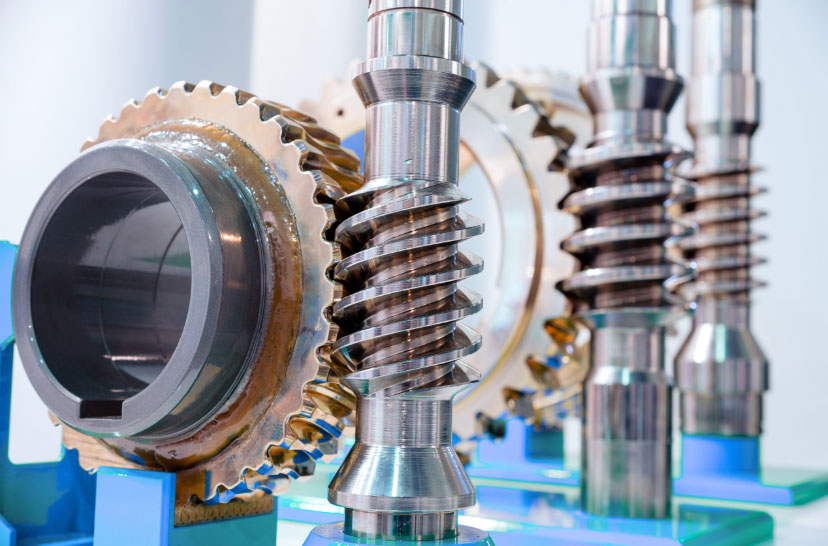
Physical examination of the failed system revealed several telltale signs. The lubricating grease within the worm gearboxes had bubbled, darkened in color, and was notably depleted. The teeth of the worm wheels showed signs of scoring and seizure. Furthermore, the entire carriage was found to be slightly tilted relative to its guiding rails. These observations pointed towards excessive heat generation, inadequate lubrication, and possible misalignment—all classic precursors to failure in worm gears.
A fundamental step was to analyze the material composition of the worm shafts. Samples were taken from all three shafts for spectroscopic analysis. The results are summarized in the table below.
| Element | Worm Shaft 2, Sample 1 | Worm Shaft 2, Sample 2 | Worm Shaft 1, Sample | Worm Shaft 3, Sample |
|---|---|---|---|---|
| C | 0.23% | 0.23% | 0.21% | 0.23% |
| Si | 0.21% | 0.22% | 0.21% | 0.21% |
| Mn | 0.55% | 0.55% | 0.55% | 0.54% |
| P | 0.026% | 0.028% | 0.026% | 0.026% |
| S | 0.010% | 0.011% | 0.008% | 0.009% |
| Cr | 0.037% | 0.037% | 0.039% | 0.037% |
| Ni | 0.010% | 0.011% | 0.010% | 0.009% |
| Cu | 0.022% | 0.022% | 0.022% | 0.022% |
The composition aligns with Grade 25 high-quality carbon structural steel per relevant standards. While this material meets basic specifications, common mechanical design practice for force-transmitting shafts like those in worm gears typically calls for medium-carbon quenched and tempered steels (e.g., 45 steel, 40Cr) which offer superior strength, hardness, and wear resistance. The choice of a lower-carbon steel like Grade 25, while ductile, inherently reduces the system’s margin against frictional wear and thermal stress, crucial factors in worm gear performance.
To assess basic integrity, a static force analysis was conducted for the worst-case scenario: lifting a fully loaded tank. The system is statically indeterminate. Defining the forces in the three worm shafts as \(F_1\), \(F_2\), and \(F_3\), the carriage weight \(Q_2 = 29.4 \text{ kN}\), and the loaded tank weight \(Q_3 = 186.2 \text{ kN}\) acting off-center, we establish equilibrium and compatibility equations. The total load \(Q\) and its effective moment arm \(L\) are:
$$ Q = Q_2 + Q_3 $$
$$ QL = Q_2 \cdot g + \frac{3}{2} Q_3 \cdot g $$
where \(g\) is the distance between adjacent worm shafts (4.9 m). The system of equations is:
$$ F_1 + F_2 + F_3 = Q $$
$$ F_2 \cdot g + 2F_3 \cdot g = QL $$
$$ \frac{2 F_2 h}{EA} = \frac{F_1 h}{EA} + \frac{F_3 h}{EA} $$
Here, \(E\) is the elastic modulus, \(A\) is the cross-sectional area of a worm shaft, and \(h\) is the shaft length. Solving yields \(F_1 = 25.3 \text{ kN}\), \(F_2 = 71.9 \text{ kN}\), and \(F_3 = 118.4 \text{ kN}\). The maximum tensile stress \(\sigma_t\) in worm shaft 3, with a root diameter \(d = 70 \text{ mm}\), is:
$$ \sigma_t = \frac{F_3}{A} = \frac{4F_3}{\pi d^2} $$
$$ \sigma_t = \frac{4 \times 118.4 \times 10^3}{\pi \times (70 \times 10^{-3})^2} \approx 30.8 \text{ MPa} $$
For Grade 25 steel with a yield strength of 275 MPa and applying a safety factor of 2, the allowable stress is 137.5 MPa. Therefore, under pure tension, the worm shafts are adequately strong. This confirms that the bending failure was not due to simple overloading in tension.
The pivotal insight came from stability analysis. Worm shafts are long, slender columns (length \(h = 5.55 \text{ m}\), diameter \(d = 70 \text{ mm}\)). Under normal operation, they are in tension. However, if the worm gears seize due to scuffing or adhesive wear (a common failure in worm gears under poor lubrication), the rotating input suddenly stops. The massive carriage, due to inertia, continues its upward motion, subjecting the worm shafts to a compressive impact force. A worm shaft can be modeled as a column fixed at the bottom (carriage connection) and simply supported at the top (worm wheel contact). The slenderness ratio \(\lambda\) determines its susceptibility to buckling:
$$ \lambda = \frac{\mu h}{r} = \frac{4 \mu h}{d} $$
where \(\mu = 0.7\) is the effective length factor for a fixed-simply supported column, and \(r\) is the radius of gyration. Calculating:
$$ \lambda = \frac{4 \times 0.7 \times 5.55}{0.070} \approx 222 $$
The critical slenderness for Grade 25 steel is approximately 92.6. Since \(\lambda > 92.6\), these are high-slenderness columns prone to elastic buckling. The critical Euler stress \(\sigma_{cr}\) and critical force \(F_{cr}\) are:
$$ \sigma_{cr} = \frac{\pi^2 E}{\lambda^2} $$
$$ F_{cr} = A \sigma_{cr} $$
Taking \(E = 210 \text{ GPa}\) for steel:
$$ \sigma_{cr} = \frac{\pi^2 \times 210 \times 10^9}{222^2} \approx 42.1 \text{ MPa} $$
$$ F_{cr} = \frac{\pi \times (0.070)^2}{4} \times 42.1 \times 10^6 \approx 162.1 \text{ kN} $$
If the compressive force exceeds \(F_{cr}\), the shaft buckles. During a seizure event, the dynamic impact force can be 3 to 5 times the static load (dynamic factor). The maximum static compression would be similar to the tension forces. Taking the largest tension force \(F_3 = 118.4 \text{ kN}\), a conservative dynamic factor of 3 gives an impact force of \(355.2 \text{ kN}\), far exceeding \(F_{cr} \approx 162.1 \text{ kN}\). Therefore, seizure inevitably leads to buckling instability, explaining the observed bending deformation pattern consistent with a fixed-simply supported column buckling mode. This chain of events highlights how the failure of the worm gears directly triggers the worm shaft collapse.
The root cause of the seizure lies in the transmission ratio selection. The SWL-25 worm gearbox specification mandates a reducer ratio of 32:1 for optimal performance. However, the installed reducers had a ratio of 24:1. This alteration significantly increased operational speeds. Key parameters are compared below.
| Parameter | Specified Design (32:1) | As-Installed (24:1) | Change |
|---|---|---|---|
| Motor Speed | 1470 rpm | 1470 rpm | 0% |
| Worm Wheel Speed | 1470 / 32 ≈ 45.9 rpm | 1470 / 24 ≈ 61.3 rpm | +33.6% |
| Lifting Speed | Proportional to 45.9 rpm | Proportional to 61.3 rpm | +33.6% |
The increased speed of 61.3 rpm has profound implications for worm gears. The sliding velocity \(v_s\) at the meshing point is proportional to the worm wheel speed. A fundamental formula for heat generation \(H\) due to friction in worm gears is:
$$ H \propto \mu \cdot P_n \cdot v_s $$
where \(\mu\) is the coefficient of friction and \(P_n\) is the normal load. An approximate relation shows that \(v_s\) is directly proportional to the worm wheel rotational speed \(n_w\):
$$ v_s \approx \frac{\pi d_w n_w}{60 \times \cos(\gamma)} $$
where \(d_w\) is the worm reference diameter and \(\gamma\) is the lead angle. Thus, a 33.6% increase in \(n_w\) leads to a similar increase in \(v_s\) and consequently in frictional heat generation \(H\). Excessive heat degrades lubricant viscosity, accelerates wear, and promotes adhesive wear (scuffing) between the worm and wheel teeth. This aligns perfectly with the observed degraded, bubbly grease and scored teeth. The improper transmission ratio created a thermally abusive environment for these worm gears, making eventual seizure highly probable.
To synthesize the findings, I constructed a fault tree analysis, mapping the primary and contributing causes to the final failure of worm shaft bending. This systematic approach underscores the interdependencies.
| Primary Cause | Mechanism | Effect on Worm Gears | Final Consequence |
|---|---|---|---|
| Incorrect Transmission Ratio (24:1 vs 32:1) | Increased sliding velocity & frictional heat | Lubricant breakdown, accelerated wear, thermal stress | Seizure of worm gears |
| Inadequate Lubrication Maintenance | Degraded/insufficient grease, loss of cooling & lubrication | Increased friction coefficient, local overheating | |
| Suboptimal Material Selection (Grade 25 Steel) | Lower wear resistance and thermal strength | Higher susceptibility to scuffing and deformation | |
| Seizure of Worm Gears | Sudden stoppage of rotation | ||
| Dynamic Compressive Impact on Worm Shafts | Load exceeds critical buckling force \(F_{cr}\) | ||
| Elastic Instability (Buckling) | Bending deformation of slender worm shafts | ||
The core failure sequence is unequivocal: the improper specification of the worm gear drive ratio induced excessive operational speeds, which, combined with poor lubrication upkeep, led to catastrophic seizure of the worm gears. This seizure event transformed the kinematic load case into a dynamic compressive one, exploiting the inherent slenderness of the worm shafts to cause buckling failure. While the material choice was not the initiating factor, it reduced the system’s overall robustness against the thermal and frictional demands intrinsic to worm gears.
Preventive measures must be multi-faceted. First and foremost, strict adherence to the manufacturer’s specified transmission ratio for worm gearboxes is non-negotiable. The design trade-off for slightly faster lifting is a drastic reduction in reliability and safety. The relationship between ratio, speed, and thermal load should be a primary design constraint. Secondly, a rigorous and scheduled lubrication maintenance protocol is essential for worm gears. This includes using the correct high-temperature, extreme-pressure grease specified for worm gears and monitoring grease condition and quantity regularly. Advanced lubrication systems with cooling features can be considered for heavy-duty applications. Thirdly, material selection for worm shafts should be upgraded to quenched and tempered alloys like 40Cr or similar, which offer higher yield strength and better resistance to the abrasive and adhesive wear common in worm gear systems. The critical buckling force \(F_{cr}\) is proportional to the elastic modulus \(E\) and inversely proportional to \(\lambda^2\). While changing material doesn’t alter \(E\) significantly for steels, increasing the shaft diameter \(d\) would dramatically increase the area \(A\) and radius of gyration, thereby reducing \(\lambda\) and increasing \(F_{cr}\). A revised design could consider a slight increase in shaft diameter for critical, long-stroke worm gear lifts. The modified critical force would be:
$$ F_{cr}^{new} = \frac{\pi^2 E I}{(\mu h)^2} = \frac{\pi^2 E}{(\mu h)^2} \cdot \frac{\pi d_{new}^4}{64} $$
showing a \(d^4\) relationship, making diameter a powerful design lever against buckling.
In conclusion, the bending failure of worm shafts in this lifting mechanism serves as a potent case study on the systemic nature of mechanical failures. It was not a simple material defect or calculation error, but a cascade initiated by a fundamental design deviation—the incorrect worm gear transmission ratio—exacerbated by operational maintenance shortcomings. Worm gears, with their unique kinematics, demand respect for their thermal limitations. This analysis underscores that every aspect, from the initial gear ratio specification and lubrication strategy to the material and geometry of associated components like the worm shaft, must be harmonized to ensure reliable service. Future designs of worm gear lifting systems must integrate thermal analysis at the design stage, explicitly modeling heat generation and dissipation for the selected operating speed. Prototype testing under load is also recommended to validate thermal performance. By learning from such failures, we can formulate more robust design codes and maintenance schedules, ensuring that the undeniable advantages of worm gears are not compromised by preventable oversights.
To further generalize the principles, let’s consider the fundamental equations governing worm gear performance and shaft stability side-by-side. The following table juxtaposes the key formulas from both domains, illustrating how they interact in this failure mode.
| Aspect | Governing Equations for Worm Gears | Governing Equations for Shaft Stability | Interaction Point |
|---|---|---|---|
| Speed & Kinematics | $$ n_w = \frac{n_{motor}}{i} $$ $$ v_s \propto n_w $$ | N/A | Ratio \(i\) determines \(n_w\), which drives heat generation. |
| Thermal Load | $$ H = f(\mu, F_n, v_s) $$ $$ \Delta T \propto H / \text{(Cooling Rate)} $$ | N/A | Excessive \(H\) leads to lubricant failure and seizure. |
| Stress State | Contact stress, bending stress in teeth. | Tensile/Compressive stress: $$ \sigma = F/A $$ | Seizure switches stress from tensile (\(\sigma_t\)) to compressive. |
| Failure Limit | Wear, scuffing, pitting limits. | Buckling limit: $$ F_{cr} = \frac{\pi^2 E I}{(\mu h)^2} $$ | Compressive force from seizure must be \(<\) \(F_{cr}\) to avoid buckling. |
| Design Parameters | Ratio \(i\), material pair, lubrication type. | Slenderness \(\lambda = \frac{\mu h}{r}\), material \(E\). | Independent choices in each domain create coupled failure risk. |
This integrated view makes it clear that designing with worm gears requires a holistic approach. The selection of the worm gear reducer defines the operational environment (speed, heat), which directly impacts the loading conditions for structural elements like the worm shaft. A failure in the gear domain (seizure) can induce a catastrophic failure in the structural domain (buckling). Therefore, verification checks should include a post-seizure load case for long, slender drive components in worm gear systems. In essence, the reliability of the entire mechanism is anchored on the health and correct application of the worm gears themselves. Through diligent design, appropriate material selection, and meticulous maintenance focused on the unique needs of worm gears, such expensive and dangerous failures can be effectively prevented.