
In my extensive experience with heavy machinery components, gear shafts represent one of the most critical elements in power transmission systems, particularly in large-scale industrial applications such as ball mills. As a professional involved in metallurgical analysis and heat treatment, I have encountered numerous cases where gear shafts fail prematurely, leading to significant operational downtime and economic losses. This article details a comprehensive failure analysis I conducted on a large gear shaft made from 20CrNi2Mo steel, which underwent carburizing and quenching, and subsequently fractured in service. The goal is to elucidate the root causes and propose effective countermeasures in the thermal processing chain to enhance the durability and reliability of such gear shafts.
The gear shaft in question was employed in a large ball mill, a device ubiquitous in mining, building materials, and chemical industries for grinding ores and other materials. With the trend toward larger and more powerful equipment to meet increasing production demands, the design and manufacturing of gear shafts have evolved. Traditionally, medium-carbon alloy steels subjected to quenching and tempering with surface hardening were used. However, for enhanced surface hardness and wear resistance, carburizing steels like 20CrNi2Mo have become preferred, undergoing deep carburizing followed by quenching and tempering. The specific gear shaft I analyzed had dimensions of approximately 579 mm in diameter and 3000 mm in length, with a module of 25 and 21 teeth. Its manufacturing process involved forging, rough machining, non-destructive testing, quenching and tempering (650°C tempering), finish machining, pre-grind hobbing, carburizing and quenching of the tooth section (with a case depth target of 2.5–3 mm and surface hardness of 57–61 HRC), tempering, and finally gear grinding. Despite this rigorous process, the gear shaft failed after about 12 months of operation. The failure was sudden: the motor continued to run, but the gear shaft ceased to rotate, indicating a complete fracture.
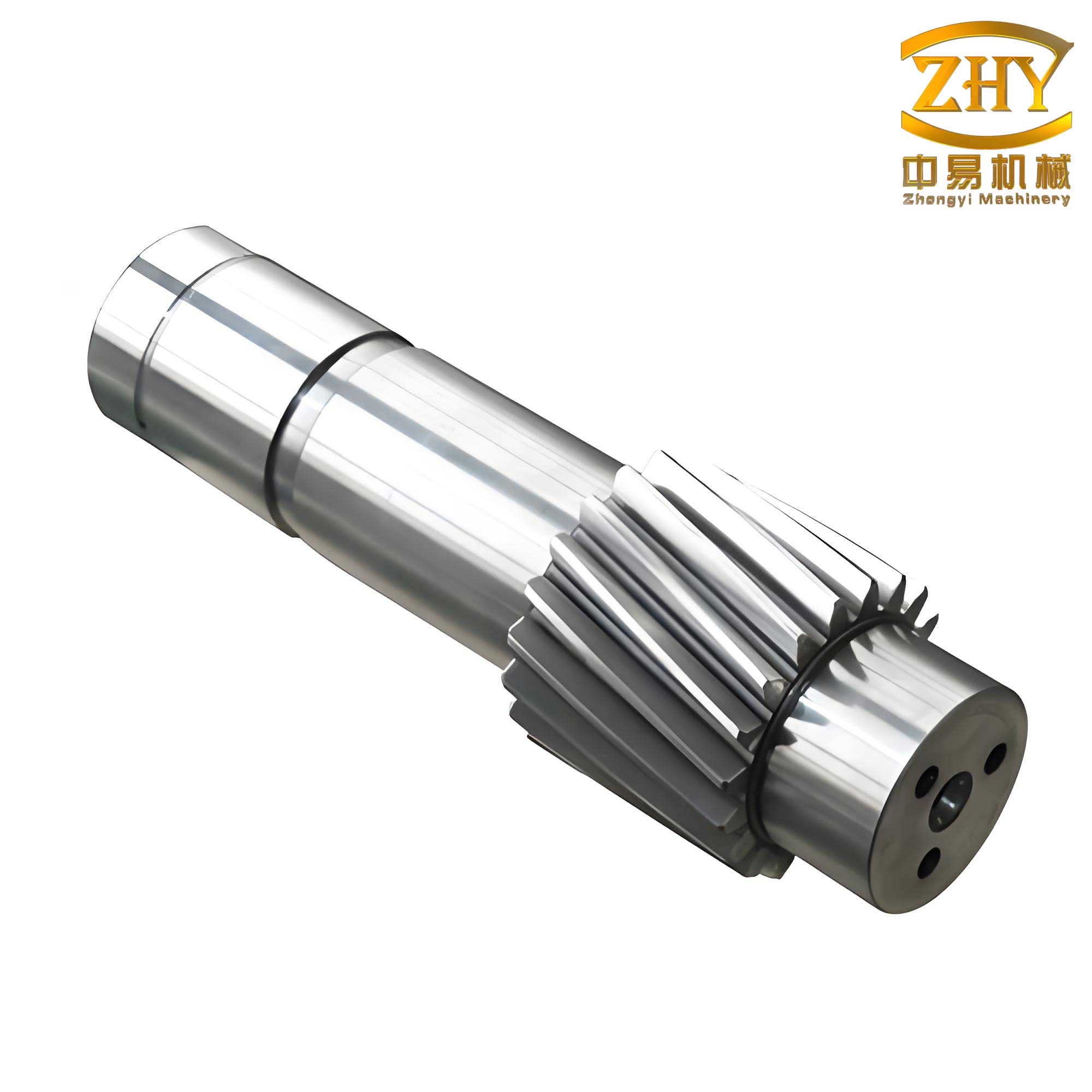
Upon visual inspection, the fracture occurred in the tooth region, presenting a radial-through break. The crack prior to separation appeared as a straight line circumferentially, with no macroscopic plastic deformation in the vicinity, suggesting a brittle fracture mode. This initial observation prompted a detailed investigation to determine whether the failure originated from design flaws, manufacturing defects, improper heat treatment, or operational overloads. Since this gear shaft was a spare part and the previous shaft had also failed after a similar service life, design and operational factors were initially considered less likely. Therefore, my focus turned to the material quality and thermal processing history. I performed a series of laboratory tests, including chemical composition analysis, metallographic examination, fractography, and mechanical property testing, on samples extracted from the fractured gear shaft.
The first step in my analysis was to examine the fracture surface macroscopically and microscopically. The fracture face was relatively flat and exhibited classic radial patterns indicative of a single-origin, fast fracture. The convergence point of these radial markings, i.e., the fracture origin, was located not at the surface but approximately 250 mm from the tooth tip, offset from the geometric center of the shaft cross-section. At this origin region, visible to the naked eye after cleaning, were distinct dendritic features and slag inclusion defects measuring about 15 mm by 10 mm and 10 mm by 2 mm. These are critical observations, as they point to potential weaknesses in the material’s core. Scanning electron microscopy (SEM) of the origin area revealed a microstructure dominated by cleavage and quasi-cleavage facets, confirming the brittle nature of the fracture. Energy-dispersive X-ray spectroscopy (EDS) on the inclusion sites detected elements such as O, Ca, Si, C, Al, Fe, Mg, Na, and K, identifying them as non-metallic slag inclusions, likely introduced during the steelmaking or casting process prior to forging.
To quantify the material’s conformance to specifications, I conducted chemical analysis. The results, compared to the standard GB/T 3203-2016 for carburizing bearing steels, are summarized in Table 1. The composition of the gear shaft was largely within the specified ranges, indicating that the material grade was correct and bulk chemistry was not the primary issue.
| Element | Standard (GB/T 3203-2016) | Measured Value |
|---|---|---|
| C | 0.19–0.23 | 0.20 |
| Si | 0.25–0.40 | 0.30 |
| Mn | 0.55–0.70 | 0.70 |
| P | ≤0.020 | 0.018 |
| S | ≤0.015 | 0.008 |
| Cr | 0.45–0.65 | 0.66 |
| Ni | 1.60–2.00 | 1.75 |
| Mo | 0.20–0.30 | 0.19 |
| Cu | ≤0.25 | 0.062 |
Next, I evaluated the metallographic structure at various locations from the surface to the core. Macro-etching tests on radial and axial sections revealed a general looseness rating of 0.5级 (according to GB/T 1979-2001), but no other significant macro-defects. However, a pronounced dendritic structure was evident throughout, particularly severe in the fracture origin zone. The carburized case and the underlying quenched-and-tempered layer were distinct, with the tempered layer starting at about 110 mm from the tooth surface. Microstructural examination showed that the carburized and quenched case at the tooth root consisted of tempered martensite, rated as Martensite Level 5. The quenched-and-tempered layer exhibited a structure of tempered sorbitte plus ferrite, still displaying dendritic patterns. Moving closer to the core, near the fracture origin, the structure transformed to pearlite and ferrite with severe dendrites, and the prior austenite grain size was finer than ASTM 8. Non-metallic inclusions were assessed per GB/T 10561-2005, with results: A (sulfide) coarse series 1, B (alumina) coarse series 1, C (silicate) 0, and D (globular oxide) fine series 2. While not excessively high, the presence of inclusions, combined with the dendritic structure, can act as stress concentrators.
Mechanical properties were tested on specimens taken radially from near the fracture origin in the core region. The results, presented in Table 2, show that the impact toughness values satisfied typical technical requirements, indicating the material possessed adequate fracture resistance. However, the tensile strength was lower than the standard reference values for longitudinal specimens from smaller diameters. This discrepancy is attributed to two factors: first, the inherent size effect where larger sections like this gear shaft exhibit lower strength due to less favorable cooling rates during heat treatment; second, the sampling location was transverse and near the central axis, whereas standards often specify sampling at the one-third radius position for large forgings. The hardness gradient from the tooth surface, indicative of the effective case depth, is shown in Table 3. The depth where hardness falls to 550 HV (approximately 52.5 HRC) is about 3.0 mm, meeting the specification. The hardness in the quenched-and-tempered region below the case is detailed in Table 4.
| Specimen | Tensile Strength, Rm (MPa) | Yield Strength, Rp0.2 (MPa) | Elongation, A (%) | Reduction of Area, Z (%) | Charpy V-Notch Impact, KV2 (J) | Brinell Hardness, HBW |
|---|---|---|---|---|---|---|
| 1# | 790 | — | 11.5 | 27 | 68 | 226, 232, 224, 241 |
| 2# | 774 | 494 | 14.5 | 41 | 68 | — |
| Reference* | ≥980 | — | ≥13 | ≥45 | ≥63 | — |
*Reference values based on GB/T 3203-2016 for longitudinal specimens after quenching and low-temperature tempering.
| Distance from Surface (mm) | Hardness (HV1) | Equivalent HRC* |
|---|---|---|
| 0.1 | 573 | 54.5 |
| 0.5 | 559 | 53.0 |
| 1.0 | 594 | 56.5 |
| 1.5 | ~566 | 53.8 |
| 2.0 | 533 | 50.5 |
| 2.5 | ~499 | 47.5 |
| 3.0 | 509 | 48.5 |
| 3.2 | 433 | 41.0 |
*Approximate conversion using $$HRC \approx \frac{HV}{10} – 3$$ for higher hardness ranges, noting it’s nonlinear.
| Distance from Surface (mm) | Hardness (HV50) | Equivalent HRC |
|---|---|---|
| 5 | 316 | 33.5 |
| 30 | 266 | 27.0 |
| 60 | 269 | 27.5 |
| 100 | 248 | 24.0 | 140 | 242 | 23.0 |
| Core | 229 | 21.0 |
Synthesizing all the evidence, I concluded that the failure of this gear shaft was a result of a transient brittle fracture initiated at a weakness in the core region. The fracture origin contained both slag inclusions and severe dendritic segregation. These defects act as stress raisers, significantly reducing the local fracture strength. In service, gear shafts are subjected to complex loading: primarily torsional shear stress from torque transmission, bending stress from gear meshing forces, and potentially residual stresses from heat treatment. The stress state in the core of a large gear shaft is often considered to be lower than at the surface, but under certain conditions—such as shock loads, misalignment, or residual stress superposition—the core can experience significant multiaxial stresses. The presence of inclusions and dendrites creates micro-notches where the local stress intensity can exceed the material’s fracture toughness, leading to crack initiation and rapid propagation. The fracture mechanics can be described by the stress intensity factor for a crack-like defect: $$K_I = \sigma \sqrt{\pi a}$$, where $\sigma$ is the applied stress and $a$ is the defect size. When $K_I$ reaches the critical value $K_{IC}$ (plane-strain fracture toughness), unstable fracture occurs. In this case, the combination of the sizable inclusions and the brittle microstructure in the dendrite boundaries provided a low $K_{IC}$ path.
The dendritic structure is a remnant of the original casting ingot structure that was not fully broken down during forging. For large forgings like these gear shafts, insufficient forging reduction (low forging ratio) can leave behind pronounced dendrites, which are essentially compositional and microstructural inhomogeneities. They often coincide with segregation of alloying elements and impurities, weakening grain boundaries. The hardness and strength in such areas can be lower, and toughness can be anisotropic. The impact energy tested was an average value; locally, at the dendrite boundaries near inclusions, it could be much lower. Furthermore, the non-metallic inclusions, especially aluminates and silicates, are brittle and poorly bonded to the matrix, acting as inherent cracks.
Therefore, the root cause of the gear shaft failure lies in material imperfections introduced during steelmaking and insufficient thermomechanical processing, rather than in the carburizing heat treatment itself. The carburized case appeared acceptable, though the martensite was slightly coarse (Grade 5), which might slightly reduce fatigue resistance but is not catastrophic. The core’s mechanical properties, while adequate on a macro-scale, were compromised by localized defects. For large gear shafts, the core quality is paramount because once a crack initiates there, it can propagate rapidly through the section, as evidenced by the radial fracture pattern.
To prevent such failures in future productions of gear shafts, I propose several improvements focused on the thermal and mechanical processing stages. These measures aim to enhance the homogeneity of the material, refine the microstructure, and ensure better integrity of the gear shafts from the inside out.
First, the steelmaking process should be optimized to reduce non-metallic inclusion content, particularly large slag inclusions. Advanced ladle refining and vacuum degassing can help achieve cleaner steel. For existing billets, ultrasonic testing could be used to detect gross internal flaws before forging.
Second, the forging process must be carefully designed to impose a sufficient forging ratio to break down the as-cast dendritic structure effectively. A higher degree of deformation, along with proper control of forging temperatures and strains, promotes recrystallization and homogenization. The forging reduction can be quantified by the forging ratio, $R_f = A_0 / A_f$, where $A_0$ and $A_f$ are the initial and final cross-sectional areas. For large gear shafts, a minimum $R_f$ of 3 to 4 is often recommended to ensure adequate breakdown of the ingot structure. Additionally, multiple upsetting and drawing cycles can be beneficial.
Third, I recommend introducing a post-forging normalizing treatment before the initial quenching and tempering. Normalizing, which involves heating to above the austenitizing temperature (e.g., 880–920°C for 20CrNi2Mo) and air cooling, helps to refine the grain structure and further homogenize the microstructure, alleviating some of the segregation effects. The normalizing temperature and time can be derived based on the prior austenite grain growth kinetics, often described by $$d^n – d_0^n = k t \exp(-Q/RT)$$, where $d$ is the grain size, $t$ is time, $T$ is temperature, and $Q$ is the activation energy. Controlling these parameters ensures a fine, uniform grain size.
Fourth, the sequence of heat treatments should be adjusted. Currently, the gear shaft undergoes quenching and tempering (650°C) after rough machining, followed by carburizing and quenching of the teeth. I suggest adding an intermediate quenching and tempering step after the teeth are rough-hobbed but before carburizing. This serves as a “preparatory” heat treatment that refines the microstructure exactly in the tooth root region where stresses concentrate, ensuring a more uniform and tougher core prior to case hardening. The tempering temperature for this step should be high enough (e.g., 600–650°C) to achieve a good combination of strength and toughness.
Fifth, the carburizing and quenching process parameters can be fine-tuned. To control case depth and minimize distortion, a boost-diffuse carburizing cycle with computer-controlled carbon potential is advisable. The carbon diffusion in steel during carburizing follows Fick’s second law: $$\frac{\partial C}{\partial t} = D \frac{\partial^2 C}{\partial x^2}$$, where $C$ is carbon concentration, $t$ is time, $x$ is depth, and $D$ is the diffusion coefficient, which is temperature-dependent: $$D = D_0 \exp(-Q_D/RT)$$. By accurately modeling this, the process can be optimized to achieve the desired 2.5–3.0 mm case depth without excessive time at high temperature, which can coarsen grains. After carburizing, the quenching should be done in a medium that provides a cooling rate sufficient to form martensite in the case but not so severe as to cause excessive distortion or quench cracking in large gear shafts. Oil quenching with agitation is typical. The resulting martensite hardness can be estimated from the carbon content using empirical relations like $$HV_{mart} \approx 1667 C_{case} + 926$$ (for carbon in weight percent), where $C_{case}$ is the surface carbon content (aiming for 0.7–0.8% C). Tempering after quenching should be performed at 180–200°C to relieve stresses while retaining high hardness.
Finally, implementing rigorous non-destructive testing (NDT) after final machining, including magnetic particle inspection of the teeth and ultrasonic testing of the core, can help detect any remaining flaws before the gear shafts are put into service. Regular monitoring of operating conditions, such as load and alignment, is also crucial for longevity.
In conclusion, the failure analysis of this 20CrNi2Mo carburized and quenched gear shaft underscores the critical importance of core quality in large, heavily loaded components. The presence of slag inclusions and a severe dendritic structure in the core acted as the initiation sites for a brittle fracture under service stresses. While surface treatments like carburizing are essential for wear resistance, the bulk material’s integrity cannot be neglected. By enhancing steel cleanliness, optimizing forging practices, adding normalizing and preparatory heat treatments, and precisely controlling carburizing parameters, the overall quality and service life of such gear shafts can be significantly improved. These gear shafts are the backbone of many industrial drivetrains, and their reliable performance is paramount for operational efficiency and safety. Through continuous improvement in thermal processing, we can ensure that gear shafts meet the demanding requirements of modern large-scale machinery.
To further illustrate the relationship between defect size and critical stress, consider the following formula derived from linear elastic fracture mechanics for a surface crack or an embedded flaw: $$\sigma_c = \frac{K_{IC}}{Y \sqrt{\pi a}}$$, where $\sigma_c$ is the critical applied stress for fracture, $K_{IC}$ is the fracture toughness, $a$ is the defect half-length, and $Y$ is a geometric factor (about 1 for an embedded elliptical flaw). For the observed inclusion of length ~15 mm (2a), assuming a typical $K_{IC}$ of 50 MPa√m for this steel in the core condition, the critical stress would be approximately: $$\sigma_c \approx \frac{50}{1 \times \sqrt{\pi \times 0.0075}} \approx 515 \text{ MPa}$$. This is lower than the expected yield strength in the core, meaning that under sufficient stress concentration or overload, fracture could initiate from such a defect. This calculation emphasizes why eliminating or minimizing such inclusions is vital for gear shafts subjected to high loads.
Moreover, the effect of dendritic segregation on local hardness and strength can be modeled using rule-of-mixtures approximations for the two-phase structure (ferrite and pearlite). If the dendrite arm spacing is $\lambda$, the yield strength $\sigma_y$ might follow a Hall-Petch type relationship with the effective grain size: $$\sigma_y = \sigma_0 + k_y \lambda^{-1/2}$$, where $\sigma_0$ and $k_y$ are material constants. A larger $\lambda$ (coarse dendrites) results in lower strength, making the area more susceptible to plastic deformation and crack initiation. Therefore, refining the dendritic structure through thermomechanical processing directly enhances the core’s resistance to failure in gear shafts.
In summary, every step in the manufacturing chain for gear shafts—from steelmaking to final heat treatment—must be meticulously controlled to avoid introducing weaknesses that can lead to premature failure. The case study presented here highlights how a holistic approach combining advanced metallurgical analysis with process optimization can solve complex failure problems and lead to more robust components. As industries continue to push for larger and more powerful equipment, the lessons learned from such failures are invaluable for advancing the design and manufacturing of critical parts like gear shafts.