
In my experience with aero-engine maintenance and design, bearings are critical components whose reliability directly impacts engine and aircraft safety. With advancing engine technologies, bearing operating conditions have become increasingly severe, leading to a higher probability of failures. Historically, both international development and domestic usage indicate that bearings are among the most fault-prone parts in engines, necessitating focused attention. This article delves into the analysis of a cracking fault in the outer ring of a bevel gear bearing in a turboshaft engine, identifying the root cause and proposing improved process methods. I will outline the structural principles, fault investigation, experimental validations, and solutions, emphasizing the role of bevel gears in this context. Additionally, I will establish field replacement procedures to ensure operational safety, drawing from practical insights and technical evaluations.
The bevel gear bearing in question is a double-row, double-inner-ring angular contact ball bearing. It is assembled with an intermediate driven bevel gear via a large nut to form a component, which is then mounted on the intake casing using pins and studs for positioning. The intermediate driven bevel gear transmits power through splines on a central drive shaft, meshing with an intermediate drive bevel gear attached to the engine’s gas generator rotor. This bearing supports the intermediate driven bevel gear in a cantilevered manner, enduring forces generated from bevel gear meshing. The meshing forces on the bevel gear can be decomposed into radial force \( F_r \), tangential force \( F_t \), and axial force \( F_x \). During engine start-up, the directions of these forces reverse. Thus, the bevel gear bearing is subjected to combined radial, axial, and moment loads, along with vibrational impacts from gear meshing, resulting in complex operating conditions. This complexity underscores the importance of robust design and manufacturing for bevel gears and their associated bearings.
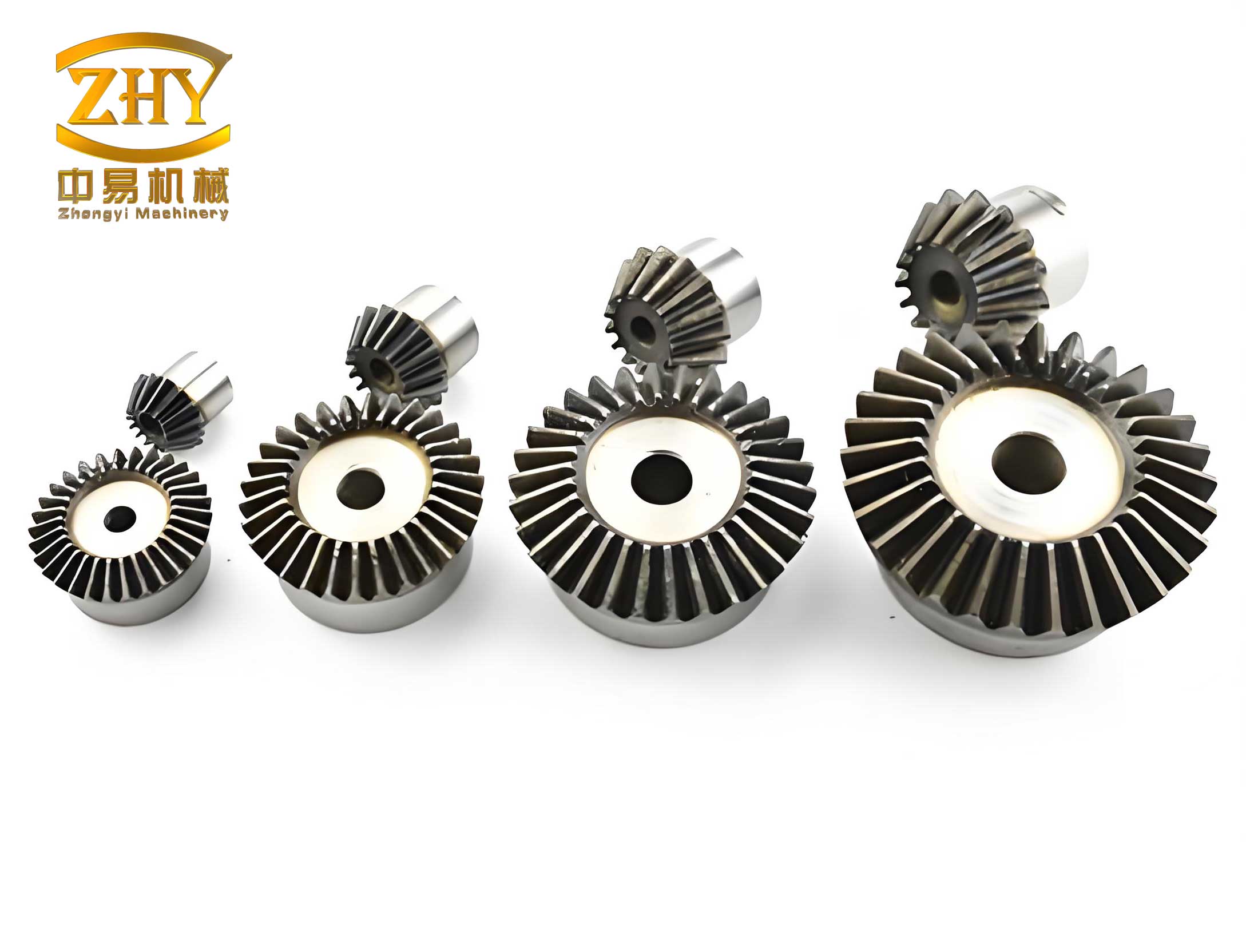
To quantify the forces on bevel gears, consider the following equations derived from gear theory. The tangential force \( F_t \) can be expressed as:
$$ F_t = \frac{2T}{d_m} $$
where \( T \) is the transmitted torque and \( d_m \) is the mean pitch diameter of the bevel gear. The radial force \( F_r \) and axial force \( F_x \) depend on the pressure angle \( \alpha \) and spiral angle \( \beta \):
$$ F_r = F_t \cdot \tan \alpha \cdot \cos \beta $$
$$ F_x = F_t \cdot \tan \alpha \cdot \sin \beta $$
These forces induce stresses in the bearing outer ring, particularly at critical locations such as transition radii. For bevel gears operating in high-speed environments, dynamic factors must also be accounted for, using equations like:
$$ \sigma_{dynamic} = K_v \cdot \sigma_{static} $$
where \( K_v \) is the dynamic factor, often derived from empirical data or simulations.
The fault occurred during an engine test run, where metal chip warnings were triggered. Disassembly revealed cracking at the transition radius (R) between the outer ring and its mounting flange. Metallurgical analysis identified a remelted layer at this location, with a maximum thickness of approximately 20 μm. Cracks propagated axially through the entire wall thickness, and wire cutting marks were evident on the outer surface and crack initiation zones. This finding prompted a comprehensive review of the manufacturing process.
Originally, due to the irregular shape of the bearing outer ring, a manual filing process was employed to remove burrs from pin and bolt holes, ensuring smooth assembly. However, this method sometimes left residual burrs, affecting quality. To enhance the appearance of non-working surfaces, a sandblasting process was introduced as an optimization. The process sequences before and after optimization are compared below:
| Process Step | Before Optimization (Manual Filing) | After Optimization (Sandblasting) |
|---|---|---|
| 1 | Cut R22 arc surface | Cut R22 arc surface |
| 2 | File R22 arc surface | Cut profile (two斜面 and R25) |
| 3 | Cut profile (two斜面 and R25) | Sandblast |
| 4 | Grind two斜面 | Grind outer diameter |
| 5 | File R25 | Final grind outer inner diameter |
| 6 | Grind outer diameter | Final grind outer raceway |
| 7 | Final grind outer inner diameter | — |
| 8 | Final grind outer raceway | — |
This change meant that the manual filing step, which effectively removed the remelted layer from wire cutting, was replaced by sandblasting. However, sandblasting has limited material removal capability, and fixture shielding prevented complete removal of the remelted layer at the transition R. The remelted layer, being hard and brittle with a rough surface, is prone to micro-crack formation. Under cyclic loading, these micro-cracks can propagate, leading to high-cycle fatigue failure. This issue is particularly critical for bevel gears, as their meshing induces vibrational stresses that exacerbate crack growth.
To validate the fault mechanism, I conducted several experiments. First, dynamic stress testing was performed on the bevel gear bearing outer ring during engine operation. Strain gauges were installed at strategic locations, and data was collected under various load conditions. The results indicated that vibration stresses were primarily dominated by 1x to 4x harmonics of the gas generator rotor frequency, with no significant resonance observed in the bearing seat. The vibration was transmitted through supporting structures, constituting forced vibration well below the natural frequency of the bearing seat. This suggests that the failure was not due to resonance but rather to stress concentrations at the remelted layer.
Second, high-cycle fatigue tests were carried out on outer ring specimens under different conditions. The specimens included those from the manual filing state, sandblasting state (identical to the fault batch), and a repaired state where the remelted layer was removed. Testing was conducted using a resonant fatigue testing machine, applying sinusoidal loads at frequencies around 1600 Hz. The stress levels and cycle counts to failure were recorded, and the fatigue limits were calculated using the staircase method. The results are summarized in the table below.
| State | Batch ID | Frequency (Hz) | Stress Level (MPa) | Cycles to Failure | Fatigue Limit (MPa) | Remarks |
|---|---|---|---|---|---|---|
| Repaired (Remelted layer removed, R0.5–0.8) | 1/1 | 1557 | 1100 | 1.0×10⁷ (no crack) | 1194–1250 | High endurance |
| 1/1 | 1557 | 1200 | 7.34×10⁶ (fracture) | Direct fracture | ||
| 1/2 | 1584 | 1300 | — (direct fracture) | — | ||
| Sandblasting (Fault batch) | 1/3 | 1615 | 800 | 4.01×10⁶ (fracture) | 793–895 | Low fatigue strength |
| 1/4 | 1557 | 900 | 5.89×10⁶ (crack) | Crack initiation | ||
| 1/5 | 1660 | 800 | — (crack during loading) | — | ||
| — | — | — | — | — | — | |
| Sandblasting (Non-fault batch) | 2/1 to 2/5 | ~1610 | 800–1000 | Varying cycles | 720–979 | High scatter |
The data clearly shows that the sandblasting state has a lower fatigue limit (around 793–895 MPa) compared to the repaired state (1194–1250 MPa), with significant scatter in the non-fault batches. This indicates that the presence of the remelted layer reduces fatigue resistance. For bevel gears operating under high vibrational loads, the fatigue safety factor \( n_f \) can be calculated as:
$$ n_f = \frac{\sigma_{endurance}}{\sigma_{working}} $$
where \( \sigma_{endurance} \) is the fatigue limit and \( \sigma_{working} \) is the maximum working stress. Typically, a safety factor of 2.5 is required for critical components. In the sandblasting state, if the remelted layer is thick and engine vibration is high, \( \sigma_{working} \) may approach \( \sigma_{endurance} \), leading to \( n_f < 2.5 \) and potential failure. This aligns with the fault scenario, where a 20 μm remelted layer coupled with operational stresses caused crack initiation and propagation.
Based on this analysis, I proposed improvements to the manufacturing process. For the outer cylindrical surface of the bevel gear bearing, a combination of filing and polishing should be applied. For the transition R between the installation plane and the R22 arc, grinding wheel dressing followed by polishing is recommended. This ensures complete removal of the remelted layer and achieves a smooth surface finish, enhancing fatigue strength. To quantify the improvement, consider the effect of surface roughness on fatigue strength using the equation:
$$ \sigma_{f,improved} = \sigma_f \cdot K_{surface} $$
where \( \sigma_f \) is the base fatigue strength and \( K_{surface} \) is the surface finish factor, typically greater than 1 for polished surfaces. Experimental validation through vibration fatigue tests showed a 50% increase in fatigue strength after implementing these methods, confirming their effectiveness for bevel gear bearings.
To address field maintenance needs, I developed an operational procedure for replacing bevel gear bearings in external settings. This procedure was refined through component tests on three engine front-section assemblies, involving 10 trials, and whole-engine tests on eight engines. The tests confirmed that replacing the bearing does not adversely affect the meshing backlash of the intermediate drive and driven bevel gears, vibration levels, or gas generator rundown time. The key steps in the procedure are illustrated in the flowchart below, which I will describe in detail.
| Step | Action | Technical Requirements |
|---|---|---|
| 1 | Engine shutdown and isolation | Ensure safe working environment; disconnect power sources. |
| 2 | Disassembly of intake casing | Remove bolts and pins carefully; document positions. |
| 3 | Extraction of bearing and bevel gear assembly | Use specialized tools to avoid damage to bevel gears. |
| 4 | Inspection of components | Check for cracks, wear, or remelted layers; measure dimensions. |
| 5 | Selection of new bearing | Match specifications; ensure improved process (filed/polished). |
| 6 | Assembly and alignment | Install bearing with proper torque; verify bevel gear meshing. |
| 7 | Testing and validation | Run engine at idle and full load; monitor vibrations and temperatures. |
| 8 | Documentation | Record replacement details; update maintenance logs. |
The procedure emphasizes the importance of proper handling for bevel gears, as misalignment can lead to increased stresses and premature failure. During assembly, the backlash \( j \) between bevel gears should be verified using the formula:
$$ j = \frac{2 \pi m_n}{\cos \beta} \cdot (1 – \epsilon) $$
where \( m_n \) is the normal module, \( \beta \) is the spiral angle, and \( \epsilon \) is the contact ratio. Maintaining optimal backlash ensures smooth operation and reduces vibrational impacts on the bearing.
In conclusion, the cracking fault in the bevel gear bearing outer ring was primarily caused by a remelted layer at the transition R, resulting from process changes that replaced manual filing with sandblasting. This layer, being brittle and rough, initiated fatigue cracks under cyclic loads from bevel gear meshing. The proposed improvements—filing and polishing for outer surfaces, and grinding wheel dressing with polishing for transition radii—effectively remove the remelted layer and enhance fatigue resistance. Field replacement procedures have been standardized to ensure safe maintenance operations. For ongoing engine use, I recommend stringent measures for metal chip warnings: during flight, if a warning light activates, reduce collective pitch and engine power, monitor parameters like oil temperature and torque fluctuations, and shut down the engine if abnormalities persist. This comprehensive approach not only resolves the immediate fault but also provides a reference for similar issues in other bearings, particularly those involving bevel gears in demanding applications.
To further support this analysis, I derived additional formulas related to stress concentration factors at the transition R. For a radius \( R \) subject to bending stress, the theoretical stress concentration factor \( K_t \) can be approximated using Peterson’s formula:
$$ K_t = 1 + \frac{a}{\sqrt{R}} $$
where \( a \) is a material constant. In the presence of a remelted layer, the effective stress concentration increases due to micro-notches, leading to a modified factor \( K_{t,eff} \):
$$ K_{t,eff} = K_t \cdot (1 + \delta) $$
with \( \delta \) representing the roughness contribution. This explains the reduced fatigue limit in sandblasted specimens. For bevel gears, the dynamic load factor \( K_v \) can be integrated into stress calculations to account for meshing impacts:
$$ \sigma_{max} = K_v \cdot K_{t,eff} \cdot \sigma_{nominal} $$
where \( \sigma_{nominal} \) is the stress from static forces. Ensuring that \( \sigma_{max} \) remains below the endurance limit is crucial for preventing failures.
Moreover, the role of bevel gears in power transmission cannot be overstated. Their design involves complex geometry, and any fault in supporting bearings like the bevel gear bearing can lead to catastrophic engine failure. Therefore, continuous monitoring and improvement of manufacturing processes are essential. In future work, I plan to explore advanced non-destructive testing methods for detecting remelted layers, such as eddy current or ultrasonic techniques, to enhance quality control for bevel gear components.
Finally, I emphasize that this study underscores the interplay between design, manufacturing, and maintenance in aerospace engineering. By addressing the root cause and implementing robust solutions, we can improve the reliability of bevel gear systems and contribute to safer aviation operations. The lessons learned here are applicable not only to turboshaft engines but also to other machinery where bevel gears and bearings operate under high-stress conditions.