
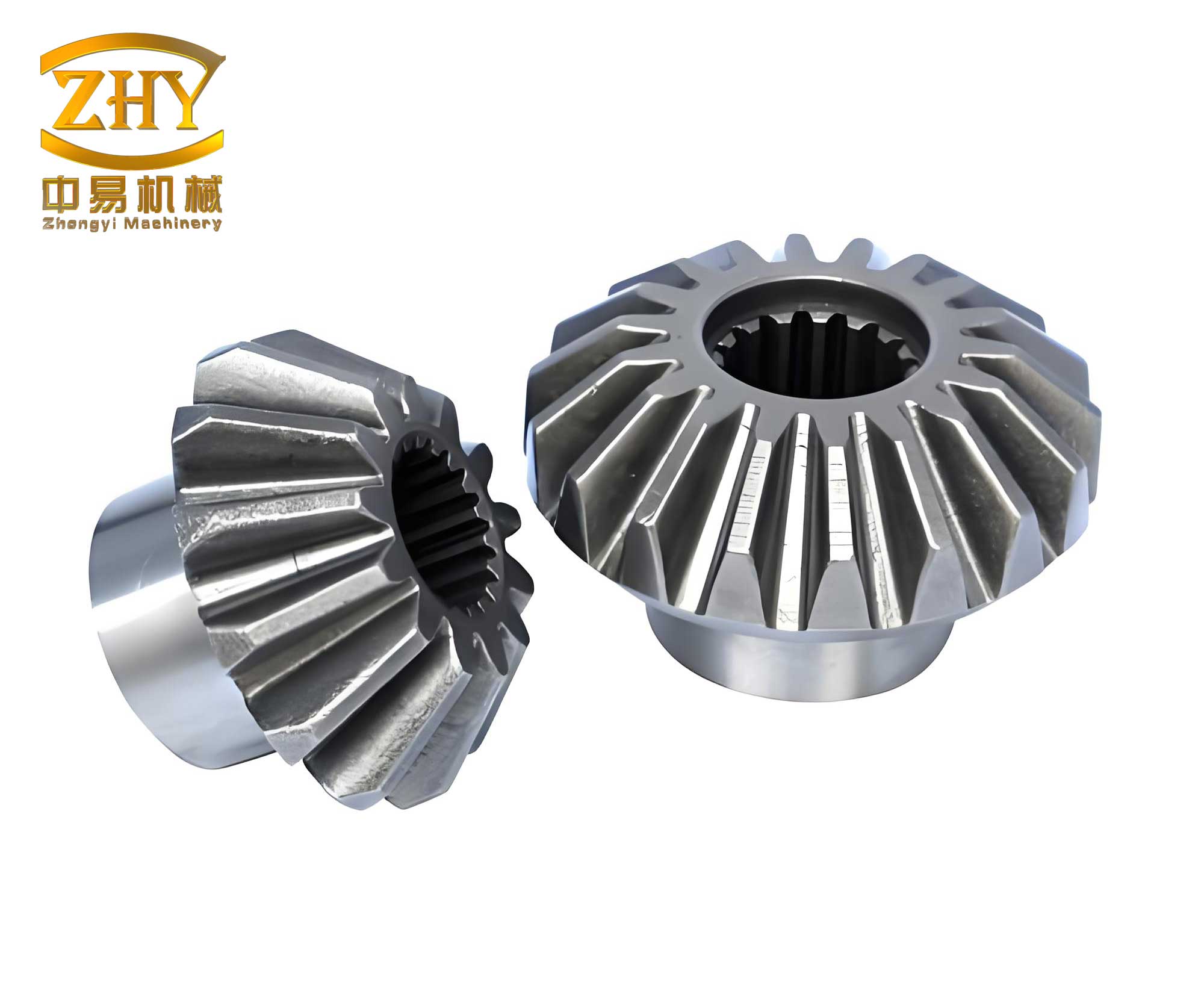
In my extensive experience within the heavy-duty automotive industry, the drive axle stands as a critical and highly stressed assembly. Central to its function is the final drive reduction unit, where the crown wheel, or the driven bevel gear, transmits immense torque to the axle shafts. The secure attachment of these large bevel gears to the differential carrier is paramount for reliable operation. This connection is typically achieved via a ring of high-strength bolts. Recently, I was tasked with investigating and resolving a field failure concerning the torque decay and subsequent loosening of these specific fastening bolts on a particular truck model. This article details my first-person analysis, from problem diagnosis through to the implementation and validation of effective countermeasures.
The initial reports from the field indicated several instances of loose and even fractured bolts securing the driven bevel gear. Upon inspection of returned units, the situation was clear and concerning. The factory-assembled bolts, which were torqued to a specification between 260 and 280 N·m, showed significant torque loss. In one disassembled axle, 14 out of 16 bolts were below the minimum specification, with one completely detached. Another axle showed all 16 bolts had experienced decay, with three found loose in their holes. Physical examination revealed tell-tale signs: threads were visibly worn on one side of the bolt shank, and corresponding scoring marks were present on the inner wall of the differential carrier’s clearance hole. Furthermore, the counterbore surface in the carrier, which interfaces with the bolt’s flange, exhibited poor surface finish. These observations pointed towards relative motion between the bolt and its mating parts, a direct consequence of lost clamp load.
To understand this failure, a multi-faceted root cause analysis was essential. It was not attributable to a single factor but rather a confluence of issues in design execution, component quality, and assembly process related to these critical bevel gears.
1. Structural Design Verification
My first step was to verify the fundamental design. The assembly consists of the driven bevel gear with tapped M14x1.5 holes, the differential carrier with φ14.5 clearance holes, and the M14x1.5 fastening bolts. A simple clearance check confirmed there was no inherent geometric interference in the design:
$$ \text{Radial Clearance} = \frac{(14.5 – 14.0)}{2} = 0.25 \text{ mm} $$
This sufficient clearance ruled out a design fault causing assembly galling. The thread and bore wear marks were thus a symptom, not the cause. The core issue was the decay of the bolt’s preload, leading to loosening under operational loads. This redirected the investigation towards factors affecting preload establishment and maintenance.
2. Component Quality Investigation
Disassembly revealed several quality irregularities that could severely impact joint integrity. I categorized them as follows:
2.1 Substandard Counterbore Surface Finish
The surface of the counterbore in the differential carrier, which contacts the bolt flange, was rough and non-uniform. A rough surface increases the scatter in the coefficient of friction (μ), making consistent preload during assembly difficult. More critically, it can lead to localized plastic deformation of surface asperities during and after assembly, a phenomenon known as embedding, which directly results in preload loss. The stability of the friction interface is crucial for any bolted joint, especially for securing high-inertia components like bevel gears.
2.2 Omitted Chamfer on Clearance Hole
A significant finding was the frequent absence of the specified chamfer at the entrance of the clearance hole in the differential carrier. This omission creates a sharp edge. During bolt tightening, the root radius of the bolt’s flange can contact this sharp edge prematurely. This creates a pivot point, preventing the flange from seating flat against the counterbore surface. The result is a gap and a drastically reduced effective bearing area. A significant portion of the applied torque is wasted in elastically deforming the bolt shank to overcome this interference, rather than generating useful axial clamp force. The subsequent relaxation leads to immediate torque decay.
2.3 Elevated Hardness of Fastening Bolts
The specified hardness for the 40Cr bolt material was 35-38 HRC. Random sampling and testing of bolts from the production line showed a consistent deviation above this range. The results from testing two bolts at 12 different locations each are summarized below:
| Test Location | Bolt 1 Hardness (HRC) | Bolt 2 Hardness (HRC) |
|---|---|---|
| 1 | 39 | 39 |
| 2 | 41 | 41 |
| 3 | 39 | 41 |
| 4 | 38 | 40 |
| 5 | 42 | 39 |
| 6 | 41 | 40 |
| 7 | 41 | 41 |
| 8 | 41 | 40 |
| 9 | 41 | 41 |
| 10 | 42 | 41 |
| 11 | 41 | 41 |
| 12 | 41 | 41 |
This elevated hardness increases the tensile and yield strength but at the expense of ductility and fracture toughness. A harder, more brittle bolt is less forgiving of minor misalignments, stress concentrations, and dynamic loading. It also increases the risk of thread stripping in the softer bevel gear material (22CrMoH). While not the sole cause, this condition reduced the bolt’s ability to maintain preload under cyclic loads and vibrations.
3. Analysis of Assembly Process Impact
The assembly process itself introduced a major destabilizing factor. The driven bevel gear and the differential carrier were designed with an interference fit, assembled using a thermal shrink-fitting process. The gear was heated to 90-130°C in a furnace before being mounted onto the carrier. The bolts were then torqued using a torque-angle method while the assembly was still at an elevated temperature.
To quantify the thermal effect, I conducted a controlled simulation. I assembled differential carriers with bevel gears at three different temperatures and measured the resulting yield torque of the bolts after cooling to room temperature. The results were conclusive:
| Bevel Gear Assembly Temperature | Minimum Measured Bolt Yield Torque (N·m) |
|---|---|
| Ambient (25°C) | 400 |
| 50°C | 367 |
| 100°C | 280 |
The data shows an inverse relationship between assembly temperature and final bolt preload capacity. The physics behind this is clear: during tightening on a hot assembly, the bolt, carrier, and gear are at different temperatures with different coefficients of thermal expansion (α). As the assembly cools, the differential contraction alters the stress state. The bolt, constrained by the now-cooled and contracted parts, can experience a reduction in tension. Furthermore, the material properties (modulus of elasticity, yield strength) are temperature-dependent. For alloy steels like 40Cr, susceptibility to stress concentration increases at higher temperatures. Therefore, the hot assembly process was a significant contributor to the installed preload being lower than intended, priming the joint for failure.
4. Development and Validation of Corrective Actions
The solution required a systematic approach addressing all identified root causes: joint design capability, component quality, and assembly methodology.
4.1 Enhancing the Joint’s Mechanical Capacity
The goal was to increase the clamp force margin. Options like increasing the number of bolts or the thread engagement length were impractical due to spatial constraints on the existing bevel gear and carrier design. I first attempted to simply increase the torque specification for the M14 bolt. Based on friction tests and component trials, a new torque range of 290-320 N·m was established. However, production trials revealed instability. Some bolts reached yield prematurely during the angle-turn phase, exhibiting necking. This proved that the M14 bolt, in this specific joint configuration and with inherent quality variables, was operating too close to its yield limit for a robust process.
The definitive fix was to upgrade the fastener size. I spearheaded the change from M14x1.5 to M16x1.5 bolts. This required modifying the bevel gear tap and the carrier clearance hole. The theoretical yield torque for the new bolt was calculated using standard formulas. First, the equivalent diameter for the bearing surface friction torque (DW) is found:
$$ D_W = \frac{2}{3} \left( \frac{d_w^3 – d_h^3}{d_w^2 – d_h^2} \right) $$
where \(d_w\) is the outer bearing diameter and \(d_h\) is the inner bearing diameter.
The torque coefficient (K) is:
$$ K = \frac{1}{2d} \left( \frac{P}{\pi} + \mu_s d_2 \sec \alpha’ + \mu_w D_W \right) $$
where \(d\) is nominal diameter, \(P\) is pitch, \(\mu_s\) is thread friction coefficient, \(d_2\) is pitch diameter, \(\alpha’\) is thread flank angle, and \(\mu_w\) is bearing surface friction coefficient.
The axial yield clamp force (Ffy) is:
$$ F_{fy} = \frac{\sigma_y A_s}{\sqrt{1 + 3 \left[ \frac{d_A}{2d_2} \left( \frac{P}{\pi} + \mu_s d_2 \sec \alpha’ \right) \right]^2}} $$
where \(\sigma_y\) is yield strength, \(A_s\) is tensile stress area, and \(d_A\) is equivalent diameter of \(A_s\).
Finally, the yield tightening torque (Tfy) is:
$$ T_{fy} = \frac{1}{1000} K F_{fy} d $$
Using material and geometry data for the M16 bolt, the calculated Tfy was approximately 381.7 N·m. Subsequent physical testing on prototype joints confirmed a robust average yield torque of 428 N·m. Based on this and production validation runs, a stable and safe assembly torque specification of 340-360 N·m (midpoint 350 N·m) was defined. The improvement in preload capacity was substantial, as shown in the comparison below:
| Parameter | Original M14 Bolt | Improved M16 Bolt |
|---|---|---|
| Specification | M14 x 1.5 | M16 x 1.5 |
| Midpoint Torque (N·m) | 270 | 350 |
| Calculated Midpoint Preload (kN) | ~75.6 | ~108.9 |
| Preload Increase | Baseline | ~44% |
4.2 Implementing Rigorous Quality Controls
Concurrently, I worked with the manufacturing team to eliminate the quality defects. This involved:
- Establishing a strict visual and tactile standard for the counterbore surface finish on the differential carrier, implementing regular audit checks.
- Mandating and verifying the chamfer operation on the clearance holes through process control plans and fixture design updates to prevent omission.
- Enforcing tighter statistical process control (SPC) on bolt hardness, requiring suppliers to maintain the 35-38 HRC range and providing incoming inspection protocols.
These measures ensured the inherent variability of the components was minimized, creating a more predictable and reliable joint foundation for the critical bevel gears.
4.3 Modifying the Assembly Process from Hot to Cold
To eliminate the thermal variable entirely, I proposed and validated changing the assembly method. The interference fit between the bevel gear and carrier was instead achieved via a controlled press-fit at ambient temperature. Using a hydraulic press and a dedicated alignment fixture, the differential carrier is precisely pressed into the gear. This cold assembly process ensures that the subsequent bolt tightening is performed on a thermally stable assembly, isolating the bolted joint from the thermal stresses of the shrink-fit operation. The integrity of the gear-carrier interface is maintained, while the bolt preload is applied under consistent, room-temperature conditions.
5. Conclusions and Learnings
The implementation of this three-pronged solution—upgrading to M16 bolts, enforcing strict component quality, and switching to cold press assembly—was validated through extensive production trials. The bolt necking issue was eliminated, and post-assembly torque audits showed negligible decay. The joint securing the bevel gears demonstrated significantly enhanced robustness.
This investigation yielded several key engineering insights applicable to high-stakes bolted joints, particularly in powertrain applications involving large bevel gears:
- The quality of the faying surfaces (counterbore, flange) is not a minor detail but a first-order parameter for joint reliability. Surface finish and geometric accuracy directly govern friction stability and preload loss from embedding.
- Final torque specification must be a triangulated outcome. It requires theoretical calculation as a starting point, must be validated through fastener friction tests and full-scale joint simulation tests, and ultimately must be proven under actual production conditions to ensure process stability and robustness.
- Thermal effects during assembly can be profoundly detrimental to achieving target preload. Whenever possible, bolted joints should be finalized at a uniform, stable temperature. If thermal processes are unavoidable for other assembly steps, their impact on the bolted connection must be thoroughly characterized and compensated for in the design or assembly specification.
By addressing the problem holistically across design, quality, and process domains, the reliability of the drive axle assembly was successfully restored, highlighting the importance of a systems-engineering approach to fastener application.