
In this investigation, I analyzed the fracture causes of a 20CrMnTiH5 steel rear axle gear shaft that failed during assembly. The gear shaft is a critical component in heavy-duty vehicle transmission systems, and its failure can lead to significant operational issues. Using various analytical techniques, including direct reading spectrometers, scanning electron microscopy, microhardness testers, and optical microscopy, I conducted macro-fracture observations, metallographic structure examinations, and hardness tests. The primary goal was to identify the root cause of the fracture and propose preventive measures to avoid similar failures in the future. The gear shaft underwent processes such as cutting, heating, die forging, isothermal normalizing, machining, gear cutting, thread milling, carburizing, quenching, and tempering. However, fractures occurred at the thread section during assembly, indicating potential issues in the heat treatment process.
The rear axle gear shaft is designed to transmit torque and motion in automotive applications, and its integrity is paramount for safety and performance. The 20CrrMnTiH5 steel is known for its good hardenability and mechanical properties, but improper processing can lead to failures. In this case, I focused on the fracture origins, material composition, microstructural characteristics, and hardness properties to determine why the gear shaft fractured. The analysis revealed that the fracture was brittle in nature, originating from the thread root, with no significant plastic deformation. This suggests that the material’s toughness was compromised, possibly due to inadequate heat treatment. Throughout this report, I will detail my findings and discuss how factors like residual stress and microstructural anomalies contributed to the failure of the gear shaft.
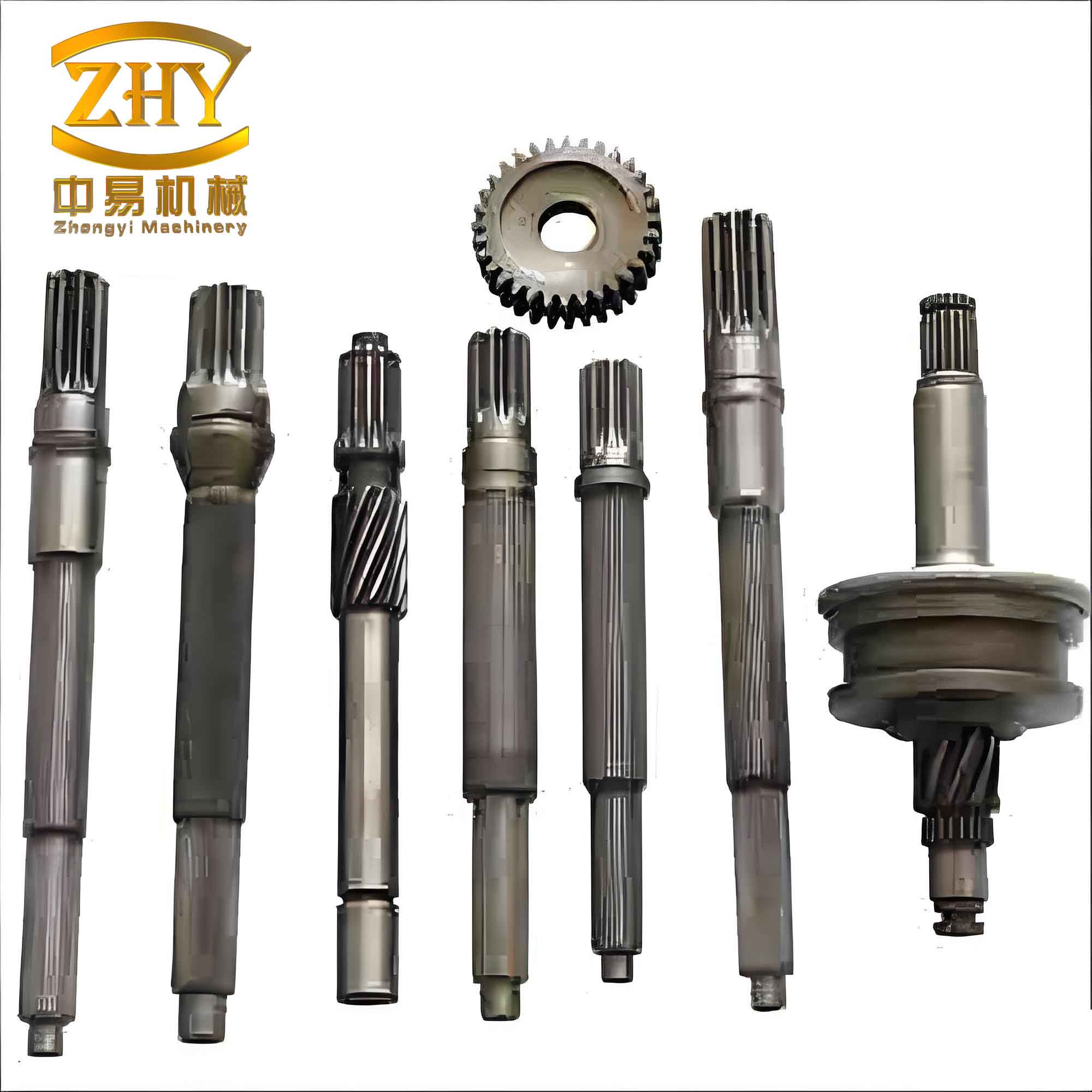
Macroscopic examination of the fractured gear shaft samples showed that the break occurred at the fourth thread tooth from the end, with the fracture surface being relatively flat and perpendicular to the axis. This indicates a brittle fracture mode, common in components with high hardness and low toughness. The fracture origins were consistently located at the thread root surface, where stress concentration is highest. No obvious surface defects, such as cracks or inclusions, were observed at the fracture origins, suggesting that the failure was not due to manufacturing defects but rather to material processing issues. The gear shaft’s design, with its threaded section, inherently creates stress risers, and if the material is embrittled, it becomes prone to fracture under assembly loads. This macroscopic evidence guided my further investigations into the microstructural and mechanical properties of the gear shaft.
To understand the material’s compliance with standards, I first analyzed the chemical composition of the fractured gear shaft samples using a direct reading spectrometer. The results are summarized in Table 1. The composition of the gear shaft material was within the specified limits of GB/T 5216-2014 for hardenability steel, indicating that the failure was not due to deviations in elemental content. Elements like carbon, chromium, and manganese play crucial roles in hardenability and strength, and their appropriate levels ensure the gear shaft can withstand operational stresses. However, even with correct composition, improper heat treatment can lead to failures, as seen in this case.
| Element | Standard Range (%) | Measured Value (%) |
|---|---|---|
| C | 0.17 – 0.23 | 0.20 |
| Si | 0.17 – 0.37 | 0.21 |
| Mn | 0.80 – 1.15 | 1.05 |
| P | ≤ 0.025 | 0.015 |
| S | ≤ 0.035 | 0.024 |
| Cr | 1.00 – 1.45 | 1.30 |
| Ti | 0.04 – 0.10 | 0.060 |
Following the chemical analysis, I performed a detailed fractographic examination using scanning electron microscopy (SEM) to study the micro-mechanisms of fracture. The fracture surfaces of all three gear shaft samples exhibited similar features, with radiating patterns indicating the origin at the thread root. At higher magnifications, the fracture origin area showed intergranular fracture with secondary cracks, while the propagation region displayed quasi-cleavage features with additional cracking. This microstructure is characteristic of brittle fractures in high-strength steels, often associated with untempered martensite. The presence of secondary cracks suggests that the material experienced high residual stresses, which could have been induced during quenching without adequate tempering. The gear shaft’s performance is highly dependent on its microstructural integrity, and these findings point to a heat treatment issue.
To quantify the microstructural characteristics, I evaluated the non-metallic inclusion content according to GB/T 10561-2005. The results, presented in Table 2, show that the inclusion levels were within acceptable limits, with no significant impurities that could act as stress concentrators. This further supports the notion that the gear shaft failure was not due to material defects but rather to processing conditions. Inclusions like sulfides or oxides can weaken the material, but in this case, their low levels indicate that the gear shaft was manufactured from high-quality steel.
| Sample | A (Thick) | A (Thin) | B (Thick) | B (Thin) | C (Thick) | C (Thin) | D (Thick) | D (Thin) |
|---|---|---|---|---|---|---|---|---|
| 1# | 0.5 | 1.0 | 0 | 0.5 | 0 | 0 | 0 | 0.5 |
| 2# | 0 | 0.5 | 0 | 0.5 | 0 | 0.5 | 0 | 0.5 |
| 3# | 0.5 | 1.0 | 0 | 0.5 | 0 | 0 | 0 | 0.5 |
Metallographic analysis of the gear shaft samples revealed distinct microstructural zones after etching with 4% nitric alcohol. The samples showed three regions: Region I (carburized hardened layer) consisted of martensite with a small amount of troostite, Region II exhibited a mixture of pearlite, bainite, and ferrite, and Region III displayed low-carbon martensite. This microstructure is inconsistent with properly tempered gear shaft materials, as the presence of untempered martensite in Region I indicates insufficient tempering after carburizing and quenching. The hardness of this region was excessively high, leading to embrittlement. The gear shaft’s required microstructure should include tempered martensite to balance strength and toughness, but the observed structure suggests that the tempering process was either skipped or inadequately performed.
To assess the mechanical properties, I conducted microhardness tests on the fracture origin area and adjacent thread teeth using a Vickers hardness tester. The results, converted to HRC for comparison, are shown in Table 3. The high hardness values, especially at the fracture origin, confirm the presence of untempered martensite. For instance, hardness values above 800 HV0.5 correspond to approximately 64-65 HRC, which is typical for brittle, high-carbon martensite. This excessive hardness reduces the gear shaft’s ability to absorb energy during assembly, making it susceptible to fracture. The relationship between Vickers hardness (HV) and Rockwell C hardness (HRC) can be approximated using empirical formulas, such as:
$$ HRC \approx \frac{HV}{10} – 3 $$
However, this is a simplified model, and actual conversions may vary based on material composition. In this gear shaft, the high hardness directly contributed to the brittle failure, as the material lacked the necessary toughness to withstand stress concentrations at the thread root.
| Location | HV0.5 | Converted HRC |
|---|---|---|
| Fracture Origin | 813.8, 828.5, 836.0 | 64.6, 65.2, 65.5 |
| Adjacent Thread Tooth | 771.9, 749.4, 796.0 | 63.0, 62.1, 63.0 |
Based on my analysis, the primary cause of the gear shaft fracture is the lack of proper tempering after carburizing and quenching. Tempering is essential to relieve residual stresses and transform brittle martensite into a more ductile structure. Without it, the gear shaft retains high hardness and low toughness, leading to catastrophic failure under load. The residual stress (σ) in a quenched component can be estimated using formulas related to thermal gradients and phase transformations, such as:
$$ \sigma = E \cdot \alpha \cdot \Delta T $$
where E is the Young’s modulus, α is the coefficient of thermal expansion, and ΔT is the temperature difference during quenching. In this gear shaft, the untempered martensite resulted in high residual stresses that, combined with the stress concentration at the thread root, exceeded the material’s fracture toughness. The fracture toughness (K_IC) for brittle materials can be described as:
$$ K_{IC} = Y \cdot \sigma \cdot \sqrt{\pi \cdot a} $$
where Y is a geometry factor, σ is the applied stress, and a is the crack size. For the gear shaft, the low toughness due to untempered martensite made it vulnerable to crack propagation even under minor assembly stresses.
In discussion, I relate these findings to the gear shaft’s performance requirements. The 20CrMnTiH5 steel is designed for high hardenability, but its properties must be optimized through heat treatment. The carburizing process increases surface carbon content, enhancing wear resistance, but quenching without tempering leaves the gear shaft brittle. I recommend implementing strict quality control on tempering parameters, such as temperature and time, to ensure the microstructure includes tempered martensite. For example, tempering between 150°C and 200°C could reduce hardness while maintaining strength, as per the relationship:
$$ HRC = A – B \cdot \ln(t) $$
where A and B are material constants, and t is tempering time. This approach would improve the gear shaft’s toughness and prevent future failures. Additionally, non-destructive testing methods, like ultrasonic inspection, could be used to detect residual stresses in critical sections of the gear shaft before assembly.
In conclusion, my investigation demonstrates that the fracture of the 20CrMnTiH5 rear axle gear shaft was primarily due to inadequate tempering after carburizing and quenching. This resulted in a brittle microstructure with high hardness and residual stresses, causing the gear shaft to fail at the thread root during assembly. By addressing the heat treatment process, similar issues can be mitigated, ensuring the reliability and safety of the gear shaft in automotive applications. Future work could involve finite element analysis to model stress distributions in the gear shaft under load, further optimizing its design and processing.