
In the field of aviation propulsion systems, the reliability of bevel gears is critical for efficient power transmission. As an engineer involved in maintenance and failure analysis, I encountered a case where a driving bevel gear bearing in a turboprop engine failed during routine inspection. This article presents a comprehensive investigation into the root causes, leveraging fault tree analysis, structural evaluations, and experimental validations. The focus is on the intricate details of bevel gears and their associated components, emphasizing how material defects and design parameters can lead to catastrophic failures. Through this analysis, I aim to provide insights that enhance the durability and safety of bevel gears in similar applications.
The failure was initially detected during a ground inspection when silver-white metal chips were observed in the main oil filters and the governor oil filter. Further examination revealed broken rivets and debris in the main oil pump, along with a dislodged cage in the driving bevel gear bearing. This prompted a detailed disassembly and analysis to understand the underlying issues. The driving bevel gear is part of an oblique transmission mechanism that drives auxiliary components, and its failure can significantly impact engine performance. In this context, the role of bevel gears in transmitting torque under high loads cannot be overstated, and any anomaly in their operation warrants meticulous scrutiny.
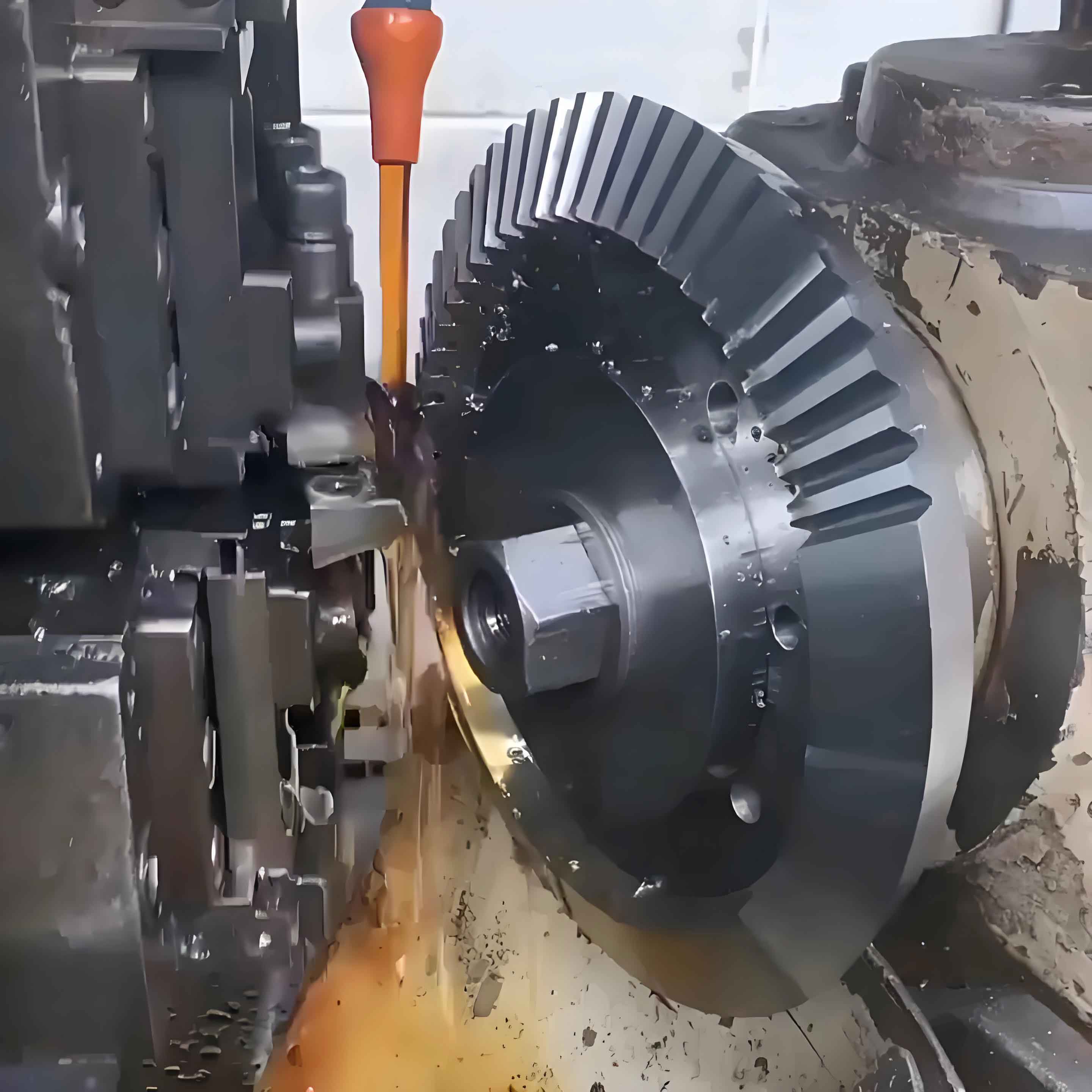
The oblique transmission mechanism in this turboprop engine is designed to transfer power from the main engine shaft to an alternator via a series of bevel gears. It includes a thin-walled drive shaft, intermediate bevel gears (both driving and driven), and lower bevel gears that facilitate power transmission through the accessory case. The driving bevel gear, which is supported by a deep groove ball bearing, operates under high rotational speeds and loads, making it susceptible to wear and fatigue. The interaction between these bevel gears ensures smooth power flow, but any misalignment or material flaw can lead to accelerated degradation. Understanding the kinematics and dynamics of these bevel gears is essential for identifying failure modes.
Upon disassembling the faulty bearing, I observed that the two halves of the cage were completely separated, with all nine rivets fractured. The outer ring exhibited minimal wear on its raceway, but the shoulder area had slight circumferential marks. The inner ring showed minor contact impressions, while the balls had varying degrees of damage: one ball had a macroscopic spall measuring approximately 4 mm by 3.5 mm, and others displayed scratches. The cage halves, particularly at the pocket interfaces, were severely worn, indicating excessive friction and impact loads. The lock washer was plastically deformed and exhibited wear patterns, suggesting overloading during operation. These observations highlight the critical role of bevel gears in maintaining structural integrity under dynamic conditions.
| Component | Condition Observed | Implications for Bevel Gears |
|---|---|---|
| Outer Ring | Minimal wear, metal discoloration | Indicates stable operation of bevel gears under normal loads |
| Inner Ring | Slight contact marks on raceway | Suggests minor misalignment in bevel gear assembly |
| Balls | One with spall, others scratched | Highlights impact forces from bevel gear interactions |
| Cage | Separated halves, severe pocket wear | Reflects excessive vibration in bevel gear transmission |
| Rivets | All fractured, fatigue origins | Emphasizes material weaknesses in bevel gear support systems |
| Lock Washer | Deformed and worn | Points to overload conditions in bevel gear drive |
Dimensional measurements were conducted on the faulted components and adjacent parts. The inner diameter of the bearing housing cover was found to be out of tolerance, while all other dimensions, including those of the bevel gears and shafts, met specifications. This discrepancy could have contributed to improper fit and increased stress on the driving bevel gear bearing. The geometry of bevel gears requires precise tolerances to ensure efficient meshing and load distribution; any deviation can exacerbate wear and lead to premature failure.
| Part Measured | Specification Range | Actual Measurement | Status |
|---|---|---|---|
| Bearing Housing Cover ID | 50.00 – 50.02 mm | 50.05 mm | Out of Tolerance |
| Driving Bevel Gear Shaft | 25.00 – 25.01 mm | 25.005 mm | Within Tolerance |
| Bevel Gear Tooth Profile | As per design | Conforms | Within Tolerance |
| Rivet Diameter | 2.00 – 2.02 mm | 2.01 mm | Within Tolerance |
Metallurgical analysis included microscopic examination, chemical composition checks, and hardness tests. The inner and outer rings, balls, and other components exhibited normal material properties and met technical standards. However, the rivets, made from ML15 steel, showed carbon content below specifications, leading to reduced mechanical strength. The fracture surfaces of the rivets indicated fatigue initiation from the surface, propagated by cyclic loading. The lock washer failure was due to overload, consistent with the high stresses encountered in bevel gear operations. The material integrity of bevel gears and their accessories is paramount; substandard materials can compromise the entire transmission system.
Quality reviews covered assembly records, machining processes, and bearing manufacturing. The engine had previously shown high vibration during factory testing, but rework resolved the issue without apparent defects. The driving bevel gear underwent rigorous heat treatment, surface processing, and inspections, all of which were compliant. The bearing manufacturing process for the bevel gear assembly showed no anomalies, indicating that the failure likely stemmed from inherent material or operational factors rather than production errors. This underscores the importance of continuous monitoring in bevel gear applications to detect subtle issues early.
To systematically identify the root cause, I developed a fault tree with the top event being the fatigue fracture of the cage rivets in the driving bevel gear bearing. The bottom events encompassed design, material, dimensional, and operational factors. After thorough analysis, the primary cause was pinpointed to defective ML15 steel in the rivets, and the secondary cause to inappropriate clearance between the rivets and rivet holes. The increased power extraction by the alternator in this aircraft platform amplified vibrations, exacerbating the stress on the bevel gear components. This fault tree approach effectively narrows down potential failure sources in complex bevel gear systems.
| Bottom Event Code | Description | Analysis Result | Rationale |
|---|---|---|---|
| X1 | Cage structure design flaw | Excluded | Historical data shows design adequacy for bevel gears |
| X2 | Inappropriate cage material | Excluded | Material meets standards for bevel gear applications |
| X3 | Rivet design issue | Excluded | Design conforms to bevel gear bearing specifications |
| X4 | Rivet material defect (ML15 steel) | Not Excluded | Low carbon content reduces strength in bevel gear environment |
| X5 | Improper rivet-hole clearance | Not Excluded | Clearance affects stress distribution in bevel gear assemblies |
| X6 | Dimensional inaccuracies in adjacent parts | Excluded | Measurements within tolerance except housing cover |
| X7 | Bearing size deviations | Excluded | Manufacturing records confirm compliance |
| X8 | Metallurgical quality issues | Excluded | Components except rivets meet material standards |
| X9 | Contamination in lubricant | Excluded | No foreign particles beyond failure debris |
| X10 | Abnormal alternator load | Excluded | Operational data within normal range for bevel gears |
| X11 | Excessive vibration | Excluded | No abnormal vibrations recorded in bevel gear operation |
| X12 | Insufficient lubrication | Excluded | No signs of oil starvation in bevel gear system |
| X13 | Improper nut tightening | Excluded | Assembly records show correct torque application |
The failure mechanism revolves around the dynamic behavior of the driving bevel gear, which has a long shaft structure supported by the bearing at one end and connected via splines at the other. This configuration results in relatively unstable operation compared to shorter, stiffer assemblies. Simulation studies revealed that the stress on the rivets is highly sensitive to the clearance between the rivets and rivet holes. When the material properties are suboptimal, as with the low-carbon ML15 steel, the rivets experience elevated stress levels under cyclic loads, leading to fatigue failure. The relationship between stress and fatigue life can be modeled using the Basquin equation:
$$ N_f = \left( \frac{\sigma_a}{\sigma_f’} \right)^{-b} $$
where \( N_f \) is the number of cycles to failure, \( \sigma_a \) is the stress amplitude, \( \sigma_f’ \) is the fatigue strength coefficient, and \( b \) is the fatigue exponent. For the rivets in the bevel gear bearing, the stress amplitude increases with improper clearance, reducing \( N_f \) significantly. Additionally, the force on the rivets due to ball impacts can be expressed as:
$$ F = m \cdot a $$
where \( m \) is the effective mass and \( a \) is the acceleration from vibrations in the bevel gear system. The stress \( \sigma \) on a rivet is then:
$$ \sigma = \frac{F}{A} = \frac{m \cdot a}{\pi r^2} $$
with \( A \) being the cross-sectional area and \( r \) the rivet radius. If the clearance is too large or too small, the impact forces escalate, causing premature fracture. This mechanistic understanding highlights the vulnerability of bevel gears to seemingly minor design and material variations.
To address these issues, several corrective measures were implemented. First, the rivet material was changed from ML15 to 12Cr18Ni9 stainless steel, which offers superior tensile strength and durability. The mechanical properties comparison is summarized below:
| Material | Tensile Strength (MPa) | Yield Strength (MPa) | Impact on Bevel Gears |
|---|---|---|---|
| ML15 (Original) | 490 – 830 | ≈ 300 | Prone to fatigue in high-load bevel gear applications |
| 12Cr18Ni9 (New) | 620 – 880 | ≈ 450 | Enhanced resilience for bevel gear bearing systems |
Second, the clearance between the rivets and rivet holes was controlled to a range of 0.03 mm clearance to 0.01 mm interference. This optimizes stress distribution and minimizes the risk of fatigue in bevel gear components. The allowable clearance \( C \) can be derived from the formula:
$$ C = D_h – D_r $$
where \( D_h \) is the rivet hole diameter and \( D_r \) is the rivet diameter. For optimal performance in bevel gears, \( C \) should satisfy:
$$ -0.01 \, \text{mm} \leq C \leq 0.03 \, \text{mm} $$
Third, assembly procedures were enhanced to include pre-riveting checks, such as aligning molds, setting correct riveting heights, and conducting first-article inspections. Each rivet is individually thermally riveted to ensure uniformity, and post-assembly tests verify integrity. These measures have been validated through over 50 hours of bench testing, including overload and endurance cycles, as well as engine life tests, with no recurrences. This holistic approach ensures the longevity of bevel gears in demanding environments.
In conclusion, the failure of the driving bevel gear bearing was primarily due to material deficiencies in the rivets and suboptimal rivet-hole clearance, exacerbated by operational vibrations. The corrective actions, focusing on material upgrades and precision control, have proven effective in mitigating these risks. This case underscores the criticality of meticulous design and material selection for bevel gears in aerospace applications. Future work should involve continuous monitoring of bevel gear systems to preempt similar failures and enhance overall engine reliability.