
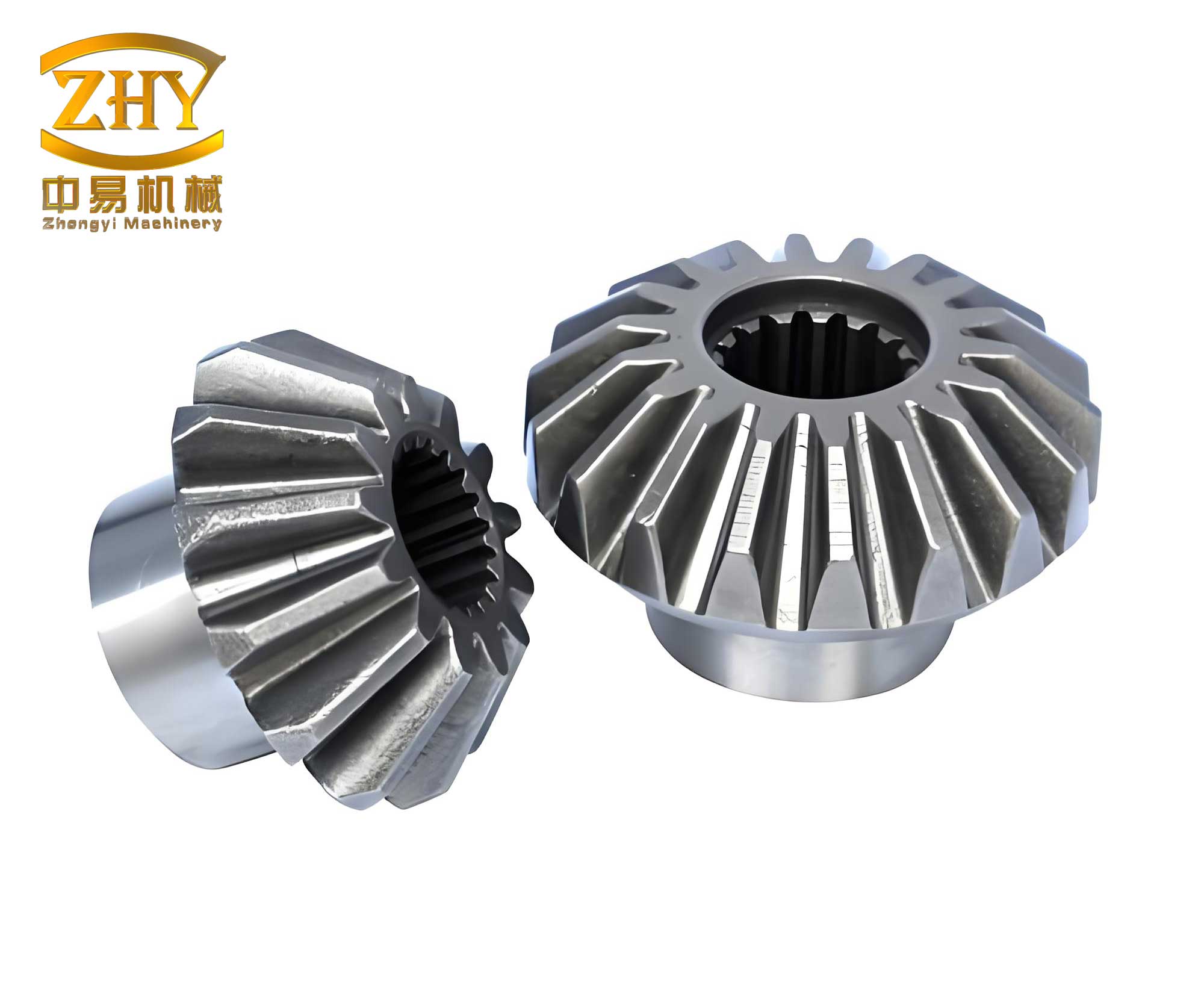
In the field of mechanical engineering, the bevel gear plays a critical role in power transmission systems, particularly in vehicles like forklifts where torque must be efficiently transferred to wheels for smooth operation. As a key component in the axle assembly, the bevel gear ensures proper speed adjustment and load handling. However, failures in such components can lead to catastrophic outcomes, such as sudden breakdowns during operation. In this comprehensive analysis, I delve into the fracture of a driving bevel gear that occurred during an unloading process of a forklift. The investigation employs multiple analytical techniques to uncover the root cause, with a focus on hydrogen embrittlement as a primary failure mechanism. This article aims to provide a detailed account of the failure analysis, emphasizing the importance of material processing and design in preventing such incidents.
The incident involved a forklift that produced an abnormal noise while lifting and reversing with a load. Upon inspection, it was found that the driving bevel gear had fractured at the transition step between shaft diameters of 45 mm and 40 mm. This bevel gear was manufactured from 20CrMnTi steel, following a standard process flow: forging → isothermal normalizing → machining → arc tooth cutting → carburizing and quenching + tempering → fine grinding → pairing → assembly. The heat treatment involved carburizing at (910 ± 10)°C for 4.5 hours using methanol and kerosene as carburizing agents in a pit-type furnace, followed by direct quenching in N32 engine oil and tempering at 180°C for 2 hours. To understand the failure, I conducted a series of tests, including macro analysis, chemical composition analysis, metallographic examination, hardness testing, and scanning electron microscopy (SEM) analysis of the fracture surface. The results point toward hydrogen embrittlement as the culprit, exacerbated by stress concentrations at the transition step.
The macroscopic examination of the fractured bevel gear revealed a brittle, crystalline fracture surface that was relatively flat and clean, with a bright gray appearance. The fracture origin was located at the transition step, with a propagation zone showing radial patterns and a rough transient rupture area. This indicates a sudden, brittle failure without significant plastic deformation. Such characteristics are often associated with hydrogen embrittlement, where atomic hydrogen infiltrates the material during processing and accumulates at stress concentration points, leading to crack initiation and rapid propagation. The bevel gear’s design, with a sharp transition between diameters, created a natural stress raiser that facilitated this process. To quantify the material properties, I performed chemical composition analysis, and the results are summarized in the table below, showing compliance with GB/T 3077-2015 standards for 20CrMnTi steel.
| Element | Measured Value | Standard Value (20CrMnTi) |
|---|---|---|
| C | 0.20 | 0.17–0.23 |
| Si | 0.26 | 0.17–0.37 |
| Mn | 1.10 | 0.80–1.10 |
| P | 0.017 | ≤0.035 |
| S | 0.010 | ≤0.035 |
| Cr | 1.28 | 1.00–1.30 |
| Ti | 0.07 | 0.04–0.10 |
Metallographic examination was conducted on samples taken from the fracture area. In the unetched condition, non-metallic inclusions were assessed according to GB/T 10561-2005, revealing low levels: sulfide A0, alumina B0.5, silicate C1.5, globular oxide D1.5, and single-particle spherical DS0. This suggests that impurity content was not a significant factor in the failure. After etching with 4% nitric alcohol solution, the microstructure of the carburized and quenched zone showed martensite and retained austenite, rated as carbide level 2 and martensite/austenite level 5 per QC/T 262-1999. Notably, cracks were observed, primarily intergranular, with no decarburization on the sides, indicating hydrogen-induced cracking. The core microstructure consisted of low-carbon martensite, tempered bainite, and a small amount of ferrite, with microcracks present as well. This aligns with the sensitivity of such microstructures to hydrogen embrittlement, where martensitic structures are particularly prone to hydrogen-assisted failure.
Hardness testing was performed on the bevel gear sample, and the results are presented in the following table. The surface hardness, core hardness, and carburized layer depth all fell below the specifications required by the product drawing. This reduction in mechanical properties likely contributed to the bevel gear’s susceptibility to fracture under load, as lower hardness can decrease wear resistance and fatigue strength. The relationship between hardness and hydrogen embrittlement susceptibility is complex; for instance, surfaces with hardness above 38 HRC are known to have an increased risk of hydrogen-induced cracking. In this case, the suboptimal hardness values may have exacerbated the hydrogen embrittlement effect.
| Parameter | Measured Value | Product Drawing Requirement |
|---|---|---|
| Surface Hardness (HRC) | 53.5, 55.0, 54.5 | 58–63 |
| Core Hardness (HRC) | 34.5, 34.5, 34.0 | 35–45 |
| Carburized Layer Depth (mm) | 1.45 | 1.50–1.80 |
Scanning electron microscopy analysis of the fracture surface provided further insights. At the crack initiation zone near the transition step, multiple steps, voids, and intergranular secondary cracks were observed. The fracture morphology exhibited features such as small, flat facets with tear ridges and fine “chicken claw” deformation lines, characteristic of hydrogen embrittlement with a mix of intergranular and quasi-cleavage modes. In the propagation and transient rupture zones, similar patterns were noted, including grain boundaries, secondary cracks, and tear ridges. These SEM findings confirm that the bevel gear failure was due to hydrogen embrittlement, where atomic hydrogen accumulated at stress concentration sites and caused brittle fracture. The hydrogen likely originated from the carburizing process, as the atmosphere containing hydrocarbons can introduce hydrogen into the steel at high temperatures.
To elaborate on the hydrogen embrittlement mechanism, hydrogen atoms can diffuse into the steel during heat treatment, especially in carburizing environments rich in hydrogen from decomposed hydrocarbons. The diffusion coefficient of hydrogen in steel at elevated temperatures is high, allowing rapid penetration. Once inside, hydrogen atoms tend to segregate at regions of high stress, such as notches or transition steps, where they can recombine into molecular hydrogen, creating internal pressure and embrittling the material. This process can be described by Fick’s laws of diffusion. For example, the flux of hydrogen, \( J \), is given by:
$$ J = -D \frac{\partial C}{\partial x} $$
where \( D \) is the diffusion coefficient, \( C \) is the hydrogen concentration, and \( x \) is the position. In the bevel gear, the transition step between diameters acts as a stress concentrator, leading to a localized increase in hydrogen concentration. The stress intensity factor, \( K \), at such a notch can be approximated by:
$$ K = \sigma \sqrt{\pi a} $$
where \( \sigma \) is the applied stress and \( a \) is the crack length. When hydrogen is present, it lowers the fracture toughness, causing cracks to initiate at lower stress levels. The susceptibility to hydrogen embrittlement also depends on microstructure; martensitic structures, as found in this bevel gear, are more vulnerable than ferritic or pearlitic ones. The sequence of increasing susceptibility is: ferrite/pearlite → bainite → low-carbon martensite → mixed martensite and bainite → twin martensite. This bevel gear’s microstructure, with martensite in the carburized layer and low-carbon martensite in the core, falls into a high-risk category.
The role of processing factors cannot be overlooked. During carburizing, the use of methanol and kerosene as agents introduces hydrogen into the furnace atmosphere. Even during heating with oil protection, the high-hydrogen environment prevents hydrogen from escaping and may further infiltrate the steel. Additionally, the quenching process in oil can introduce hydrogen if the oil contains moisture or impurities. To mitigate this, post-heat treatment dehydrogenation processes, such as baking at elevated temperatures, are recommended. For instance, baking at 150–200°C for several hours can help diffuse hydrogen out of the steel, reducing embrittlement risk. The delay characteristic of hydrogen embrittlement means that failure can occur under sustained load, even below the material’s yield strength, which explains why the bevel gear fractured during normal operation.
In terms of design, the transition step between shaft diameters of 45 mm and 40 mm in the bevel gear created a geometric stress concentration. The stress concentration factor, \( K_t \), for such a step can be calculated using empirical formulas based on geometry. For a shaft with a diameter change, \( K_t \) is often in the range of 1.5 to 3.0, depending on the fillet radius. In this case, the absence of a sufficient fillet likely resulted in a high \( K_t \), exacerbating hydrogen accumulation. Finite element analysis (FEA) could be used to model the stress distribution, but from a practical standpoint, redesigning the transition with a larger radius or smoother gradient could reduce stress concentrations and improve the bevel gear’s fatigue life.
To further illustrate the impact of hydrogen content, consider the relationship between hydrogen concentration and fracture stress. Empirical models suggest that the fracture stress, \( \sigma_f \), decreases with increasing hydrogen concentration, \( C_H \), following an equation like:
$$ \sigma_f = \sigma_0 – k C_H $$
where \( \sigma_0 \) is the fracture stress in the absence of hydrogen, and \( k \) is a material constant. For this bevel gear, the hydrogen introduced during carburizing likely raised \( C_H \) at the transition step, lowering \( \sigma_f \) below the applied operational stress. Combined with the suboptimal hardness, this led to a low-stress brittle fracture. The table below summarizes key factors contributing to the failure, highlighting the interplay between material, processing, and design.
| Factor Category | Specific Issue | Impact on Failure |
|---|---|---|
| Material | 20CrMnTi steel with martensitic microstructure | High susceptibility to hydrogen embrittlement |
| Processing | Carburizing in hydrogen-rich atmosphere | Introduction of atomic hydrogen into the bevel gear |
| Heat Treatment | Inadequate hardness and carburized layer depth | Reduced mechanical strength and fatigue resistance |
| Design | Sharp transition step between diameters | Stress concentration promoting hydrogen segregation |
| Operating Conditions | Normal load during forklift operation | Triggered hydrogen-assisted cracking under stress |
In conclusion, the fracture of this bevel gear was primarily caused by hydrogen embrittlement, resulting from hydrogen infiltration during carburizing and subsequent segregation at the stress-concentrated transition step. The brittle fracture mode, evidenced by macro and micro analyses, underscores the importance of controlling hydrogen levels in heat treatment processes. To prevent similar failures in bevel gears, I recommend several measures: first, optimize the carburizing and quenching process to minimize hydrogen intake, perhaps by using alternative atmospheres or adding dehydrogenation steps; second, improve the design of the bevel gear by incorporating smoother transitions or larger fillet radii to reduce stress concentrations; third, ensure proper hardness and depth of carburized layers through rigorous quality control; and fourth, implement post-heat treatment baking to remove residual hydrogen. These steps can enhance the durability and reliability of bevel gears in critical applications like forklifts, ultimately contributing to safer and more efficient mechanical systems.
Reflecting on this analysis, it is clear that bevel gear failures often involve a complex interplay of factors, and a systematic approach combining multiple analytical techniques is essential for accurate diagnosis. Future research could focus on developing advanced materials with lower hydrogen sensitivity or innovative heat treatment methods that inherently resist hydrogen embrittlement. For now, by addressing the identified issues, manufacturers can significantly reduce the risk of such fractures. The bevel gear, as a fundamental component, deserves careful attention in both design and processing to ensure optimal performance in demanding environments. Through continuous improvement and vigilance, we can mitigate failure risks and extend the service life of these critical mechanical parts.
To further elaborate on the hydrogen diffusion process, consider the time-dependent concentration profile in the bevel gear. Using the error function solution to Fick’s second law for a semi-infinite solid, the hydrogen concentration at depth \( x \) and time \( t \) can be expressed as:
$$ C(x,t) = C_s \left(1 – \text{erf}\left(\frac{x}{2\sqrt{Dt}}\right)\right) $$
where \( C_s \) is the surface concentration. During carburizing, \( C_s \) is high due to the hydrogen-rich atmosphere, leading to significant hydrogen ingress. After quenching, if not properly treated, this hydrogen remains trapped, especially at microstructural defects. The activation energy for hydrogen diffusion in steel, \( Q \), relates to the diffusion coefficient via the Arrhenius equation:
$$ D = D_0 \exp\left(-\frac{Q}{RT}\right) $$
where \( D_0 \) is a pre-exponential factor, \( R \) is the gas constant, and \( T \) is the temperature. For 20CrMnTi steel, typical values of \( Q \) range from 20 to 40 kJ/mol, indicating that diffusion is temperature-sensitive. This underscores the need for precise control during heat treatment to minimize hydrogen uptake.
In addition, the hardness results from Table 2 can be analyzed statistically. The average surface hardness is approximately 54.3 HRC, which is below the required 58–63 HRC. This deviation may be due to inadequate carbon potential during carburizing or improper quenching. The core hardness average is about 34.3 HRC, also slightly below the specification. These deficiencies could be modeled using regression analysis to correlate process parameters with hardness outcomes. For example, a multiple linear regression model might take the form:
$$ \text{Hardness} = \beta_0 + \beta_1 \cdot T_{\text{carb}} + \beta_2 \cdot t_{\text{carb}} + \beta_3 \cdot C_{\text{pot}} + \epsilon $$
where \( T_{\text{carb}} \) is carburizing temperature, \( t_{\text{carb}} \) is time, \( C_{\text{pot}} \) is carbon potential, and \( \epsilon \) is error. Optimizing these parameters could help achieve the desired hardness and reduce hydrogen embrittlement risk.
Furthermore, the fracture toughness in the presence of hydrogen, \( K_{\text{IH}} \), can be estimated using models that account for hydrogen concentration. For instance, a simplified relation is:
$$ K_{\text{IH}} = K_{\text{IC}} – \alpha \sqrt{C_H} $$
where \( K_{\text{IC}} \) is the plain-strain fracture toughness without hydrogen, and \( \alpha \) is a constant. In this bevel gear, the low \( K_{\text{IH}} \) due to hydrogen segregation at the transition step likely caused fracture under operational stresses. This highlights the importance of material selection and processing to maintain high toughness in hydrogen-prone environments.
To prevent future failures, regular inspection and non-destructive testing (NDT) methods, such as ultrasonic testing or eddy current testing, could be employed to detect early-stage cracks in bevel gears. Additionally, implementing a robust quality assurance program that includes hydrogen content measurement, perhaps using thermal desorption spectroscopy (TDS), would provide valuable data for process control. By integrating these practices, the reliability of bevel gears in forklifts and other machinery can be significantly enhanced, ensuring safe and efficient operations across industries.