
In my experience as a mechanical engineer specializing in power transmission systems, I have encountered numerous cases where the failure of coupling components leads to significant downtime in industrial operations. One such critical instance involved a coaxial helical gear reducer, where the coupling elastic block failed prematurely, causing excessive vibration and noise. This article delves into a comprehensive failure analysis, focusing on the coaxial helical gear reducer’s design, the coupling’s elastic block, and the root causes of its失效. I will present detailed analyses using tables, formulas, and empirical data, emphasizing the role of helical gears in these systems. The keyword ‘helical gears’ is integral to this discussion, as these gears are central to the reducer’s performance and reliability.
The coaxial helical gear reducer is a compact and efficient power transmission device, widely used in various industries due to its high torque capacity and smooth operation. Helical gears, with their angled teeth, provide gradual engagement, reducing noise and vibration compared to spur gears. In this case, the reducer was part of a production line, and its failure led to operational interruptions. The coupling connecting the motor to the reducer was a梅花弹性联轴器 (plum blossom elastic coupling), specifically a KTR ROTEX G28 type with an elastic block made of polyurethane. The initial symptom was abnormal vibration and noise, prompting maintenance personnel to inspect the system.
Upon disassembly, the elastic block was found crushed and fragmented. After replacing it, the vibration persisted, leading to the replacement of the motor, which resolved the issue. This sequence of events suggested that the elastic block failure was a symptom rather than the root cause. Therefore, I conducted a systematic analysis covering coupling selection, material aging, installation alignment, and operational concentricity. Throughout this analysis, the importance of helical gears in maintaining system integrity cannot be overstated, as any misalignment or vibration directly affects their meshing and wear characteristics.
Coupling Selection Analysis
The first step in the analysis was to verify if the coupling was appropriately sized for the application. The coupling must withstand the operational torque without exceeding its rated capacity. The elastic coupling used here had a rated torque $T_{KN} = 160 \, \text{Nm}$ and an allowable speed of $8500 \, \text{r/min}$. The actual working torque $T_{AN}$ needed to be calculated based on the motor power and operational factors.
The formula for calculating the actual torque is:
$$ T_{AN} = \frac{P \times 9550}{n} \times K_1 \times K_2 \times K_3 $$
where $P$ is the motor power in kW, $n$ is the motor speed in r/min, $K_1$ is the temperature coefficient, $K_2$ is the starting frequency coefficient, and $K_3$ is the impact coefficient. For this system, $P = 7.35 \, \text{kW}$, $n = 1140 \, \text{r/min}$. Based on operational conditions: ambient temperature $30-35^\circ\text{C}$, so $K_1 = 1.0$; continuous operation with starts less than 100 times, so $K_2 = 1.0$; and light impact load, so $K_3 = 1.5$. Plugging in the values:
$$ T_{AN} = \frac{7.35 \times 9550}{1140} \times 1.0 \times 1.0 \times 1.5 \approx 93 \, \text{Nm} $$
Since $T_{AN} = 93 \, \text{Nm} < T_{KN} = 160 \, \text{Nm}$, the coupling was adequately sized. This ruled out selection error as a cause. To further illustrate, I present a table summarizing the coefficients used in various scenarios for helical gear reducers:
| Condition | Coefficient Type | Value Range | Selected Value |
|---|---|---|---|
| Ambient Temperature | $K_1$ (Temperature) | 1.0 to 1.8 | 1.0 |
| Starting Frequency | $K_2$ (Starting) | 1.0 to 1.6 | 1.0 |
| Load Impact | $K_3$ (Impact) | 1.5 to 2.2 | 1.5 |
This calculation confirms that for helical gear reducers operating under normal conditions, the coupling selection is often robust. However, other factors like material properties and alignment play crucial roles.
Elastic Block Material Aging Analysis
Polyurethane elastic blocks can degrade over time due to environmental factors, leading to loss of elasticity and hardening. The failed block had been in service for only six months, which is relatively short. The operating environment was a controlled, temperature-humidity stable车间, with no exposure to corrosive agents. Typically, aging failure produces fine powder and small fragments, but in this case, the block broke into larger pieces, indicating a different failure mode.
To quantitatively assess aging, I arranged for Shore hardness testing of the fragments. The hardness was measured at $98 \, \text{Shore A}$, matching the design specification. The Shore hardness test is based on the penetration depth of an indenter, and for polyurethane, it relates to elasticity via empirical models. One common relation for polyurethane’s modulus $E$ and hardness $H$ is:
$$ E \approx \frac{15.75 \times H}{100 – H} \, \text{MPa} $$
where $H$ is the Shore A hardness. For $H = 98$, $E \approx \frac{15.75 \times 98}{100 – 98} = \frac{1543.5}{2} \approx 771.75 \, \text{MPa}$. This high modulus indicates the material was still within its elastic range, not significantly aged. Additionally, the fatigue life of polyurethane under cyclic loading can be estimated using the stress-life curve:
$$ N_f = C \cdot \sigma^{-m} $$
where $N_f$ is the number of cycles to failure, $\sigma$ is the stress amplitude, and $C$ and $m$ are material constants. Given the short service period, fatigue was unlikely. Thus, material aging was dismissed as a cause, reinforcing that helical gears and their associated couplings require precise alignment to avoid premature failure.
Installation Alignment Issues
The motor and reducer were connected via a flange with定位 steps and螺栓 holes, designed for foolproof alignment. This design minimizes manual alignment errors, as the components self-align during assembly. Even if minor deviations exist, elastic couplings are intended to compensate for轴向 (axial),径向 (radial), and角向 (angular) misalignments. The allowable misalignments for this coupling type are typically up to $0.5^\circ$ angular and $0.5 \, \text{mm}$ radial, as per manufacturer specifications.
To mathematically model misalignment effects, consider the coupling as a spring-damper system. The force due to misalignment can be expressed as:
$$ F = k \cdot \delta + c \cdot \dot{\delta} $$
where $k$ is the stiffness of the elastic block, $c$ is the damping coefficient, and $\delta$ is the misalignment displacement. For helical gears, misalignment can induce additional loads on gear teeth, affecting the contact pattern. The transmitted torque through helical gears involves axial forces, given by:
$$ F_a = F_t \cdot \tan \beta $$
where $F_t$ is the tangential force and $\beta$ is the helix angle. Misalignment can exacerbate these forces, leading to vibration. However, in this case, the installation design precluded significant misalignment, so this factor was eliminated. This highlights that even with robust designs, helical gears are sensitive to operational dynamics.
Operational Concentricity and Vibration Analysis
The most revealing part of the analysis came from vibration measurements after replacing the elastic block. Using a vibration data collector, I recorded spectra from both the motor and reducer. The reducer showed low vibration levels, but the motor exhibited high vibration in the vertical direction, exceeding $2.0 \, \text{mm/s}$, while the GB10068-2008 standard specifies a limit of $1.1 \, \text{mm/s}$ for such machines. The spectrum was dominated by 4× frequency components, indicative of looseness in the bearing housing.
Vibration analysis often employs Fast Fourier Transform (FFT) to decompose signals into frequency components. The velocity spectrum $V(f)$ can be related to displacement $D(f)$ by:
$$ V(f) = 2\pi f \cdot D(f) $$
For the motor, the predominant frequency at 4× the rotational frequency $f_r$ suggested bearing outer race movement. Upon disassembling the motor, I found significant wear in the drive-end bearing housing, with a clearance of $0.55 \, \text{mm}$, far above the standard $0.06 \, \text{mm}$. This looseness allowed the bearing outer race to slip, causing eccentricity and high shear forces on the coupling elastic block.
The shear stress $\tau$ on the elastic block due to misalignment can be approximated as:
$$ \tau = \frac{F_s}{A} $$
where $F_s$ is the shear force and $A$ is the cross-sectional area of the block lobes. The shear force arises from the relative displacement $\Delta y$ between shafts:
$$ F_s = k_s \cdot \Delta y $$
with $k_s$ being the shear stiffness. Given the large clearance, $\Delta y$ was substantial, leading to $\tau$ exceeding the material’s endurance limit. This caused the block to fracture in shear, rather than in compression during normal operation. Below is a table summarizing vibration data and implications for helical gear reducers:
| Component | Vibration Velocity (mm/s) | Dominant Frequency | Diagnosis |
|---|---|---|---|
| Reducer (Helical Gears) | 0.8 | 1× $f_r$ | Normal meshing |
| Motor Drive End | 2.2 | 4× $f_r$ | Bearing Housing Looseness |
| Motor Free End | 1.0 | 1× $f_r$ | Normal |
This table underscores how vibration patterns can pinpoint issues in systems involving helical gears. The image below illustrates a typical helical gear, which is central to understanding the reducer’s function. Proper alignment is crucial for these gears to transmit power smoothly.
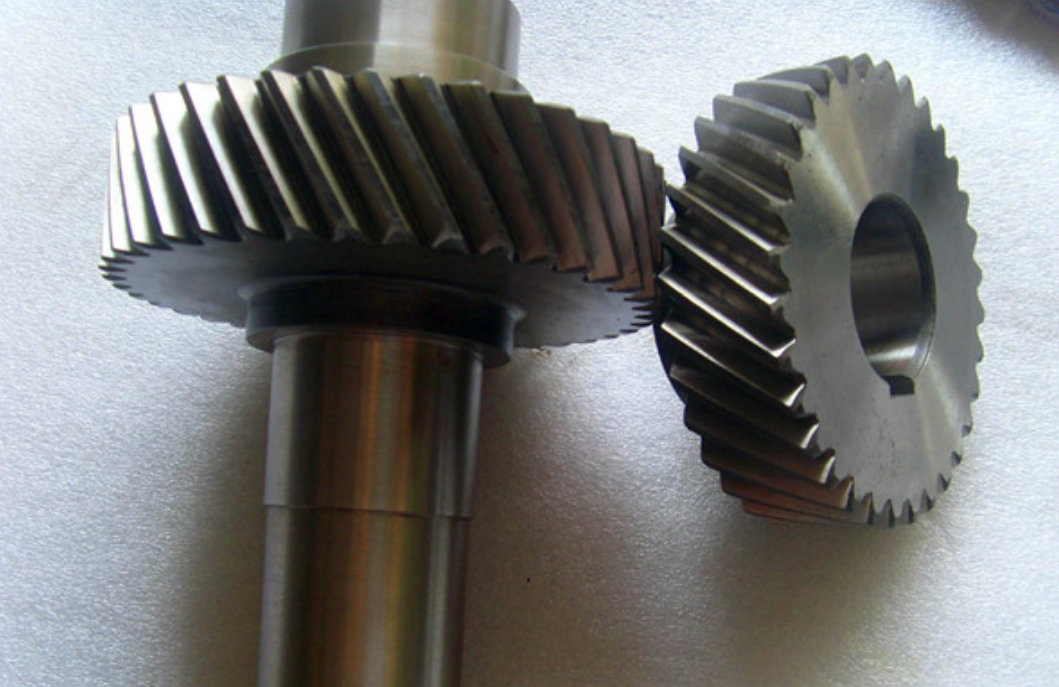
Helical gears, with their螺旋 teeth, provide continuous engagement, but they are prone to axial thrust. In coaxial designs, this thrust is balanced internally, yet external misalignment can disturb this balance. The wear in the motor bearing housing introduced dynamic misalignment, which the coupling could not fully absorb, leading to elastic block failure. This scenario emphasizes the interdependence of components in helical gear drives.
Extended Analysis: Helical Gears and System Dynamics
To further elaborate, let’s consider the dynamics of helical gears in reducers. The meshing stiffness of helical gears varies periodically, causing vibration excitations. The time-varying mesh stiffness $k_m(t)$ can be modeled as:
$$ k_m(t) = k_0 + \sum_{n=1}^{\infty} k_n \cos(n\omega_m t + \phi_n) $$
where $\omega_m$ is the mesh frequency, and $k_0$ is the average stiffness. For helical gears, the contact ratio is higher than spur gears, reducing amplitude variations. However, misalignment alters the load distribution along the tooth face, leading to edge loading and increased stress. The contact stress $\sigma_H$ for helical gears is given by the Hertzian formula:
$$ \sigma_H = \sqrt{\frac{F_t}{b \cdot d_1} \cdot \frac{u+1}{u} \cdot \frac{Z_E Z_H Z_\epsilon}{\cos^2 \beta}} $$
where $b$ is face width, $d_1$ is pitch diameter, $u$ is gear ratio, $Z_E$ is elasticity factor, $Z_H$ is zone factor, $Z_\epsilon$ is contact ratio factor, and $\beta$ is helix angle. Misalignment increases $F_t$ locally, raising $\sigma_H$ and accelerating wear. This interplay between gears and coupling underscores the need for holistic maintenance.
Moreover, the natural frequencies of the system should be considered. For a rotor-bearing-coupling system, the equation of motion is:
$$ M\ddot{x} + C\dot{x} + Kx = F(t) $$
where $M$, $C$, and $K$ are mass, damping, and stiffness matrices. The bearing housing wear reduced $K$ locally, shifting natural frequencies and potentially causing resonance. This could explain the persistent vibration after elastic block replacement. Helical gears, due to their geometry, introduce coupled torsional-translational modes, making analysis complex.
To mitigate such issues, predictive maintenance techniques like vibration monitoring are essential. For helical gear reducers, I recommend定期测量 vibration and temperature, with attention to bearing conditions. A comprehensive checklist includes:
| Parameter | Acceptable Range | Measurement Method |
|---|---|---|
| Vibration Velocity | ≤ 1.1 mm/s (ISO 10816) | Accelerometer |
| Bearing Clearance | ≤ 0.1 mm | Dial Indicator |
| Elastic Block Hardness | 95-100 Shore A | Durometer |
| Helical Gear Backlash | 0.1-0.2 mm | Feeler Gauge |
By adhering to such protocols, failures in helical gear systems can be preempted.
Conclusion and Recommendations
In conclusion, the failure of the coupling elastic block in the coaxial helical gear reducer was primarily due to excessive vibration caused by bearing housing wear in the motor, leading to misalignment and high shear stresses on the block. The analysis covered selection, material aging, installation, and operational factors, with helical gears being a recurring theme due to their sensitivity to alignment. The coupling was correctly sized, the material was not aged, and installation was foolproof, but the operational eccentricity from bearing wear proved decisive.
To prevent recurrence, I advocate for regular vibration monitoring and bearing inspections in helical gear reducers. Specifically, for coaxial helical gear reducers, ensure that motor bearings are checked for housing fit periodically. Additionally, consider using condition monitoring systems that track vibration spectra in real-time, alerting to changes in frequency patterns. The elastic block should be replaced every two years as a preventive measure, even if no visible wear is present, due to material fatigue over time.
Helical gears are robust components, but their performance hinges on precise alignment and stable support structures. This case study reinforces that a systems approach—considering gears, couplings, bearings, and motors—is essential for reliability. By integrating analytical tools like torque calculations, hardness tests, and vibration analysis, engineers can extend the life of helical gear drives and minimize unplanned downtime.
In future designs, for helical gear reducers in critical applications, I suggest incorporating alignment sensors or using couplings with higher misalignment tolerance. Research into advanced materials for elastic blocks, such as thermoplastic polyurethanes with improved fatigue resistance, could also benefit helical gear systems. Ultimately, understanding the dynamics of helical gears and their interactions with other components is key to optimizing power transmission systems.