
In my role as an engineer involved in the investigation of a critical failure incident, I encountered a case where the input gear shaft of a hoist gearbox fractured during the lowering of a bridge structure on a large dredger. This catastrophic event led to the bridge collapsing into the sea, accompanied by the failure of the high-speed brake system. The gear shaft, a crucial component in the transmission system, broke into three sections at the bearing step, with one end lost in the ocean and the high-speed brake destroyed. Through a comprehensive analysis, I aimed to determine the root cause of this gear shaft failure, focusing on material properties, design integrity, and operational conditions.
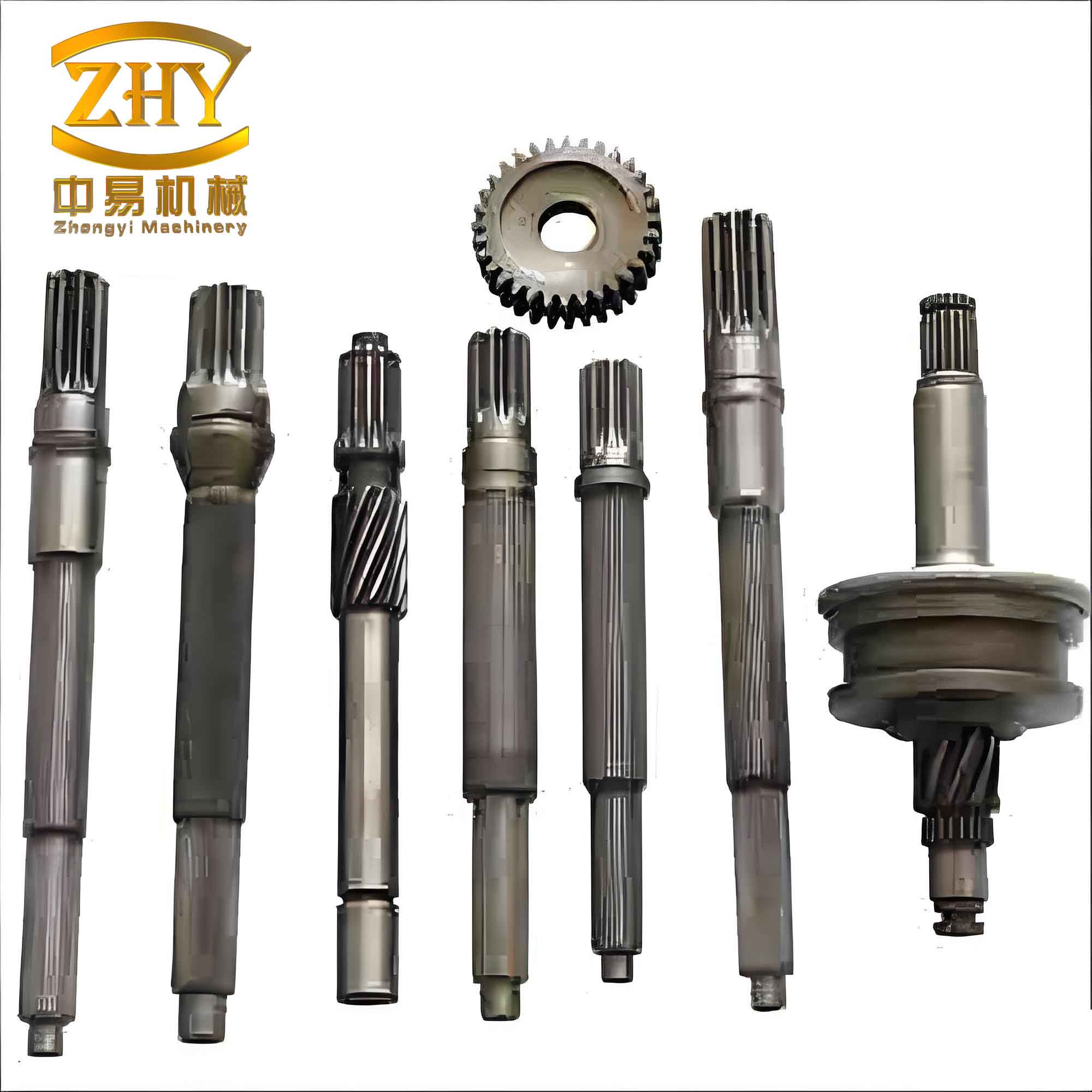
The hoist system, which had been in service for over three years with more than 3600 hours of operation, consisted of a rope drum, band brake system, base, gearbox, motor, high-speed brake, and control system. During the incident, the left hoist accelerated unexpectedly while lowering the bridge at rated speed, triggering an overvoltage alarm in the frequency converter. The high-speed brake engaged after approximately 2 seconds but failed after 12 seconds due to overload, resulting in brake disc rupture. Subsequently, the rope detached within 7 seconds, and the bridge fell. Throughout this 20-second period, the main drum hydraulic brake did not activate, indicating a systemic control failure. The gear shaft structure, as illustrated in the provided image, showed fracture surfaces that were rough and perpendicular to the axis, with no signs of fatigue cracking.
To assess the design adequacy of the gear shaft, I performed strength calculations based on the nominal stresses at the fracture locations. The gear shaft was made of 20CrMnMoA steel, with specified heat treatment requirements: carburizing and quenching for the tooth section to achieve a surface hardness of 58-62 HRC and an effective hardened layer depth of 1.2-1.8 mm at 550 HV. Non-carburized areas were protected during treatment. The material’s chemical composition and mechanical properties were verified against standards, ensuring compliance. The strength evaluation considered stress concentrations at step transitions, and the safety factors were calculated using the following formulas for fatigue and static strength:
For fatigue safety factor, I used the equation: $$ n_f = \frac{\sigma_e}{\sigma_a} $$ where \( \sigma_e \) is the endurance limit and \( \sigma_a \) is the alternating stress amplitude. For static strength, the formula was: $$ n_s = \frac{\sigma_y}{\sigma_m} $$ where \( \sigma_y \) is the yield strength and \( \sigma_m \) is the maximum stress. The results, summarized in the table below, confirmed that the gear shaft met design requirements with sufficient safety margins, even after accounting for stress concentrations at the fracture sites.
| Fracture Location | Nominal Stress (MPa) | Fatigue Safety Factor | Static Safety Factor |
|---|---|---|---|
| Motor End | 60.4 | 5.307 | 6.166 |
| Free End | 12 | 18.536 | 59.144 |
Next, I conducted a series of material tests on samples from both a non-fractured gear shaft (designated as 1#) and the fractured gear shaft (2#), which had two break points labeled 2#-1 and 2#-2. Non-destructive testing on sample 1# revealed no cracks. Chemical composition analysis was performed using spectrometry, and the results compared to the standard requirements for 20CrMnMoA steel. The table below shows that all elements were within specified limits, confirming the material’s conformity.
| Element | Standard Range (%) | 1# Sample Measured (%) | 2# Sample Measured (%) |
|---|---|---|---|
| C | 0.17-0.23 | 0.23 | 0.21 |
| Si | 0.17-0.37 | 0.35 | 0.29 |
| Mn | 0.90-1.20 | 0.97 | 0.96 |
| P | ≤0.025 | 0.021 | 0.021 |
| S | ≤0.01 | 0.002 | 0.002 |
| Cr | 1.1-1.4 | 1.13 | 1.21 |
| Ni | ≤0.30 | 0.15 | 0.16 |
| Mo | 0.20-0.30 | 0.24 | 0.21 |
| Cu | ≤0.2 | 0.055 | 0.051 |
Mechanical properties were evaluated through tensile and impact tests. The yield strength, tensile strength, elongation, reduction of area, and impact energy were measured. Sample 1# exhibited values that met or exceeded the standards, while sample 2# had one impact value below the requirement, but overall, the gear shaft material demonstrated adequate performance. The data is presented in the following table.
| Property | Requirement | 1# Sample Value | 2# Sample Value |
|---|---|---|---|
| Yield Strength (MPa) | ≥490 | 660 | 647 |
| Tensile Strength (MPa) | ≥835 | 1033 | 861 |
| Elongation (%) | ≥15 | 17.5 | 20.5 |
| Reduction of Area (%) | ≥40 | 53 | 56 |
| Impact Energy (J) | ≥31 | 58, 55, 31 | 44, 30, 61 |
Macro-examination of low-magnification structures revealed that sample 2# had a coarser microstructure compared to sample 1#, which could influence toughness but was not the primary cause of failure. Fracture surface analysis using scanning electron microscopy (SEM) showed that both break points (2#-1 and 2#-2) exhibited features of ductile and quasi-cleavage fractures, with crack origins at the surface. No fatigue striations were observed, indicating that the gear shaft failed due to a single overload event rather than progressive fatigue. For instance, the fracture surface of 2#-1 displayed dimples and quasi-cleavage patterns, while 2#-2 showed shear lips and similar micro-features, confirming the absence of cyclic loading effects.
Metallographic examination of non-fractured areas involved assessing non-metallic inclusions and microstructure. Sample 1# had inclusions rated as A0.5, B0, C0, D1, D0.5e according to standard methods, with a microstructure of tempered sorbite and granular bainite. Sample 2# showed inclusions rated as A0, B0, C0, D1, D0.5e, with a microstructure of granular bainite and fine pearlite. These results indicated that the material quality was acceptable, with no significant abnormalities that would predispose the gear shaft to failure.
Analyzing the operational conditions during the incident, I calculated the average speeds based on recorded data. The motor speed reached approximately 6835 rpm, far exceeding the rated 750 rpm, while the drum speed averaged 32.4 rpm during initial acceleration and 120 rpm during free fall. This overspeed condition occurred because the motor lost control under heavy load, leading to a runaway scenario where the gear shaft experienced forces beyond its design limits. The high-speed brake, designed for static loads up to 20000 Nm, was overwhelmed by the dynamic overload, resulting in its failure. The control system’s delay in activating the main hydraulic brake further exacerbated the situation, as it did not engage within the critical time frame.
From this analysis, I concluded that the gear shaft fracture was not due to material defects or inadequate design strength but was caused by external forces exceeding the rated operational conditions. The overspeed descent of the bridge generated stresses that led to a single-event fracture of the gear shaft. Additionally, the emergency braking system failed to function as intended, highlighting control system deficiencies.
To address these issues, I proposed several solutions. First, the damaged gearbox components were replaced, and the hoist was returned for overhaul. Second, an additional high-speed brake was installed on the opposite end of the gear shaft to provide redundancy, with staggered activation times to reduce shock loads. The brake disc flatness was controlled within 0.2 mm, and clearances were adjusted to 0.5 mm and 0.3 mm. The response times of the high-speed brakes were reduced to 0.15 s and 0.05 s, respectively. Third, the drum band brake response time was shortened to 1.5 s by upgrading the accumulator capacity from 16 L to 40 L, increasing initial pressure, and optimizing hydraulic flow paths. Fourth, the control system was enhanced with a speed limiting function that automatically engages braking if the descent speed exceeds a set threshold, providing an extra layer of protection for the gear shaft and overall system.
Testing methods were implemented to validate these improvements. Static load tests were conducted on the hoist, with the drum rated for 1300 kN and brakes tested at 2600 kN for the high-speed end and 3380 kN for the low-speed end. The setup involved hydraulic cylinders to simulate loads, as shown in the test diagram. Key verification points included ensuring no slippage during braking, checking brake clearances, and measuring response times. All tests confirmed that the modifications met the required specifications, with brakes holding loads for 3 minutes without failure and response times within targets.
In summary, this failure analysis of the gear shaft underscores the importance of robust design, material verification, and control system integration. By implementing these solutions, the hoist system was successfully recommissioned, passing both factory static tests and dynamic shipboard trials. This experience has provided valuable insights for future projects, emphasizing the need for comprehensive safety measures in gear shaft applications to prevent similar incidents. The repeated focus on the gear shaft throughout this analysis highlights its critical role in mechanical systems and the necessity of ensuring its reliability under extreme conditions.